Vietnam Kosher Food Market Size, Share & Growth Rate
The Vietnam Kosher Food Market was estimated at USD 828 Million in 2025 and is projected to reach USD 1178 Million by 2032, growing at a CAGR of 5.2% from 2026 to 2032. This growth trajectory is fueled by an increasing awareness among consumers of the benefits associated with kosher dietary laws, including perceived health advantages and quality assurance. Additionally, the expanding range of kosher-certified products available in Vietnam is attracting diverse consumer segments, including those who prioritize food safety and ethical sourcing.
Vietnam Kosher Food Market Year-wise Growth Rate and Key Drivers
This graph highlights how the Vietnam Kosher Food Market has steadily grown over the years, supported by major growth factors.
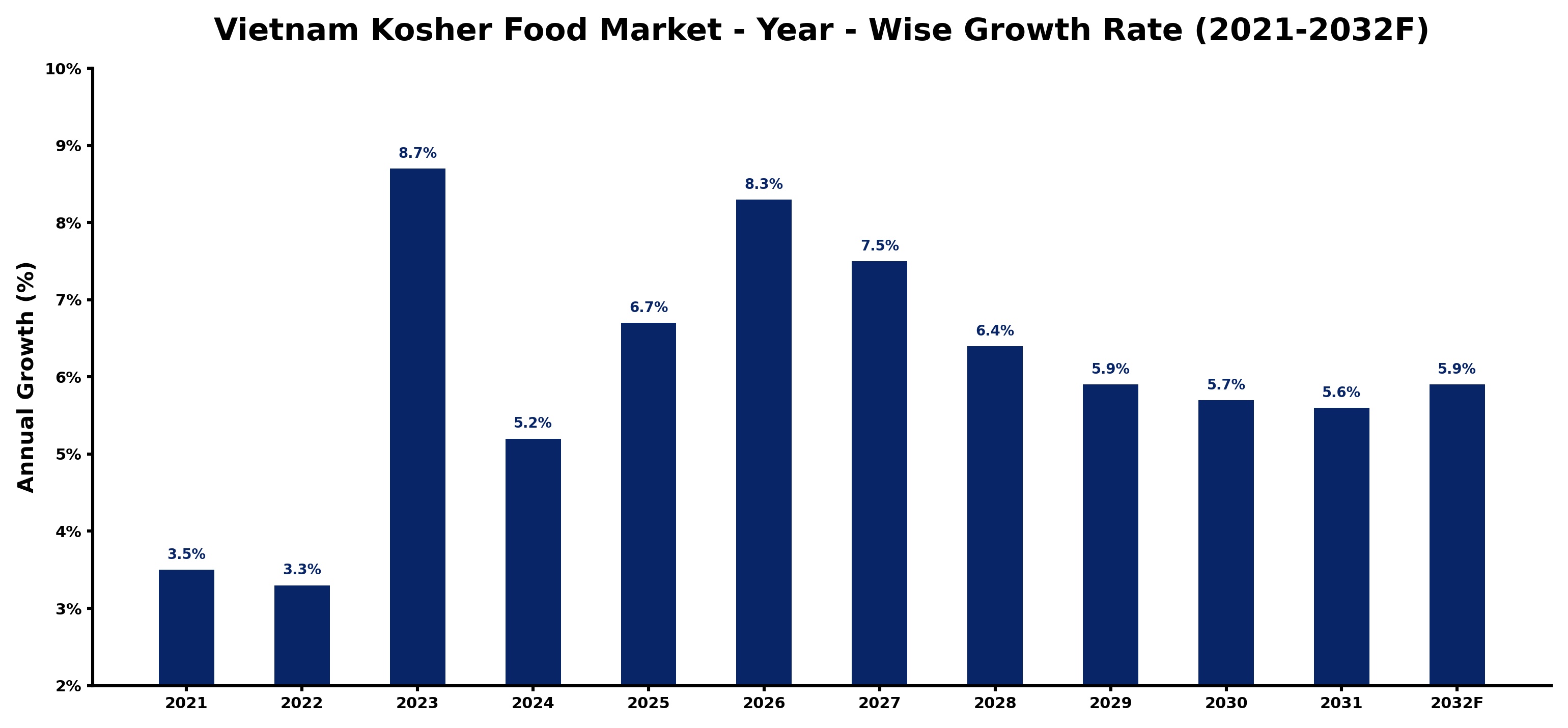
The table below presents the year‑wise growth rates along with the key drivers influencing the market
| Year | Growth Rate | Major Drivers |
| 2021 | 3.5% | Export demand for kosher certified products boosts local food production |
| 2022 | 3.3% | Vietnamese manufacturers boosted capacity to meet rising kosher food exports |
| 2023 | 8.7% | Kosher certification investments boost food production capabilities for exports |
| 2024 | 5.2% | Smart factory solutions boosted efficiency in kosher food production |
| 2025 | 6.7% | Manufacturing investments in halal certification boost Vietnam's kosher food exports |
| 2026 | 8.3% | New processing facilities boost Kosher certification capacity and efficiency |
| 2027 | 7.5% | Foreign investments boost modern processing facilities for kosher food production |
| 2028 | 6.4% | Improved logistics infrastructure boosts kosher food manufacturing efficiency |
| 2029 | 5.9% | Domestic processing plants optimized operations for Kosher certification compliance |
| 2030 | 5.7% | Export driven food processing technology investments boost kosher certification capabilities |
| 2031 | 5.6% | Export demand for certified kosher foods boosts local production capacity |
| 2032 | 5.9% | Export driven demand spurred growth in halal food processing facilities |
Note - Market size estimations and growth projections presented in this report are based on 6Wresearch’s advanced forecasting approach, validated with industry datasets as of June 2026.
Vietnam Kosher Food Market Synopsis
Despite the recent challenges posed by the global pandemic, which temporarily disrupted supply chains for kosher products, the Vietnam Kosher Food market is on an upward trajectory. As we look toward the future, the demand for kosher-certified products continues to grow, reflecting a cultural shift and a deeper appreciation for diverse dietary practices within Vietnam.
The market is expected to rebound and surpass pre-pandemic levels as consumers increasingly seek out kosher products for their quality and adherence to safety standards. With a multicultural population and a rising interest in health-conscious eating, the prospects for the Vietnam Kosher Food market are brighter than ever.
Vietnam Kosher Food Market Key Takeaways
- The market's growth is driven by increasing health consciousness and rising demand for products adhering to kosher dietary standards.
- Consumer awareness regarding food safety and quality is propelling the popularity of kosher-certified items among non-Jewish customers.
- COVID-19 caused temporary disruptions but also highlighted the resilience and adaptability of the market.
- Key players are expanding their offerings, making a wider range of kosher products available to meet diverse consumer preferences.
- The regulatory framework surrounding kosher certification presents both a challenge and an opportunity for market participants.
Evaluation of Restraints in Vietnam Kosher Food Market
Despite its growth potential, the Vietnam Kosher Food market faces significant restraints related to the complexities of obtaining and maintaining kosher certification. The certification process involves rigorous inspections and adherence to stringent regulations, which can be both time-consuming and costly. For producers, ensuring compliance not only demands financial resources but also necessitates a deep understanding of kosher laws. These challenges can deter new entrants while also complicating operations for existing market participants.
Vietnam Kosher Food Market Trends
A notable trend within the Vietnam Kosher Food market is the increasing incorporation of health-focused ingredients in kosher products, such as organic and gluten-free options. Additionally, digital platforms for food delivery are becoming more popular, facilitating access to kosher products for a broader audience. As consumer preferences evolve, the demand for transparency in food sourcing is also growing, making kosher certification a crucial selling point for many producers.
Vietnam Kosher Food Market Opportunities
The Vietnam Kosher Food market presents promising growth and investment opportunities, especially for new entrants willing to navigate the certification process. As the awareness of kosher food expands beyond religious communities, there lies potential for innovation in product offerings that cater to health-conscious consumers. Brands can also explore strategic partnerships with local retailers to enhance distribution channels, thereby tapping into a wider customer base.
Government Initiatives in the Vietnam Kosher Food Market
The Vietnamese government has recognized the importance of food safety and quality standards, which indirectly supports the kosher food sector. Although there are no specific government initiatives solely for kosher certification, existing frameworks encourage compliance with international food safety standards. This regulatory environment can be favorable for kosher producers who align with these guidelines, promoting confidence among consumers.
Future Insights of the Vietnam Kosher Food Market
Looking ahead to the period from 2026 to 2032, the Vietnam Kosher Food market is poised for substantial growth. As consumer interest in specialized dietary options continues to rise, the market is likely to witness increased innovation and diversification of products. Furthermore, ongoing investments in supply chain improvements and distribution channels are expected to enhance the accessibility of kosher foods. This trajectory, coupled with a supportive regulatory landscape, suggests a bright future for kosher food in Vietnam.
Vietnam Kosher Food Market Latest Developments (May 2025 - June 2026)
Recent developments in the Vietnam Kosher Food market indicate a strong recovery as supply chains stabilize post-pandemic. Producers are increasingly focusing on diversifying their product lines to include healthier, organic, and innovative kosher options. Additionally, collaborations with local retailers and online platforms are expanding access, making kosher products more available to consumers across the nation.
Vietnam Kosher Food Market - Key Attractiveness of the Report
- 10 Years of Market Numbers
- Historical Data Starting from 2022 to 2025
- Base Year: 2025
- Forecast Data until 2032
- Key Performance Indicators Impacting the Market
- Major Upcoming Developments and Projects
Key Highlights of the Report:
- Vietnam Kosher Food Market Outlook
- Market Size of Vietnam Kosher Food Market, 2025
- Forecast of Vietnam Kosher Food Market, 2032
- Historical Data and Forecast of Vietnam Kosher Food Revenues & Volume for the Period 2022-2032F
- Vietnam Kosher Food Market Trend Evolution
- Vietnam Kosher Food Market Drivers and Challenges
- Vietnam Kosher Food Price Trends
- Vietnam Kosher Food Porter's Five Forces
- Vietnam Kosher Food Industry Life Cycle
- Historical Data and Forecast of Vietnam Kosher Food Market Revenues & Volume By Type for the Period 2022-2032F
- Historical Data and Forecast of Vietnam Kosher Food Market Revenues & Volume By Meat for the Period 2022-2032F
- Historical Data and Forecast of Vietnam Kosher Food Market Revenues & Volume By Dairy for the Period 2022-2032F
- Historical Data and Forecast of Vietnam Kosher Food Market Revenues & Volume By Pareve for the Period 2022-2032F
- Historical Data and Forecast of Vietnam Kosher Food Market Revenues & Volume By Application for the Period 2022-2032F
- Historical Data and Forecast of Vietnam Kosher Food Market Revenues & Volume By Seafood for the Period 2022-2032F
- Historical Data and Forecast of Vietnam Kosher Food Market Revenues & Volume By Processed Meat and Poultry for the Period 2022-2032F
- Historical Data and Forecast of Vietnam Kosher Food Market Revenues & Volume By Beverages for the Period 2022-2032F
- Historical Data and Forecast of Vietnam Kosher Food Market Revenues & Volume By Staples for the Period 2022-2032F
- Historical Data and Forecast of Vietnam Kosher Food Market Revenues & Volume By Snacks & Savoury for the Period 2022-2032F
- Historical Data and Forecast of Vietnam Kosher Food Market Revenues & Volume By Bakery and Confectionery for the Period 2022-2032F
- Historical Data and Forecast of Vietnam Kosher Food Market Revenues & Volume By Others for the Period 2022-2032F
- Historical Data and Forecast of Vietnam Kosher Food Market Revenues & Volume By Distribution Channel for the Period 2022-2032F
- Historical Data and Forecast of Vietnam Kosher Food Market Revenues & Volume By Supermarkets and Hypermarkets for the Period 2022-2032F
- Historical Data and Forecast of Vietnam Kosher Food Market Revenues & Volume By Grocery Stores for the Period 2022-2032F
- Historical Data and Forecast of Vietnam Kosher Food Market Revenues & Volume By Online Stores for the Period 2022-2032F
- Vietnam Kosher Food Import Export Trade Statistics
- Market Opportunity Assessment By Type
- Market Opportunity Assessment By Application
- Market Opportunity Assessment By Distribution Channel
- Vietnam Kosher Food Top Companies Market Share
- Vietnam Kosher Food Competitive Benchmarking By Technical and Operational Parameters
- Vietnam Kosher Food Company Profiles
- Vietnam Kosher Food Key Strategic Recommendations






































