Vietnam Leather Market Summary
The vietnam leather market was estimated at USD 358 Million in 2025 and is projected to reach USD 504 Million by 2032, growing at a CAGR of 7.8% from 2026 to 2032.
Vietnam Leather Market Year-wise Growth Rate and Key Drivers
This graph highlights how the Vietnam Leather Market has steadily grown over the past five years, supported by major growth factors.
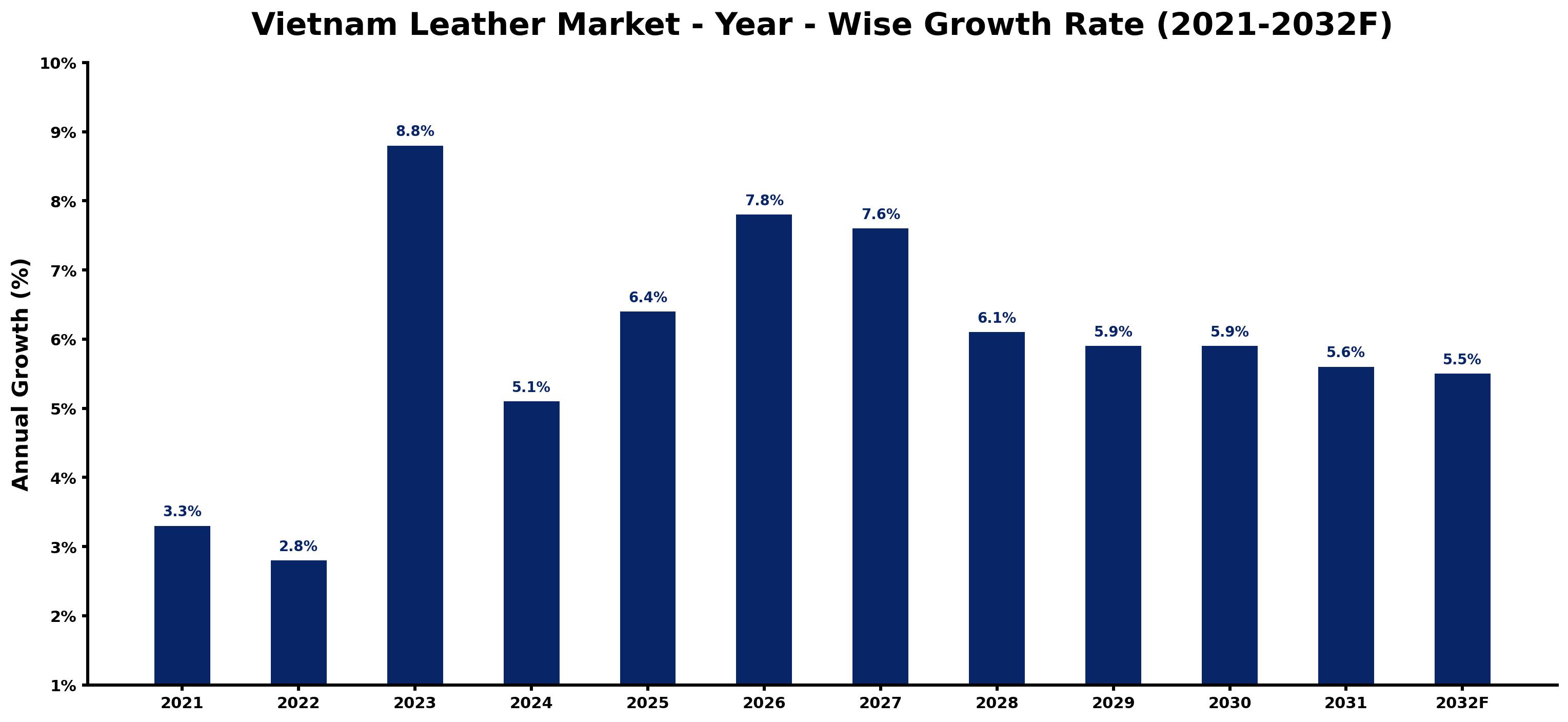
The table below presents the year wise growth rates along with the key drivers influencing the market
| Year | Growth Rate | Major Drivers |
| 2021 | 3.3% | Vietnam's leather sector adapts quickly to shifting global manufacturing landscapes. |
| 2022 | 2.8% | Emerging local brands enhance competitiveness through innovative designs and marketing strategies. |
| 2023 | 8.8% | The international demand for sustainable leather products shapes production practices significantly. |
| 2024 | 5.1% | Investment in eco-friendly tanning processes attracts environmentally-conscious consumers and partners. |
| 2025 | 6.4% | Vietnam's participation in trade agreements expands market access for leather exporters. |
| 2026 | 7.8% | Technological upgrades in manufacturing processes improve efficiency and product quality across factories. |
| 2027 | 7.6% | Urbanization trends increase disposable incomes, driving demand for premium leather goods. |
| 2028 | 6.1% | E-commerce platforms facilitate direct-to-consumer sales, reshaping retail dynamics in the sector. |
| 2029 | 5.9% | Collaborations between artisans and designers revive traditional craftsmanship, appealing to niche markets. |
| 2030 | 5.9% | Rural communities increasingly engage in leather production, diversifying income sources for families. |
| 2031 | 5.6% | Emerging consumer preferences highlight the importance of ethical production practices. |
| 2032 | 5.5% | Vietnam's leather exports increase as global markets recognize quality and craftsmanship improvements. |
Note - Market size estimations and growth projections presented in this report are based on 6Wresearch's advanced forecasting approach, validated with industry datasets as of June 2026.
Vietnam Leather Market Synopsis
The Vietnam Leather Market is projected to reach 7.8% and witness significant growth during the forecast period (2026-2032). The market is anticipated to expand at an annual growth rate of 6.3 percent, driven primarily by a burgeoning middle class, evolving lifestyle patterns, and an increasing appetite for fashionable footwear and luxurious goods. The demand for leather products in Vietnam is influenced by the country's strong export relations, particularly with nations such as Japan and members of the European Union, which are expected to significantly contribute to the leather industry's growth.
Vietnam Leather Market Growth Drivers
Several key factors are propelling the expansion of the Vietnam Leather Market. Firstly, the increasing income levels of the Vietnamese population are fostering a demand for high-quality leather goods, allowing consumers to invest in more luxury items. Secondly, the global trend toward sustainability and ethical sourcing is encouraging Vietnamese manufacturers to adopt advanced processes that enhance product quality while meeting international standards.
- The rising middle class in Vietnam is significantly influencing consumption patterns, with consumers seeking premium leather products that reflect their status and lifestyle choices.
- Changing consumer preferences towards fashionable and functional footwear, coupled with a shift in retail dynamics where experiential shopping becomes crucial, are impacting market trajectories.
- Vietnam's advantageous geographical location allows for easy access to major markets in Asia and beyond, facilitating exports and driving economic growth in the leather sector.
- Increased foreign investments are bolstered by government incentives, including tax breaks, which are aimed at enhancing the capacity and efficiency of local manufacturers.
- Technological advancements in manufacturing and finishing processes are improving the overall quality of leather products, making them more competitive in the global market.
Vietnam Leather Market Trends and Opportunities
As the Vietnam Leather Market evolves, notable trends are emerging that present vast opportunities for growth. The push towards sustainable manufacturing practices, for instance, is prompting local manufacturers to innovate and improve their operational processes.
- There is a growing emphasis on eco-friendly leather alternatives and biodegradable materials, catering to the environmentally-conscious consumer demographic.
- The rise of e-commerce is reshaping retail dynamics, allowing leather manufacturers and retailers to reach a broader audience with their products and engage with consumers directly.
- Collaborations with international designers and brands are on the rise, aiming to enhance product offerings and capitalize on global fashion trends.
- Investment in research and development is becoming increasingly important as manufacturers seek to innovate product lines and improve competitiveness.
- The enhancement of local craftsmanship is being promoted through skill development initiatives, leading to better quality products that can compete on the international stage.
Vietnam Leather Market Government Investment and Initiatives
The Vietnamese government has instituted several initiatives aimed at bolstering the leather industry. Key policies focus on enhancing the competitiveness of local manufacturers and integrating advanced technologies in production processes. The government has been actively promoting foreign direct investment in the sector through tax incentives and subsidies, creating a favorable environment for both domestic and international players.
- This includes fostering partnerships between public institutions and private enterprises to stimulate innovation and improve manufacturing standards within the industry.
- Various development plans have been launched to upgrade infrastructure, particularly in regions known for leather production, enhancing logistics and distribution capabilities.
- The government is also focusing on sustainability initiatives, encouraging companies to adopt environmentally friendly practices to mitigate ecological impacts.
- Skill enhancement programs are being implemented to develop a highly skilled workforce capable of meeting the demands of modern production techniques.
- Additionally, exhibitions and trade fairs organized by the government serve as platforms for networking and promoting Vietnamese leather products to global markets.
Vietnam Leather Market Latest Developments (May 2025 - June 2026)
In the early to mid-2026 period, the Vietnam Leather Market is witnessing various developments that shape its trajectory. Industry leaders are increasingly focusing on the incorporation of cutting-edge manufacturing technologies aimed at enhancing productivity.
- Investment in advanced finishing techniques is on the rise, allowing manufacturers to produce higher-quality products that meet international standards and consumer expectations.
- The sector is increasingly attentive to sustainable practices, with many companies implementing measures to reduce waste and enhance the recycling of materials.
- Collaborations between domestic businesses and international brands have become more prominent, focusing on knowledge transfer and best practices to promote innovation.
- Emerging trends around customization and personalization are prompting local manufacturers to adapt their offerings to meet consumer preferences.
- The ongoing emphasis on digital marketing solutions is reshaping how companies approach customer engagement, providing new channels for reaching consumers.
Vietnam Leather Market - Key Attractiveness of the Report
- 10 Years of Market Numbers
- Historical Data Starting from 2022 to 2025
- Base Year: 2025
- Forecast Data until 2032
- Key Performance Indicators Impacting the Market
- Major Upcoming Developments and Projects
Key Highlights of the Report:
- Vietnam Leather Market Outlook
- Market Size of Vietnam Leather Market, 2025
- Forecast of Vietnam Leather Market, 2032F
- Historical Data and Forecast of Vietnam Leather Revenues & Volume for the Period 2022-2032F
- Vietnam Leather Market Trend Evolution
- Vietnam Leather Market Drivers and Challenges
- Vietnam Leather Price Trends
- Vietnam Leather Porter's Five Forces
- Vietnam Leather Industry Life Cycle
- Historical Data and Forecast of Vietnam Leather Market Revenues & Volume By Type for the Period 2022-2032F
- Historical Data and Forecast of Vietnam Leather Market Revenues & Volume By Luggage for the Period 2022-2032F
- Historical Data and Forecast of Vietnam Leather Market Revenues & Volume By Footwear for the Period 2022-2032F
- Historical Data and Forecast of Vietnam Leather Market Revenues & Volume By Accessories for the Period 2022-2032F
- Historical Data and Forecast of Vietnam Leather Market Revenues & Volume By Distribution Channel for the Period 2022-2032F
- Historical Data and Forecast of Vietnam Leather Market Revenues & Volume By Online for the Period 2022-2032F
- Historical Data and Forecast of Vietnam Leather Market Revenues & Volume By Offline for the Period 2022-2032F
- Vietnam Leather Import Export Trade Statistics
- Market Opportunity Assessment By Type
- Market Opportunity Assessment By Distribution Channel
- Vietnam Leather Top Companies Market Share
- Vietnam Leather Competitive Benchmarking By Technical and Operational Parameters
- Vietnam Leather Company Profiles
- Vietnam Leather Key Strategic Recommendations






































