Vietnam LED Traffic Signs and Signals Market Size, Share & Growth Rate
The Vietnam LED Traffic Signs and Signals Market was estimated at USD 166 Million in 2025 and is projected to reach USD 235 Million by 2032, growing at a CAGR of 5.1% from 2026 to 2032. This growth trajectory is driven by a surge in urbanization efforts and smart city initiatives, necessitating efficient and reliable traffic management solutions. The increasing emphasis on road safety and energy efficiency further underpins the rising demand for LED traffic signage and signals.
Vietnam LED Traffic Signs and Signals Market Year-wise Growth Rate and Key Drivers
This graph highlights how the Vietnam LED Traffic Signs and Signals Market has steadily grown over the years, supported by major growth factors.
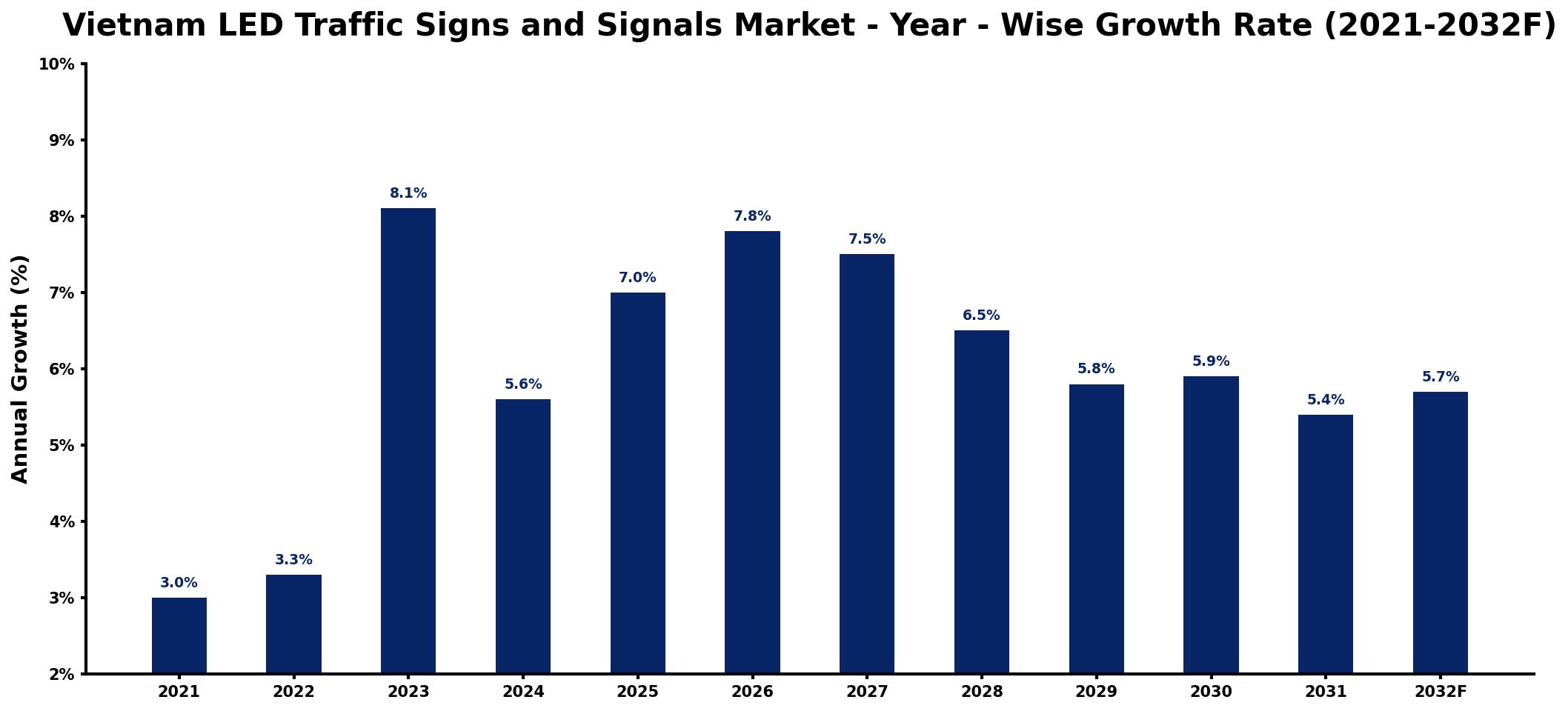
The table below presents the year‑wise growth rates along with the key drivers influencing the market
| Year | Growth Rate | Major Drivers |
| 2021 | 3.0% | Increasing urban infrastructure investments |
| 2022 | 3.3% | Rising demand for smart cities |
| 2023 | 8.1% | Government initiatives for modernization |
| 2024 | 5.6% | Growth in transportation safety regulations |
| 2025 | 7.0% | Expansion of public transportation networks |
| 2026 | 7.8% | Technological advancements in automation |
| 2027 | 7.5% | Higher focus on environmental sustainability |
| 2028 | 6.5% | Increased public awareness campaigns |
| 2029 | 5.8% | Emerging trends in smart mobility |
| 2030 | 5.9% | Investment in renewable energy solutions |
| 2031 | 5.4% | Strengthening of urban planning policies |
| 2032 | 5.7% | Enhanced collaboration among stakeholders |
Note: Market size estimations and growth projections presented in this report are based on 6Wresearch's proprietary forecasting methodology, utilizing the latest available industry data, government publications, and primary research inputs.
Vietnam LED Traffic Signs and Signals Market Synopsis
In Vietnam, the push for advanced traffic management systems has catalyzed a significant demand for LED traffic signs and signals. These solutions not only enhance visibility but also offer durability and low maintenance costs, aligning with the country's infrastructure development goals.
The deployment of LED technology is particularly vital in urban areas where traffic congestion is prevalent. By adopting these modern solutions, Vietnam is on the path to improving road safety and facilitating better traffic flow, ultimately benefiting its citizens and economy.
Vietnam LED Traffic Signs and Signals Market Key Takeaways
- Market projected to grow from USD 166 Million in 2025 to USD 235 Million by 2032.
- Urbanization and smart city projects are key drivers for market expansion.
- Energy-efficient solutions are increasingly preferred to reduce operating costs.
- Local manufacturers are leveraging technology to enhance road safety measures.
- Traffic control visibility remains a top priority for effective management.
Evaluation of Restraints in Vietnam LED Traffic Signs and Signals Market
The Vietnam LED traffic signs and signals market faces constraints primarily related to ensuring visibility and reliability, especially during adverse weather conditions. Many existing infrastructures require upgrades to accommodate modern solutions, leading to potential delays in deployment. Furthermore, the initial investment cost for LED technology can deter some stakeholders from transitioning from traditional signage, even as long-term benefits become increasingly clear. These factors can hinder the pace of market growth and require strategic approaches to overcome.
Vietnam LED Traffic Signs and Signals Market Trends
The market is witnessing several emerging trends, such as the integration of IoT capabilities in traffic signals, enabling real-time data analysis and traffic management. Additionally, the rise of smart city concepts is promoting the adoption of interconnected traffic systems, enhancing the overall effectiveness of road safety measures. Sustainable practices in manufacturing are also gaining traction, as companies focus on minimizing their environmental footprint while providing cutting-edge solutions.
Vietnam LED Traffic Signs and Signals Market Opportunities
There are ample opportunities for growth in the Vietnam LED traffic signs and signals market, particularly in the context of government initiatives aimed at upgrading transportation infrastructure. Investment in smart city development is set to open new avenues for innovative traffic solutions. Additionally, collaborations between local manufacturers and international technology providers can further enhance product offerings, presenting a unique landscape for potential investors and stakeholders.
Government Initiatives in the Vietnam LED Traffic Signs and Signals Market
The Vietnamese government is actively promoting infrastructure enhancement through various initiatives, including financial support for smart city projects and investments in road safety technologies. Policies aimed at improving urban traffic management systems are encouraging the adoption of LED traffic signs and signals. Furthermore, the government's commitment to reducing carbon emissions aligns with the energy-efficient attributes of LED solutions, paving the way for favorable market conditions.
Future Insights of the Vietnam LED Traffic Signs and Signals Market
From 2026 to 2032, the Vietnam LED traffic signs and signals market is expected to experience robust growth fueled by ongoing urban development and a rising focus on road safety. Technological advancements will likely continue to enhance the efficiency and functionality of traffic management systems. As the market matures, the integration of artificial intelligence and machine learning into traffic solutions could become commonplace, further optimizing traffic flow and safety measures.
Vietnam LED Traffic Signs and Signals Market Latest Developments (2025 - 2026)
Recent developments in the Vietnam LED traffic signs and signals market indicate a growing trend towards adopting smart solutions to address urban traffic challenges. Initiatives aimed at modernizing existing traffic systems are underway, with pilot projects showcasing the effectiveness of new technologies. This progression reflects a commitment to embracing innovative approaches in road safety and traffic management.
Vietnam LED Traffic Signs and Signals Market - Key Attractiveness of the Report
- 10 Years of Market Numbers
- Historical Data Starting from 2022 to 2025
- Base Year: 2025
- Forecast Data until 2032
- Key Performance Indicators Impacting the Market
- Major Upcoming Developments and Projects
Key Highlights of the Report:
- Vietnam LED Traffic Signs and Signals Market Outlook
- Market Size of Vietnam LED Traffic Signs and Signals Market, 2025
- Forecast of Vietnam LED Traffic Signs and Signals Market, 2032
- Historical Data and Forecast of Vietnam LED Traffic Signs and Signals Revenues & Volume for the Period 2022-2032F
- Vietnam LED Traffic Signs and Signals Market Trend Evolution
- Vietnam LED Traffic Signs and Signals Market Drivers and Challenges
- Vietnam LED Traffic Signs and Signals Price Trends
- Vietnam LED Traffic Signs and Signals Porter's Five Forces
- Vietnam LED Traffic Signs and Signals Industry Life Cycle
- Historical Data and Forecast of Vietnam LED Traffic Signs and Signals Market Revenues & Volume By Product for the Period 2022-2032F
- Historical Data and Forecast of Vietnam LED Traffic Signs and Signals Market Revenues & Volume By LED Traffic Signals for the Period 2022-2032F
- Historical Data and Forecast of Vietnam LED Traffic Signs and Signals Market Revenues & Volume By LED Traffic Signs for the Period 2022-2032F
- Vietnam LED Traffic Signs and Signals Import Export Trade Statistics
- Market Opportunity Assessment By Product
- Vietnam LED Traffic Signs and Signals Top Companies Market Share
- Vietnam LED Traffic Signs and Signals Competitive Benchmarking By Technical and Operational Parameters
- Vietnam LED Traffic Signs and Signals Company Profiles
- Vietnam LED Traffic Signs and Signals Key Strategic Recommendations






































