Vietnam Mimosa Extract Market Size, Share & Growth Rate
The Vietnam Mimosa Extract Market was estimated at USD 198 Million in 2025 and is projected to reach USD 279 Million by 2032, growing at a CAGR of 5.0% from 2026 to 2032. This growth is primarily driven by the increasing incorporation of mimosa extract in the cosmetics and textile industries, where its natural properties provide effective solutions for skin health and dyeing applications. Additionally, the rising consumer inclination towards sustainable and natural products is amplifying demand across various sectors.
Vietnam Mimosa Extract Market Year-wise Growth Rate and Key Drivers
This graph highlights how the Vietnam Mimosa Extract Market has steadily grown over the years, supported by major growth factors.
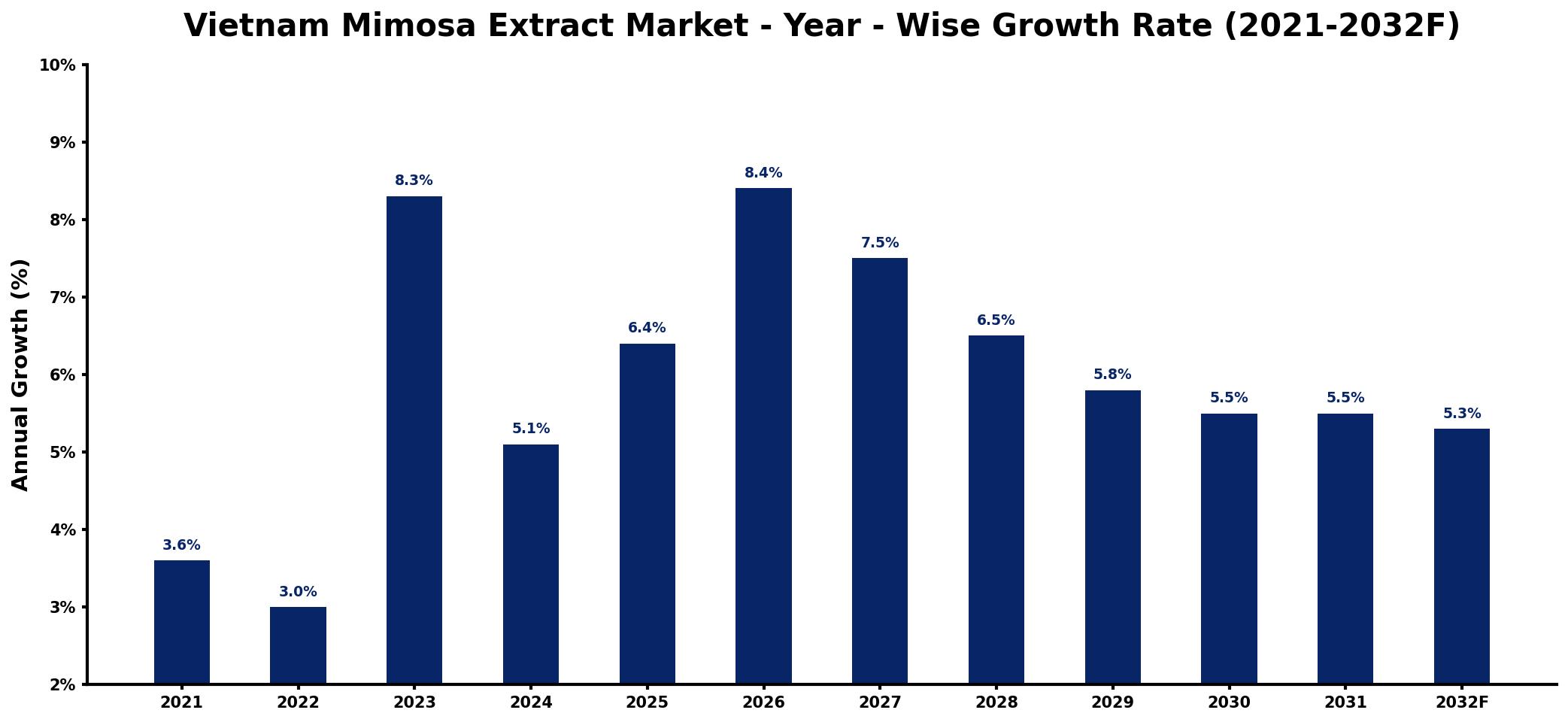
The table below presents the year‑wise growth rates along with the key drivers influencing the market
| Year | Growth Rate | Major Drivers |
| 2021 | 3.6% | Rising consumer health awareness |
| 2022 | 3.0% | Increased herbal product popularity |
| 2023 | 8.3% | Growing demand for natural ingredients |
| 2024 | 5.1% | Expansion of wellness market trends |
| 2025 | 6.4% | Surge in dietary supplement sales |
| 2026 | 8.4% | Investment in sustainable sourcing |
| 2027 | 7.5% | Enhanced research and development focus |
| 2028 | 6.5% | Broader applications in cosmetics |
| 2029 | 5.8% | Emergence of innovative formulations |
| 2030 | 5.5% | Strengthened distribution networks globally |
| 2031 | 5.5% | Growing interest in holistic remedies |
| 2032 | 5.3% | Expanding e-commerce market presence |
Note: Market size estimations and growth projections presented in this report are based on 6Wresearch's proprietary forecasting methodology, utilizing the latest available industry data, government publications, and primary research inputs.
Vietnam Mimosa Extract Market Synopsis
A significant force currently shaping the Vietnam Mimosa Extract Market is the escalating popularity of natural ingredients within the cosmetics industry. With a growing emphasis on health and wellness, mimosa extract is increasingly recognized for its anti-inflammatory and skin-soothing properties, making it a favored choice among manufacturers of skincare products.
Moreover, the traditional medicine sector is also leveraging the therapeutic benefits of mimosa extract, enhancing its presence in the market. As consumers become more informed and selective about product ingredients, the demand for high-quality, naturally sourced mimosa extract is likely to surge, presenting exciting growth prospects.
Vietnam Mimosa Extract Market Key Takeaways
- The market is driven by increased demand in cosmetics and textiles due to the natural benefits of mimosa extract.
- Sustainable sourcing and adherence to ecological standards remain pivotal for long-term market viability.
- Consumer trends favoring natural and effective ingredients are transforming product formulations.
- The pandemic positively impacted the demand for skincare products, although supply chain issues were a challenge.
- Innovations in extraction and processing methods are enhancing the quality and application of mimosa extract.
Evaluation of Restraints in Vietnam Mimosa Extract Market
Despite the promising growth, the Vietnam mimosa extract market faces significant restraints related to sustainable sourcing practices. The reliance on the bark of the mimosa tree necessitates a careful balance between meeting market demand and preserving the ecosystem. Overharvesting could lead to resource depletion, thereby threatening long-term supply. Furthermore, navigating international regulations on natural extracts adds another layer of complexity, necessitating constant vigilance and adaptation from market players.
Vietnam Mimosa Extract Market Trends
Current trends within the Vietnam Mimosa Extract Market reflect a shift towards holistic health and beauty products. Manufacturers are increasingly focusing on formulations that highlight the natural origins of their ingredients, including mimosa extract. There is a notable rise in the demand for multifunctional products that not only address specific skin concerns but also promote overall wellness. Additionally, the growing trend of sustainability is influencing production practices, with companies seeking eco-friendly sourcing and packaging solutions.
Vietnam Mimosa Extract Market Opportunities
The potential for growth in the Vietnam Mimosa Extract Market lies in the expansion of product applications across diverse sectors. Beyond cosmetics and traditional medicine, there are emerging opportunities in food and beverage industries, where natural extracts are gaining traction for their flavor and health benefits. Furthermore, innovative research into the extraction techniques could yield higher quality products, attracting higher-end markets and improving profit margins.
Government Initiatives in the Vietnam Mimosa Extract Market
The Vietnamese government has been proactive in promoting agricultural sustainability and the utilization of natural resources. Initiatives aimed at enhancing the forestry sector aim to support sustainable harvesting practices for mimosa trees. Public spending on eco-friendly agricultural practices is encouraging local farmers to adopt responsible sourcing methods, fostering both environmental stewardship and economic growth within the mimosa extract industry.
Future Insights of the Vietnam Mimosa Extract Market
Looking ahead to 2026-2032, the Vietnam Mimosa Extract Market is poised for considerable expansion driven by shifting consumer preferences towards natural ingredients. As regulatory frameworks evolve and consumers become increasingly discerning, there will be a growing demand for transparency in sourcing and product composition. Market players who prioritize sustainability, quality, and innovation will be well-positioned to capitalize on this upward trajectory, ensuring relevance in an ever-changing landscape.
Vietnam Mimosa Extract Market Latest Developments (2025 - 2026)
Recent developments in the Vietnam Mimosa Extract Market indicate a shift towards more advanced extraction methods aimed at enhancing product efficacy. Companies are increasingly adopting innovative technologies that streamline production while minimizing ecological impact. Furthermore, collaborations between manufacturers and research institutions are driving new product innovations, catering to the evolving preferences of health-conscious consumers.
Vietnam Mimosa Extract Market - Key Attractiveness of the Report
- 10 Years of Market Numbers
- Historical Data Starting from 2022 to 2025
- Base Year: 2025
- Forecast Data until 2032
- Key Performance Indicators Impacting the Market
- Major Upcoming Developments and Projects
Key Highlights of the Report:
- Vietnam Mimosa Extract Market Outlook
- Market Size of Vietnam Mimosa Extract Market, 2025
- Forecast of Vietnam Mimosa Extract Market, 2032
- Historical Data and Forecast of Vietnam Mimosa Extract Revenues & Volume for the Period 2022-2032F
- Vietnam Mimosa Extract Market Trend Evolution
- Vietnam Mimosa Extract Market Drivers and Challenges
- Vietnam Mimosa Extract Price Trends
- Vietnam Mimosa Extract Porter's Five Forces
- Vietnam Mimosa Extract Industry Life Cycle
- Historical Data and Forecast of Vietnam Mimosa Extract Market Revenues & Volume By End User for the Period 2022-2032F
- Historical Data and Forecast of Vietnam Mimosa Extract Market Revenues & Volume By Forestry for the Period 2022-2032F
- Historical Data and Forecast of Vietnam Mimosa Extract Market Revenues & Volume By Paper & Wood Products for the Period 2022-2032F
- Vietnam Mimosa Extract Import Export Trade Statistics
- Market Opportunity Assessment By End User
- Vietnam Mimosa Extract Top Companies Market Share
- Vietnam Mimosa Extract Competitive Benchmarking By Technical and Operational Parameters
- Vietnam Mimosa Extract Company Profiles
- Vietnam Mimosa Extract Key Strategic Recommendations






































