Vietnam Modular Data Center Market Size, Share & Growth Rate
The Vietnam Modular Data Center Market was estimated at USD 1313 Million in 2025 and is projected to reach USD 1982 Million by 2032, growing at a CAGR of 6.1% from 2026 to 2032. This growth trajectory is significantly driven by the increasing need for flexible data solutions amidst a digital transformation era. Additionally, the rising demands of cloud computing and data analytics are compelling organizations to seek modular data centers, which offer rapid deployment and scalability to meet evolving data needs.
Vietnam Modular Data Center Market Year-wise Growth Rate and Key Drivers
This graph highlights how the Vietnam Modular Data Center Market has steadily grown over the years, supported by major growth factors.
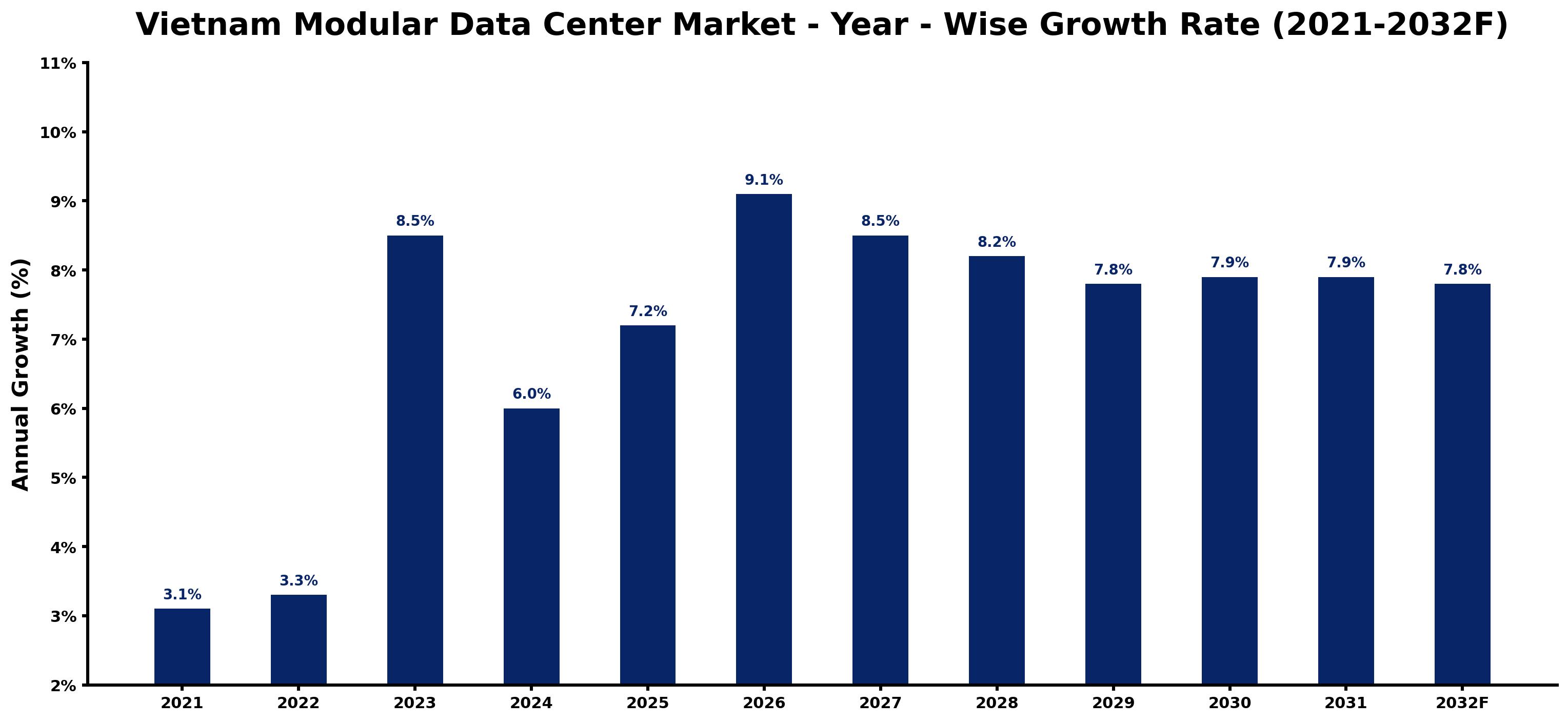
The table below presents the year‑wise growth rates along with the key drivers influencing the market
| Year | Growth Rate | Major Drivers |
| 2021 | 3.1% | Growing renewable energy integration projects |
| 2022 | 3.3% | Increasing adoption of advanced technologies |
| 2023 | 8.5% | Increasing industrial infrastructure investments |
| 2024 | 6.0% | Rapid growth in telecom and data center sectors |
| 2025 | 7.2% | Rising electricity demand across industries |
| 2026 | 9.1% | Increasing smart city development projects |
| 2027 | 8.5% | Increasing smart city development projects |
| 2028 | 8.2% | Increasing industrial automation investments |
| 2029 | 7.8% | Growing renewable energy integration projects |
| 2030 | 7.9% | Rising electricity demand across industries |
| 2031 | 7.9% | Growing urbanization and commercial development |
| 2032 | 7.8% | Rising electricity demand across industries |
Note - Market size estimations and growth projections presented in this report are based on 6Wresearch’s advanced forecasting approach, validated with industry datasets as of June 2026.
Vietnam Modular Data Center Market Synopsis
The Vietnam Modular Data Center Market is currently witnessing remarkable momentum fueled by surging demands for efficient data management solutions. As organizations pivot towards digital operations, modular data centers stand out for their capacity to adapt swiftly to changing requirements, making them an essential component of modern IT infrastructure.
Looking ahead, the market is poised for further growth as investments in digital infrastructure continue to escalate. The integration of advanced technologies and growing partnerships among industry stakeholders will further enhance the modular data center landscape, positioning Vietnam as a key player in the regional data storage ecosystem.
Vietnam Modular Data Center Market Key Takeaways
- Rapid growth driven by increasing data storage needs and digital transformation.
- Modular solutions are gaining traction due to their flexibility and cost-effectiveness.
- The rise of cloud computing is shaping demand for scalable data infrastructure.
- Collaboration among technology providers and local operators is fostering market growth.
- Environmental sustainability is becoming a critical focus in data center operations.
Evaluation of Restraints in Vietnam Modular Data Center Market
While the Vietnam Modular Data Center Market shows promise, there are tangible restraints affecting its pace of development. A primary concern is the need for robust power and cooling solutions that can support high-density computing environments. Insufficient power supply and cooling infrastructure can lead to performance issues and downtime, ultimately affecting reliability. Moreover, as global sustainability practices gain traction, companies must adapt to stringent environmental regulations, which may necessitate investment in greener technologies and practices.
Vietnam Modular Data Center Market Trends
A notable trend in the Vietnam Modular Data Center Market is the increasing convergence of modular technology with advanced automation and artificial intelligence. This integration not only streamlines operations but also enhances performance and efficiency. Furthermore, the growing focus on energy-efficient solutions is driving innovations in cooling technologies, ensuring that new deployments adhere to sustainability goals while delivering optimal operational outcomes.
Vietnam Modular Data Center Market Opportunities
The market presents significant investment opportunities, particularly in urban areas where digital services are expanding rapidly. The push for data localization is driving enterprises to develop local data center capabilities, further propelling the demand for modular solutions. Additionally, as businesses increasingly prioritize disaster recovery and business continuity, modular data centers are emerging as preferred options due to their inherent flexibility and rapid deployment characteristics.
Government Initiatives in the Vietnam Modular Data Center Market
The Vietnamese government is actively promoting digital transformation initiatives, which include investments in IT infrastructure to support the growing demand for data services. Policies aimed at enhancing technology adoption among businesses are being introduced, alongside incentives for sustainable practices in data center operations. These initiatives underline the government's commitment to positioning Vietnam as a competitive player in the regional technology landscape.
Future Insights of the Vietnam Modular Data Center Market
Looking towards 2026 and beyond, the Vietnam Modular Data Center Market is expected to maintain its growth trajectory, primarily driven by technological advancements and ongoing digitalization efforts. As businesses increasingly rely on data-driven decision-making, the demand for modular data centers will likely escalate. Moreover, innovations in edge computing and increased data security concerns will further enhance the attractiveness of modular solutions for diverse applications.
Vietnam Modular Data Center Market Latest Developments (May 2025 - June 2026)
The landscape of the Vietnam Modular Data Center Market is evolving with notable recent developments. Increased collaborations between local and international technology firms are evident, aimed at enhancing service offerings and boosting local expertise. Efforts to integrate renewable energy sources into modular solutions are gaining momentum, reflecting the growing emphasis on sustainability and reducing carbon footprints within the data center sector.
Vietnam Modular Data Center Market - Key Attractiveness of the Report
- 10 Years of Market Numbers
- Historical Data Starting from 2022 to 2025
- Base Year: 2025
- Forecast Data until 2032
- Key Performance Indicators Impacting the Market
- Major Upcoming Developments and Projects
Key Highlights of the Report:
- Vietnam Modular Data Center Market Outlook
- Market Size of Vietnam Modular Data Center Market, 2025
- Forecast of Vietnam Modular Data Center Market, 2032
- Historical Data and Forecast of Vietnam Modular Data Center Revenues & Volume for the Period 2022-2032F
- Vietnam Modular Data Center Market Trend Evolution
- Vietnam Modular Data Center Market Drivers and Challenges
- Vietnam Modular Data Center Price Trends
- Vietnam Modular Data Center Porter's Five Forces
- Vietnam Modular Data Center Industry Life Cycle
- Historical Data and Forecast of Vietnam Modular Data Center Market Revenues & Volume By Functional module solution for the Period 2022-2032F
- Historical Data and Forecast of Vietnam Modular Data Center Market Revenues & Volume By All-in One Functional Module for the Period 2022-2032F
- Historical Data and Forecast of Vietnam Modular Data Center Market Revenues & Volume By Individual Functional Module for the Period 2022-2032F
- Historical Data and Forecast of Vietnam Modular Data Center Market Revenues & Volume By Service for the Period 2022-2032F
- Historical Data and Forecast of Vietnam Modular Data Center Market Revenues & Volume By Infrastructure Management for the Period 2022-2032F
- Historical Data and Forecast of Vietnam Modular Data Center Market Revenues & Volume By Integration & Deployment for the Period 2022-2032F
- Historical Data and Forecast of Vietnam Modular Data Center Market Revenues & Volume By Consulting for the Period 2022-2032F
- Historical Data and Forecast of Vietnam Modular Data Center Market Revenues & Volume By Industry for the Period 2022-2032F
- Historical Data and Forecast of Vietnam Modular Data Center Market Revenues & Volume By BFSI for the Period 2022-2032F
- Historical Data and Forecast of Vietnam Modular Data Center Market Revenues & Volume By Retail for the Period 2022-2032F
- Historical Data and Forecast of Vietnam Modular Data Center Market Revenues & Volume By Government for the Period 2022-2032F
- Historical Data and Forecast of Vietnam Modular Data Center Market Revenues & Volume By Healthcare for the Period 2022-2032F
- Historical Data and Forecast of Vietnam Modular Data Center Market Revenues & Volume By Telecommunication for the Period 2022-2032F
- Historical Data and Forecast of Vietnam Modular Data Center Market Revenues & Volume By Utilities for the Period 2022-2032F
- Historical Data and Forecast of Vietnam Modular Data Center Market Revenues & Volume By Others for the Period 2022-2032F
- Vietnam Modular Data Center Import Export Trade Statistics
- Market Opportunity Assessment By Functional module solution
- Market Opportunity Assessment By Service
- Market Opportunity Assessment By Industry
- Vietnam Modular Data Center Top Companies Market Share
- Vietnam Modular Data Center Competitive Benchmarking By Technical and Operational Parameters
- Vietnam Modular Data Center Company Profiles
- Vietnam Modular Data Center Key Strategic Recommendations






































