Vietnam Railway Maintenance Machinery Market Size, Share & Growth Rate
The Vietnam Railway Maintenance Machinery Market was estimated at USD 713 Million in 2025 and is projected to reach USD 1161 Million by 2032, growing at a CAGR of 7.2% from 2026 to 2032. This robust growth trajectory is fundamentally driven by Vietnam's strategic initiatives to modernize its railway infrastructure and improve safety standards. Increasing investment in both freight and passenger transportation is further propelling demand for efficient and reliable railway maintenance machinery.
Vietnam Railway Maintenance Machinery Market Year-wise Growth Rate and Key Drivers
This graph highlights how the Vietnam Railway Maintenance Machinery Market has steadily grown over the years, supported by major growth factors.
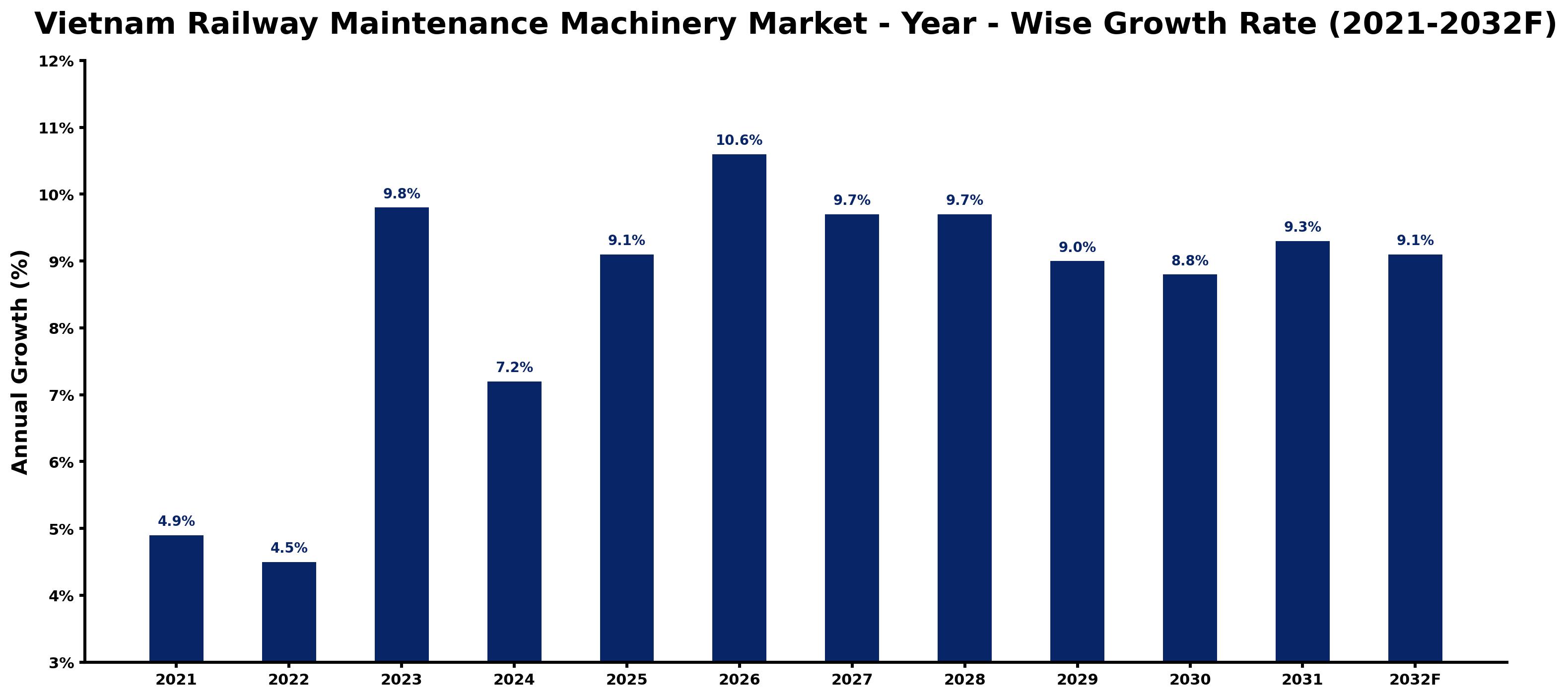
The table below presents the year‑wise growth rates along with the key drivers influencing the market
| Year | Growth Rate | Major Drivers |
| 2021 | 4.9% | Expansion of manufacturing activities |
| 2022 | 4.5% | Expansion of commercial construction activities |
| 2023 | 9.8% | Growing urbanization and commercial development |
| 2024 | 7.2% | Expansion of commercial construction activities |
| 2025 | 9.1% | Expansion of commercial construction activities |
| 2026 | 10.6% | Increasing smart city development projects |
| 2027 | 9.7% | Growing renewable energy integration projects |
| 2028 | 9.7% | Growing renewable energy integration projects |
| 2029 | 9.0% | Increasing industrial infrastructure investments |
| 2030 | 8.8% | Expansion of commercial construction activities |
| 2031 | 9.3% | Growing urbanization and commercial development |
| 2032 | 9.1% | Expansion of manufacturing activities |
Note - Market size estimations and growth projections presented in this report are based on 6Wresearch's advanced forecasting approach, validated with industry datasets as of June 2026.
Vietnam Railway Maintenance Machinery Market Synopsis
The most significant force shaping the Vietnam Railway Maintenance Machinery Market is the government's commitment to revitalizing the national railway system. With extensive railway expansions underway, there is a heightened focus on acquiring state-of-the-art maintenance machinery to ensure operational efficiency and safety.
In tandem with this, growing freight and passenger transport demands underscore the necessity for effective maintenance solutions. Domestic and international players are increasingly investing in innovative technologies to cater to the evolving needs of the railway sector, enhancing both the reliability and sustainability of railway operations.
Vietnam Railway Maintenance Machinery Market Key Takeaways
- The market is fueled by government-led infrastructure initiatives aimed at modernizing railway networks.
- There is a notable shift towards sustainable and environmentally friendly machinery to align with global standards.
- Innovations in technology are leading to the development of advanced maintenance equipment.
- Increased freight and passenger demand necessitate a more efficient maintenance approach, further driving the market.
- Continuous investments from both local and foreign manufacturers are diversifying the machinery offerings.
Evaluation of Restraints in Vietnam Railway Maintenance Machinery Market
While the Vietnam Railway Maintenance Machinery Market is witnessing significant growth, several restraints must be navigated. Budget constraints on public infrastructure spending pose a challenge, as insufficient funding can delay the acquisition of necessary machinery. Moreover, the introduction of advanced technologies requires a robust training regime for personnel, which can strain existing resources. The market also faces risks from counterfeit machinery that could compromise safety and operational efficiency, making supplier verification essential. As Vietnam continues its modernization efforts, addressing these limitations is crucial for sustained growth.
Vietnam Railway Maintenance Machinery Market Trends
Emerging trends in the Vietnam Railway Maintenance Machinery Market highlight a clear shift towards automation and predictive maintenance technologies. These advancements aim to enhance the efficiency and lifespan of machinery through real-time monitoring and analytics. Furthermore, an increasing emphasis on eco-friendly equipment is driving manufacturers to innovate in the realm of sustainable practices, reducing the environmental impact of railway operations. The integration of digital solutions for maintenance management is also on the rise, improving operational workflow.
Vietnam Railway Maintenance Machinery Market Opportunities
Opportunities in the Vietnam Railway Maintenance Machinery Market are abundant as the nation seeks to upgrade its infrastructure. There is significant potential for investment in specialized machinery designed for specific maintenance tasks, such as ballast regulators and rail grinders. Additionally, partnerships with international technology providers could foster innovation and elevate the standards of local manufacturing capabilities. As Vietnam's railway network expands, the demand for advanced maintenance solutions will continue to offer lucrative growth avenues for industry stakeholders.
Government Initiatives in the Vietnam Railway Maintenance Machinery Market
The Vietnamese government has rolled out various initiatives aimed at bolstering the railway sector, including substantial investments in infrastructure development. Public spending on railway projects is being prioritized to facilitate modernization efforts and enhance operational efficiency. Additionally, the government promotes policies encouraging the adoption of advanced technologies within the railway maintenance sector, providing incentives for both domestic and foreign manufacturers to contribute to this growth.
Future Insights of the Vietnam Railway Maintenance Machinery Market
Looking ahead to 2026-2032, the Vietnam Railway Maintenance Machinery Market is poised for sustained growth driven by continued investments in railway infrastructure and increasing technological advancements. As the government intensifies efforts to improve railway services, the demand for innovative maintenance machinery will remain strong. Furthermore, the growing emphasis on safety and sustainability will likely spur further investment in environmentally friendly technologies, setting the stage for a robust and dynamic market landscape.
Vietnam Railway Maintenance Machinery Market Latest Developments (May 2025 - June 2026)
In the latest industry updates, several initiatives aimed at accelerating railway projects have gained momentum, with new machinery tenders being announced to support ongoing infrastructure upgrades. The focus on public-private partnerships is also increasing, fostering collaborations that aim to integrate modern technologies into maintenance practices. Moreover, there is a noticeable uptick in industry workshops and training programs aimed at enhancing the skill sets of maintenance personnel, ensuring they are equipped to operate advanced machinery effectively.
Vietnam Railway Maintenance Machinery Market - Key Attractiveness of the Report
- 10 Years of Market Numbers
- Historical Data Starting from 2022 to 2025
- Base Year: 2025
- Forecast Data until 2032
- Key Performance Indicators Impacting the Market
- Major Upcoming Developments and Projects
Key Highlights of the Report:
- Vietnam Railway Maintenance Machinery Market Outlook
- Market Size of Vietnam Railway Maintenance Machinery Market, 2025
- Forecast of Vietnam Railway Maintenance Machinery Market, 2032
- Historical Data and Forecast of Vietnam Railway Maintenance Machinery Revenues & Volume for the Period 2022-2032F
- Vietnam Railway Maintenance Machinery Market Trend Evolution
- Vietnam Railway Maintenance Machinery Market Drivers and Challenges
- Vietnam Railway Maintenance Machinery Price Trends
- Vietnam Railway Maintenance Machinery Porter's Five Forces
- Vietnam Railway Maintenance Machinery Industry Life Cycle
- Historical Data and Forecast of Vietnam Railway Maintenance Machinery Market Revenues & Volume By Type for the Period 2022-2032F
- Historical Data and Forecast of Vietnam Railway Maintenance Machinery Market Revenues & Volume By Tamping Machine for the Period 2022-2032F
- Historical Data and Forecast of Vietnam Railway Maintenance Machinery Market Revenues & Volume By Stabilizing Machinery for the Period 2022-2032F
- Historical Data and Forecast of Vietnam Railway Maintenance Machinery Market Revenues & Volume By Rail Handling Machinery for the Period 2022-2032F
- Historical Data and Forecast of Vietnam Railway Maintenance Machinery Market Revenues & Volume By Ballast Cleaning Machine for the Period 2022-2032F
- Historical Data and Forecast of Vietnam Railway Maintenance Machinery Market Revenues & Volume By Other for the Period 2022-2032F
- Historical Data and Forecast of Vietnam Railway Maintenance Machinery Market Revenues & Volume By Applications for the Period 2022-2032F
- Historical Data and Forecast of Vietnam Railway Maintenance Machinery Market Revenues & Volume By Ballast Track for the Period 2022-2032F
- Historical Data and Forecast of Vietnam Railway Maintenance Machinery Market Revenues & Volume By Ballastless Track for the Period 2022-2032F
- Vietnam Railway Maintenance Machinery Import Export Trade Statistics
- Market Opportunity Assessment By Type
- Market Opportunity Assessment By Applications
- Vietnam Railway Maintenance Machinery Top Companies Market Share
- Vietnam Railway Maintenance Machinery Competitive Benchmarking By Technical and Operational Parameters
- Vietnam Railway Maintenance Machinery Company Profiles
- Vietnam Railway Maintenance Machinery Key Strategic Recommendations






































