Vietnam Reptile Leather Market Size, Share & Growth Rate
The Vietnam Reptile Leather Market was estimated at USD 643 Million in 2025 and is projected to reach USD 914 Million by 2032, growing at a CAGR of 5.2% from 2026 to 2032. This upward trajectory is primarily driven by the increasing demand from the fashion and luxury sectors, where unique and premium materials are highly valued. The growing awareness of ethical sourcing and sustainable practices in the industry further supports the market's expansion as consumers gravitate towards products that align with their values.
Vietnam Reptile Leather Market Year-wise Growth Rate and Key Drivers
This graph highlights how the Vietnam Reptile Leather Market has steadily grown over the years, supported by major growth factors.
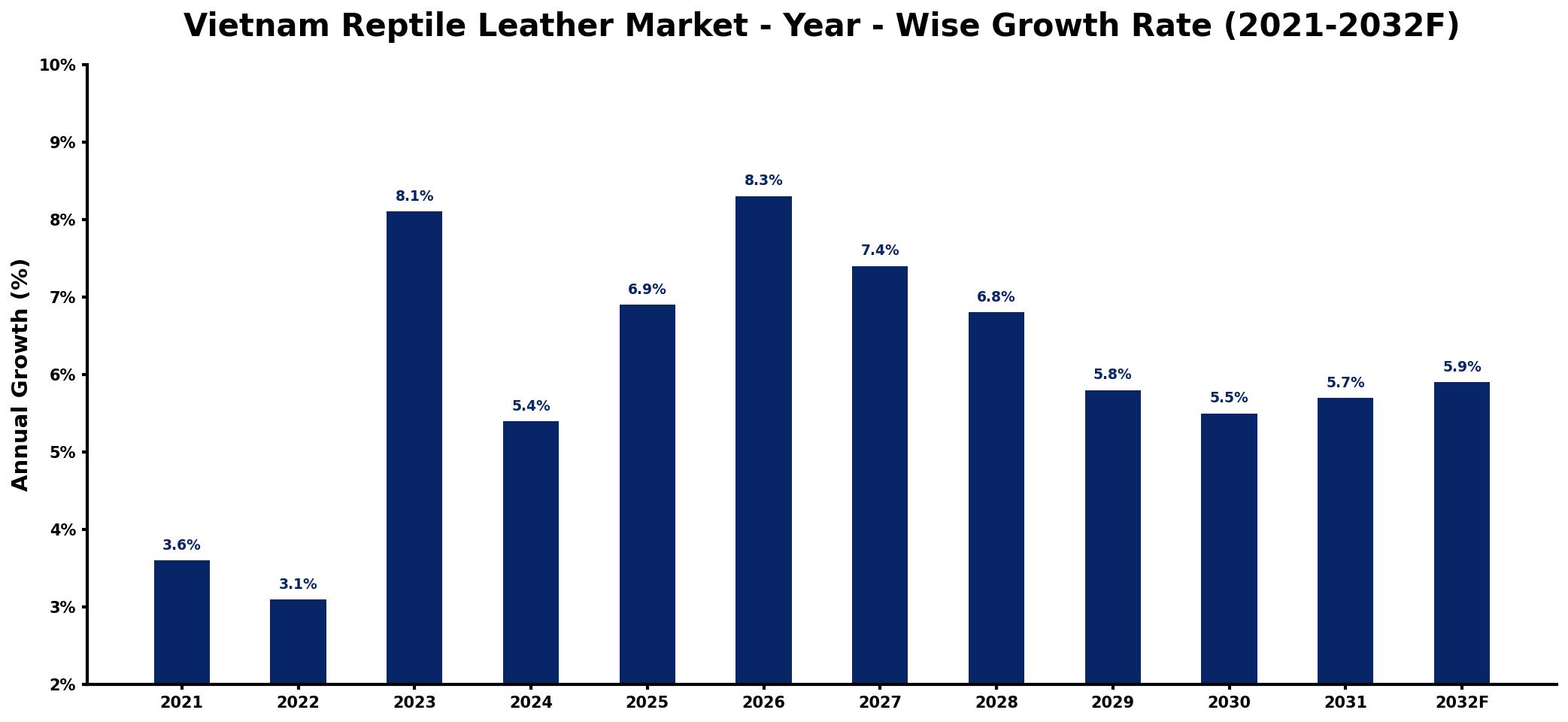
The table below presents the year‑wise growth rates along with the key drivers influencing the market
| Year | Growth Rate | Major Drivers |
| 2021 | 3.6% | Rising interest in luxury fashion |
| 2022 | 3.1% | Increased exports to international markets |
| 2023 | 8.1% | Growing demand for sustainable materials |
| 2024 | 5.4% | Expansion of high-end retail sector |
| 2025 | 6.9% | Emergence of new fashion trends |
| 2026 | 8.3% | Investment in advanced production technologies |
| 2027 | 7.4% | Strengthening of international trade agreements |
| 2028 | 6.8% | Surge in bespoke product offerings |
| 2029 | 5.8% | Enhanced marketing strategies for luxury |
| 2030 | 5.5% | Growth in eco-conscious consumer base |
| 2031 | 5.7% | Development of innovative design collaborations |
| 2032 | 5.9% | Rising popularity of artisanal craftsmanship |
Note: Market size estimations and growth projections presented in this report are based on 6Wresearch's proprietary forecasting methodology, utilizing the latest available industry data, government publications, and primary research inputs.
Vietnam Reptile Leather Market Synopsis
In recent years, the Vietnam reptile leather market has experienced robust growth, fueled by a resurgence in luxury spending and an appreciation for craftsmanship. As consumer preferences evolve, the market is pivoting towards sustainable and ethically sourced materials, positioning Vietnam as a viable player within the global arena.
Looking ahead, the market is on a promising path, bolstered by the burgeoning demand for unique fashion accessories. With Vietnam's skilled artisans and competitive production costs, the country is well-poised to meet the rising expectations of both domestic and international consumers seeking exclusive reptile leather products.
Vietnam Reptile Leather Market Key Takeaways
- The market is projected to experience steady growth, driven by demand for luxury reptile leather goods.
- Sustainable and ethical practices are becoming increasingly important to consumers and manufacturers alike.
- Vietnam's craftsmanship and favorable labor costs enhance its competitive edge in the global market.
- Fashion trends favoring unique materials continue to support the expansion of the market.
- Regulatory challenges regarding the ethical sourcing of reptile hides remain a focal point for the industry.
Evaluation of Restraints in Vietnam Reptile Leather Market
The growth of the Vietnam reptile leather market is tempered by significant challenges related to ethical sourcing and conservation. Consumers and regulators are increasingly scrutinizing the impact of exotic leather production on wildlife populations and ecosystems. Additionally, varying international regulations on the trade of certain species can disrupt supply chains, making it essential for stakeholders to navigate these complexities. The volatility of fashion trends further complicates market stability, emphasizing the need for adaptability in production and marketing strategies.
Vietnam Reptile Leather Market Trends
Emerging trends within the Vietnam reptile leather market include a heightened focus on sustainable practices and transparency in sourcing. As the luxury sector pivots towards environmentally friendly products, there is growing consumer interest in brands that demonstrate commitment to ethical practices. Additionally, advancements in technology are enabling more efficient processing methods, enhancing product quality and consistency. The integration of design innovation with traditional craftsmanship is also gaining traction, appealing to a new generation of luxury consumers.
Vietnam Reptile Leather Market Opportunities
Significant growth opportunities exist for investors and manufacturers within the Vietnam reptile leather market. As global demand for unique and premium leather goods rises, there is a compelling case for expanding production capabilities and enhancing product offerings. Collaborations with international luxury brands can open new channels for distribution and increase brand visibility. Furthermore, innovations in sustainable farming and ethical sourcing present avenues for differentiation and growth, catering to the values of todays conscious consumers.
Government Initiatives in the Vietnam Reptile Leather Market
The Vietnamese government is actively promoting the growth of its leather industry through various initiatives aimed at enhancing sustainability and ethical practices. This includes supporting research and development projects that focus on sustainable sourcing methods for reptile leather. Public spending on training programs for artisans ensures the preservation of traditional craftsmanship while also adopting modern techniques. Additionally, the government encourages compliance with international regulations regarding wildlife conservation, which is crucial for the long-term viability of the market.
Future Insights of the Vietnam Reptile Leather Market
From 2026 to 2032, the Vietnam reptile leather market is expected to evolve with a stronger emphasis on sustainability and ethical practices. Market participants will likely adapt to the increasing consumer demand for transparency in sourcing and production processes. As the luxury sector continues to grow, Vietnamese producers will benefit from their unique craftsmanship and ability to provide high-quality products. This trend suggests a dynamic landscape where innovation and tradition coexist, ultimately leading to increased global competitiveness.
Vietnam Reptile Leather Market Latest Developments (2025 - 2026)
In the recent months, there has been a noticeable shift in the Vietnam reptile leather market towards embracing more sustainable practices. Manufacturers are increasingly prioritizing ethical sourcing while collaborating with conservation groups to ensure compliance with environmental regulations. This period also witnessed several local workshops and expos showcasing Vietnam's rich heritage in leather craftsmanship, drawing interest from international buyers and fostering potential partnerships. Moreover, innovative marketing campaigns focusing on transparency and sustainability have begun to resonate well with consumers, signaling a positive shift in market dynamics.
Vietnam Reptile Leather Market - Key Attractiveness of the Report
- 10 Years of Market Numbers
- Historical Data Starting from 2022 to 2025
- Base Year: 2025
- Forecast Data until 2032
- Key Performance Indicators Impacting the Market
- Major Upcoming Developments and Projects
Key Highlights of the Report:
- Vietnam Reptile Leather Market Outlook
- Market Size of Vietnam Reptile Leather Market, 2025
- Forecast of Vietnam Reptile Leather Market, 2032
- Historical Data and Forecast of Vietnam Reptile Leather Revenues & Volume for the Period 2022-2032F
- Vietnam Reptile Leather Market Trend Evolution
- Vietnam Reptile Leather Market Drivers and Challenges
- Vietnam Reptile Leather Price Trends
- Vietnam Reptile Leather Porter's Five Forces
- Vietnam Reptile Leather Industry Life Cycle
- Historical Data and Forecast of Vietnam Reptile Leather Market Revenues & Volume By Distribution Channels for the Period 2022-2032F
- Historical Data and Forecast of Vietnam Reptile Leather Market Revenues & Volume By Online stores for the Period 2022-2032F
- Historical Data and Forecast of Vietnam Reptile Leather Market Revenues & Volume By Retail stores for the Period 2022-2032F
- Vietnam Reptile Leather Import Export Trade Statistics
- Market Opportunity Assessment By Distribution Channels
- Vietnam Reptile Leather Top Companies Market Share
- Vietnam Reptile Leather Competitive Benchmarking By Technical and Operational Parameters
- Vietnam Reptile Leather Company Profiles
- Vietnam Reptile Leather Key Strategic Recommendations






































