Vietnam Robotic Vacuum Cleaner Market Size, Share & Growth Rate
The Vietnam Robotic Vacuum Cleaner Market was estimated at USD 479 Million in 2025 and is projected to reach USD 675 Million by 2032, growing at a CAGR of 5.0% from 2026 to 2032. This growth trajectory is driven by rapid urbanization and changing consumer lifestyles, which increasingly favor automation and convenience in household cleaning tasks. The rise in disposable income among Vietnamese consumers further supports market expansion, as more households invest in advanced cleaning technologies.
Vietnam Robotic Vacuum Cleaner Market Year-wise Growth Rate and Key Drivers
This graph highlights how the Vietnam Robotic Vacuum Cleaner Market has steadily grown over the years, supported by major growth factors.
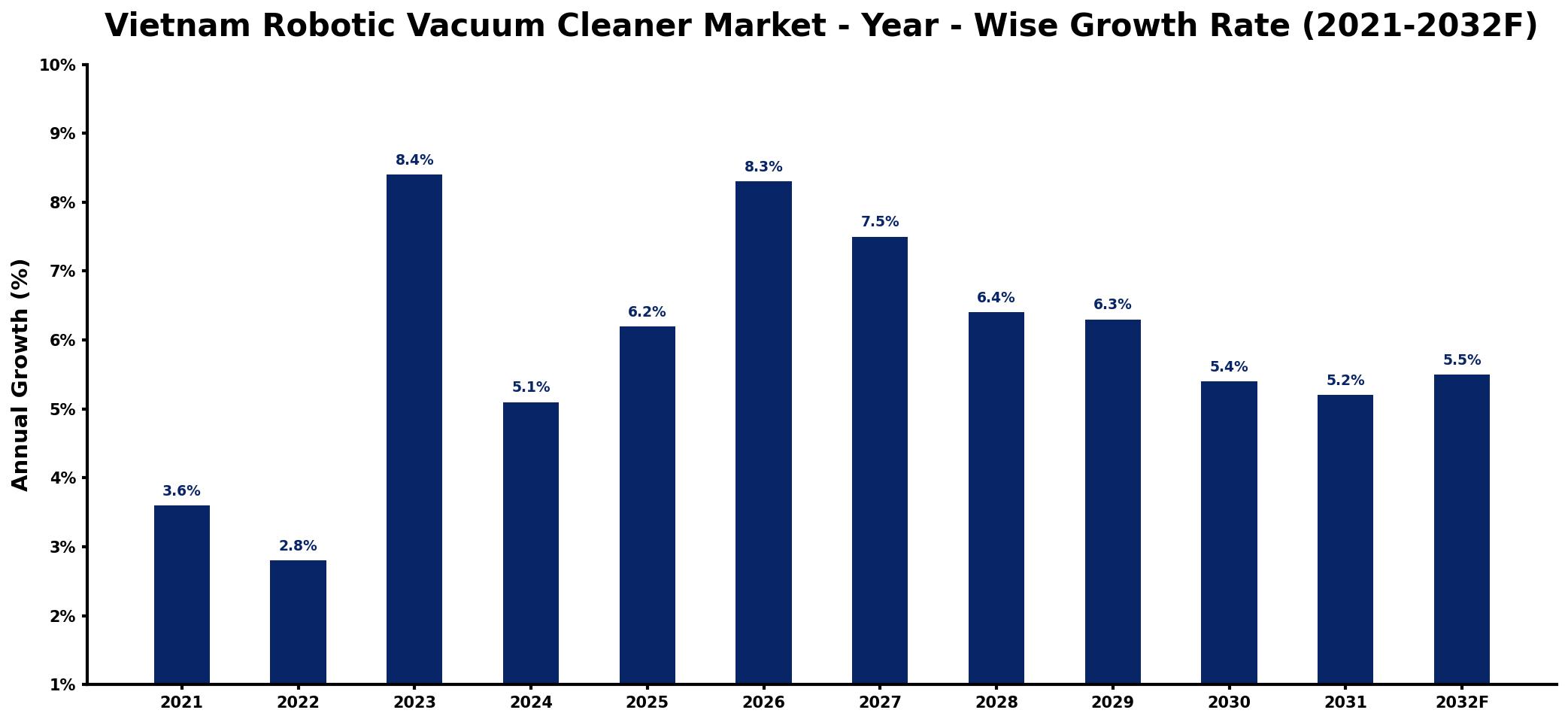
The table below presents the year‑wise growth rates along with the key drivers influencing the market
| Year | Growth Rate | Major Drivers |
| 2021 | 3.6% | Rising consumer technology adoption |
| 2022 | 2.8% | Increased urbanization and lifestyle changes |
| 2023 | 8.4% | Growing demand for automation solutions |
| 2024 | 5.1% | Expansion of e-commerce platforms |
| 2025 | 6.2% | Enhanced consumer awareness campaigns |
| 2026 | 8.3% | Technological advancements in AI |
| 2027 | 7.5% | Increase in disposable income levels |
| 2028 | 6.4% | Shift towards smart home integration |
| 2029 | 6.3% | Growth of green technology initiatives |
| 2030 | 5.4% | Rising popularity of home convenience |
| 2031 | 5.2% | Investment in home automation systems |
| 2032 | 5.5% | Development of advanced cleaning technologies |
Note: Market size estimations and growth projections presented in this report are based on 6Wresearch's proprietary forecasting methodology, utilizing the latest available industry data, government publications, and primary research inputs.
Vietnam Robotic Vacuum Cleaner Market Synopsis
As urban living spaces become increasingly compact, the demand for efficient cleaning solutions has surged in Vietnam. Robotic vacuum cleaners, equipped with intelligent navigation systems and AI technology, cater to this demand by offering automated floor cleaning in both residential and commercial settings.
These devices not only save time but also enhance the overall cleaning experience, making them particularly appealing to busy urban professionals and families. The integration of smart home features into these robotic vacuums further solidifies their attractiveness, allowing users to control cleaning routines remotely.
Vietnam Robotic Vacuum Cleaner Market Key Takeaways
- The market is characterized by increasing consumer awareness of hygiene and automation in cleaning tasks.
- Technological advancements, including AI and sensor integration, are driving product innovation.
- Urbanization and busy lifestyles significantly contribute to the demand for automated cleaning solutions.
- Consumer preferences are shifting towards products that offer convenience, efficiency, and smart features.
- Competition is intensifying, prompting manufacturers to focus on quality and cost-effectiveness.
Evaluation of Restraints in Vietnam Robotic Vacuum Cleaner Market
Despite its promising growth, the Vietnam robotic vacuum cleaner market faces several restraints. The need for high-quality products that provide effective cleaning while ensuring navigation accuracy remains a challenge. Furthermore, balancing production costs with the demand for affordable, reliable options can hinder market expansion. As technology continues to evolve, manufacturers must keep pace with the latest trends to maintain competitiveness. Ensuring that products meet cleaning equipment standards is crucial as well, particularly in a market where consumer expectations are rising.
Vietnam Robotic Vacuum Cleaner Market Trends
One of the most significant trends influencing the Vietnam robotic vacuum cleaner market is the integration of smart home technology. Consumers are increasingly looking for devices that can seamlessly connect with other smart appliances. Moreover, eco-friendly designs are gaining traction, with manufacturers introducing models that utilize sustainable materials and energy-efficient operations. The demand for multi-functional devices that can vacuum and mop simultaneously is also on the rise, reflecting a trend towards more versatile household cleaning solutions.
Vietnam Robotic Vacuum Cleaner Market Opportunities
As the market matures, there are significant opportunities for investment in product development focusing on enhanced features like advanced AI and better user interfaces. Expanding sales channels, particularly online platforms, will allow manufacturers to reach a broader audience. Additionally, targeting smaller cities and rural areas where awareness of robotic cleaning devices is still growing represents an untapped market segment. Collaborations with tech firms to integrate cutting-edge navigation and smart home functionalities can also pave the way for new product innovations.
Government Initiatives in the Vietnam Robotic Vacuum Cleaner Market
The Vietnamese government has been promoting technological advancements and smart home solutions as part of its broader economic development strategy. Initiatives aimed at increasing public awareness of smart technologies and improving infrastructure for digital services are likely to bolster market growth. Support for green technology projects also aligns with consumer preferences for eco-friendly products, creating a favorable environment for robotic vacuum cleaner manufacturers to thrive.
Future Insights of the Vietnam Robotic Vacuum Cleaner Market
Looking ahead to 2026-2032, the Vietnam robotic vacuum cleaner market is poised for substantial growth driven by technological advancements and changing consumer behavior. As more households adopt smart home technologies, the demand for sophisticated, interconnected robotic cleaning devices will likely increase. Manufacturers focusing on enhancing the user experience and developing high-quality, efficient products will find a receptive audience in a market that is evolving rapidly towards automation and convenience.
Vietnam Robotic Vacuum Cleaner Market Latest Developments (2025 - 2026)
In recent months, the Vietnam robotic vacuum cleaner market has seen heightened competition, with new entrants introducing innovative features to attract tech-savvy consumers. Companies are increasingly focusing on sustainability, launching eco-friendly models that appeal to environmentally conscious buyers. Efforts to enhance online sales platforms have also gained traction, allowing consumers easier access to a wider range of products and features. The emphasis on smart connectivity is growing, with many brands incorporating advanced AI capabilities into their latest offerings.
Vietnam Robotic Vacuum Cleaner Market - Key Attractiveness of the Report
- 10 Years of Market Numbers
- Historical Data Starting from 2022 to 2025
- Base Year: 2025
- Forecast Data until 2032
- Key Performance Indicators Impacting the Market
- Major Upcoming Developments and Projects
Key Highlights of the Report:
- Vietnam Robotic Vacuum Cleaner Market Outlook
- Market Size of Vietnam Robotic Vacuum Cleaner Market, 2025
- Forecast of Vietnam Robotic Vacuum Cleaner Market, 2032
- Historical Data and Forecast of Vietnam Robotic Vacuum Cleaner Revenues & Volume for the Period 2022-2032F
- Vietnam Robotic Vacuum Cleaner Market Trend Evolution
- Vietnam Robotic Vacuum Cleaner Market Drivers and Challenges
- Vietnam Robotic Vacuum Cleaner Price Trends
- Vietnam Robotic Vacuum Cleaner Porter's Five Forces
- Vietnam Robotic Vacuum Cleaner Industry Life Cycle
- Historical Data and Forecast of Vietnam Robotic Vacuum Cleaner Market Revenues & Volume By Type for the Period 2022-2032F
- Historical Data and Forecast of Vietnam Robotic Vacuum Cleaner Market Revenues & Volume By Floor Vacuum Cleaner for the Period 2022-2032F
- Historical Data and Forecast of Vietnam Robotic Vacuum Cleaner Market Revenues & Volume By Window Vacuum Cleaner for the Period 2022-2032F
- Historical Data and Forecast of Vietnam Robotic Vacuum Cleaner Market Revenues & Volume By Pool Vacuum Cleaner for the Period 2022-2032F
- Historical Data and Forecast of Vietnam Robotic Vacuum Cleaner Market Revenues & Volume By Application for the Period 2022-2032F
- Historical Data and Forecast of Vietnam Robotic Vacuum Cleaner Market Revenues & Volume By Household for the Period 2022-2032F
- Historical Data and Forecast of Vietnam Robotic Vacuum Cleaner Market Revenues & Volume By Commercial for the Period 2022-2032F
- Historical Data and Forecast of Vietnam Robotic Vacuum Cleaner Market Revenues & Volume By Operation Mode for the Period 2022-2032F
- Historical Data and Forecast of Vietnam Robotic Vacuum Cleaner Market Revenues & Volume By Self-Drive for the Period 2022-2032F
- Historical Data and Forecast of Vietnam Robotic Vacuum Cleaner Market Revenues & Volume By Remote Control for the Period 2022-2032F
- Historical Data and Forecast of Vietnam Robotic Vacuum Cleaner Market Revenues & Volume By Distribution Channel for the Period 2022-2032F
- Historical Data and Forecast of Vietnam Robotic Vacuum Cleaner Market Revenues & Volume By Online for the Period 2022-2032F
- Historical Data and Forecast of Vietnam Robotic Vacuum Cleaner Market Revenues & Volume By Offline for the Period 2022-2032F
- Historical Data and Forecast of Vietnam Robotic Vacuum Cleaner Market Revenues & Volume By Price for the Period 2022-2032F
- Historical Data and Forecast of Vietnam Robotic Vacuum Cleaner Market Revenues & Volume By Below USD 150 for the Period 2022-2032F
- Historical Data and Forecast of Vietnam Robotic Vacuum Cleaner Market Revenues & Volume By USD 150 - 300 for the Period 2022-2032F
- Historical Data and Forecast of Vietnam Robotic Vacuum Cleaner Market Revenues & Volume By USD 300 - 500 for the Period 2022-2032F
- Historical Data and Forecast of Vietnam Robotic Vacuum Cleaner Market Revenues & Volume By Above USD 500 for the Period 2022-2032F
- Vietnam Robotic Vacuum Cleaner Import Export Trade Statistics
- Market Opportunity Assessment By Type
- Market Opportunity Assessment By Application
- Market Opportunity Assessment By Operation Mode
- Market Opportunity Assessment By Distribution Channel
- Market Opportunity Assessment By Price
- Vietnam Robotic Vacuum Cleaner Top Companies Market Share
- Vietnam Robotic Vacuum Cleaner Competitive Benchmarking By Technical and Operational Parameters
- Vietnam Robotic Vacuum Cleaner Company Profiles
- Vietnam Robotic Vacuum Cleaner Key Strategic Recommendations






































