Vietnam Security Analytics Market Size & Growth Rate (2026-2032)
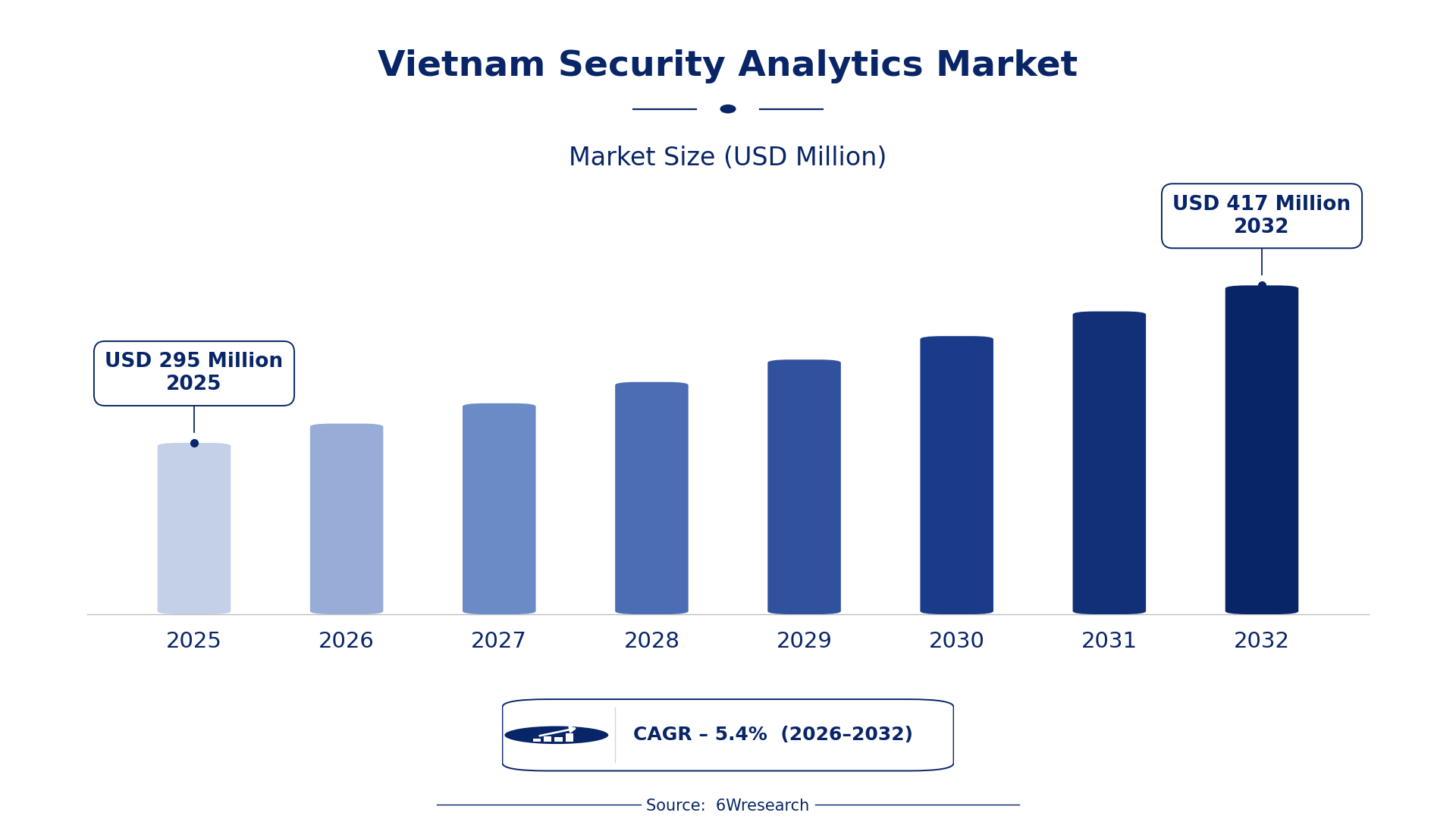
The Vietnam Security Analytics Market was estimated at USD 295 Million in 2025 and is projected to reach USD 417 Million by 2032, growing at a CAGR of 5.4% from 2026 to 2032.
Vietnam Security Analytics Market Synopsis
The rising sophistication of cyber threats is the most significant factor currently shaping the Vietnam Security Analytics Market. Organizations are increasingly aware that traditional security measures are no longer sufficient to combat advanced attacks.
As a result, the demand for advanced analytics tools has surged, allowing entities to identify, assess, and respond to security incidents in real-time. This proactive approach is becoming a cornerstone of security strategies across various sectors in Vietnam.
Vietnam Security Analytics Market Year-wise Growth Rate and Key Drivers
This graph illustrates the annual growth rates of the Vietnam Security Analytics Market from 2021 to 2032, highlighting a steady upward trajectory and projected expansion over the forecast period.
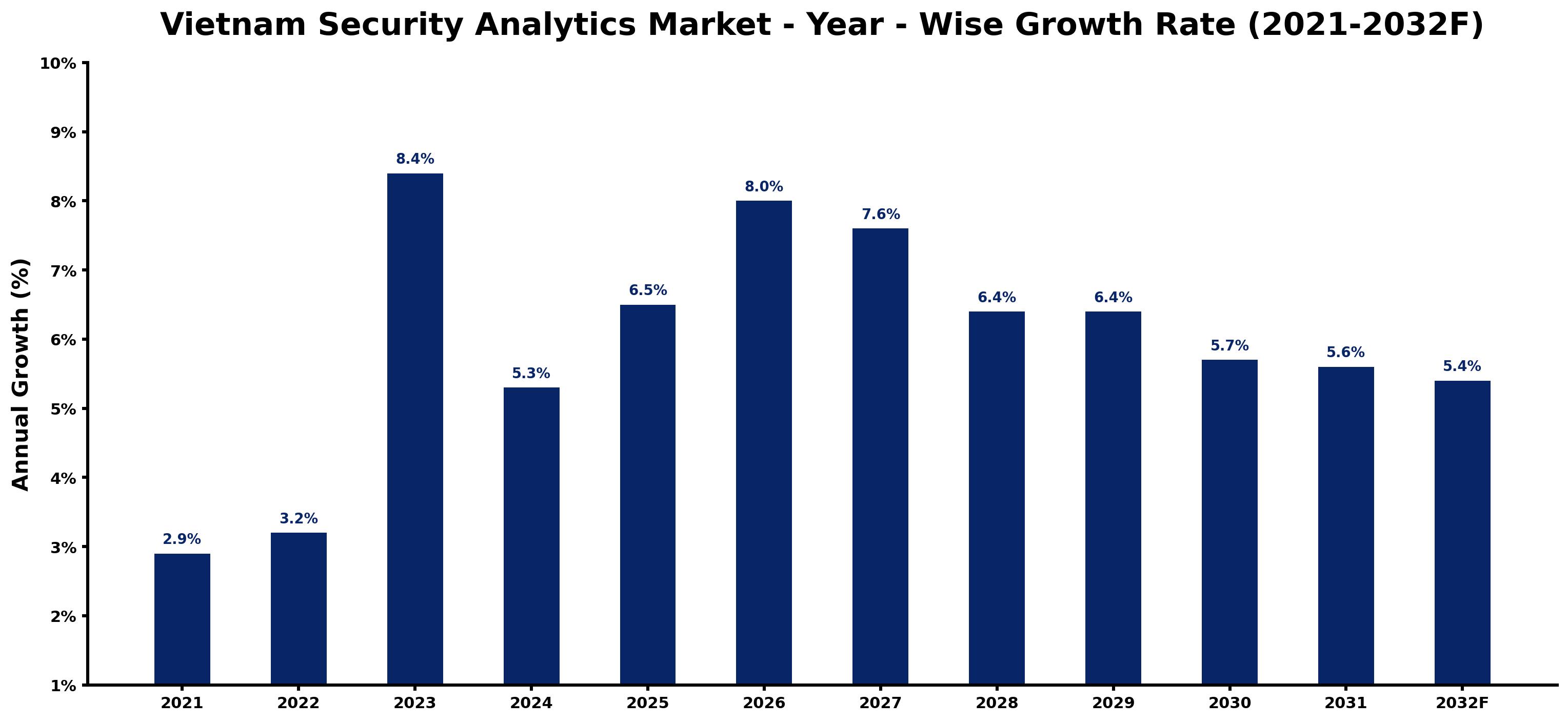
The table below presents the year‑wise growth rates along with the key drivers influencing the market
| Year | Growth Rate | Major Drivers |
| 2021 | 2.9% | Government push for digital transformation initiatives in Vietnam. |
| 2022 | 3.2% | Rising cyber threats prompting enhanced security measures nationwide. |
| 2023 | 8.4% | Increased adoption of cloud services driving security analytics demand. |
| 2024 | 5.3% | Enhanced regulations on data privacy and cybersecurity compliance. |
| 2025 | 6.5% | Growing investments in fintech requiring advanced security solutions. |
| 2026 | 8.0% | Rising internet penetration fostering security analytics demand. |
| 2027 | 7.6% | Implementation of national cybersecurity strategy boosting analytics sector. |
| 2028 | 6.4% | Increasing enterprise data vulnerabilities leading to analytics growth. |
| 2029 | 6.4% | Emerging smart city projects requiring robust security frameworks. |
| 2030 | 5.7% | Digital payment growth necessitating heightened security measures. |
| 2031 | 5.6% | Regulatory focus on critical infrastructure security analytics enhancement. |
| 2032 | 5.4% | Local tech innovations improving security analytics capabilities. |
Note: Market size estimations and growth projections presented in this report are based on 6Wresearch's proprietary forecasting methodology, utilizing the latest available industry data, government publications, and primary research inputs.
Vietnam Security Analytics Market Key Takeaways
Below are some of the specific key takeaways from the market, including:
- Organizations are increasingly adopting AI and machine learning technologies to enhance threat detection.
- The growing volume of data generated by enterprises necessitates sophisticated analytics solutions for effective security management.
- Regulatory compliance is becoming stricter, compelling organizations to adopt advanced security analytics tools.
- Real-time threat detection and rapid incident response capabilities are critical for organizations to safeguard their data.
- Investment in skilled cybersecurity personnel remains a crucial challenge for organizations striving to implement effective security analytics.
Evaluation of Restraints in Vietnam Security Analytics Market
Despite the optimistic growth trajectory, several restraints are hindering the Vietnam Security Analytics Market. A primary concern is the overwhelming amount of data that organizations must analyze. This data overload can strain resources and complicate the extraction of actionable insights. on top of that, inaccuracies in security alerts can lead to fatigue among analysts, resulting in potentially dangerous oversights. Integrating new analytics solutions with existing cybersecurity frameworks often proves to be a complex endeavor. The challenge is compounded by a shortage of skilled analysts, making it harder to build effective security teams capable of navigating the rapidly evolving threat environment.
Vietnam Security Analytics Market Trends
A noticeable trend in the Vietnam Security Analytics Market is the shift towards cloud-based security solutions, driven by the increasing flexibility and scalability they offer. Organizations are increasingly looking to utilize analytics that provide predictive capabilities, allowing them to anticipate threats before they manifest. on top of that, the adoption of unified security platforms is gaining traction, promoting a more integrated approach to security management.
Vietnam Security Analytics Market Opportunities
Opportunities abound in the Vietnam Security Analytics Market, particularly for companies ready to innovate in AI-driven analytics tools. As regulatory frameworks evolve, there will be a pressing need for solutions that ensure compliance while also improving security efficacy. The growing trend of digital transformation in various sectors further opens up avenues for investment in security analytics. Organizations seeking to protect their sensitive data are likely to allocate more budgets towards advanced analytics solutions, creating a fertile ground for growth.
Government Initiatives in the Vietnam Security Analytics Market
The Vietnamese government is making substantial efforts to bolster the nation’s cybersecurity posture. With a focus on developing a regulatory framework that fosters innovation in security technologies, public policy is increasingly prioritizing enhanced protection against cyber threats. These initiatives are crucial for ensuring that organizations meet compliance standards while also improving overall national security.
- A regulatory framework introduced in 2025 emphasizes the importance of cybersecurity measures for critical infrastructure.
- Currently, a national cybersecurity awareness campaign is underway, aiming to educate businesses and the public on security best practices.
- A planned public-private initiative set for 2026 intends to fund research and development in security analytics technologies.
- The government launched a cybersecurity certification program in late 2024 to improve workforce readiness in the sector.
- An ongoing initiative focuses on enhancing cybersecurity capabilities within government agencies, ensuring they are well-equipped to handle emerging threats.
Future Insights of the Vietnam Security Analytics Market
From 2026 to 2032, the Vietnam Security Analytics Market is expected to flourish. Organizations will likely continue to prioritize advanced security measures, especially as the frequency of cyber incidents rises. The integration of AI and machine learning will further enhance detection capabilities, allowing for quicker responses to threats. Additionally, as the regulatory landscape grows more complex, companies that can provide compliant and effective analytics solutions will find themselves in a prime position for growth.
Vietnam Security Analytics Market Latest Developments
In the past year, the Vietnam Security Analytics Market has seen significant activity, particularly in the adoption of AI technologies. Companies are increasingly investing in analytics that provide real-time insights to combat rising cyber threats. As organizations recognize the urgency of enhanced security measures, momentum in the sector continues to build.
- A major technology vendor launched an AI-powered threat detection tool in Q2 2025, aimed at helping organizations mitigate risks faster.
- An initiative that began in early 2025 focuses on improving analytics capabilities for small and medium-sized enterprises, addressing a critical market need.
- A partnership between key industry stakeholders was announced in late 2025 to enhance cybersecurity training programs for aspiring analysts.
- Current development of a cloud-based security analytics solution is underway and expected to be available by mid-2026.
- In early 2025, a regional operator expanded its service portfolio to include advanced security analytics features, responding to customer demand for better protection.
Vietnam Security Analytics Market - Key Attractiveness of the Report
- 10 Years of Market Numbers
- Historical Data Starting from 2022 to 2025
- Base Year: 2025
- Forecast Data until 2032
- Key Performance Indicators Impacting the Market
- Major Upcoming Developments and Projects
Key Highlights of the Report:
- Vietnam Security Analytics Market Outlook
- Market Size of Vietnam Security Analytics Market, 2025
- Forecast of Vietnam Security Analytics Market, 2032
- Historical Data and Forecast of Vietnam Security Analytics Revenues & Volume for the Period 2022-2032F
- Vietnam Security Analytics Market Trend Evolution
- Vietnam Security Analytics Market Drivers and Challenges
- Vietnam Security Analytics Price Trends
- Vietnam Security Analytics Porter's Five Forces
- Vietnam Security Analytics Industry Life Cycle
- Historical Data and Forecast of Vietnam Security Analytics Market Revenues & Volume By Application for the Period 2022-2032F
- Historical Data and Forecast of Vietnam Security Analytics Market Revenues & Volume By Web Security Analytics for the Period 2022-2032F
- Historical Data and Forecast of Vietnam Security Analytics Market Revenues & Volume By Network Security Analytics for the Period 2022-2032F
- Historical Data and Forecast of Vietnam Security Analytics Market Revenues & Volume By Endpoint SecurityAnalytics for the Period 2022-2032F
- Historical Data and Forecast of Vietnam Security Analytics Market Revenues & Volume By Application Security Analytics for the Period 2022-2032F
- Historical Data and Forecast of Vietnam Security Analytics Market Revenues & Volume By Others(Content Security, ICS Security, Database Security, Cloud Security) for the Period 2022-2032F
- Historical Data and Forecast of Vietnam Security Analytics Market Revenues & Volume By Vertical for the Period 2022-2032F
- Historical Data and Forecast of Vietnam Security Analytics Market Revenues & Volume By BFSI for the Period 2022-2032F
- Historical Data and Forecast of Vietnam Security Analytics Market Revenues & Volume By Retail and eCommerce for the Period 2022-2032F
- Historical Data and Forecast of Vietnam Security Analytics Market Revenues & Volume By Media and Entertainment for the Period 2022-2032F
- Historical Data and Forecast of Vietnam Security Analytics Market Revenues & Volume By Travel and Hospitality for the Period 2022-2032F
- Historical Data and Forecast of Vietnam Security Analytics Market Revenues & Volume By Telecom and IT for the Period 2022-2032F
- Historical Data and Forecast of Vietnam Security Analytics Market Revenues & Volume By Healthcare for the Period 2022-2032F
- Historical Data and Forecast of Vietnam Security Analytics Market Revenues & Volume By Others(automobile, government, and education) for the Period 2022-2032F
- Historical Data and Forecast of Vietnam Security Analytics Market Revenues & Volume By Component for the Period 2022-2032F
- Historical Data and Forecast of Vietnam Security Analytics Market Revenues & Volume By Platform for the Period 2022-2032F
- Historical Data and Forecast of Vietnam Security Analytics Market Revenues & Volume By Services for the Period 2022-2032F
- Historical Data and Forecast of Vietnam Security Analytics Market Revenues & Volume By Professional Services for the Period 2022-2032F
- Historical Data and Forecast of Vietnam Security Analytics Market Revenues & Volume By Deployment Mode for the Period 2022-2032F
- Historical Data and Forecast of Vietnam Security Analytics Market Revenues & Volume By Cloud for the Period 2022-2032F
- Historical Data and Forecast of Vietnam Security Analytics Market Revenues & Volume By On-premises for the Period 2022-2032F
- Historical Data and Forecast of Vietnam Security Analytics Market Revenues & Volume By Organization Size for the Period 2022-2032F
- Historical Data and Forecast of Vietnam Security Analytics Market Revenues & Volume By Large enterprises for the Period 2022-2032F
- Historical Data and Forecast of Vietnam Security Analytics Market Revenues & Volume By Small and medium-sized enterprises (SMEs) for the Period 2022-2032F
- Vietnam Security Analytics Import Export Trade Statistics
- Market Opportunity Assessment By Application
- Market Opportunity Assessment By Vertical
- Market Opportunity Assessment By Component
- Market Opportunity Assessment By Deployment Mode
- Market Opportunity Assessment By Organization Size
- Vietnam Security Analytics Top Companies Market Share
- Vietnam Security Analytics Competitive Benchmarking By Technical and Operational Parameters
- Vietnam Security Analytics Company Profiles
- Vietnam Security Analytics Key Strategic Recommendations






































