Vietnam Simulation Software Market Size & Growth Rate (2026-2032)
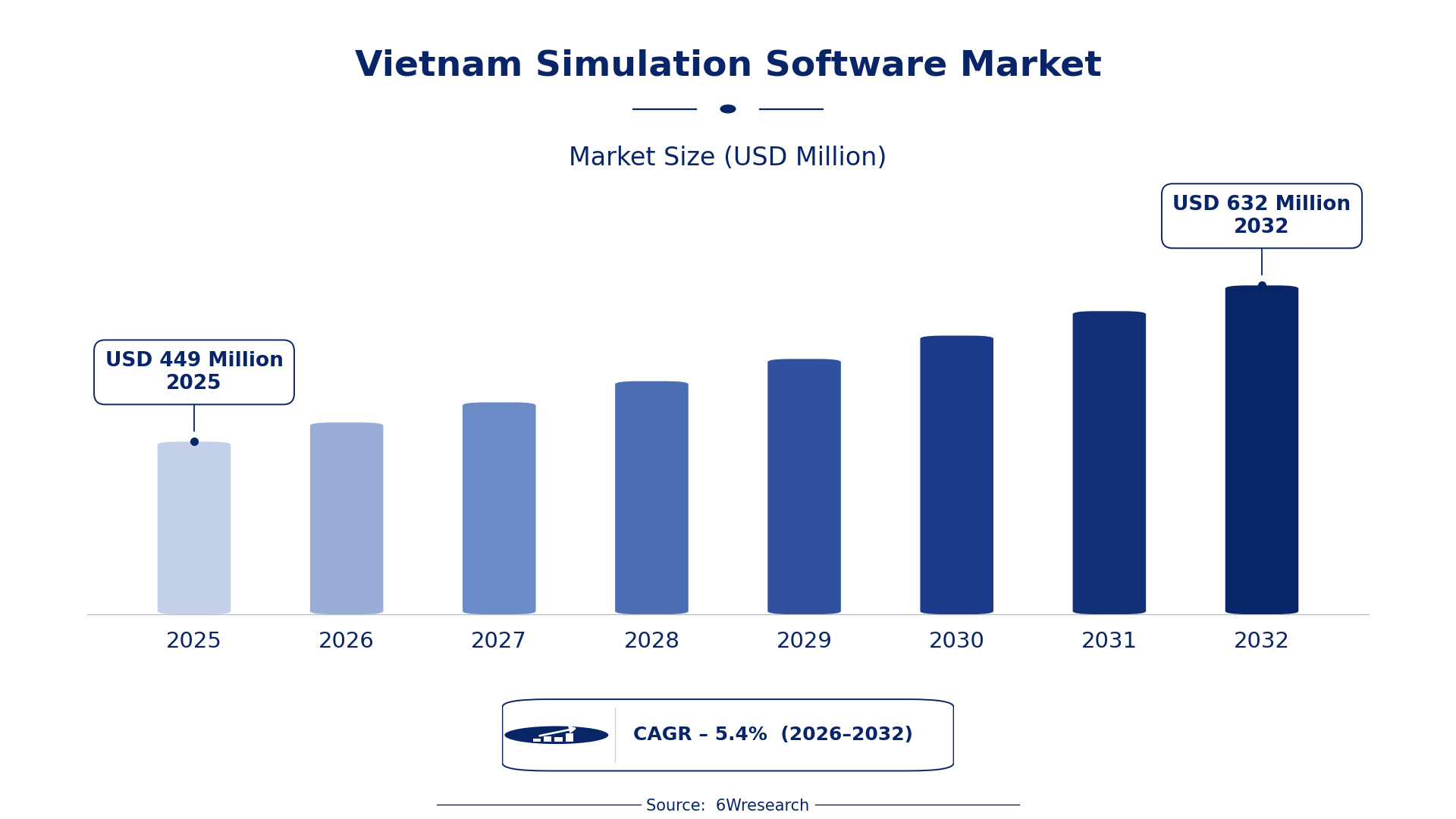
The Vietnam Simulation Software Market was estimated at USD 449 Million in 2025 and is projected to reach USD 632 Million by 2032, growing at a CAGR of 5.4% from 2026 to 2032.
Vietnam Simulation Software Market Synopsis
A strong push for digital transformation is the primary force driving the Vietnam Simulation Software Market. Organizations across sectors are recognizing the need for advanced simulation tools to enhance training and product development, making these solutions indispensable for operational efficiency.
As Vietnam continues to invest in technology and innovation, simulation software is increasingly integrated into various industries, including healthcare and manufacturing. This trend not only reflects a demand for cost-effective solutions but also highlights the need for immersive experiences that mimic real-world challenges.
Vietnam Simulation Software Market Year-wise Growth Rate and Key Drivers
This graph illustrates the annual growth rates of the Vietnam Simulation Software Market from 2021 to 2032, highlighting a steady upward trajectory and projected expansion over the forecast period.
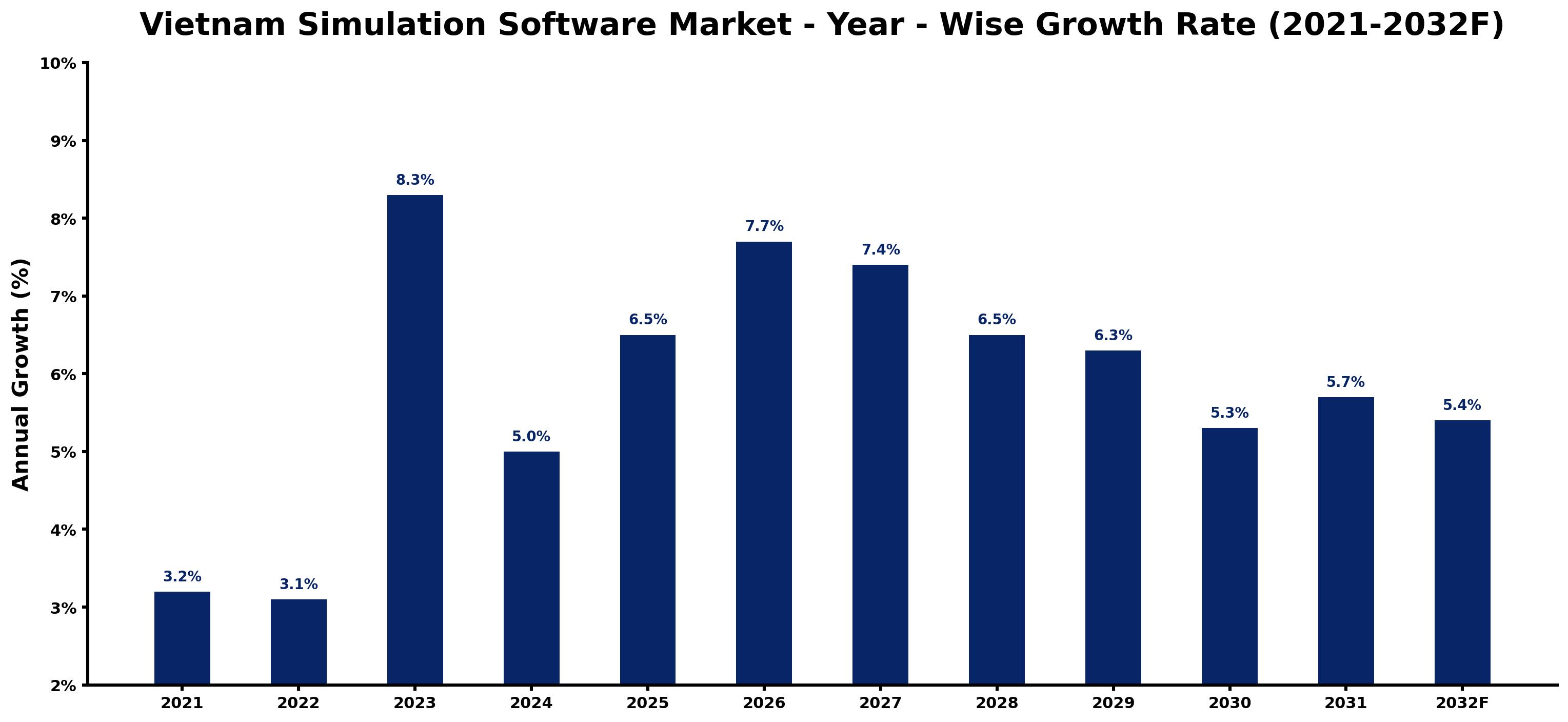
The table below presents the year‑wise growth rates along with the key drivers influencing the market
| Year | Growth Rate | Major Drivers |
| 2021 | 3.2% | Increased adoption of simulation in educational institutions. |
| 2022 | 3.1% | Growing use of simulation for urban planning projects. |
| 2023 | 8.3% | Government incentives for digital twin technology implementation. |
| 2024 | 5.0% | Rising interest in simulating renewable energy systems. |
| 2025 | 6.5% | Collaboration with international firms for advanced simulation tools. |
| 2026 | 7.7% | Expanding online education platforms incorporating simulation software. |
| 2027 | 7.4% | Emergence of local simulation competitions boosting innovation. |
| 2028 | 6.5% | Increased focus on sustainable engineering practices requiring simulations. |
| 2029 | 6.3% | Regulatory emphasis on safety simulations in construction sector. |
| 2030 | 5.3% | Higher education reforms integrating more simulation-based curricula. |
| 2031 | 5.7% | Emerging Vietnamese game industry utilizing simulation technologies. |
| 2032 | 5.4% | Growing interest in simulating healthcare processes for efficiency. |
Note: Market size estimations and growth projections presented in this report are based on 6Wresearch's proprietary forecasting methodology, utilizing the latest available industry data, government publications, and primary research inputs.
Vietnam Simulation Software Market Key Takeaways
Below are some of the specific key takeaways from the market, including:
- The market is experiencing consistent growth, driven by the integration of AR and VR technologies.
- Organizations are prioritizing simulation software for training to minimize costs and risks.
- Government initiatives are focusing on enhancing technological capabilities across industries.
- Healthcare and manufacturing sectors are leading the demand for simulation solutions.
- The COVID-19 pandemic has accelerated the adoption of virtual training methods.
Evaluation of Restraints in Vietnam Simulation Software Market
The Vietnam Simulation Software Market faces challenges that could impede its growth trajectory. One major restraint is the shortage of skilled professionals trained in developing and managing simulation software. This talent gap can hinder the implementation of advanced solutions across sectors. Additionally, the cost associated with developing and deploying simulation software can be a barrier, especially for smaller enterprises. Ensuring the accuracy of simulations is critical, as any discrepancies can lead to misguided decisions. Finally, integrating simulation tools into existing workflows can be complex and time-consuming, which may deter companies from fully committing to these technologies.
Vietnam Simulation Software Market Trends
Several trends are shaping the Vietnam Simulation Software Market. The integration of augmented reality (AR) and virtual reality (VR) is enhancing the realism of simulations, allowing for more effective training scenarios. Companies are increasingly adopting cloud-based solutions, which facilitate access to simulation tools without the need for significant infrastructure investments. on top of that, there is a rising emphasis on data-driven decision-making, with simulation software providing insights that help organizations strategize effectively.
Vietnam Simulation Software Market Opportunities
Opportunities within the Vietnam Simulation Software Market are abundant, particularly in sectors like healthcare and manufacturing. Companies can invest in customized simulation solutions to cater to their specific needs, fostering greater efficiency. As educational institutions recognize the value of simulation for teaching complex subjects, partnerships between tech providers and educational organizations could lead to innovative applications. Additionally, the ongoing push for digital transformation opens avenues for new entrants in the market to offer tailored solutions and capitalize on emerging technologies.
Government Initiatives in the Vietnam Simulation Software Market
Government policies play a crucial role in shaping the Vietnam Simulation Software Market. The Vietnamese government is focusing on technological advancement to bolster economic growth and competitiveness. This focus is translating into various initiatives aimed at enhancing the adoption of simulation technologies across different sectors, ensuring that the market is aligned with national development goals.
- A national digital infrastructure upgrade programme launched in early 2023 aims to support the development of simulation technologies.
- Currently ongoing is a public-private partnership initiative that encourages the integration of simulation software in educational institutions, enhancing training methodologies.
- A planned regulatory framework is expected to be introduced by 2026, mandating standards for simulation software accuracy and reliability.
- In 2024, a government-funded initiative will promote research and development in simulation technology tailored for the manufacturing sector.
- Recent investments in technology parks are aimed at fostering innovation and collaboration among simulation software developers.
Future Insights of the Vietnam Simulation Software Market
Looking ahead to 2026-2032, the Vietnam Simulation Software Market is set to evolve significantly. Increased investment in technology and a growing recognition of the value of immersive training experiences will continue to drive demand. As more industries embrace digital tools, simulation software will become integral to operational strategies. The anticipated advancements in AR and VR will further enhance the capabilities of simulation solutions, enabling organizations to address complex challenges with greater efficiency. Companies that invest in innovation and training will likely emerge as leaders in this burgeoning market.
Vietnam Simulation Software Market Latest Developments
Recent activity in the Vietnam Simulation Software Market indicates a strong trajectory towards innovation and collaboration. In the past year, organizations have increasingly recognized the importance of simulation software for training and decision-making processes.
- A leading technology vendor launched a new simulation software platform in Q2 2023, aimed at enhancing training capabilities in the healthcare sector.
- In early 2024, a partnership between an educational institution and a simulation software provider was established to develop a specialized training program for engineering students.
- Ongoing upgrades to existing simulation tools are enhancing user experience and functionality, with a major release expected by mid-2025.
- A pilot project integrating simulation software into manufacturing processes began in late 2023 and is currently underway.
- Upcoming initiatives are planned for 2026 to develop simulation solutions tailored for the defense sector, addressing specific operational needs.
Vietnam Simulation Software Market - Key Attractiveness of the Report
- 10 Years of Market Numbers
- Historical Data Starting from 2022 to 2025
- Base Year: 2025
- Forecast Data until 2032
- Key Performance Indicators Impacting the Market
- Major Upcoming Developments and Projects
Key Highlights of the Report:
- Vietnam Simulation Software Market Outlook
- Market Size of Vietnam Simulation Software Market, 2025
- Forecast of Vietnam Simulation Software Market, 2032
- Historical Data and Forecast of Vietnam Simulation Software Revenues & Volume for the Period 2022-2032F
- Vietnam Simulation Software Market Trend Evolution
- Vietnam Simulation Software Market Drivers and Challenges
- Vietnam Simulation Software Price Trends
- Vietnam Simulation Software Porter's Five Forces
- Vietnam Simulation Software Industry Life Cycle
- Historical Data and Forecast of Vietnam Simulation Software Market Revenues & Volume By Component for the Period 2022-2032F
- Historical Data and Forecast of Vietnam Simulation Software Market Revenues & Volume By Software for the Period 2022-2032F
- Historical Data and Forecast of Vietnam Simulation Software Market Revenues & Volume By Professional Services for the Period 2022-2032F
- Historical Data and Forecast of Vietnam Simulation Software Market Revenues & Volume By Deployment for the Period 2022-2032F
- Historical Data and Forecast of Vietnam Simulation Software Market Revenues & Volume By Cloud for the Period 2022-2032F
- Historical Data and Forecast of Vietnam Simulation Software Market Revenues & Volume By On-premises for the Period 2022-2032F
- Historical Data and Forecast of Vietnam Simulation Software Market Revenues & Volume By Application for the Period 2022-2032F
- Historical Data and Forecast of Vietnam Simulation Software Market Revenues & Volume By Product Engineering for the Period 2022-2032F
- Historical Data and Forecast of Vietnam Simulation Software Market Revenues & Volume By Research and Development for the Period 2022-2032F
- Historical Data and Forecast of Vietnam Simulation Software Market Revenues & Volume By Gamification for the Period 2022-2032F
- Historical Data and Forecast of Vietnam Simulation Software Market Revenues & Volume By Vertical Automobile for the Period 2022-2032F
- Historical Data and Forecast of Vietnam Simulation Software Market Revenues & Volume By Automobile for the Period 2022-2032F
- Historical Data and Forecast of Vietnam Simulation Software Market Revenues & Volume By Aerospace and Defense for the Period 2022-2032F
- Historical Data and Forecast of Vietnam Simulation Software Market Revenues & Volume By Electrical and Electronics for the Period 2022-2032F
- Historical Data and Forecast of Vietnam Simulation Software Market Revenues & Volume By Healthcare and Pharmaceuticals for the Period 2022-2032F
- Historical Data and Forecast of Vietnam Simulation Software Market Revenues & Volume By Oil and Gas and Mining for the Period 2022-2032F
- Historical Data and Forecast of Vietnam Simulation Software Market Revenues & Volume By Construction for the Period 2022-2032F
- Historical Data and Forecast of Vietnam Simulation Software Market Revenues & Volume By Ship Buildings and Marine for the Period 2022-2032F
- Historical Data and Forecast of Vietnam Simulation Software Market Revenues & Volume By Chemicals for the Period 2022-2032F
- Vietnam Simulation Software Import Export Trade Statistics
- Market Opportunity Assessment By Component
- Market Opportunity Assessment By Deployment
- Market Opportunity Assessment By Application
- Market Opportunity Assessment By Vertical Automobile
- Vietnam Simulation Software Top Companies Market Share
- Vietnam Simulation Software Competitive Benchmarking By Technical and Operational Parameters
- Vietnam Simulation Software Company Profiles
- Vietnam Simulation Software Key Strategic Recommendations






































