Vietnam Toys and Hobby Goods Market Summary
The vietnam toys and hobby goods market was estimated at USD 471 Million in 2025 and is projected to reach USD 663 Million by 2032, growing at a CAGR of 7.9% from 2026 to 2032.
Vietnam Toys and Hobby Goods Market Year-wise Growth Rate and Key Drivers
This graph highlights how the Vietnam Toys and Hobby Goods Market has steadily grown over the past five years, supported by major growth factors.
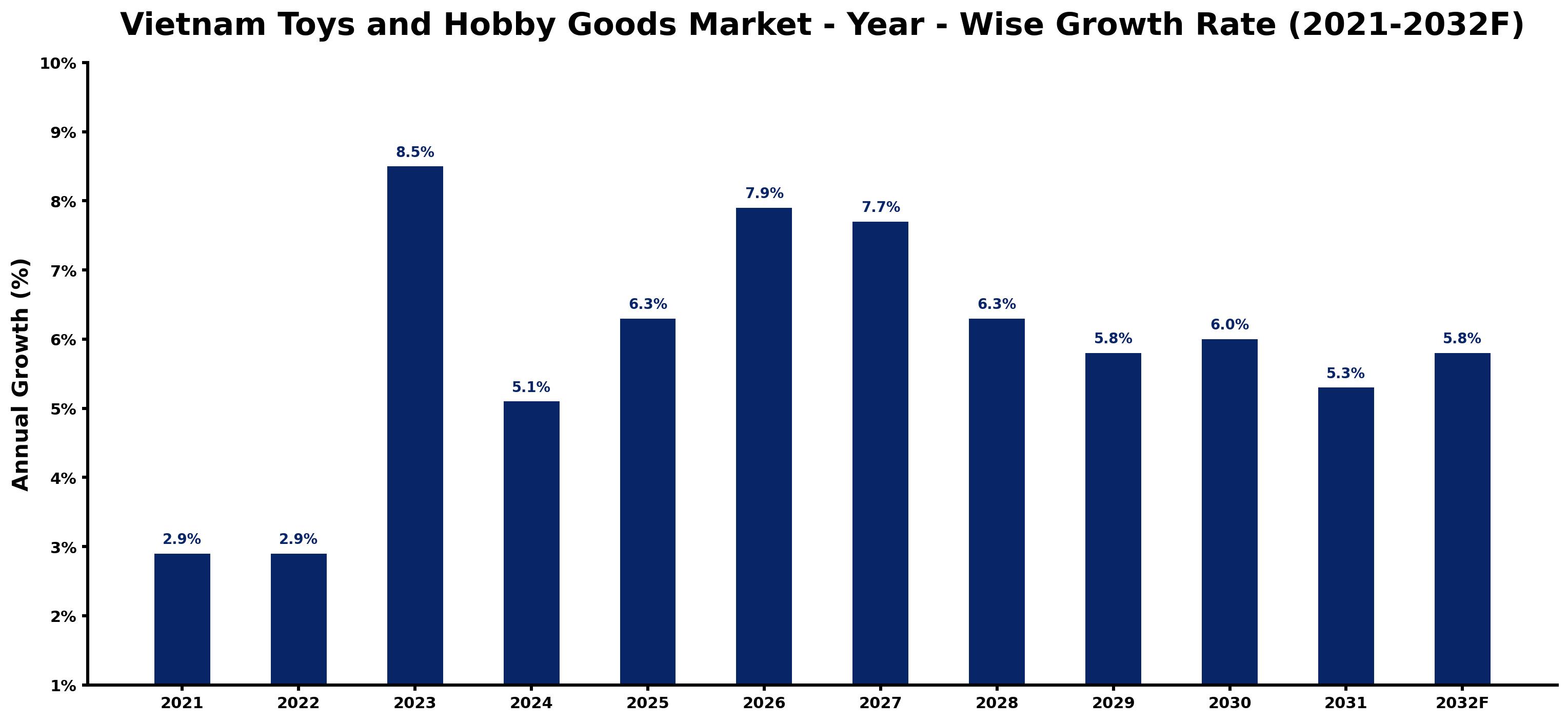
The table below presents the year wise growth rates along with the key drivers influencing the market
| Year | Growth Rate | Major Drivers |
| 2021 | 2.9% | Post-lockdown retail projects sparked renewed interest in family-oriented leisure activities. |
| 2022 | 2.9% | Investments in local manufacturing increased, reducing reliance on imports significantly. |
| 2023 | 8.5% | Online marketplaces flourished as internet penetration reached unprecedented levels across demographics. |
| 2024 | 5.1% | Cultural festivals showcased traditional toys, boosting national pride and collector interest. |
| 2025 | 6.3% | Rising disposable income among urban households enhanced spending on premium hobby goods. |
| 2026 | 7.9% | Collaboration between toy brands and local artists captured interest from younger consumers. |
| 2027 | 7.7% | Sustainability trends encouraged eco-friendly toys, aligning with environmental consciousness growth. |
| 2028 | 6.3% | Technological integration in toys became more mainstream, enhancing interactive play experiences for children. |
| 2029 | 5.8% | The influencer marketing boom played a significant role in shaping consumer preferences. |
| 2030 | 6.0% | Expansion of e-commerce platforms led to increased accessibility for rural consumers seeking products. |
| 2031 | 5.3% | A focus on educational toys emerged, reflecting parents' growing awareness of developmental benefits. |
| 2032 | 5.8% | Rural electrification projects supported broader market reach for toys and hobby goods retailers. |
Note - Market size estimations and growth projections presented in this report are based on 6Wresearch's advanced forecasting approach, validated with industry datasets as of June 2026.
Vietnam Toys and Hobby Goods Market Synopsis
The Vietnam Toys and Hobby Goods Market is projected to reach 7.9% and witness significant growth during the forecast period (2026-2032). This sector encompasses a diverse array of products, including toys, games, puzzles, crafts, collectibles, and hobby-related items designed for children as well as hobby enthusiasts of all ages. The interplay of economic factors and evolving consumer preferences is shaping the landscape of this market, indicating strong potential for expansion.
Vietnam Toys and Hobby Goods Market Growth Drivers
Several key drivers are propelling the growth of the Vietnam Toys and Hobby Goods Market. Firstly, sustained economic growth in Vietnam has resulted in increased disposable income among families, enabling higher spending on toys and hobby goods. This financial empowerment is particularly visible in urban areas, where parents are keen to invest in entertainment and educational products for their children. Additionally, the rapid urbanization trend has created a shift in consumer behavior, leading to a higher demand for engaging activities.
- The rising trend of urbanization in Vietnam contributes to the growing demand for toys and hobby products as families relocate to cities.
- Increased exposure to international media, including movies and television shows, significantly boosts the popularity of licensed toys and branded merchandise.
- Growing interest in hobbies and collectibles among adults has further diversified the market, enhancing sales of various hobby-related goods.
- Educational toys are gaining traction as parents emphasize developmental benefits alongside entertainment value, leading to a shift in purchasing patterns.
- Innovative marketing strategies and online sales channels are expanding the reach of toys and hobby goods, engaging a wider consumer base.
Vietnam Toys and Hobby Goods Market Challenges and Restraints
Despite the positive growth outlook, the Vietnam Toys and Hobby Goods Market faces several challenges that could restrain its momentum. Price sensitivity is a crucial concern, as many consumers prioritize affordability in their purchasing decisions, often opting for low-cost alternatives. Additionally, the prevalence of counterfeit products poses significant risks, undermining consumer trust and potentially affecting the reputation of genuine brands. Adhering to safety and quality regulations remains a challenge for manufacturers, necessitating stringent compliance to ensure product integrity.
- The market's price sensitivity may compel consumers to choose lower-priced options, affecting the sales of premium products.
- The presence of counterfeit toys can lead to safety concerns, as well as diminish brand credibility among consumers.
- Manufacturers face ongoing challenges in ensuring compliance with safety regulations and standards, which are crucial for market entry.
- Supply chain disruptions can unpredictably affect inventory levels and product availability, posing risks to retailers.
- Intense competition among domestic and international brands complicates market positioning and product differentiation.
Vietnam Toys and Hobby Goods Market Government Investment and Initiatives
The Vietnamese government recognizes the significance of the toys and hobby goods industry as a contributor to economic development and job creation. Recent initiatives aim to foster industry growth through enhanced public spending on cultural and recreational activities, supporting both local manufacturers and international investments. Policies encouraging innovation and education in the toy sector are being implemented, with incentives for companies focusing on sustainability and safety compliance. Furthermore, public campaigns promoting traditional and culturally-appropriate toys are being launched, which could impact consumer preferences and market dynamics.
Vietnam Toys and Hobby Goods Market Latest Developments (May 2025 - June 2026)
During the period from May 2025 to June 2026, the Vietnam Toys and Hobby Goods Market has experienced notable developments that reflect broader industry trends. The market has seen a marked rise in demand for educational toys that promote both learning and play, aligning with parental preferences for products that contribute positively to child development. Innovations in product design and technology have led to new offerings that capture the interest of both children and collectors. Additionally, there has been a continued emphasis on online retail platforms, facilitating easier access to diverse toy selections. Challenges related to product pricing and counterfeit goods have remained prevalent, prompting discussions around regulatory safeguards and consumer awareness initiatives.
Vietnam Toys and Hobby Goods Market - Key Attractiveness of the Report
- 10 Years of Market Numbers
- Historical Data Starting from 2022 to 2025
- Base Year: 2025
- Forecast Data until 2032
- Key Performance Indicators Impacting the Market
- Major Upcoming Developments and Projects
Key Highlights of the Report:
- Vietnam Toys and Hobby Goods Market Outlook
- Market Size of Vietnam Toys and Hobby Goods Market, 2025
- Forecast of Vietnam Toys and Hobby Goods Market, 2032
- Historical Data and Forecast of Vietnam Toys and Hobby Goods Revenues & Volume for the Period 2022-2032F
- Vietnam Toys and Hobby Goods Market Trend Evolution
- Vietnam Toys and Hobby Goods Market Drivers and Challenges
- Vietnam Toys and Hobby Goods Price Trends
- Vietnam Toys and Hobby Goods Porter's Five Forces
- Vietnam Toys and Hobby Goods Industry Life Cycle
- Historical Data and Forecast of Vietnam Toys and Hobby Goods Market Revenues & Volume By Type for the Period 2022-2032F
- Historical Data and Forecast of Vietnam Toys and Hobby Goods Market Revenues & Volume By Sports Toys for the Period 2022-2032F
- Historical Data and Forecast of Vietnam Toys and Hobby Goods Market Revenues & Volume By Intellectual Toys for the Period 2022-2032F
- Historical Data and Forecast of Vietnam Toys and Hobby Goods Market Revenues & Volume By Education Toys for the Period 2022-2032F
- Historical Data and Forecast of Vietnam Toys and Hobby Goods Market Revenues & Volume By Decorative Toys for the Period 2022-2032F
- Historical Data and Forecast of Vietnam Toys and Hobby Goods Market Revenues & Volume By Other for the Period 2022-2032F
- Historical Data and Forecast of Vietnam Toys and Hobby Goods Market Revenues & Volume By Application for the Period 2022-2032F
- Historical Data and Forecast of Vietnam Toys and Hobby Goods Market Revenues & Volume By Online Sales for the Period 2022-2032F
- Historical Data and Forecast of Vietnam Toys and Hobby Goods Market Revenues & Volume By Offline Sales for the Period 2022-2032F
- Historical Data and Forecast of Vietnam Toys and Hobby Goods Market Revenues & Volume By Others for the Period 2022-2032F
- Vietnam Toys and Hobby Goods Import Export Trade Statistics
- Market Opportunity Assessment By Type
- Market Opportunity Assessment By Application
- Vietnam Toys and Hobby Goods Top Companies Market Share
- Vietnam Toys and Hobby Goods Competitive Benchmarking By Technical and Operational Parameters
- Vietnam Toys and Hobby Goods Company Profiles
- Vietnam Toys and Hobby Goods Key Strategic Recommendations






































