Vietnam Toys & Games Market Summary
The vietnam toys & games market was estimated at USD 1480 Million in 2025 and is projected to reach USD 2107 Million by 2032, growing at a CAGR of 7.9% from 2026 to 2032.
Vietnam Toys & Games Market Year-wise Growth Rate and Key Drivers
This graph highlights how the Vietnam Toys & Games Market has steadily grown over the past five years, supported by major growth factors.
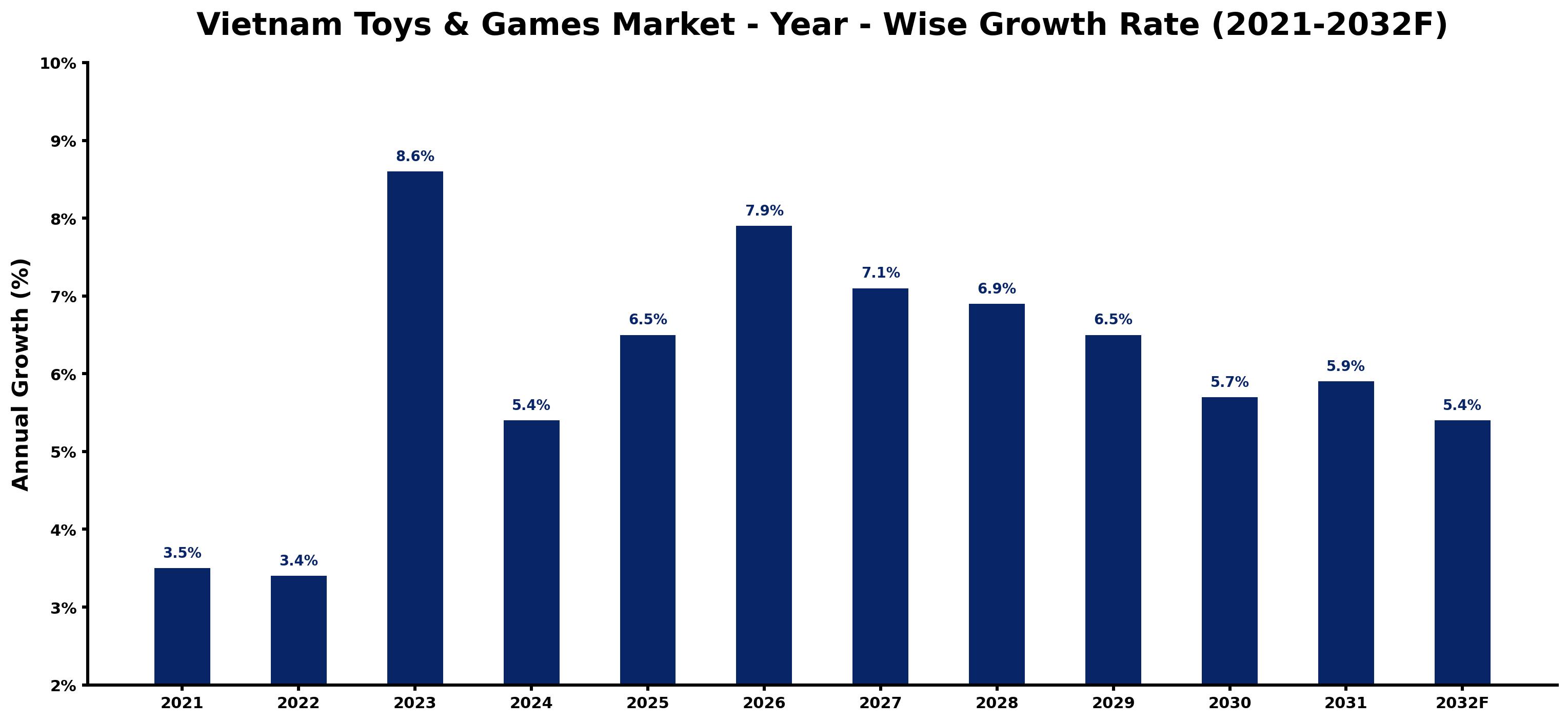
The table below presents the year wise growth rates along with the key drivers influencing the market
| Year | Growth Rate | Major Drivers |
| 2021 | 3.5% | Post-lockdown retail projects adapt to evolving consumer preferences and behaviors. |
| 2022 | 3.4% | Increased local production capabilities shift focus to high-quality, affordable toys. |
| 2023 | 8.6% | Rural electrification enhances accessibility to toys and games across the country. |
| 2024 | 5.4% | Digital gaming popularity influences traditional toy manufacturers to innovate. |
| 2025 | 6.5% | Youth population growth fuels expansive market opportunities and diversifies offerings. |
| 2026 | 7.9% | Urbanization trends create a demand for modern educational and developmental toys. |
| 2027 | 7.1% | E-commerce platforms expand, enabling families to access diverse toy selections easily. |
| 2028 | 6.9% | Sustainability concerns prompt brands to explore eco-friendly toy materials and designs. |
| 2029 | 6.5% | Cultural shifts toward interactive play experiences redefine consumer preferences and standards. |
| 2030 | 5.7% | Partnerships with international toy brands enhance local product visibility and credibility. |
| 2031 | 5.9% | Emergence of augmented reality games offers unique engagement opportunities for children. |
| 2032 | 5.4% | Increased disposable income among families allows for premium toy purchases and experiences. |
Note - Market size estimations and growth projections presented in this report are based on 6Wresearch's advanced forecasting approach, validated with industry datasets as of June 2026.
Vietnam Toys & Games Market Synopsis
The Vietnam Toys Games Market is projected to reach 7.9% and witness significant growth during the forecast period (2026-2032). This market is characterized by a youthful population and a burgeoning middle class, driving the demand for a diverse array of toys and games. As disposable incomes increase, there is a marked willingness among parents and caregivers to invest in educational and recreational toys. The market encompasses traditional Vietnamese toys, licensed merchandise from popular franchises, and educational toys aimed at enhancing learning and skill development. The rapid development of modern retail channels, alongside the surge in e-commerce platform utilization, has further amplified market accessibility and growth.
Vietnam Toys & Games Market Growth Drivers
Several key factors are propelling the growth of the Vietnam Toys & Games Market. First and foremost, the country's youthful demographic plays a crucial role, as the number of children and young families rises steadily. This trend is compounded by the expansion of the middle class, which not only increases purchasing power but also drives a shift toward quality, educational, and recreational toys. Additionally, parents' growing recognition of the importance of play in child development has led to increased demand for toys that foster learning and creativity.
- This growing awareness extends to a wide variety of products, including educational games and STEM toys that promote cognitive skills.
- Furthermore, the integration of technology into toys is becoming increasingly popular, as parents seek interactive and engaging experiences for their children.
- The accessibility of modern retail channels and the rise of e-commerce platforms have made it easier for consumers to obtain diverse toy offerings.
- Innovative product designs and safety standards are also attracting consumers, reinforcing trust and brand loyalty in the market.
- Lastly, parents are looking for toys that can stimulate social interaction among children, further diversifying demand within the market.
Vietnam Toys & Games Market Challenges and Restraints
While the Vietnam Toys & Games Market is poised for growth, several challenges persist that could affect its trajectory. A significant concern is the prevalence of counterfeit and unregulated toys, which pose safety risks. The presence of such products not only undermines consumer confidence but also places children at risk due to poor quality and lack of safety compliance.
- Moreover, the rapid evolution of digital technology presents a dual challenge; traditional toys are facing stiff competition from digital entertainment options, which are becoming more appealing to tech-savvy consumers.
- Further complicating matters is the seasonal nature of toy sales, where demand spikes during holidays and festive seasons, leading to potential inventory management issues for manufacturers.
- Economic fluctuations can also lead families to prioritize essential expenditures over discretionary spending, impacting toy and game sales.
- Finally, manufacturers must continuously adapt to changing consumer preferences to stay relevant in this dynamic market landscape.
Vietnam Toys & Games Market Government Investment and Initiatives
The Vietnamese government has recognized the importance of the Toys & Games Market as a contributor to economic growth and child development. Investment initiatives are geared toward fostering innovation in playthings, emphasizing safety standards and educational value. Government policies aim to promote local manufacturing, thereby reducing dependency on imports and boosting the economy. Public spending is directed toward improving education and child welfare, indirectly supporting demand for educational toys and games. Additionally, initiatives that encourage foreign investment in the local toy industry are aimed at elevating the market's global competitiveness.
Vietnam Toys & Games Market Latest Developments (May 2025 - June 2026)
Recent developments in the Vietnam Toys & Games Market indicate a continued focus on innovation and market adaptation. Over this period, there has been a noticeable increase in the introduction of interactive and tech-integrated toys, reflecting a shift in consumer preferences toward products that offer immersive experiences. Additionally, the impacts of the COVID-19 pandemic have prompted a resurgence in board games and traditional toys, as families seek engaging home-based entertainment options.
- Manufacturers are increasingly investing in sustainable practices to meet consumer demand for environmentally friendly products.
- The rise of online shopping continues to transform the retail landscape, with many companies enhancing their digital presence to reach consumers more effectively.
- Partnerships with educational institutions are becoming more common, as brands seek to develop toys that align with educational curricula and developmental milestones.
- Moreover, the government has introduced new regulations aimed at improving product safety and protecting consumers, bolstering the integrity of the market.
- Finally, as the economy stabilizes, manufacturers are responding to challenges with proactive pricing strategies to maintain consumer interest in a competitive market.
Vietnam Toys & Games Market - Key Attractiveness of the Report
- 10 Years of Market Numbers
- Historical Data Starting from 2022 to 2025
- Base Year: 2025
- Forecast Data until 2032
- Key Performance Indicators Impacting the Market
- Major Upcoming Developments and Projects
Key Highlights of the Report:
- Vietnam Toys & Games Market Outlook
- Market Size of Vietnam Toys & Games Market, 2025
- Forecast of Vietnam Toys & Games Market, 2032
- Historical Data and Forecast of Vietnam Toys & Games Revenues & Volume for the Period 2022-2032F
- Vietnam Toys & Games Market Trend Evolution
- Vietnam Toys & Games Market Drivers and Challenges
- Vietnam Toys & Games Price Trends
- Vietnam Toys & Games Porter's Five Forces
- Vietnam Toys & Games Industry Life Cycle
- Historical Data and Forecast of Vietnam Toys & Games Market Revenues & Volume By Product Type for the Period 2022-2032F
- Historical Data and Forecast of Vietnam Toys & Games Market Revenues & Volume By Puzzles for the Period 2022-2032F
- Historical Data and Forecast of Vietnam Toys & Games Market Revenues & Volume By Preschool Toys for the Period 2022-2032F
- Historical Data and Forecast of Vietnam Toys & Games Market Revenues & Volume By Outdoor/Sports for the Period 2022-2032F
- Historical Data and Forecast of Vietnam Toys & Games Market Revenues & Volume By Dolls for the Period 2022-2032F
- Historical Data and Forecast of Vietnam Toys & Games Market Revenues & Volume By Video Games for the Period 2022-2032F
- Historical Data and Forecast of Vietnam Toys & Games Market Revenues & Volume By Others for the Period 2022-2032F
- Historical Data and Forecast of Vietnam Toys & Games Market Revenues & Volume By Applications for the Period 2022-2032F
- Historical Data and Forecast of Vietnam Toys & Games Market Revenues & Volume By 0 - 8 Years for the Period 2022-2032F
- Historical Data and Forecast of Vietnam Toys & Games Market Revenues & Volume By 8 - 15 Years for the Period 2022-2032F
- Historical Data and Forecast of Vietnam Toys & Games Market Revenues & Volume By 15 Years & Above for the Period 2022-2032F
- Historical Data and Forecast of Vietnam Toys & Games Market Revenues & Volume By Distribution Channel for the Period 2022-2032F
- Historical Data and Forecast of Vietnam Toys & Games Market Revenues & Volume By Offline for the Period 2022-2032F
- Historical Data and Forecast of Vietnam Toys & Games Market Revenues & Volume By Online for the Period 2022-2032F
- Vietnam Toys & Games Import Export Trade Statistics
- Market Opportunity Assessment By Product Type
- Market Opportunity Assessment By Applications
- Market Opportunity Assessment By Distribution Channel
- Vietnam Toys & Games Top Companies Market Share
- Vietnam Toys & Games Competitive Benchmarking By Technical and Operational Parameters
- Vietnam Toys & Games Company Profiles
- Vietnam Toys & Games Key Strategic Recommendations






































