Vietnam Tripod Jack For Civil Aircraft Market Size, Share & Growth Rate
The Vietnam Tripod Jack For Civil Aircraft Market was estimated at USD 1129 Million in 2025 and is projected to reach USD 1834 Million by 2032, growing at a CAGR of 7.2% from 2026 to 2032. This robust growth trajectory is primarily driven by the aviation sector's increasing demand for reliable and efficient ground support equipment, essential for enhancing maintenance procedures. As safety and operational efficiency become paramount, the requirement for advanced tripod jacks, tailored for various aircraft sizes, continues to rise.
Vietnam Tripod Jack For Civil Aircraft Market Year-wise Growth Rate and Key Drivers
This graph highlights how the Vietnam Tripod Jack For Civil Aircraft Market has steadily grown over the years, supported by major growth factors.
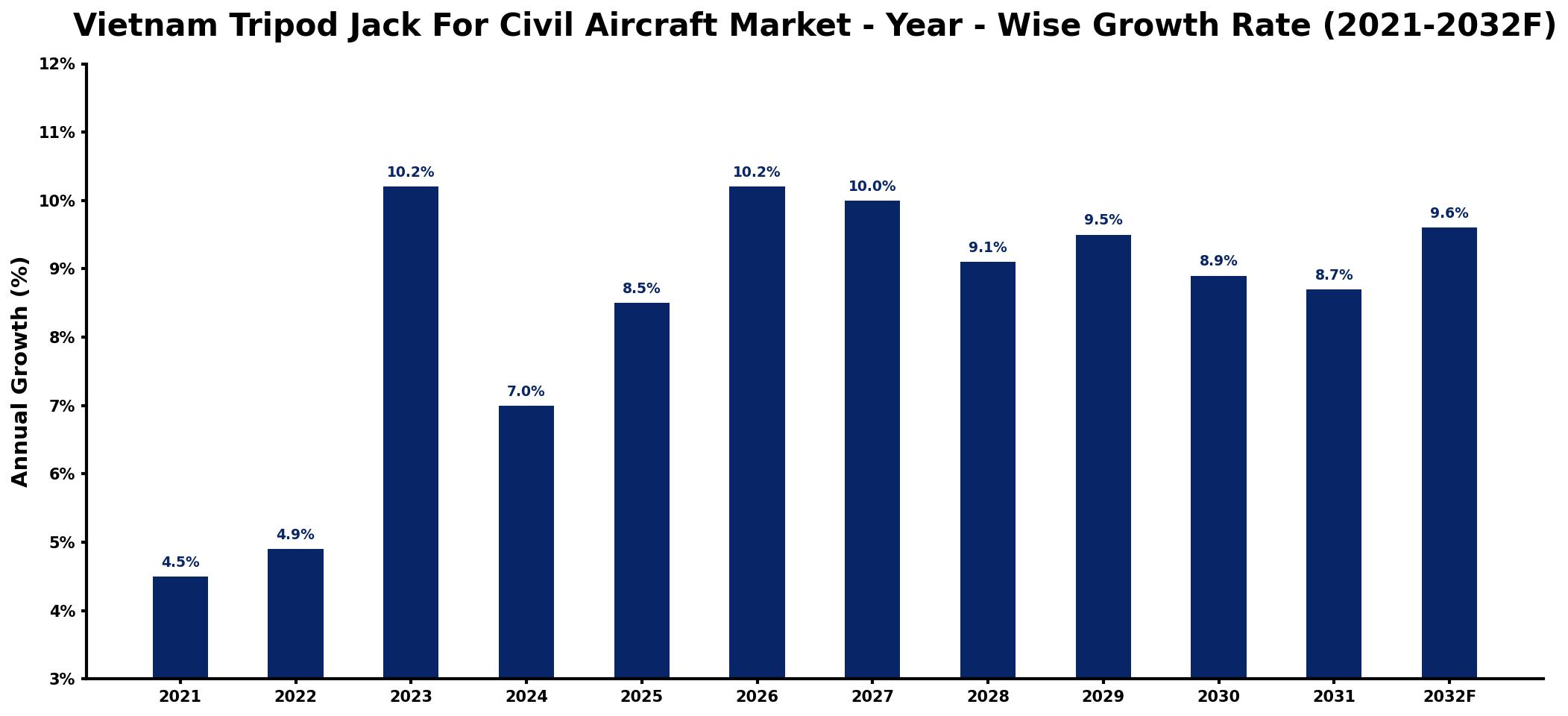
The table below presents the year‑wise growth rates along with the key drivers influencing the market
| Year | Growth Rate | Major Drivers |
| 2021 | 4.5% | Rising demand for aviation services |
| 2022 | 4.9% | Increased investment in infrastructure |
| 2023 | 10.2% | Expansion of regional airline networks |
| 2024 | 7.0% | Growth in domestic travel demand |
| 2025 | 8.5% | Technological advancements in maintenance |
| 2026 | 10.2% | Higher safety regulations compliance |
| 2027 | 10.0% | Emergence of new market players |
| 2028 | 9.1% | Strengthened supply chain partnerships |
| 2029 | 9.5% | Surge in tourism activities |
| 2030 | 8.9% | Enhanced training programs for personnel |
| 2031 | 8.7% | Focus on environmental sustainability initiatives |
| 2032 | 9.6% | Development of next-generation technologies |
Note: Market size estimations and growth projections presented in this report are based on 6Wresearch's proprietary forecasting methodology, utilizing the latest available industry data, government publications, and primary research inputs.
Vietnam Tripod Jack For Civil Aircraft Market Synopsis
The Vietnam tripod jack for civil aircraft market has recently gained momentum as the aviation sector rebounds from the impacts of the COVID-19 pandemic. With an anticipated increase in air traffic and the expansion of maintenance facilities, the market is poised for substantial growth. This uptrend reflects a broader shift towards prioritizing safety and compliance with rigorous aviation standards, leading to innovation and enhanced designs in tripod jacks.
Looking ahead, the market is expected to sustain its growth, driven by ongoing innovations in hydraulic systems and enhanced safety features. Manufacturers are responding to the evolving demands of maintenance professionals by developing tripod jacks that not only offer superior stability but also align with the latest aviation regulations. This focus on quality and performance will solidify the markets position as a critical component in aircraft maintenance.
Vietnam Tripod Jack For Civil Aircraft Market Key Takeaways
- The market is projected to reach USD 1834 Million by 2032, reflecting a robust CAGR of 7.2% from 2026.
- Increasing demand for safety and efficiency in aircraft maintenance is driving market growth.
- Innovation in tripod jack design and compliance with aviation regulations are key market influences.
- COVID-19 has led to strategic pivots by manufacturers, focusing on equipment maintenance and upgrades.
- Market players must navigate production costs while ensuring quality and reliability in their offerings.
Evaluation of Restraints in Vietnam Tripod Jack For Civil Aircraft Market
The Vietnam tripod jack for civil aircraft market faces significant challenges related to the stringent requirements of aviation safety standards. Ensuring that the jacks meet high safety and load-bearing specifications is crucial, yet it demands considerable investment in quality assurance processes. Additionally, fluctuating production costs can pose a dilemma, as manufacturers strive to balance affordability with uncompromising quality. Staying attuned to rapid technological advancements in aircraft maintenance further complicates the landscape, as market players must continuously adapt to remain competitive.
Vietnam Tripod Jack For Civil Aircraft Market Trends
Currently, one of the most notable trends in the Vietnam tripod jack for civil aircraft market is the growing emphasis on ergonomic designs that enhance usability and safety for maintenance personnel. Additionally, advancements in hydraulic technology are making jacks more versatile, allowing them to accommodate a wider range of aircraft models. Sustainability also emerges as a significant trend, with manufacturers exploring eco-friendly materials and practices in their production processes, aligning with global moves towards environmental responsibility.
Vietnam Tripod Jack For Civil Aircraft Market Opportunities
As Vietnam's aviation sector continues to grow, numerous opportunities arise within the tripod jack market. The expansion of regional airports and increased air traffic opens up prospects for maintenance facilities to invest in advanced ground support equipment. Furthermore, partnerships with international aviation companies can enhance technology transfer and innovation in tripod jack designs. These evolving dynamics present a ripe environment for investment and growth, particularly for businesses willing to innovate and adapt to the changing landscape.
Government Initiatives in the Vietnam Tripod Jack For Civil Aircraft Market
The Vietnamese government has been actively investing in the aviation sector, promoting modernization and safety compliance in line with international standards. Public spending is directed toward infrastructure improvements and the expansion of maintenance facilities, creating an encouraging environment for the tripod jack market. Additionally, government programs aimed at enhancing workforce training and skill development in aviation maintenance serve to further bolster the sector's growth potential.
Future Insights of the Vietnam Tripod Jack For Civil Aircraft Market
Looking forward to the 2026-2032 period, the Vietnam tripod jack for civil aircraft market is set to experience transformative growth driven by technological advancements and an increasing focus on safety. The sector is expected to benefit from the ongoing recovery of air travel, with rising aircraft maintenance needs translating into heightened demand for reliable jacks. As manufacturers innovate and enhance their offerings, the market will not only expand in size but also in quality, positioning itself as a cornerstone of aviation safety and operational efficiency.
Vietnam Tripod Jack For Civil Aircraft Market Latest Developments (2025 - 2026)
Recent developments in the Vietnam tripod jack for civil aircraft market have highlighted an increased focus on advanced hydraulic systems that enhance the safety and efficiency of maintenance operations. Companies are actively exploring collaborations with aviation maintenance organizations to ensure their products meet the latest regulatory requirements. Additionally, there has been a noticeable shift towards leveraging technology to improve the design and functionality of tripod jacks, reflecting broader industry trends toward modernization and innovation.
Vietnam Tripod Jack For Civil Aircraft Market - Key Attractiveness of the Report
- 10 Years of Market Numbers
- Historical Data Starting from 2022 to 2025
- Base Year: 2025
- Forecast Data until 2032
- Key Performance Indicators Impacting the Market
- Major Upcoming Developments and Projects
Key Highlights of the Report:
- Vietnam Tripod Jack For Civil Aircraft Market Outlook
- Market Size of Vietnam Tripod Jack For Civil Aircraft Market, 2025
- Forecast of Vietnam Tripod Jack For Civil Aircraft Market, 2032
- Historical Data and Forecast of Vietnam Tripod Jack For Civil Aircraft Revenues & Volume for the Period 2022-2032F
- Vietnam Tripod Jack For Civil Aircraft Market Trend Evolution
- Vietnam Tripod Jack For Civil Aircraft Market Drivers and Challenges
- Vietnam Tripod Jack For Civil Aircraft Price Trends
- Vietnam Tripod Jack For Civil Aircraft Porter's Five Forces
- Vietnam Tripod Jack For Civil Aircraft Industry Life Cycle
- Historical Data and Forecast of Vietnam Tripod Jack For Civil Aircraft Market Revenues & Volume By Product for the Period 2022-2032F
- Historical Data and Forecast of Vietnam Tripod Jack For Civil Aircraft Market Revenues & Volume By Single Stage for the Period 2022-2032F
- Historical Data and Forecast of Vietnam Tripod Jack For Civil Aircraft Market Revenues & Volume By Multi Stage for the Period 2022-2032F
- Historical Data and Forecast of Vietnam Tripod Jack For Civil Aircraft Market Revenues & Volume By Application for the Period 2022-2032F
- Historical Data and Forecast of Vietnam Tripod Jack For Civil Aircraft Market Revenues & Volume By Jetliners for the Period 2022-2032F
- Historical Data and Forecast of Vietnam Tripod Jack For Civil Aircraft Market Revenues & Volume By Business Jet for the Period 2022-2032F
- Historical Data and Forecast of Vietnam Tripod Jack For Civil Aircraft Market Revenues & Volume By Regional Aircraft for the Period 2022-2032F
- Historical Data and Forecast of Vietnam Tripod Jack For Civil Aircraft Market Revenues & Volume By Commericial Jetliner for the Period 2022-2032F
- Vietnam Tripod Jack For Civil Aircraft Import Export Trade Statistics
- Market Opportunity Assessment By Product
- Market Opportunity Assessment By Application
- Vietnam Tripod Jack For Civil Aircraft Top Companies Market Share
- Vietnam Tripod Jack For Civil Aircraft Competitive Benchmarking By Technical and Operational Parameters
- Vietnam Tripod Jack For Civil Aircraft Company Profiles
- Vietnam Tripod Jack For Civil Aircraft Key Strategic Recommendations






































