Vietnam Warm Air Heating Equipment Market Size, Share & Growth Rate
The Vietnam Warm Air Heating Equipment Market was estimated at USD 696 Million in 2025 and is projected to reach USD 1133 Million by 2032, growing at a CAGR of 7.2% from 2026 to 2032. This growth trajectory is underpinned by the increasing demand for energy-efficient heating solutions across residential, commercial, and industrial sectors. As the nation continues to urbanize and modernize its infrastructure, the need for reliable warm air heating systems has become more pronounced, particularly in the context of the growing focus on indoor climate comfort.
Vietnam Warm Air Heating Equipment Market Year-wise Growth Rate and Key Drivers
This graph highlights how the Vietnam Warm Air Heating Equipment Market has steadily grown over the years, supported by major growth factors.
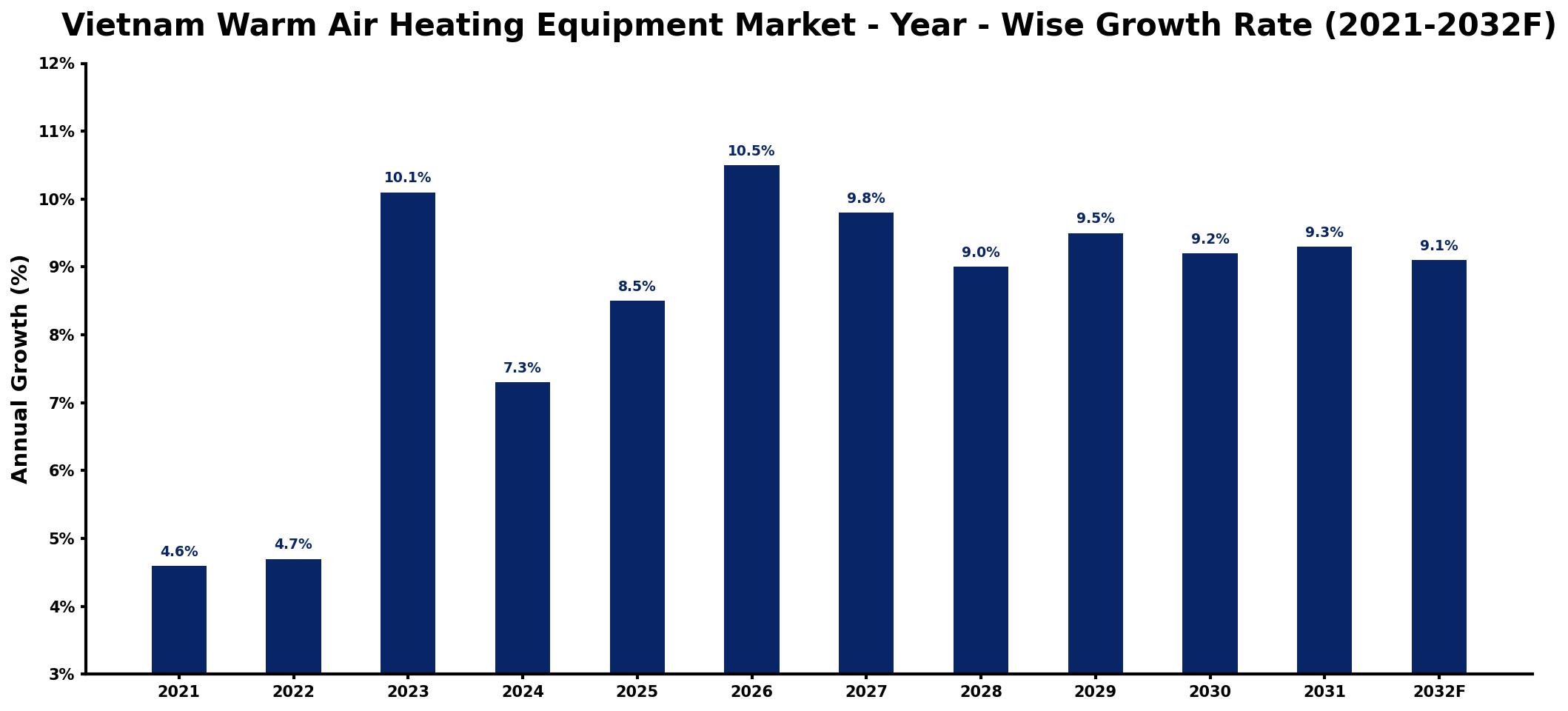
The table below presents the year‑wise growth rates along with the key drivers influencing the market
| Year | Growth Rate | Major Drivers |
| 2021 | 4.6% | Rising consumer energy efficiency awareness |
| 2022 | 4.7% | Growth in residential construction projects |
| 2023 | 10.1% | Expansion of renewable energy initiatives |
| 2024 | 7.3% | Increased industrial automation investments |
| 2025 | 8.5% | Surge in government infrastructure spending |
| 2026 | 10.5% | increased capital investment inflows |
| 2027 | 9.8% | Rising demand for sustainable solutions |
| 2028 | 9.0% | Increasing urbanization and population density |
| 2029 | 9.5% | Strengthening of environmental regulations |
| 2030 | 9.2% | strengthening underlying market demand |
| 2031 | 9.3% | Rising disposable income and spending |
| 2032 | 9.1% | Development of energy-efficient standards |
Note: Market size estimations and growth projections presented in this report are based on 6Wresearch's proprietary forecasting methodology, utilizing the latest available industry data, government publications, and primary research inputs.
Vietnam Warm Air Heating Equipment Market Synopsis
The Vietnam warm air heating equipment market is rapidly evolving, driven by a surge in construction activity and heightened consumer awareness regarding energy efficiency. This landscape is marked by a transition towards advanced heating technologies that not only enhance comfort but also minimize environmental impact.
In both urban and rural settings, warm air heating systems are becoming a preferred choice due to their capacity for quick heat distribution and energy savings. As households and businesses seek solutions that offer consistent heating without excessive energy costs, the market is poised for substantial growth.
Vietnam Warm Air Heating Equipment Market Key Takeaways
- Increasing urbanization and infrastructure development are major growth drivers for the market.
- The demand for energy-efficient heating systems is significantly shaping market offerings.
- Technological advancements are enhancing the performance and reliability of heating solutions.
- Consumer focus on indoor comfort is fostering innovative heating designs and products.
- Recovery from COVID-19 is gradually boosting the market's growth potential.
Evaluation of Restraints in Vietnam Warm Air Heating Equipment Market
While the Vietnam warm air heating equipment market showcases robust growth potential, it faces certain restraints that could hinder its progress. One notable constraint is the balancing act between delivering high-quality, energy-efficient products and managing production costs. As energy standards evolve, manufacturers are challenged to innovate while adhering to these regulations, which may result in increased operational expenses. Additionally, the fluctuating availability of key components can impact the timely delivery of systems and the overall consumer experience.
Vietnam Warm Air Heating Equipment Market Trends
Emerging trends in the Vietnam warm air heating equipment market highlight a shift towards smart heating solutions. Home automation is becoming increasingly popular, leading to the integration of heating systems with smart home technologies. This shift not only enhances user convenience but also optimizes energy consumption. Moreover, a growing emphasis on sustainability is driving manufacturers to focus on eco-friendly materials and production processes.
Vietnam Warm Air Heating Equipment Market Opportunities
The landscape of opportunities in the Vietnam warm air heating equipment market is promising. With government initiatives focusing on green building standards, there's a significant opportunity for companies to develop and market energy-efficient heating systems. Additionally, the growing popularity of renovation projects presents an avenue for upgrading existing heating infrastructures to modern, efficient alternatives. Furthermore, as consumers become more environmentally conscious, products that meet eco-friendly criteria are expected to see heightened demand.
Government Initiatives in the Vietnam Warm Air Heating Equipment Market
The Vietnamese government is actively promoting energy efficiency and sustainable development, which has positive implications for the warm air heating equipment market. Policies aimed at reducing energy consumption and carbon emissions are in place, coupled with funding for public infrastructure projects that integrate advanced heating solutions. Incentives for green technologies further support manufacturers and consumers alike, creating a conducive environment for market growth.
Future Insights of the Vietnam Warm Air Heating Equipment Market
Looking ahead to the period between 2026 and 2032, the Vietnam warm air heating equipment market is expected to continue its upward trajectory. With ongoing advancements in technology and a growing emphasis on energy-efficient solutions, the market is likely to see increased investments from both domestic and foreign players. Additionally, a shift in consumer behavior towards prioritizing indoor air quality and comfort will further drive demand. As Vietnam advances towards a more robust economy, the market is positioned for sustained growth and innovation.
Vietnam Warm Air Heating Equipment Market Latest Developments (2025 - 2026)
Recent developments in the Vietnam warm air heating equipment market indicate a trend towards more integrated heating solutions that align with smart home technologies. Manufacturers are increasingly focusing on enhancing product features to improve energy efficiency and user experience. Additionally, the post-pandemic recovery phase has catalyzed a renewed investment in residential and commercial infrastructure, contributing positively to market dynamics.
Vietnam Warm Air Heating Equipment Market - Key Attractiveness of the Report
- 10 Years of Market Numbers
- Historical Data Starting from 2022 to 2025
- Base Year: 2025
- Forecast Data until 2032
- Key Performance Indicators Impacting the Market
- Major Upcoming Developments and Projects
Key Highlights of the Report:
- Vietnam Warm Air Heating Equipment Market Outlook
- Market Size of Vietnam Warm Air Heating Equipment Market, 2025
- Forecast of Vietnam Warm Air Heating Equipment Market, 2032
- Historical Data and Forecast of Vietnam Warm Air Heating Equipment Revenues & Volume for the Period 2022-2032F
- Vietnam Warm Air Heating Equipment Market Trend Evolution
- Vietnam Warm Air Heating Equipment Market Drivers and Challenges
- Vietnam Warm Air Heating Equipment Price Trends
- Vietnam Warm Air Heating Equipment Porter's Five Forces
- Vietnam Warm Air Heating Equipment Industry Life Cycle
- Historical Data and Forecast of Vietnam Warm Air Heating Equipment Market Revenues & Volume By Product Type for the Period 2022-2032F
- Historical Data and Forecast of Vietnam Warm Air Heating Equipment Market Revenues & Volume By Heat Pumps for the Period 2022-2032F
- Historical Data and Forecast of Vietnam Warm Air Heating Equipment Market Revenues & Volume By Humidifying Equipment for the Period 2022-2032F
- Historical Data and Forecast of Vietnam Warm Air Heating Equipment Market Revenues & Volume By Fuel Type for the Period 2022-2032F
- Historical Data and Forecast of Vietnam Warm Air Heating Equipment Market Revenues & Volume By Electric Powered for the Period 2022-2032F
- Historical Data and Forecast of Vietnam Warm Air Heating Equipment Market Revenues & Volume By Gas-Powered for the Period 2022-2032F
- Historical Data and Forecast of Vietnam Warm Air Heating Equipment Market Revenues & Volume By Hybrid for the Period 2022-2032F
- Historical Data and Forecast of Vietnam Warm Air Heating Equipment Market Revenues & Volume By Solar Powered for the Period 2022-2032F
- Historical Data and Forecast of Vietnam Warm Air Heating Equipment Market Revenues & Volume By Application for the Period 2022-2032F
- Historical Data and Forecast of Vietnam Warm Air Heating Equipment Market Revenues & Volume By Air to Air for the Period 2022-2032F
- Historical Data and Forecast of Vietnam Warm Air Heating Equipment Market Revenues & Volume By Air to Water for the Period 2022-2032F
- Historical Data and Forecast of Vietnam Warm Air Heating Equipment Market Revenues & Volume By Implementation for the Period 2022-2032F
- Historical Data and Forecast of Vietnam Warm Air Heating Equipment Market Revenues & Volume By New Construction for the Period 2022-2032F
- Historical Data and Forecast of Vietnam Warm Air Heating Equipment Market Revenues & Volume By Maintenance for the Period 2022-2032F
- Historical Data and Forecast of Vietnam Warm Air Heating Equipment Market Revenues & Volume By End User Industry for the Period 2022-2032F
- Historical Data and Forecast of Vietnam Warm Air Heating Equipment Market Revenues & Volume By Residential for the Period 2022-2032F
- Historical Data and Forecast of Vietnam Warm Air Heating Equipment Market Revenues & Volume By Commercial for the Period 2022-2032F
- Historical Data and Forecast of Vietnam Warm Air Heating Equipment Market Revenues & Volume By Industrial for the Period 2022-2032F
- Historical Data and Forecast of Vietnam Warm Air Heating Equipment Market Revenues & Volume By Business Type for the Period 2022-2032F
- Historical Data and Forecast of Vietnam Warm Air Heating Equipment Market Revenues & Volume By Original Equipment Manufacturer (OEM) for the Period 2022-2032F
- Historical Data and Forecast of Vietnam Warm Air Heating Equipment Market Revenues & Volume By Aftermarket for the Period 2022-2032F
- Vietnam Warm Air Heating Equipment Import Export Trade Statistics
- Market Opportunity Assessment By Product Type
- Market Opportunity Assessment By Fuel Type
- Market Opportunity Assessment By Application
- Market Opportunity Assessment By Implementation
- Market Opportunity Assessment By End User Industry
- Market Opportunity Assessment By Business Type
- Vietnam Warm Air Heating Equipment Top Companies Market Share
- Vietnam Warm Air Heating Equipment Competitive Benchmarking By Technical and Operational Parameters
- Vietnam Warm Air Heating Equipment Company Profiles
- Vietnam Warm Air Heating Equipment Key Strategic Recommendations






































