Vietnam Web Application Firewall Market Size & Growth Rate (2026-2032)
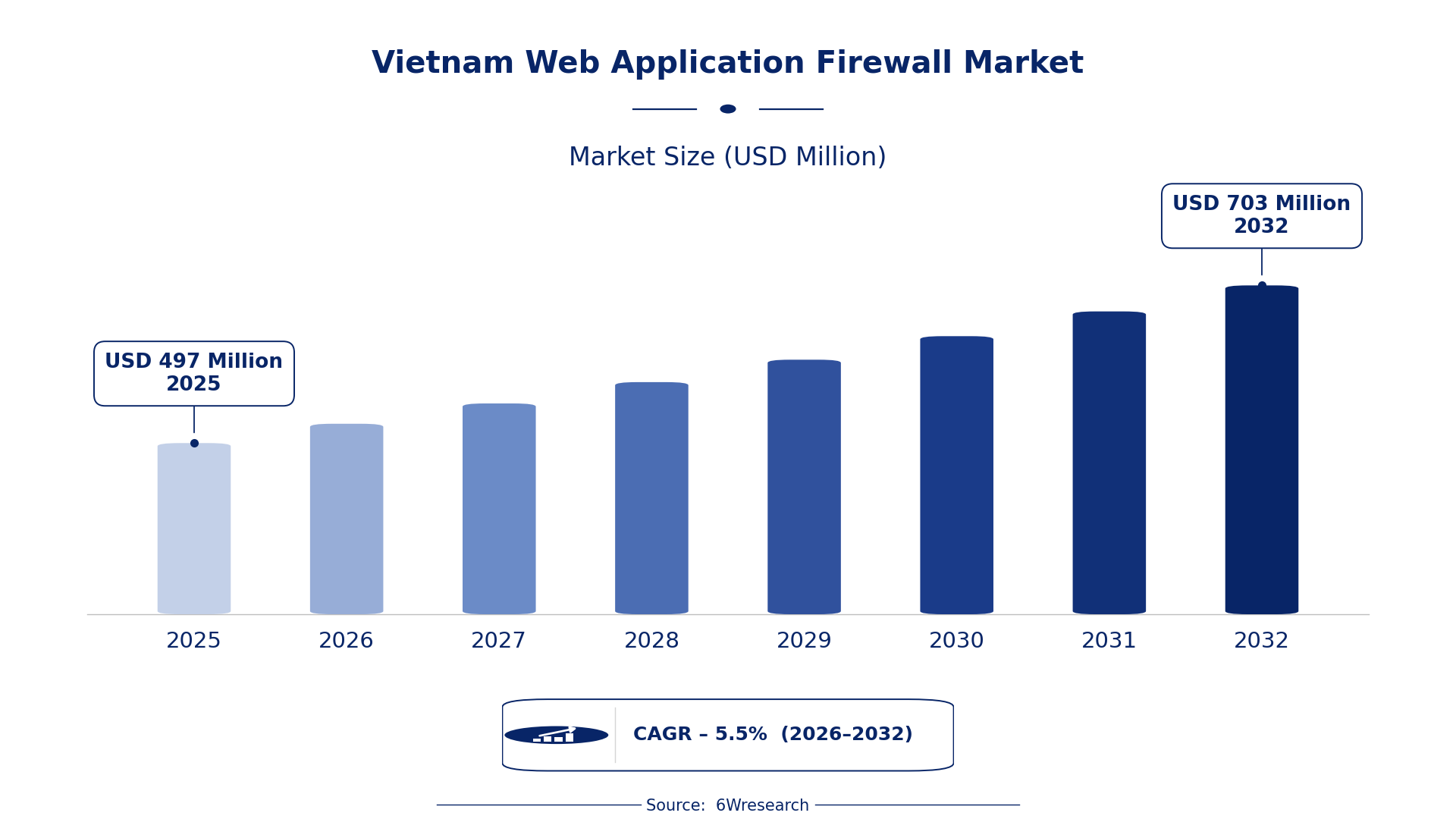
The Vietnam Web Application Firewall Market was estimated at USD 497 Million in 2025 and is projected to reach USD 703 Million by 2032, growing at a CAGR of 5.5% from 2026 to 2032.
Vietnam Web Application Firewall Market Synopsis
The demand for web application firewalls (WAFs) in Vietnam is surging as businesses grapple with an increase in cyber threats targeting their digital infrastructure. As companies pivot towards online platforms for their operations, securing these applications has become non-negotiable, forcing organizations to invest significantly in WAF solutions.
The market exhibits a growing trend towards the integration of real-time threat detection and mitigation capabilities. Organizations across various sectors are prioritizing WAF solutions not just for compliance, but as a vital component of their cybersecurity strategy in a climate where digital assets are increasingly under attack.
Vietnam Web Application Firewall Market Year-wise Growth Rate and Key Drivers
This graph illustrates the annual growth rates of the Vietnam Web Application Firewall Market from 2021 to 2032, highlighting a steady upward trajectory and projected expansion over the forecast period.
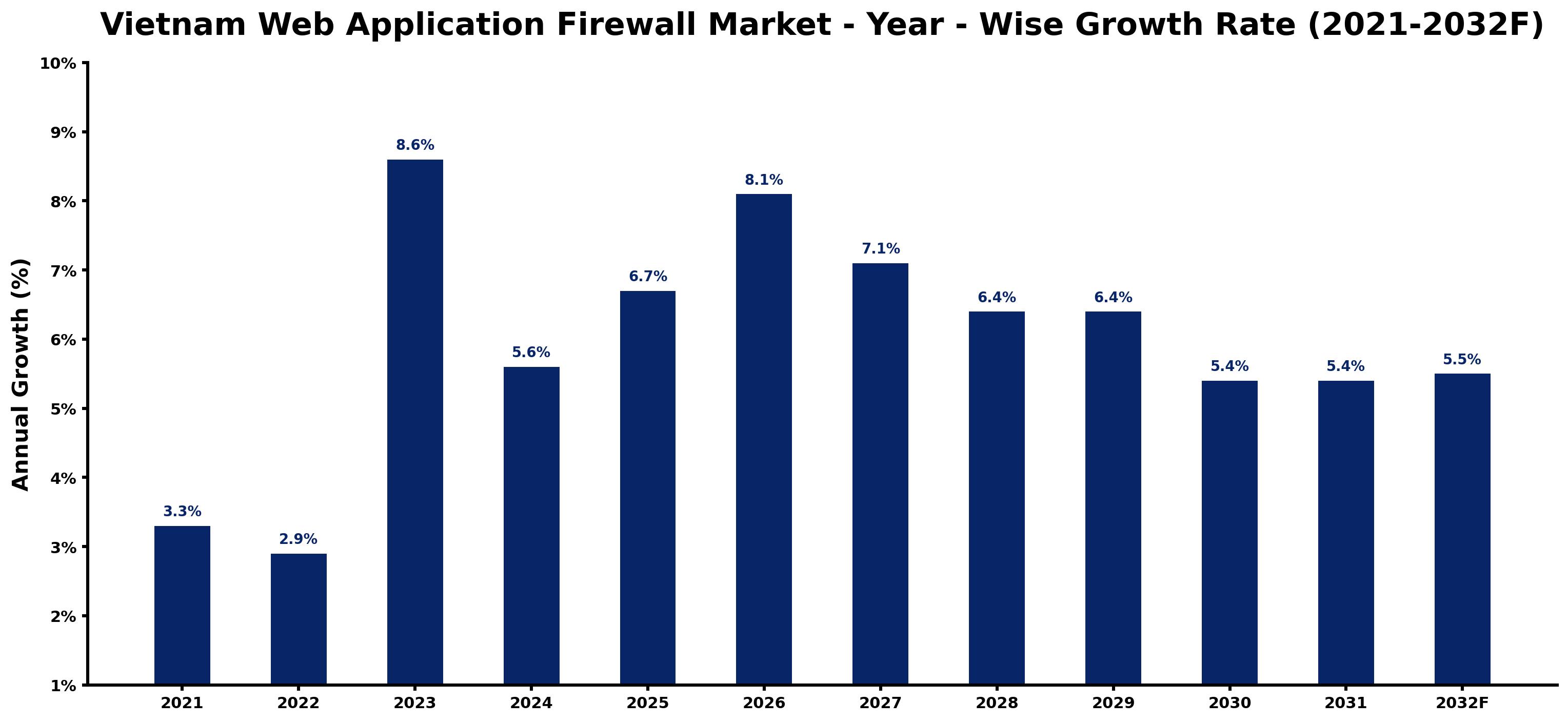
The table below presents the year‑wise growth rates along with the key drivers influencing the market
| Year | Growth Rate | Major Drivers |
| 2021 | 3.3% | Growing regulatory focus on cybersecurity by VNISA. |
| 2022 | 2.9% | Increased cyber threat incidents prompting security investments. |
| 2023 | 8.6% | Rising e-commerce growth driving demand for web security. |
| 2024 | 5.6% | Government promoting digital transformation in small businesses. |
| 2025 | 6.7% | Penetration of 5G enhancing online transactions and threats. |
| 2026 | 8.1% | Local tech startups prioritizing application security solutions. |
| 2027 | 7.1% | Adoption of remote work increasing web application usage. |
| 2028 | 6.4% | Cybersecurity awareness programs boosting enterprise security measures. |
| 2029 | 6.4% | Investment in fintech stimulating web application security needs. |
| 2030 | 5.4% | Emergence of digital identity regulations enhancing security compliance. |
| 2031 | 5.4% | Growing cloud adoption necessitating advanced security applications. |
| 2032 | 5.5% | Increased digital infrastructure attracting cyber attacks prompting upgrades. |
Note: Market size estimations and growth projections presented in this report are based on 6Wresearch's proprietary forecasting methodology, utilizing the latest available industry data, government publications, and primary research inputs.
Vietnam Web Application Firewall Market Key Takeaways
Below are some of the specific key takeaways from the market, including:
- The market is experiencing a rapid increase in demand as cyber threats evolve and become more sophisticated.
- Organizations are particularly focused on protecting sensitive data and ensuring uptime for their web services.
- Cloud and mobile application integrations are driving the necessity for advanced WAF solutions.
- A shortage of skilled cybersecurity professionals is impacting the effective implementation and management of WAFs.
- Regular updates and maintenance of WAF solutions are crucial to counteract emerging threats effectively.
Evaluation of Restraints in Vietnam Web Application Firewall Market
One of the significant obstacles stalling market growth is the constantly changing nature of web application threats. Cybercriminals are continuously developing new tactics, which means WAFs must adapt swiftly. This adaptability is hindered by the intricate architecture of modern web applications, making configuration a daunting task. Furthermore, the skills gap in cybersecurity professionals complicates proper implementation, leaving many organizations vulnerable due to lack of expertise.
Vietnam Web Application Firewall Market Trends
A few notable trends are reshaping the Vietnam WAF market. First, the shift towards cloud-based infrastructures is pushing businesses to seek scalable and flexible WAF solutions. Integration with artificial intelligence and machine learning technologies is on the rise, enhancing real-time threat detection capabilities. Additionally, as businesses increasingly adopt DevSecOps practices, there is a growing emphasis on embedding security within the software development lifecycle.
Vietnam Web Application Firewall Market Opportunities
There is a wealth of opportunities for growth in this market, especially as digital transformation accelerates across sectors. Companies can explore partnerships with cloud service providers to enhance their WAF offerings. Additionally, the increasing regulatory focus on data protection and privacy will drive demand for compliant web security solutions. Finally, as more organizations invest in their digital ecosystems, there is a ripe market for innovative WAF technologies that can adapt to diverse application architectures.
Government Initiatives in the Vietnam Web Application Firewall Market
Government actions are significantly influencing the Vietnam WAF market, pushing for improved cybersecurity standards. Regulatory frameworks are being established to promote the adoption of cybersecurity measures across both public and private sectors. With increasing frequency and sophistication of cyberattacks, policy-makers recognize the necessity of robust cybersecurity infrastructures, which in turn creates opportunities for WAF solutions.
- A national cybersecurity strategy launched in early 2023 focuses on enhancing digital security across critical sectors.
- Current efforts include an ongoing initiative to educate organizations on cybersecurity best practices, promoting the adoption of WAF technologies.
- Upcoming legislation is expected in 2025, mandating all organizations handling sensitive data to deploy adequate security measures, including WAFs.
- A planned public-private partnership aims to boost investment in cybersecurity technologies by 2026.
Future Insights of the Vietnam Web Application Firewall Market
Looking ahead to 2026-2032, the Vietnam WAF market is on a trajectory of steady growth. Companies will increasingly prioritize cybersecurity, driven by heightened awareness and regulatory pressures. As digital threats become more complex, WAF providers who invest in developing adaptive, intelligent solutions will likely see substantial market share increases. The incorporation of AI and machine learning into WAF technology will likely be a game changer, allowing for more proactive security measures.
Vietnam Web Application Firewall Market Latest Developments
In the past 12 months, the Vietnam Web Application Firewall market has seen considerable activity, largely spurred by the increased urgency around cybersecurity. Organizations are actively seeking out advanced WAF solutions to fortify their defenses against rising cyber threats, leading to numerous technology upgrades and new product launches.
- A leading cybersecurity firm announced a major upgrade to its WAF solution in Q1 2023, enhancing capabilities with machine learning algorithms for better threat detection.
- In mid-2023, a significant partnership was formed between tech firms aimed at developing next-generation WAF solutions tailored for the Vietnamese market.
- A major technology vendor commenced a rollout of a cloud-native WAF service in early Q4 2023, catering to the demand for scalable solutions.
- Ongoing training programs aimed at improving the skills of local cybersecurity professionals are being conducted, with support from government initiatives.
Vietnam Web Application Firewall Market - Key Attractiveness of the Report
- 10 Years of Market Numbers
- Historical Data Starting from 2022 to 2025
- Base Year: 2025
- Forecast Data until 2032
- Key Performance Indicators Impacting the Market
- Major Upcoming Developments and Projects
Key Highlights of the Report:
- Vietnam Web Application Firewall Market Outlook
- Market Size of Vietnam Web Application Firewall Market, 2025
- Forecast of Vietnam Web Application Firewall Market, 2032
- Historical Data and Forecast of Vietnam Web Application Firewall Revenues & Volume for the Period 2022-2032F
- Vietnam Web Application Firewall Market Trend Evolution
- Vietnam Web Application Firewall Market Drivers and Challenges
- Vietnam Web Application Firewall Price Trends
- Vietnam Web Application Firewall Porter's Five Forces
- Vietnam Web Application Firewall Industry Life Cycle
- Historical Data and Forecast of Vietnam Web Application Firewall Market Revenues & Volume By Component for the Period 2022-2032F
- Historical Data and Forecast of Vietnam Web Application Firewall Market Revenues & Volume By Solutions (Hardware Appliances, Virtual Appliances, Cloud-Based) for the Period 2022-2032F
- Historical Data and Forecast of Vietnam Web Application Firewall Market Revenues & Volume By Services (Professional and Managed) for the Period 2022-2032F
- Historical Data and Forecast of Vietnam Web Application Firewall Market Revenues & Volume By Organization Size for the Period 2022-2032F
- Historical Data and Forecast of Vietnam Web Application Firewall Market Revenues & Volume By SMEs for the Period 2022-2032F
- Historical Data and Forecast of Vietnam Web Application Firewall Market Revenues & Volume By Large Enterprises for the Period 2022-2032F
- Historical Data and Forecast of Vietnam Web Application Firewall Market Revenues & Volume By Vertical for the Period 2022-2032F
- Historical Data and Forecast of Vietnam Web Application Firewall Market Revenues & Volume By Banking, Financial Services & Insurance for the Period 2022-2032F
- Historical Data and Forecast of Vietnam Web Application Firewall Market Revenues & Volume By Retail for the Period 2022-2032F
- Historical Data and Forecast of Vietnam Web Application Firewall Market Revenues & Volume By IT & Telecommunications for the Period 2022-2032F
- Historical Data and Forecast of Vietnam Web Application Firewall Market Revenues & Volume By Government & Defense for the Period 2022-2032F
- Historical Data and Forecast of Vietnam Web Application Firewall Market Revenues & Volume By Healthcare for the Period 2022-2032F
- Historical Data and Forecast of Vietnam Web Application Firewall Market Revenues & Volume By Energy & Utilities for the Period 2022-2032F
- Historical Data and Forecast of Vietnam Web Application Firewall Market Revenues & Volume By Education for the Period 2022-2032F
- Historical Data and Forecast of Vietnam Web Application Firewall Market Revenues & Volume By Other Verticals for the Period 2022-2032F
- Vietnam Web Application Firewall Import Export Trade Statistics
- Market Opportunity Assessment By Component
- Market Opportunity Assessment By Organization Size
- Market Opportunity Assessment By Vertical
- Vietnam Web Application Firewall Top Companies Market Share
- Vietnam Web Application Firewall Competitive Benchmarking By Technical and Operational Parameters
- Vietnam Web Application Firewall Company Profiles
- Vietnam Web Application Firewall Key Strategic Recommendations






































