Zambia Corrugated Board Market: Top 5 Importing Countries and Market Competition (HHI) Analysis
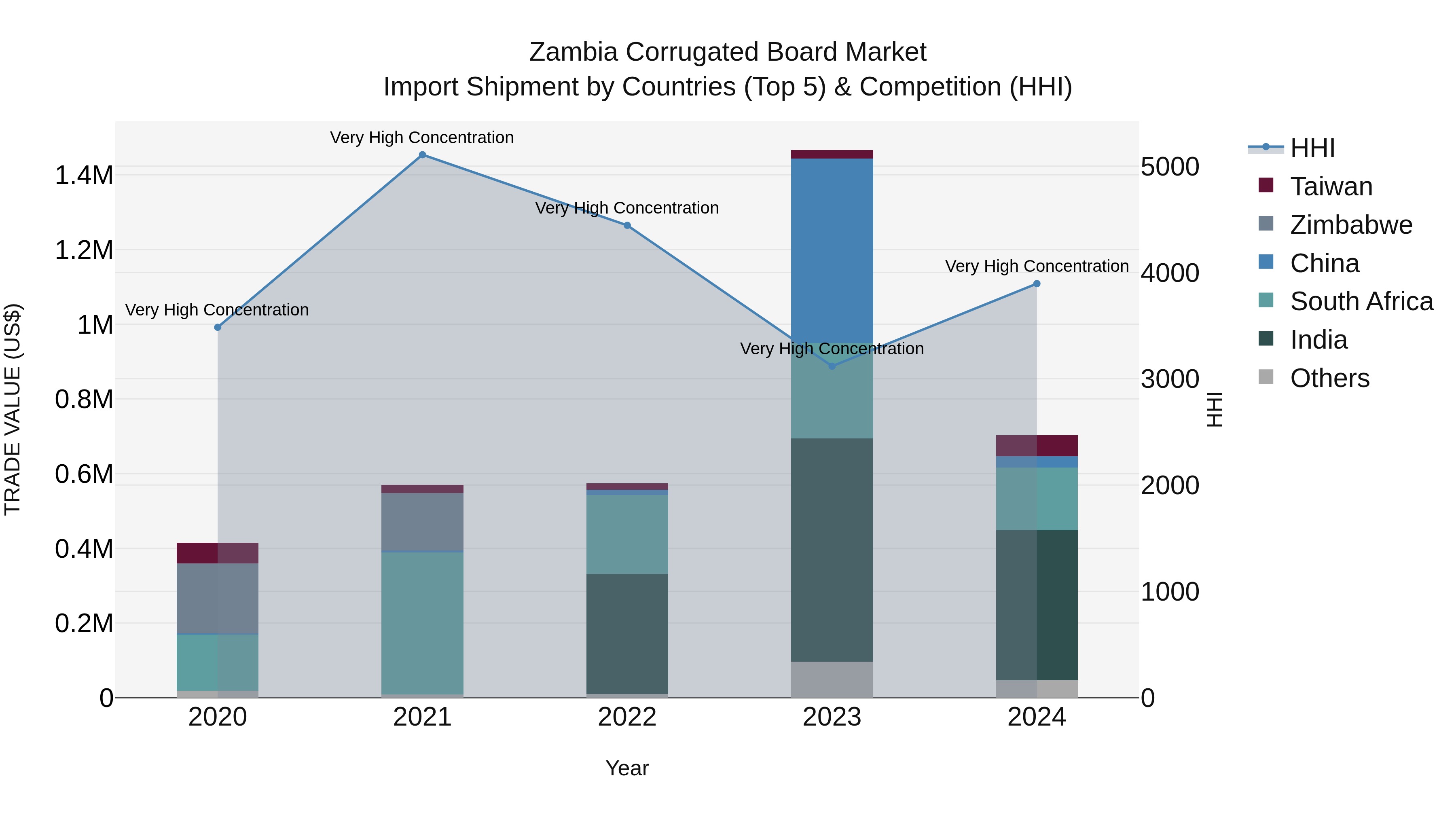
In 2024, Zambia continued to rely on imports of corrugated board, with the top exporting countries being India, South Africa, Taiwan, China, and the United States of America. The high Herfindahl-Hirschman Index (HHI) indicates a concentrated market, while the impressive compound annual growth rate (CAGR) of 14.07% from 2020 to 2024 highlights sustained demand. However, the significant decline in growth rate from 2023 to 2024 at -52.07% suggests a potential slowdown or shift in market dynamics. Monitoring these trends will be crucial for stakeholders in the corrugated board import industry in Zambia.
Topics Covered in Zambia Corrugated Board Market Report
Zambia Corrugated Board Market Report thoroughly covers the market by board type, material type, flute type and end use industry. Zambia Corrugated Board Market Outlook report provides an unbiased and detailed analysis of the ongoing Zambia Corrugated Board Market trends, opportunities/high growth areas, and market drivers. This would help stakeholders devise and align their market strategies according to the current and future market dynamics.
Zambia Corrugated Board Market Synopsis
Zambia’s corrugated board market has witnessed steady expansion over the past few years, driven by expanding manufacturing sector and growing agriculture sector. Zambia’s agricultural sector has seen strong growth, driven mainly by maize production rising against domestic consumption, resulting in a surplus of MT and positioning the country as a regional food exporter. This shift has increased demand for durable and cost-effective packaging across domestic and export supply chains.
In parallel, the expansion of supermarkets and FMCG distribution networks strengthened consumption of corrugated boxes for secondary and transit packaging applications. Additionally, improving trade activity, and gradual development of Zambia’s logistics and warehousing infrastructure further supported market growth. Furthermore, the rising adoption of sustainable and recyclable packaging materials encouraged manufacturers and end users to shift toward corrugated board packaging solutions across multiple industries.
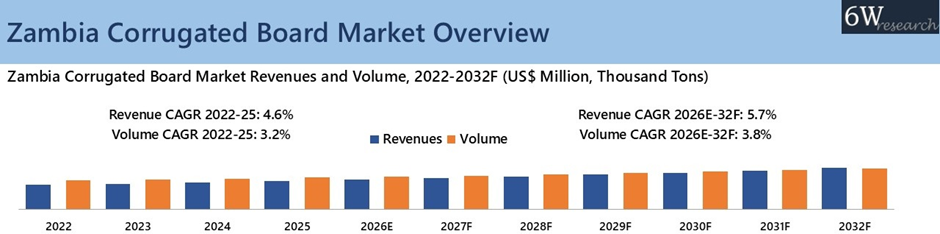
According to 6Wresearch, Zambia Corrugated Board Market revenue size is projected to grow at a CAGR of 5.7% during 2026-2032. Zambia corrugated boards market is poised to maintain its growth supported by the expansion of Zambia’s manufacturing, food & beverage, agriculture, and e-commerce sectors. The manufacturing sector accounted for high number of percentages of Zambia’s GDP in 2023, against the government’s long-term Vision 2030 target.
This sustained industrial growth would contribute to the expansion of the Zambia corrugated board market, as rising production across these industries increases demand for packaging solutions used for storage, handling, and distribution of goods. Additionally, Zambia’s annual food demand, which is projected to increase by 2030, with processed health foods and perishables expected to be the highest in demand. This would act as a major catalyst for the expansion of the corrugated board market, driven by the increasing need for protective, hygienic, and sustainable packaging solutions across food supply chains.
Market Segmentation By Board type
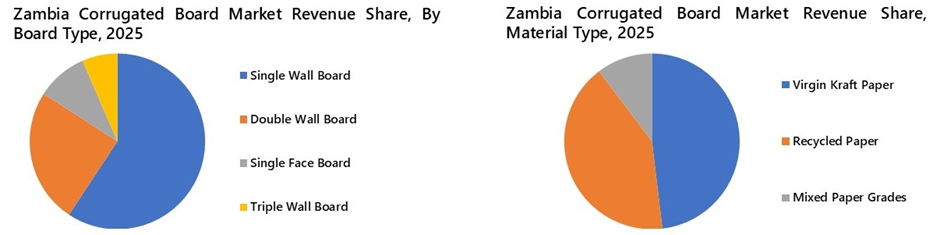
The fastest-growing subsegment in Zambia’s corrugated board market is expected to be Double Wall Board, driven by increasing demand from export-oriented agriculture, mining-related logistics, industrial equipment packaging, and cross-border trade within Southern Africa. As supply chains expand and goods move over longer distances, the need for higher stacking strength, better compression resistance, and improved product protection is rising, accelerating adoption of double wall corrugated solutions faster than other board types.
Market Segmentation By Material type
The Recycled Paper segment is expected to experience the fastest growth in the Zambia Corrugated Market, driven by rising adoption of cost-efficient and sustainable packaging solutions, increasing availability of recovered fiber, and expanding use in high-volume FMCG, food distribution, agriculture, and retail logistics packaging. Growing emphasis on circular economy practices and affordability in mass packaging applications will further accelerate its expansion compared to other material types.
Market Segmentation By Flute type
The ‘E-Flute’ segment in Zambia’s corrugated board market is expected to witness the fastest growth from 2025 to 2032, driven by rising demand for lightweight, visually appealing, and high-print-quality packaging across retail, FMCG, pharmaceutical, and e-commerce sectors. Growing organized retail and online shopping activities are further supporting adoption of E-Flute packaging solutions in the country.
Market Segmentation By End use industry
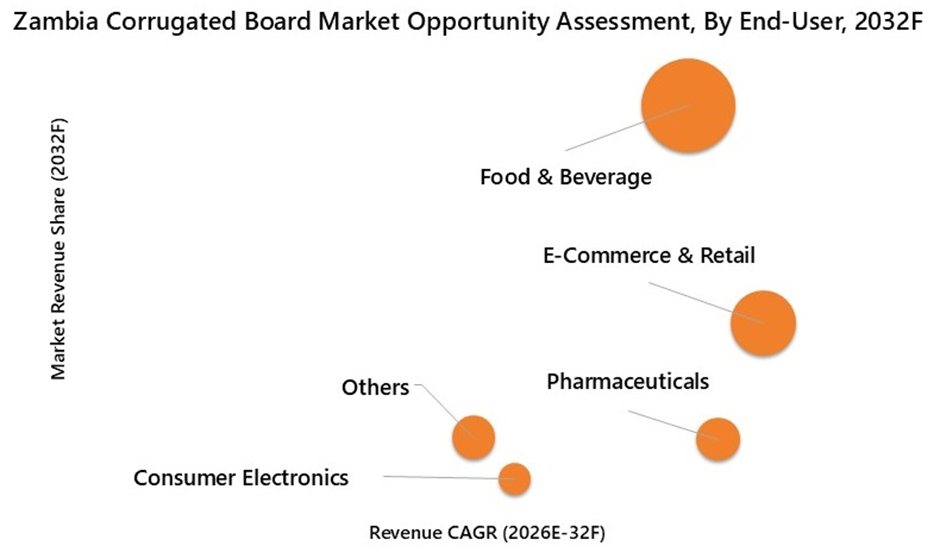
The ‘E-Commerce & Retail’ segment in Zambia’s Corrugated Board Market is expected to witness the fastest growth rate from 2025 to 2032, driven by rapid expansion of online retail platforms, increasing internet and smartphone penetration, and rising consumer preference for doorstep delivery services. The growing need for secure, lightweight, and cost-efficient secondary packaging for shipment and last-mile logistics is further accelerating demand, while the expansion of organized retail and third-party logistics networks continues to strengthen the adoption of corrugated packaging solutions across diverse product categories.
Key Attractiveness of the Report
- 10 Years Market Numbers.
- Historical Data Starting from 2022 to 2025
- Base Year: 2025
- Forecast Data until 2032
- Key Performance Indicators Impacting the Market.
- Major Upcoming Developments and Projects.
Key Highlights of the Report:
- Global Corrugated Board Market Overview
- Zambia Corrugated Board Market Overview
- Zambia Corrugated Board Market Outlook
- Zambia Corrugated Board Market Forecast
- Historical Data and Forecast of Zambia Corrugated Board Market Revenues & Volume for the Period 2022-2032F
- Historical Data and Forecast of Zambia Corrugated Board Market Revenues & Volume, By Board Type, for the Period 2022-2032F
- Historical Data and Forecast of Zambia Corrugated Board Market Revenues & Volume, By Material Type, for the Period 2022-2032F
- Historical Data and Forecast of Zambia Corrugated Board Market Revenues & Volume, By Flute Type, for the Period 2022-2032F
- Historical Data and Forecast of Zambia Corrugated Board Market Revenues, By End-User, for the Period 2022-2032F
- Industry Life Cycle
- Porter’s Five Force Analysis
- Zambia Corrugated Board Market Drivers and Restraints
- Market Trends & Evolution
- Market Opportunity Assessment
- Zambia Corrugated Board Market Revenue Ranking, By Top 3 Companies
- Competitive Benchmarking
- Company Profiles
- Key Strategic Recommendations
Market Scope and Segmentation
The report provides a detailed analysis of the following market segments:
By Board Type
- Single Face Board
- Single Wall Board
- Double Wall Board
- Triple Wall Board
By Material Type
- Virgin Kraft Paper
- Recycled Paper
- Mixed Paper Grades
By Flute Type
- A-Flute
- B-Flute
- C-Flute
- E-Flute
- Others
By End-User
- Food & Beverage
- E-Commerce & Retail
- Consumer Electronics
- Pharmaceuticals
- Others






































