GCC Air Conditioner (AC) Market Size & Growth Rate
According to 6Wresearch internal database and industry insights, the GCC Air Conditioner (AC) Market was valued at USD 8 billion in 2025 and is projected to reach USD 14.62 billion by 2032, growing at a CAGR of approximately 9% during 2026–2032.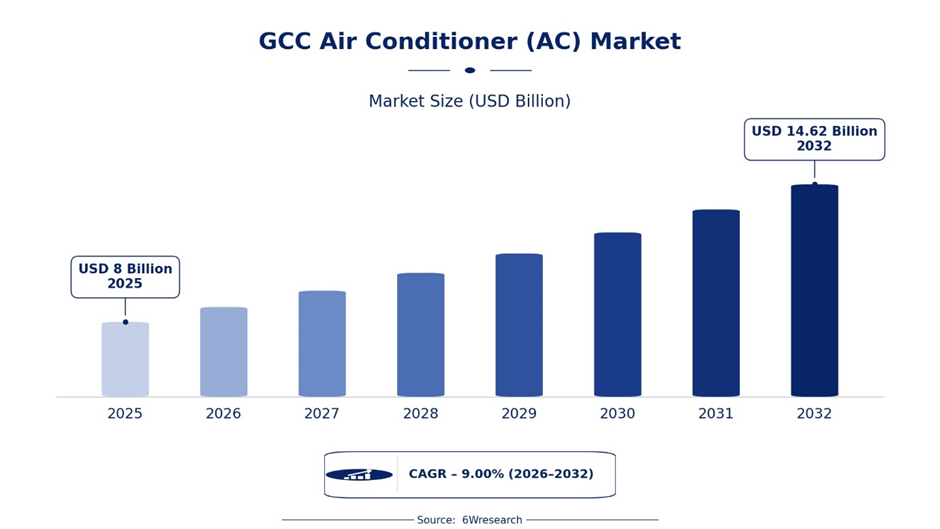
GCC Air Conditioner (AC) Market Highlights
|
Report Metric |
Details |
|
Report Name |
GCC Air Conditioner (AC) Market (2026-2032) |
|
Market Size 2025 |
USD 8 billion |
|
Market Size 2032 |
USD 14.62 billion |
|
Absolute Growth 2025–2032 |
USD 6.62 billion |
|
CAGR 2026–2032 |
9% |
|
Peak Annual Growth |
10.2% in 2028 |
|
Forecast Period |
2026–2032 |
|
Historical Data |
2022–2025 |
|
Base Year |
2025 |
|
Leading Types, 2025 |
Room AC (Window and Split) with a 36% share |
|
Fastest-Growing Types |
Ductless AC at a 10.4% CAGR |
|
Leading Applications, 2025 |
Residential with a 38% share |
|
Fastest-Growing Applications |
Healthcare at an 11.0% CAGR |
|
Leading Countries, 2025 |
Saudi Arabia with a 46% share |
|
Fastest-Growing Countries |
Oman at a 10.1% CAGR |
|
Growing Sector |
Healthcare and Hospitality facilities |
|
Key End Users or Key Procuring Entities |
Residential developers, hotel and resort operators, hospital networks, commercial real estate owners, oil and gas operators, airport and metro authorities, EPC and facility management contractors, and government building owners |
GCC Air Conditioner (AC) Market Year-wise Growth Rate and Key Drivers (2022–2032)
This graph illustrates the annual growth rates of the market from 2022 to 2032, highlighting a steady upward trajectory and projected market expansion over the forecast period.
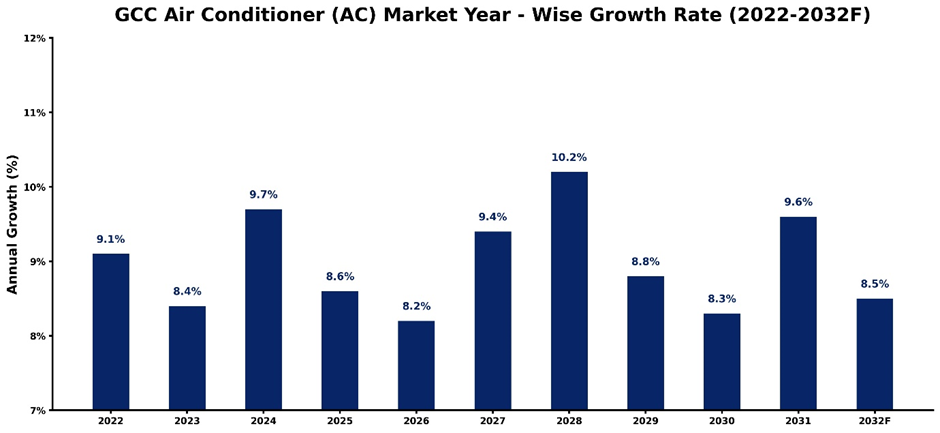
The following table presents the estimated annual growth rate for each year together with the principal factor influencing market performance. The values are intended to highlight year-specific drivers rather than to provide a direct comparison between individual years.
| Year | Estimated Annual Growth (%) | Market Rationale |
| 2022 | 9.1% | Post-pandemic reopening of offices, malls and hotels and the FIFA World Cup in Qatar lifted installations across the region. |
| 2023 | 8.4% | Higher interest rates and elevated freight and compressor costs slowed purchases as the market normalised after the initial rebound. |
| 2024 | 9.7% | Record summer temperatures, including the extreme heat during the June Hajj season, accelerated replacement of failed and ageing units. |
| 2025 | 8.6% | Softer oil prices and the re-phasing of selected giga-project packages moderated commercial procurement despite continued residential demand. |
| 2026 | 8.2% | Phase-down of high global-warming-potential refrigerants is expected to raise equipment costs and cause buyers to defer some purchases. |
| 2027 | 9.4% | Housing delivery under Saudi Arabia’s Vision 2030 homeownership programme and new hotel openings are expected to restore installation momentum. |
| 2028 | 10.2% | Peak fit-out of FIFA World Cup 2034 stadiums, transport hubs and fan accommodation is expected to maximise equipment orders. |
| 2029 | 8.8% | Completion of first-wave mixed-use and entertainment developments is expected to reduce new-build installations as contractors enter handover phases. |
| 2030 | 8.3% | Conclusion of Expo 2030 preparations is expected to ease large commercial fit-out orders and temper project-driven demand. |
| 2031 | 9.6% | Replacement of units installed during the early-2020s construction wave is expected to lift demand as warranties expire. |
| 2032 | 8.5% | Rising penetration of high-efficiency inverter models is expected to lengthen replacement intervals and moderate unit volume growth. |
Note: Market size estimations and growth projections presented in this report are based on 6Wresearch’s proprietary forecasting methodology, utilizing the latest available industry data, government publications, and primary research inputs.
GCC Air Conditioner (AC) Market Synopsis
The GCC Air Conditioner (AC) Market is predicted to grow at a fierce pace through 2032. The industry has room, ducted, ductless and centralised cooling equipment, including window and split units, rooftop packaged systems, cassettes, VRF, chillers and associated coils and compressors, supplied for residential, commercial and industrial buildings across Saudi Arabia, the United Arab Emirates, Qatar, Kuwait, Oman and Bahrain. Summer temperatures above 45°C, Vision 2030 housing and tourism projects, large-scale stadium and transport construction and efficiency regulations are shaping demand.
Market Dynamics Impact Analysis (2026–2032)
|
Factor |
Type |
Impact |
Primary Segment Affected |
|
Extreme summer heat sustaining year-round cooling use |
Driver |
High |
Room AC (Window and Split) |
|
Mega-event and giga-project construction |
Driver |
High |
Centralized AC |
|
Retrofit of ageing units with high-efficiency models |
Opportunity |
High |
Ductless AC |
|
Healthcare facility expansion requiring precise climate control |
Opportunity |
Medium |
Healthcare |
|
Dependence on imported units and components |
Restraint |
High |
Room AC (Window and Split) |
|
Electricity tariff reform raising operating costs |
Restraint |
Medium |
Residential |
|
Refrigerant transition and retraining costs |
Challenge |
High |
Ducted AC |
|
Low-priced imported units with uncertain conformity |
Challenge |
Medium |
Room AC (Window and Split) |
Evaluation of Drivers in the GCC Air Conditioner (AC) Market (2026–2032)
Below mentioned are some major drivers and their influence on the market dynamics:
|
Drivers |
Primary Segment Affected |
Why It Matters (Evidence) |
|
Extreme heat sustaining year-round cooling use |
Room AC (Window and Split) |
In Saudi Arabia, air conditioning accounts for around 70% of residential electricity use, which shows how continuously units run and why wear shortens replacement cycles. |
|
Tourism and hospitality build-out |
Hospitality |
Every new hotel and resort room requires installed cooling, so each added key creates equipment demand, and Saudi Arabia targets 150 million annual tourist visits by 2030. |
|
Mega-event and giga-project construction |
Centralized AC |
Large venues and integrated cities need chiller plants, VRF and air-handling systems, and Riyadh’s selection to host Expo 2030 in November 2023 has brought forward tender activity. |
|
Population growth and urbanisation |
Residential |
Each new household adds at least one cooling unit, and the GCC population of around 60 million is growing by roughly 2% a year. |
|
Energy-efficiency programmes |
Ductless AC |
Efficiency targets push owners to replace old units with high-efficiency models, and Dubai’s Demand Side Management Strategy aims to cut electricity and water demand by 30% by 2030. |
GCC Air Conditioner (AC) Market Growth is underpinned by sustained non-oil economic expansion, which contributes about half of Saudi Arabia’s real GDP and keeps building activity and consumer spending rising. Foreign direct investment inflows of around USD 30.7 billion into the UAE in 2023 reflect strong private capital interest in real estate and industrial assets that require cooling. Rising disposable incomes allow buyers to upgrade to larger, higher-capacity units, and the build-out of data centres and advanced manufacturing facilities adds continuous cooling loads that did not exist at scale a decade ago. Expanding power generation and transmission capacity across the region also supports wider adoption of cooling equipment.
Evaluation of Restraints in the GCC Air Conditioner (AC) Market
Below mentioned are some major restraints and their influence on the market dynamics:
|
Market Restraint |
Primary Segment Affected |
Why It Matters (Evidence) |
|
Dependence on imported units and components |
Room AC (Window and Split) |
Most compressors and components are imported, so currency moves and freight disruptions raise landed costs, as seen when Red Sea shipping disruptions from late 2023 lengthened Asia-Gulf transit times. |
|
Electricity tariff reform raising operating costs |
Residential |
Higher power prices make buyers cautious about large units and delay replacement, as in Saudi Arabia where residential tariffs were raised in 2018. |
|
Fiscal reprioritisation of project spending |
Commercial Offices & Retail |
Saudi Arabia recorded a budget deficit in 2024, and re-phasing of selected projects delayed some tenders, pushing back large office and retail fit-out orders. |
|
Income disparity limiting premium adoption |
Ductless AC |
Qatar’s GDP per capita is roughly four times that of Oman, so premium models find a narrower buyer base in lower-income markets. |
|
District cooling displacing direct unit sales |
Centralized AC |
Developers connecting buildings to district cooling avoid buying chillers, and Qatar Cool supplies chilled water to developments such as The Pearl-Qatar, reducing direct equipment sales in those areas. |
GCC Air Conditioner (AC) Market Challenges
The GCC Air Conditioner (AC) Market Industry is facing structural restrictions. Phasing out R-410A, which has a global warming potential of about 2,088, requires retraining technicians and revising stock plans, leaving suppliers exposed on legacy inventory. In addition, demand compressed into roughly five months of extreme summer heat strains importers’ logistics and service teams, creating delivery delays and uneven installation quality at peak. Retrofitting buildings constructed before 2010 is complicated by outdated ducting, limited plant space and inconsistent building control standards, which lengthens project timelines for contractors. Moreover, low-priced imported units with uncertain conformity pressure margins for established brands and expose buyers to higher failure rates.
Trends in the GCC Air Conditioner (AC) Market
Important trends shaping the GCC Air Conditioner (AC) Market are detailed below:
- Hot-Climate Engineering Prioritised over Standard Designs: Several manufacturers now supply split and VRF models designed to operate at ambient temperatures up to about 55°C, reflecting summers in Kuwait and inland Saudi Arabia that exceed standard test conditions. These units hold capacity during peak heat and protect compressors. Suppliers certifying performance at extreme ambient conditions gain an advantage in specification-led projects.
- Shift from Equipment Sales to Service-Led Contracts: Facility owners in Saudi Arabia and the UAE increasingly buy maintenance-inclusive and performance-based agreements instead of stand-alone equipment, supported by energy service company retrofit programmes such as Dubai’s Etihad ESCO. This favours suppliers that bundle installation, remote monitoring and spare parts, and creates recurring service revenue beyond the initial sale.
- Indoor Air Quality Prioritised over Basic Temperature Control: Hospitals, hotels and premium buildings in Saudi Arabia and the UAE increasingly specify filtration, fresh-air handling and humidity control alongside cooling, a preference that strengthened after the pandemic. Specifications now reference international ventilation standards such as ASHRAE 170 for healthcare. This favours suppliers of air handling units and filtration-integrated systems.
Investment Opportunities in the GCC Air Conditioner (AC) Market
Major investment opportunities in the GCC Air Conditioner (AC) Market are presented below:
- District Cooling Plants and Chillers: Master-planned cities and event districts in the Gulf are specifying shared cooling plants to cut peak electricity load. Opportunities exist in chillers, thermal energy storage and distribution piping, best entered through joint ventures or supply contracts with operators such as Tabreed and Empower, or with developers of integrated communities.
- Local Assembly and Service Centres: Import dependence and lead-time pressure create room for in-region assembly of room units and coils, plus service centres and technician training in Saudi Arabia, Oman and the UAE. Investors can enter through joint ventures with local distributors, set up in industrial cities or free zones such as Sohar, and secure conformity approvals to qualify for government and developer supply lists.
- Rooftop Packaged Systems for Malls and Logistics Parks: Retail destinations and logistics parks under development in Riyadh, Dubai and Muscat prefer rooftop packaged and ducted units for large open volumes, supporting steady orders for factory-assembled units that install quickly. Investors can supply packaged units and maintenance contracts, entering through partnerships with mechanical contractors and master developers.
Leading Players in GCC Air Conditioner (AC) Market
A comprehensive listing of prominent companies in the GCC Air Conditioner (AC) Market is provided below:
1. Daikin Industries, Ltd.
|
Company Name |
Daikin Industries, Ltd. |
|---|---|
|
Established Year |
1924 |
|
Headquarters |
Osaka, Japan |
|
Official Website |
A global manufacturer of air conditioning and refrigeration equipment with a broad presence across the Gulf through regional subsidiaries and distributors. It supplies residential split units, VRF systems and chillers to building developers and contractors.
2. LG Electronics Inc.
|
Company Name |
LG Electronics Inc. |
|---|---|
|
Established Year |
1958 |
|
Headquarters |
Seoul, South Korea |
|
Official Website |
A consumer electronics and appliance manufacturer with a strong position in residential split units and a growing range of VRF and commercial systems across the Gulf, sold through regional distributors and retail networks.
3. Midea Group Co., Ltd.
|
Company Name |
Midea Group Co., Ltd. |
|---|---|
|
Established Year |
1968 |
|
Headquarters |
Foshan, China |
|
Official Website |
A major appliance and HVAC manufacturer whose room and light commercial air conditioners are widely distributed across the Gulf, with growing activity in VRF and chiller systems supplied to developers and contractors.
4. Trane Technologies plc
|
Company Name |
Trane Technologies plc |
|---|---|
|
Established Year |
1913 |
|
Headquarters |
Dublin, Ireland |
|
Official Website |
A provider of commercial and residential HVAC systems, controls and services. Its chillers, air handling units and service capability support large commercial, healthcare and district cooling projects in the region.
Government Initiatives in the GCC Air Conditioner (AC) Market
Saudi Vision 2030, launched in 2016, targets 70% homeownership by 2030, creating sustained demand for new residential units that require cooling. The UAE Net Zero by 2050 Strategic Initiative, announced in 2021, pushes building owners towards efficient equipment, while minimum energy performance requirements administered by the Saudi Standards, Metrology and Quality Organization (SASO) and the GCC Standardization Organization (GSO) set efficiency floors for air conditioners.
Delivery sits with agencies such as the Saudi Energy Efficiency Center, which coordinates national efficiency programmes for cooling equipment, and Dubai Electricity and Water Authority, whose Etihad ESCO subsidiary targets the retrofit of 30,000 buildings by 2030. The Saudi Green Initiative, launched in 2021 with a 2060 net-zero target, adds a framework for lower-emission building and cooling investment across the region.
Future Insights of the GCC Air Conditioner (AC) Market
The GCC Air Conditioner (AC) Market is predicted to grow at a fierce pace through 2032. Connected control platforms and AI-based energy management are expected to improve operating efficiency and widen the appeal of premium cooling equipment across the Gulf. Additionally, wider adoption of green building ratings such as Mostadam in Saudi Arabia and Estidama in Abu Dhabi will specify higher-performance cooling in new developments. Saudi Arabia’s plan to source 50% of its electricity from renewables and reach 130 GW of renewable capacity by 2030 should lower the cost of running cooling systems. Additionally, continued modernisation of power grids and wider time-of-use electricity pricing will support adoption of storage-ready and demand-responsive equipment.
Market Segmentation Analysis
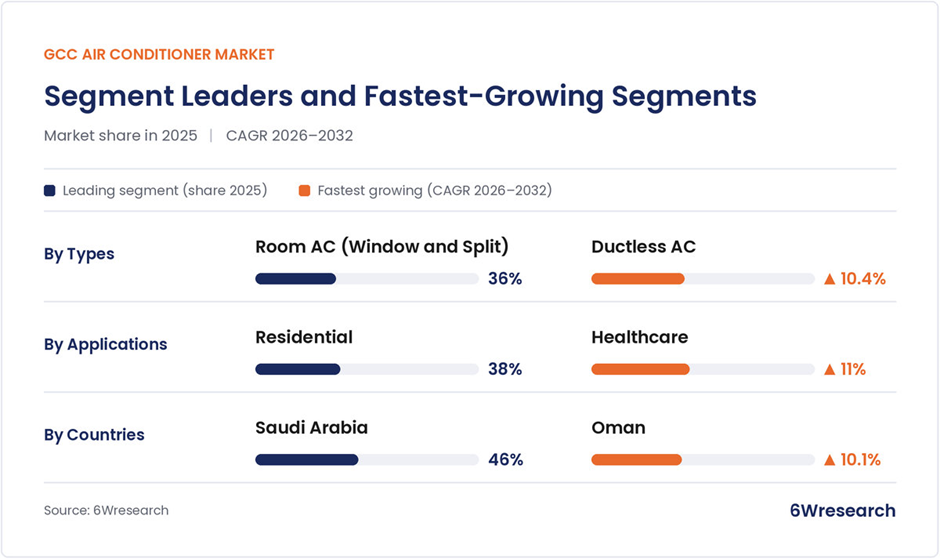
The report offers a comprehensive study of the market across its key segments. The chart below highlights the leading segment by market share in 2025 and the fastest-growing segment by CAGR over 2026–2032, followed by a detailed analysis of each segment.
By Types – Room AC (Window and Split) Leads, Ductless AC Expected to Grow Fastest
According to Ravi Bhandari, Research Head at 6Wresearch, Room AC (Window and Split) led with a 36% GCC Air Conditioner (AC) Market Share in 2025, as split units serve the villas and apartments that dominate Gulf housing and are replaced frequently because of continuous summer operation and dust loading. In parallel, Ductless AC is expected to grow fastest at a CAGR of 10.4% during 2026–2032, driven by retrofits in older buildings without ductwork and by zoned cooling in new hotels and clinics.
By Applications – Residential Leads, Healthcare Expected to Grow Fastest
Residential demand held the largest industry share at 38% in 2025, anchored by rising household formation and steady housing delivery in Saudi Arabia and the UAE, where every dwelling relies on cooling for most of the year. At the same time, Healthcare is projected to post the fastest CAGR of 11.0% over 2026–2032 as new hospitals and specialist clinics across the Gulf require tightly controlled temperature, humidity and filtration.
By Countries – Saudi Arabia Leads, Oman Expected to Grow Fastest
Saudi Arabia accounted for 46% industry share of 2025 owing to its large population, the scale of its housing and giga-project pipeline and the extreme heat of inland cities such as Riyadh. Meanwhile, Oman is expected to record the fastest CAGR of 10.1% during 2026–2032, supported by the Duqm and Sohar industrial zones, tourism development under Oman Vision 2040 and a lower installed base from which demand is catching up.
Key Attractiveness of the Report
- 10 Years of Market Numbers
- Historical Data Starting from 2022 to 2025
- Base Year 2025
- Forecast Data until 2032
- Key Performance Indicators Impacting the Market
- Major Upcoming Developments and Projects
Key Highlights of the Report:
- GCC Air Conditioner Market Overview
- GCC Air Conditioner Market Outlook
- GCC Air Conditioner Market Size and GCC Air Conditioner Market Forecast until 2025F
- Historical Data of GCC Air Conditioner Market Revenues, By Types for the Period, 2022-2032
- Market Size & Forecast of GCC Air Conditioner Market Revenues, By Types until 2025F
- Historical Data of Saudi Arabia Air Conditioner Market Revenues for the Period, 2022-2032
- Market Size & Forecast of Saudi Arabia Air Conditioner Market Revenues, until 2025F
- Historical Data of Saudi Arabia Air Conditioner Market Revenues & Volume for the Period 2022-2032, By Types
- Market Size & Forecast of Saudi Arabia Air Conditioner Market Revenues & Volume until 2025F, By Types
- Historical Data of Saudi Arabia Air Conditioner Market Revenues for the Period 2022-2032, By Applications
- Market Size & Forecast of Saudi Arabia Air Conditioner Market Revenues until 2025F, By Applications
- Historical Data of UAE Air Conditioner Market Revenues for the Period, 2022-2032
- Market Size & Forecast of UAE Air Conditioner Market Revenues, until 2025F
- Historical Data of UAE Air Conditioner Market Revenues & Volume for the Period 2022-2032, By Types
- Market Size & Forecast of UAE Air Conditioner Market Revenues & Volume until 2025F, By Types
- Historical Data of UAE Air Conditioner Market Revenues for the Period 2022-2032, By Applications
- Market Size & Forecast of UAE Air Conditioner Market Revenues until 2025F, By Applications
- Historical Data of Qatar Air Conditioner Market Revenues for the Period 2022-2032
- Market Size & Forecast of Qatar Air Conditioner Market Revenues, until 2025F
- Historical Data of Qatar Air Conditioner Market Revenues & Volume for the Period 2022-2032, By Types
- Market Size & Forecast of Qatar Air Conditioner Market Revenues & Volume until 2025F, By Types
- Historical Data of Qatar Air Conditioner Market Revenues for the Period 2022-2032, By Applications
- Market Size & Forecast of Qatar Air Conditioner Market Revenues until 2025F, By Applications
- Historical Data of Kuwait Air Conditioner Market Revenues for the Period, 2022-2032
- Market Size & Forecast of Kuwait Air Conditioner Market Revenues, until 2025F
- Historical Data of Kuwait Air Conditioner Market Revenues & Volume for the Period, 2022-2032, By Types
- Market Size & Forecast of Kuwait Air Conditioner Market Revenues & Volume until 2025F, By Types
- Historical Data of Kuwait Air Conditioner Market Revenues for the Period 2022-2032, By Applications
- Market Size & Forecast of Kuwait Air Conditioner Market Revenues until 2025F, By Applications
- Historical Data of Oman Air Conditioner Market Revenues for the Period, 2022-2032
- Market Size & Forecast of Oman Air Conditioner Market Revenues, until 2025F
- Historical Data of Oman Air Conditioner Market Revenues & Volume for the Period 2022-2032, By Types
- Market Size & Forecast of Oman Air Conditioner Market Revenues & Volume until 2025F, By Types
- Historical Data of Oman Air Conditioner Market Revenues for the Period 2022-2032, By Applications
- Market Size & Forecast of Oman Air Conditioner Market Revenues until 2025F, By Applications
- Historical Data of Bahrain Air Conditioner Market Revenues for the Period, 2022-2032
- Market Size & Forecast of Bahrain Air Conditioner Market Revenues, until 2025F
- Historical Data of Bahrain Air Conditioner Market Revenues & Volume for the Period 2022-2032, By Types
- Market Size & Forecast of Bahrain Air Conditioner Market Revenues & Volume until 2025F, By Types
- Historical Data of Bahrain Air Conditioner Market Revenues for the Period 2022-2032, By Applications
- Market Size & Forecast of Bahrain Air Conditioner Market Revenues until 2025F, By Applications
- Market Drivers and Restraints
- GCC Air Conditioner Market Trends
- GCC Air Conditioner Market Overview on Competitive Benchmarking
- Competitive Landscape
- GCC Air Conditioner Market Share, By Players
- Company Profiles
- Key Strategic Recommendations
Market Covered
The report offers an extensive study of the following market segments.
By Types
- Room AC (Window and Split)
- Ducted AC (Ceiling Concealed and Rooftop Packaged)
- Ductless AC (Cassette, Floor Standing, and Ceiling Suspended)
- Centralized AC (VRF, AHU/FCU, Chiller, Condensing Unit and Others including Evaporator Coils and Compressors)
By Applications
- Residential
- Commercial Offices & Retail
- Oil & Gas
- Healthcare
- Transport
- Hospitality
- Others including Education and BFSI
By Countries
- Saudi Arabia
- United Arab Emirates
- Qatar
- Kuwait
- Oman
- Bahrain






































