India Structured Cabling Market (2026-2032) | Analysis, Size, Revenue, Trends, Growth, Forecast, Industry, Outlook, Value & Segmentation
Market Forecast By Product Types (Cables and Components), By Cable Types (Copper Cables and Fiber Optics), By Component Types (Racks & Cabinets, Patch Panel & Cross Connects, Communication Outlets and Patch Cords & Cable Assemblies), By Applications (Commercial, Residential, Industrial, Education and Others including Govt. Buildings and Transportation), By Regions (Eastern, Western, Northern and Southern) and Competitive Landscape
| Product Code: ETC000553 | Publication Date: Jan 1970 | Updated Date: Mar 2026 | Product Type: Report | |
| Publisher: 6Wresearch | Author: Ravi Bhandari | No. of Pages: 70 | No. of Figures: 35 | No. of Tables: 5 |
India Structured Cabling Market Import Shipment Trend (2020-2024)
The India structured cabling market import shipment demonstrated robust growth with a notable CAGR from 2020-2024. The growth rate accelerated between 2023 and 2024, indicating increasing momentum. The market expanded significantly over the period, showcasing a strong upward trend.

India Structured Cabling Market Growth Rate
According to 6Wresearch internal database and industry insights, the India Structured Cabling Market is expected to gain traction, registering a compound annual growth rate (CAGR) of 10.2% during the forecast period (2026-2032).
Topics Covered in the India Structured Cabling Market Report
India Structured Cabling Market report thoroughly covers the market by product type, cable type, component type, application, and region. The report provides a detailed analysis of ongoing market trends, opportunities/high-growth areas, and market drivers that will help stakeholders align strategies based on current and future market dynamics.
India Structured Cabling Market Highlights
| Report Name | India Structured Cabling Market |
| Forecast period | 2026-2032 |
| CAGR | 10.2% |
| Growing Sector | Data Center |
India Structured Cabling Market Synopsis
India Structured Cabling Market is expected to attain growth in the coming years due to the relentless demand for high-speed data transmission and the national push toward a "Gigabit Economy." Apart from this, the growth is further augmented by the aggressive expansion of hyperscale data centers and the transition from traditional networking to software-defined architectures. This industry is also profiting from the government’s focus on 100 Smart Cities and the extensive fiberization of telecom towers to support the nationwide 5G ecosystem.
Evaluation of Growth Drivers in India Structured Cabling Market
Below are some major drivers and their influence on the market dynamics:
| Drivers | Primary Segment Affected | Why It Matters (Evidence) |
| 5G Network Proliferation | Fiber Optics | The installation of over 4.69 lakh 5G base stations necessitates high-bandwidth backhaul cabling to handle massive data traffic. |
| Data Center Boom | Racks & Cabinets | India’s data center capacity is forecast to reach 4.5 GW by 2030, driving demand for high-density cable management solutions. |
| Industrial 4.0 Adoption | Industrial | Automation in manufacturing plants requires ruggedized cabling to support real-time sensor data and machine-to-machine (M2M) communication. |
| Cloud Computing Shift | Commercial | Enterprises migrating to hybrid cloud models are upgrading local area networks (LAN) to Category 6A and 7 cables to avert bottlenecks. |
| Rural Connectivity Projects | Cables | Initiatives like BharatNet are encompassing optical fiber to over 2.5 lakh Gram Panchayats, creating a major footprint for cabling infrastructure. |
India Structured Cabling Market is estimated to proliferate, exhibiting a CAGR of approximately 10.2% during the forecast period 2026-2032. Due to surging demand for high-speed internet, digitization across sectors, and the government's focus on enhancing telecommunication infrastructure, the overall development of this industry is expected to thrive in the upcoming years. Along with this, an increasing number of data centers, IT parks, and smart cities in India is further stimulating the demand for structured cabling systems, particularly in urban areas. In addition, the increased demand for both fibre optic and next generation components reflect consumers’ need for faster data transfer speeds and increased bandwidth availability.
Evaluation of Restraints in the India Structured Cabling Market
Below-mentioned are some major restraints and their impact on the market dynamics:
| Restraints | Primary Segment Affected | What This Means (Evidence) |
| Raw Material Price Unpredictability | Cables (Copper) | Fluctuations in global copper and plastic polymer prices directly impact the profit margins of local cable manufacturers. |
| Rising Installation Costs | Fiber Optics | The specialized labor and equipment required for fiber splicing and testing can deter smaller enterprises from upgrading. |
| Counterfeit Products | Components | The presence of uncertified, low-grade patch cords in Tier-3 markets poses significant fire risks and network performance issues. |
| Interoperability Issues | Components | Limited standardization across different vendor hardware can lead to integration challenges during legacy system upgrades. |
| Complex Right of Way (RoW) | Outdoor Cabling | Administrative barriers and high fees for laying cables in urban areas frequently delay large-scale infrastructure projects. |
India Structured Cabling Market Challenges
India structured cabling industry is expected to continue its upward momentum; however, the shortage of certified network technicians poses a significant hurdle for high-quality deployments in remote regions. Additionally, the high dependency on imported high-grade optical glass and specialized polymers makes the market vulnerable to global supply chain disruptions. Furthermore, the rapid pace of technological obsolescence (e.g., the move from Cat 6 to Cat 8) forces distributors to maintain complex inventories, often leading to capital lock-in for older product generations.
India Structured Cabling Market Trends
The factors reshaping India structured cabling market growth are:
- Advent of fiber-to-the-desk (FTTD): More companies are going straight from the data center to desktops using fiber, as they require more bandwidth in the future.
- Rising Use of Power over Ethernet (PoE++): Higher capacity PoE is now becoming the standard for powering devices, such as smart lighting, security cameras, and VoIP phones, through a single data cable.
- Green Cabling Solutions: Expanding use of green cabling solutions, such as low-smoke-zero-halogen (LSZH) and recyclable materials, to comply with international sustainability and fire-safety standards.
- AI-Driven Infrastructure Management: The emergence of AI-driven infrastructure management through intelligent patching systems and real-time monitoring of the physical layer connections to minimize downtime.
Investment Opportunities in the India Structured Cabling Market
Several profitable opportunities available to stakeholders in the India structured cabling industry are:
- Specialty connector manufacturing - Case for localizing the manufacture of precision-manufactured fiber connectors and patch panels to support the "Make in India" initiative.
- Edge data center infrastructure - High growth niche created by investing in compact pre-terminated cabling solutions for edge facilities in Tier-2 and Tier-3 cities.
- Pre-terminated assembly units - Need to create "plug and play" prefabricated MPO/MTP fiber trunks by establishing local assembly lines to meet fast-paced data center deployment timelines.
Top 5 Leading Players in India Structured Cabling Market
Below is a list of companies operating in the India Structured Cabling Market:
1. Siemens
| Company Name | Siemens |
|---|---|
| Established Year | 1957 |
| Headquarters | Gurugram, India |
| Official Website | Click Here |
Siemens is a leading player in the Indian structured cabling market, providing innovative cabling solutions for industrial, commercial, and residential applications.
2. Schneider Electric
| Company Name | Schneider Electric |
|---|---|
| Established Year | 1836 |
| Headquarters | Rueil-Malmaison, France (Active in India) |
| Official Website | Click Here |
Schneider Electric offers comprehensive cabling systems for data centers, industrial applications, and smart cities, driving India’s demand for efficient energy and communication solutions.
3. AFL
| Company Name | AFL |
|---|---|
| Established Year | 1995 |
| Headquarters | Noida, India |
| Official Website | Click Here |
AFL India is a key supplier of fiber optic cabling systems for telecom, data centers, and enterprise networks, enabling high-performance communication.
4. Legrand
| Company Name | Legrand |
|---|---|
| Established Year | 2001 |
| Headquarters | Mumbai, India |
| Official Website | Click Here |
Legrand provides a range of structured cabling systems, including copper and fiber optic cables, catering to commercial and residential applications in India.
5. Panduit
| Company Name | Panduit |
|---|---|
| Established Year | 1955 |
| Headquarters | Illinois, USA (Active in India) |
| Official Website | Click Here |
Panduit is a leading provider of structured cabling solutions for industrial, commercial, and telecommunications sectors, offering cutting-edge solutions for networking and connectivity.
India Structured Cabling Market: Government Initiatives
According to Indian Government Data, the emphasis on developing digital infrastructure across the country directly supports and accelerates the adoption of structured cabling systems. In general, initiatives such as Digital India and the Smart Cities Mission aim to thrive internet penetration, improve broadband connectivity, and modernize communication networks in both urban and rural areas. This is creating a broad foundation for structured cabling deployment in government buildings, educational institutions, transportation hubs, and public enterprises. Digital India, for instance, has massively expanded internet access and digital services, with major investments to boost digital inclusiveness and backbone connectivity that depends on robust cabling infrastructure.
Future Insights of the India Structured Cabling Market
The growth projections for the India Structured Cabling Market are highly promising, underpinned by the country’s booming digital transformation and ever‑increasing need for robust connectivity infrastructure.
As enterprises, data centers, and smart building ecosystems develop across urban and semi‑urban regions, the demand for structured cabling solutions that can support high‑speed data transmission, scalable network frameworks, and modern communication technologies continues to grow to a major extent.
Apart from this, investments in digital infrastructure, such as new data centers and enterprise networks, are anticipated to bolster the adoption of structured cabling systems that can handle surging data traffic from advanced applications like cloud computing, IoT, and big data analytics.
Market Segmentation Analysis
The report offers a comprehensive study of the following market segments and their leading categories:
By Product Type – Cables to Lead the Market
Cables segment is projected to hold the dominant position in this industry, driven by the sheer volume required for large-scale infrastructure projects. This dominance is sustained by the ongoing replacement of legacy wiring in commercial buildings and the massive requirements of the BharatNet project. As the physical backbone of any network, cables represent the largest portion of the initial capital expenditure in structured cabling installations.
By Cable Type – Copper Cables to Lead the Market
According to Rishil, Senior Research Analyst, 6Wresearch, Copper Cables segment is anticipated to lead the India structured cabling market share, primarily due to its cost-effectiveness and ease of installation for short-distance Local Area Networks (LAN). While fiber is growing fast for backbones, copper (specifically Cat 6 and Cat 6A) remains the preferred choice for horizontal cabling in office environments and residential complexes because it supports Power over Ethernet (PoE) applications efficiently.
By Region – Southern Region to Lead the Market
South India leads the market share, influenced by its status as the nation's premier technology and data center corridor. The high concentration of software parks in Bengaluru, coupled with the emergence of Chennai as a landing station for undersea cables and a hub for hyperscale data centers, ensures that this region remains the most attractive for medical and technological infrastructure suppliers.
Key Attractiveness of the Report
- 10 Years of Market Numbers
- Historical Data Starting from 2022 to 2025
- Base Year: 2025
- Forecast Data until 2032
- Key Performance Indicators Impacting the Market
- Major Upcoming Developments and Projects
Key Highlights of the Report:
- India Structured Cabling Market Outlook
- Market Size of India Structured Cabling Market, 2025
- Forecast of India Structured Cabling Market, 2032
- Historical Data and Forecast of India Structured Cabling Revenues & Volume for the Period 2022–2032
- India Structured Cabling Market Trend Evolution
- India Structured Cabling Market Drivers and Challenges
- India Structured Cabling Price Trends
- India Structured Cabling Porter's Five Forces Analysis
- India Structured Cabling Industry Life Cycle
- Historical Data and Forecast of India Structured Cabling Market Revenues & Volume By Product Types for the Period 2022–2032
- Historical Data and Forecast of India Structured Cabling Market Revenues & Volume By Cables for the Period 2022–2032
- Historical Data and Forecast of India Structured Cabling Market Revenues & Volume By Components for the Period 2022–2032
- Historical Data and Forecast of India Structured Cabling Market Revenues & Volume By Cable Types (Copper Cables and Fiber Optics) for the Period 2022–2032
- Historical Data and Forecast of India Structured Cabling Market Revenues & Volume By Component Types for the Period 2022–2032
- Historical Data and Forecast of India Structured Cabling Market Revenues & Volume By Racks & Cabinets for the Period 2022–2032
- Historical Data and Forecast of India Structured Cabling Market Revenues & Volume By Patch Panel & Cross Connects for the Period 2022–2032
- Historical Data and Forecast of India Structured Cabling Market Revenues & Volume By Communication Outlets for the Period 2022–2032
- Historical Data and Forecast of India Structured Cabling Market Revenues & Volume By Patch Cords & Cable Assemblies for the Period 2022–2032
- Historical Data and Forecast of India Structured Cabling Market Revenues & Volume By Applications for the Period 2022–2032
- Historical Data and Forecast of India Structured Cabling Market Revenues & Volume By Commercial for the Period 2022–2032
- Historical Data and Forecast of India Structured Cabling Market Revenues & Volume By Residential for the Period 2022–2032
- Historical Data and Forecast of India Structured Cabling Market Revenues & Volume By Industrial for the Period 2022–2032
- Historical Data and Forecast of India Structured Cabling Market Revenues & Volume By Education for the Period 2022–2032
- Historical Data and Forecast of India Structured Cabling Market Revenues & Volume By Others (Govt. Buildings & Transportation) for the Period 2022–2032
- Historical Data and Forecast of India Structured Cabling Market Revenues & Volume By Regions (Eastern, Western, Northern, and Southern) for the Period 2022–2032
- Historical Data and Forecast of India Structured Cabling Market Revenues & Volume By Eastern for the Period 2022–2032
- Historical Data and Forecast of India Structured Cabling Market Revenues & Volume By Western for the Period 2022–2032
- Historical Data and Forecast of India Structured Cabling Market Revenues & Volume By Northern for the Period 2022–2032
- Historical Data and Forecast of India Structured Cabling Market Revenues & Volume By Southern for the Period 2022–2032
- India Structured Cabling Import-Export Trade Statistics
- Market Opportunity Assessment By Product Types
- Market Opportunity Assessment By Cable Types
- Market Opportunity Assessment By Component Types
- Market Opportunity Assessment By Applications
- Market Opportunity Assessment By Regions
- India Structured Cabling Top Companies Market Share
- India Structured Cabling Competitive Benchmarking By Technical and Operational Parameters
- India Structured Cabling Company Profiles
- India Structured Cabling Key Strategic Recommendations
Market Covered
India Structured Cabling Market report provides a detailed analysis of the following market segments:
By Product Types
- Cables
- Components
By Cable Types
- Copper Cables
- Fiber Optics
By Component Types
- Racks & Cabinets
- Patch Panel & Cross Connects
- Communication Outlets
- Patch Cords & Cable Assemblies
By Applications
- Commercial
- Residential
- Industrial
- Education
- Others (Govt. Buildings, Transportation, etc.)
By Regions
- Eastern
- Western
- Northern
- Southern
India Structured Cabling Market (2026-2032): FAQs
India Structured Cabling Market is expected to grow at a CAGR of 10.2% during the forecast period of 2026-2032.
India Structured Cabling Market will be driven by the increasing demand for high-speed internet, digital transformation, and the expansion of data centers.
High installation costs, especially for fiber optic systems, and regulatory hurdles for large-scale infrastructure projects are some of the key challenges.
Copper Cables are witnessing the highest growth rate due to its cost-effectiveness and ease of installation for short-distance Local Area Networks (LAN).
| 1. Executive Summary |
| 2. Introduction |
| 2.1 Key Highlights of the Report |
| 2.2 Report Description |
| 2.3 Market Scope & Segmentation |
| 2.4 Research Methodology |
| 2.5 Assumptions |
| 3. Global Structured Cabling Market Overview |
| 3.1. Global Structured Cabling Market Revenues, 2022-2032F |
| 3.2. Global Structured Cabling Market Revenues, By Regions, 2022-2032F |
| 4. India Structured Cabling Market Overview |
| 4.1. India Country Indicators |
| 4.2. India Structured Cabling Market Revenues, 2022-2032F |
| 4.3. India Structured Cabling Market - Industry Life Cycle |
| 4.4. India Structured Cabling Market - Porter's Five Forces Model |
| 4.5. India Structured Cabling Market Revenue Share, By Product Types, 2022 & 2032F |
| 4.6. India Structured Cabling Market Revenue Share, By Cable Types, 2022 & 2032F |
| 4.7. India Structured Cabling Market Revenue Share, By Component Types, 2022 & 2032F |
| 4.8. India Structured Cabling Market Revenue Share, By Applications, 2022 & 2032F |
| 4.9. India Structured Cabling Market Revenue Share, By Regions, 2022 & 2032F |
| 5. India Structured Cabling Market Dynamics |
| 5.1. Impact Analysis |
| 5.2. Market Drivers |
| 5.2.1 Increasing demand for high-speed internet and data connectivity in India |
| 5.2.2 Growing adoption of cloud services and data centers in the country |
| 5.2.3 Government initiatives to promote digitalization and smart city projects |
| 5.3. Market Restraints |
| 5.3.1 High initial investment and installation costs associated with structured cabling systems |
| 5.3.2 Lack of skilled professionals for designing and implementing structured cabling solutions |
| 5.3.3 Rapidly changing technology leading to the need for frequent upgrades and replacements |
| 6. India Structured Cabling Market Trends |
| 7. India Structured Cabling Market Overview, By Product Types |
| 7.1. India Cables Market Revenues, 2022-2032F |
| 7.2. India Cables Market Revenues, By Types, 2022 & 2032F |
| 7.2.1. India Fiber Cables Market Revenues, 2022-2032F |
| 7.2.2. India Copper Cables Market Revenues, 2022-2032F |
| 7.2.2.1 India Shielded Copper Cables Market Revenues, 2022-2032F |
| 7.2.2.2 India Unshielded Copper Cables Market Revenues, 2022-2032F |
| 7.3. India Structured Cabling Components Market Revenues, 2022-2032F |
| 7.4. India Structured Cabling Components Market Revenues, By Types, 2022 & 2032F |
| 7.4.1. India Communication Outlets Market Revenues, 2022-2032F |
| 7.4.2. India Patch Panels & Cross Connects Market Revenues, 2022-2032F |
| 7.4.3. India Patch Cords & Cable Assemblies Market Revenues, 2022-2032F |
| 7.4.4. India Racks & Cabinets Market Revenues, 2022-2032F |
| 8. India Structured Cabling Market Overview, By Applications |
| 8.1. India Structured Cabling Market Revenues, By Commercial Application, 2022-2032F |
| 8.1.1. India Office Sector Outlook |
| 8.1.2. India Retail Sector Outlook |
| 8.1.3. India Hospitality Sector Outlook |
| 8.1.4. India Airport Sector Outlook |
| 8.2. India Structured Cabling Market Revenues, By Residential Application, 2022-2032F |
| 8.2.1. India Residential Sector Outlook |
| 8.3. India Structured Cabling Market Revenues, By Industrial Application, 2022-2032F |
| 8.3.1. India Industrial Sector Outlook |
| 8.4. India Structured Cabling Market Revenues, By Education Application, 2022-2032F |
| 8.4.1. India Education Sector Outlook |
| 8.5. India Structured Cabling Market Revenues, By Other Applications, 2022-2032F |
| 8.5.1. India Transportation Sector Outlook |
| 9. India Structured Cabling Market Overview, By Regions |
| 9.1. India Structured Cabling Market Revenues, By Northern Region, 2022-2032F |
| 9.2. India Structured Cabling Market Revenues, By Western Region, 2022-2032F |
| 9.3. India Structured Cabling Market Revenues, By Eastern Region, 2022-2032F |
| 9.4. India Structured Cabling Market Revenues, By Southern Region, 2022-2032F |
| 10. India Structured Cabling Market - Key Performance Indicators |
| 10.1. India Government Spending Outlook |
| 10.2. India Transportation Infrastructure Outlook |
| 11. India Structured Cabling Market Opportunity Assessment |
| 11.1. By Product Types |
| 11.2. By Component Types |
| 11.3. By Application Types |
| 12. India Structured Cabling Market - Competitive Landscape |
| 12.1. Competitive Benchmarking, By Product Types |
| 12.2. India Structured Cabling Market Revenue Share, By Company, 2025 |
| 13. Company Profiles |
| 14. Key Strategic Recommendations |
| 15. Disclaimer |
Market Forecast By Product Types (Cables and Components), By Cable Types (Copper Cables and Fiber Optics), By Component Types (Racks & Cabinets, Patch Panel & Cross Connects, Communication Outlets and Patch Cords & Cable Assemblies), By Applications (Commercial, Residential, Industrial, Education and Others including Govt. Buildings and Transportation), By Regions (Eastern, Western, Northern and Southern) and Competitive Landscape
| Product Code: ETC000553 | Publication Date: Sep 2021 | Product Type: Report | |
| Publisher: 6Wresearch | No. of Pages: 110 | No. of Figures: 68 | No. of Tables: 6 |
Latest 2023 Developments of the India Structured Cabling Market
India Structured Cabling Market is innovating as the country's desire for higher bandwidth and transmission rates is growing. Furthermore, government initiatives to establish 100 smart towns and provide free Wi-Fi in trains, as well as rising demand for artificial intelligence-based buildings, are boosting market development in the country. The innovation is the introduction of contactless connectors. Contactless connections are an emerging solution for high-reliability markets that have typically pushed connectors through a large number of mating cycles, such as manufacturing and other automation-driven industries.
India Structured Cabling Market Synopsis
Upcoming infrastructural projects along with the establishment of new and expansion of existing metro railway networks would be some of the key drivers for the growth of the structured cabling market in India over the coming years. Further, government initiatives such as the Smart Cities Mission and Make in India campaign, would also strengthen the commercial and industrial sectors of the country which would generate more demand for structured cabling solutions in these domains during 2018-24.
According to 6Wresearch, India structured cabling market size is projected to grow at a CAGR of 7.5% during 2018-2024. The Union Budget for 2019 laid special emphasis on infrastructure development in the country and with a continued focus on setting up new data centres, office spaces, hotels, healthcare facilities, and other commercial establishments in India, the market for structured cabling solutions is expected to reap the benefits as well during the forecast period.
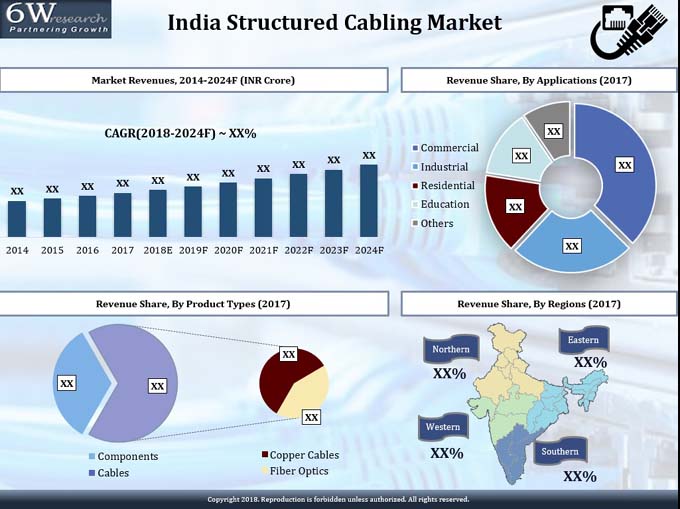
The cables segment occupied the majority of the overall India structured cabling market share, by product type, in 2017. Structured cabling is extensively used across multiple applications such as transportation infrastructure projects, IT & telecom industries, and smart homes as well. However, due to a shorter life cycle, the components market is also expected to grow at a healthy pace over the years to come.
The India structured cabling market report thoroughly covers India's structured cabling market by product types, applications, and regions. The India structured cabling market outlook report provides an unbiased and detailed analysis of the India structured cabling market trends, opportunities/high growth areas, and market drivers, which would help stakeholders device and align market strategies according to the current and future market dynamics. India structured cabling market's increasing demand for copper cables, increasing number of product launches in the market, centre market, growing data centre market and rising demand for bandwidth solution is the major factor in the increasing growth rate of the market. India-based structure of the cabling market has been divided into such as cat5e, cat6, cat6A, and cat7 cables having different categories in the large market of structured cabling in India. The Cat6 cable is the most popular among all these cables such as cat5, cat5e, and cat3. In the forecast period, cat6A cable is expected to register high, and demand also increases in the market for Cat6A.
India structured cabling market is projected to grow more in the forecast period. There is a lot of products which going to increase in demand such as copper cables, an increase in the number of product that is launched and different activities, and growth in the data center market. There are key players in how going to rise the demand for the structured cabling market. There is an application that has been categorized in many sectors of the data center and LAN facilities. The data center people going to register more and more chances to register faster growth in the market in the upcoming years.
India structured cabling market is anticipated to register significant market growth in the coming years backed by the growth and development of the telecommunications industry in the country. Structured cabling is the buzzword in the cable management world and with an increased demand for technology upgrades and advancements in the telecommunications grid, the structured cabling market is expected to garner potential revenues in India in the coming years. Technical advantages of structured cabling such as reduced jungle wiring system, reduction in the risk of downtime, cost-effectiveness, and less time consumption are, further, expected to trigger the market value for India structured cabling market during the forecast period 2020-26F. The right structured cabling system ensures increased data transmission speed, reduced power consumption costs, and enhanced network performance and is the center of attraction for the cable management world and would contribute towards generating significant demand projections in the coming and benefit the healthy growth of India structured cabling market in the near future.
India structured cabling market is projected to witness tremendous growth in the forthcoming years on the back of the rising wide scope of applications in the automotive and energy sector. Further, the residential sector is estimated to generate high sales revenues in the market underpinned by the rising cosmetics sectors expansion like malls, and offices as a result structured cabling also rises to ensure adequate power supply.
The top players operating in the structured cabling market include Belden Inc., 3C3 India Pvt. Ltd.., Molex LLC., Legrand Holding SA and ABB Group.
Key Highlights of the Report:
• India Structured Cabling Market Overview
• India Structured Cabling Market Outlook
• India Structured Cabling Market Forecast
• Historical data of Global Structured Cabling Market Revenues, 2014-2017
• Market Size & Forecast of Global Structured Cabling Market Revenues, until 2024
• Historical data of India Structured Cabling Market Revenues, 2014-2017
• India Structured Cabling Market Size & India Structured Cabling Market Forecast of Revenues, until 2024
• Historical Data of India Structured Cabling Market Revenues, By Product Types, 2014-2017
• Market Size & Forecast of India Structured Cabling Market Revenues, By Product Types until, 2024
• Historical Data of India Structured Cabling Market Revenues, By Applications, 2014-2017
• Market Size & Forecast of India Structured Cabling Market Revenues, By Applications, Until 2024
• Historical Data of India Structured Cabling Market Revenues, By Regions, 2014-2017
• Market Size & Forecast of India Structured Cabling Market Revenues, By Regions, Until 2024
• Market Drivers and Restraints
• India Structured Cabling Market Trends and Opportunities
• Porter's Five Force Analysis and Market Opportunity Assessment
• India Structured Cabling Market Share, By Players
• India Structured Cabling Market Overview on Competitive Landscape
• Company Profiles and Key Strategic Recommendations
Markets Covered
The India Structured Cabling Market report provides a detailed analysis of the following market segments:
By Product Types
- Cables
- Components
By Cable Types
- Copper Cables
- Fiber Optics
By Component Types
- Racks & Cabinets
- Patch Panel & Cross Connects
- Communication Outlets
- Patch Cords & Cable Assemblies
By Applications
- Commercial
- Residential
- Industrial
- Education
- Others (Govt. Buildings, Transportation, etc.)
By Regions
- Eastern
- Western
- Northern
- Southern
Global Go To Market Strategy - 2030
Export potential enables firms to identify high-growth global markets with greater confidence by combining advanced trade intelligence with a structured quantitative methodology. The framework analyzes emerging demand trends and country-level import patterns while integrating macroeconomic and trade datasets such as GDP and population forecasts, bilateral import–export flows, tariff structures, elasticity differentials between developed and developing economies, geographic distance, and import demand projections. Using weighted trade values from 2020–2024 as the base period to project country-to-country export potential for 2030, these inputs are operationalized through calculated drivers such as gravity model parameters, tariff impact factors, and projected GDP per-capita growth. Through an analysis of hidden potentials, demand hotspots, and market conditions that are most favorable to success, this method enables firms to focus on target countries, maximize returns, and global expansion with data, backed by accuracy.
By factoring in the projected importer demand gap that is currently unmet and could be potential opportunity, it identifies the potential for the Exporter (Country) among 190 countries, against the general trade analysis, which identifies the biggest importer or exporter.
To discover high-growth global markets and optimize your business strategy:
Click Here
Request Primary Research & Report
- Single User License$ 1,995
- Department License$ 2,400
- Site License$ 3,120
- Global License$ 3,795

Leadership Perspectives from Industry Events
Search
6Wresearch in the News
 Forbes
Citing 6Wresearch analytics to map global infrastructure and pharmaceutical industry trajectories.
 Bloomberg Law
Direct syndication of 6Wresearch's macro data points, capturing complex supply chain shifts.
 Reuters
Tracking industrial manufacturing adjustments and electronic security ecosystem scaling.
 Mint
Mint
Utilizing deep-tech sector market sizing to analyze global automation and robotics.
 The Economic Times
Anchoring features on industrial IoT growth metrics and connected smart-grid devices.
 Business Standard
Featuring strategic evaluations of Advanced Driver Assistance Systems (ADAS) and AI road safety.
 The Hindu
Spotlighting core commercial metrics ranging from unmanned aerial vehicles (UAVs) to consumer durables.
 Financial Express
Anchoring quarterly reviews on cross-border real estate tech and structural hardware manufacturing.
 Yahoo Finance
Syndicating the tracker's $30.1 billion untapped-market findings, spotlighting Japan, the US and China as India's top new-potential importers.
 India Today
Carrying the release on smartphones leading India's export potential to $94 billion by 2031, per 6WExportGTM data.
 Dailyhunt
Distributing the tracker findings to its regional readership, framing India's export diversification into Japan and Mexico.
 PR Newswire Original release
Publishing the full India Export Attractiveness Tracker 2026, detailing new trade corridors across iron ore, LCVs and pharmaceuticals.
 The Industrial
Highlighting the tracker's read on India's semiconductor ambitions and long-term chip-assembly export potential.
 PTI News
Reporting on the $66.81 billion pharmaceuticals export opportunity flagged in the tracker, amid looming US generic-drug tariffs.
 Tribune India
Covering the tracker's tariff-versus-regulation analysis across India's mature export markets in the US, China and UAE.
 ANI News
Amplifying the report's findings on polished diamonds, refined petroleum and medicines as India's core export engines.
 International Business Magazine
Covering the report's insight into how AEB, blind spot detection, and driver monitoring are reshaping India's ADAS market.
 Focus Gaming News
Highlighting the research forecast for Egypt's gambling market, projecting steady growth through 2032.
Thought Leadership and Analyst Meet





Our Clients








Latest Reports
- Global Whey Protein Market (2025-2031)
- Bahrain Vehicle-Supported Bicycle Drive Chains Market (2026-2032)
- Azerbaijan Vehicle-Supported Bicycle Drive Chains Market (2026-2032)
- Australia Vehicle-Supported Bicycle Drive Chains Market (2026-2032)
- Argentina Vehicle-Supported Bicycle Drive Chains Market (2026-2032)
- Algeria Vehicle-Supported Bicycle Drive Chains Market (2026-2032)
- Zimbabwe Vehicle-Grade Aluminum Materials Market (2026-2032)
- Zambia Vehicle-Grade Aluminum Materials Market (2026-2032)
- Yemen Vehicle-Grade Aluminum Materials Market (2026-2032)
- Vanuatu Vehicle-Grade Aluminum Materials Market (2026-2032)
Industry Events and Analyst Meet

EV India Expo 2026

HIMTEX 2026

India Refining Summit 2026

India EV Show 2026

EV tech India Expo 2026
Whitepaper
- Middle East & Africa Commercial Security Market Click here to view more.
- Middle East & Africa Fire Safety Systems & Equipment Market Click here to view more.
- GCC Drone Market Click here to view more.
- Middle East Lighting Fixture Market Click here to view more.
- GCC Physical & Perimeter Security Market Click here to view more.


