Japan Fitness Equipment Market Size & Growth Rate
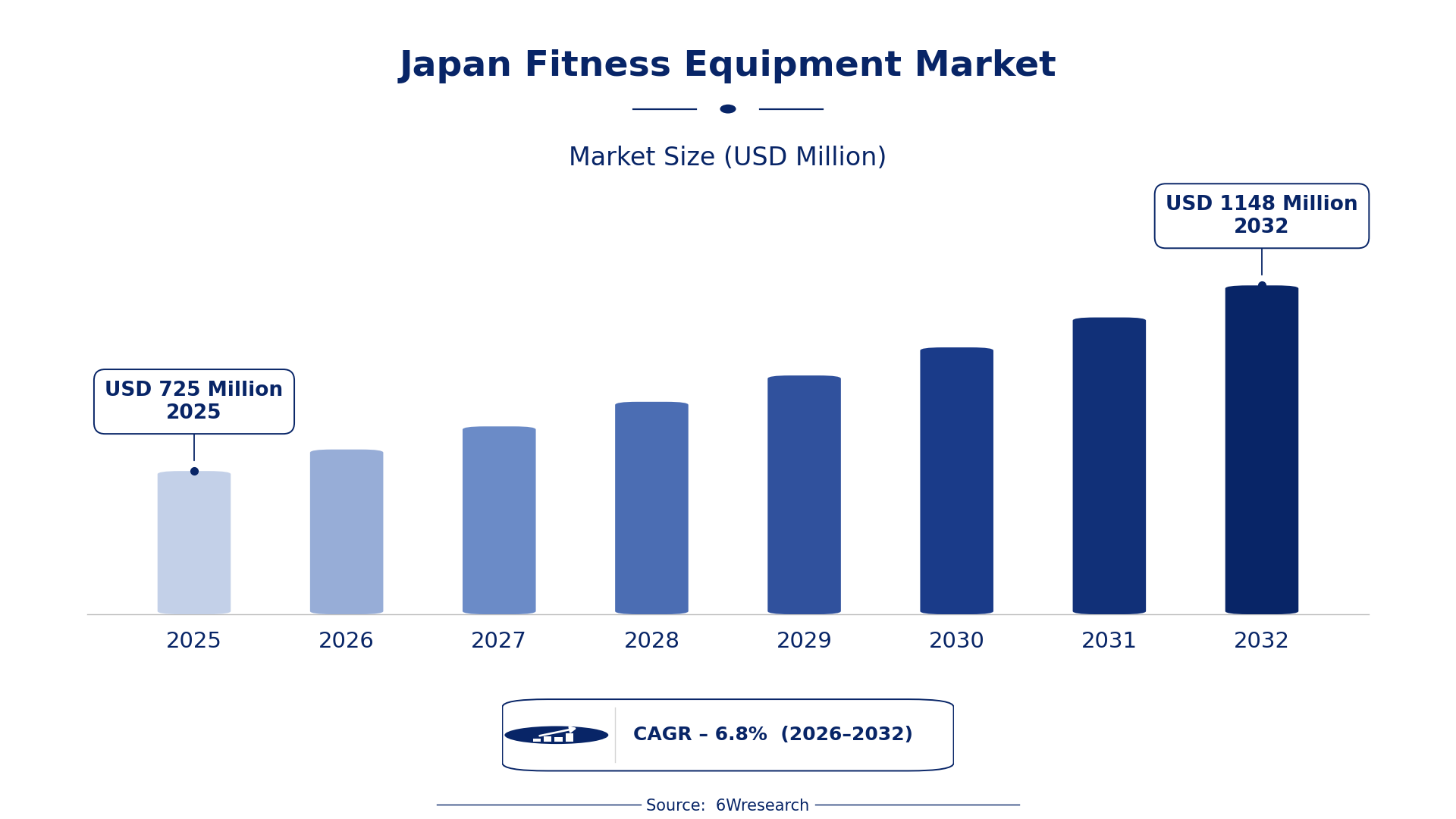
According to 6Wresearch internal database and industry insights, the Japan Fitness Equipment Market was valued at USD 725 Million in 2025 and is projected to reach USD 1,148 Million by 2032, growing at a CAGR of approximately 6.8% during 2026–2032.
Japan Fitness Equipment Market Highlights
| Report Metric | Details |
| Report Name | Japan Fitness Equipment Market (2026-2032) |
| Market Size 2025 | USD 725 Million |
| Market Size 2032 | USD 1,148 Million |
| Absolute Growth 2025–2032 | USD 423 Million |
| CAGR 2026–2032 | 6.8% |
| Peak Annual Growth | 7.5% in 2027 |
| Forecast Period | 2026–2032 |
| Historical Data | 2022–2025 |
| Base Year | 2025 |
| Leading Types, 2025 | Cardiovascular Equipment (63% share) |
| Leading End User, 2025 | Gyms & Health Clubs (44% share) |
| Leading Regions, 2025 | Kanto (34% share) |
| Fastest-Growing Types | Strength Equipment and Others (9.2% CAGR) |
| Fastest-Growing End User | Commercial fitness Centers (8.8% CAGR) |
| Fastest-Growing Regions | Chubu (9.0% CAGR) |
| Growing Sector | Gyms & Health Clubs |
| Key End Users | Gyms, Health Clubs, Commercial Fitness Centers, Residential Facilities |
Japan Fitness Equipment Market Year-wise Growth Rate and Key Drivers (2022–2032)
This graph illustrates the annual growth rates of the market from 2022 to 2032, highlighting a steady upward trajectory and projected market expansion over the forecast period.
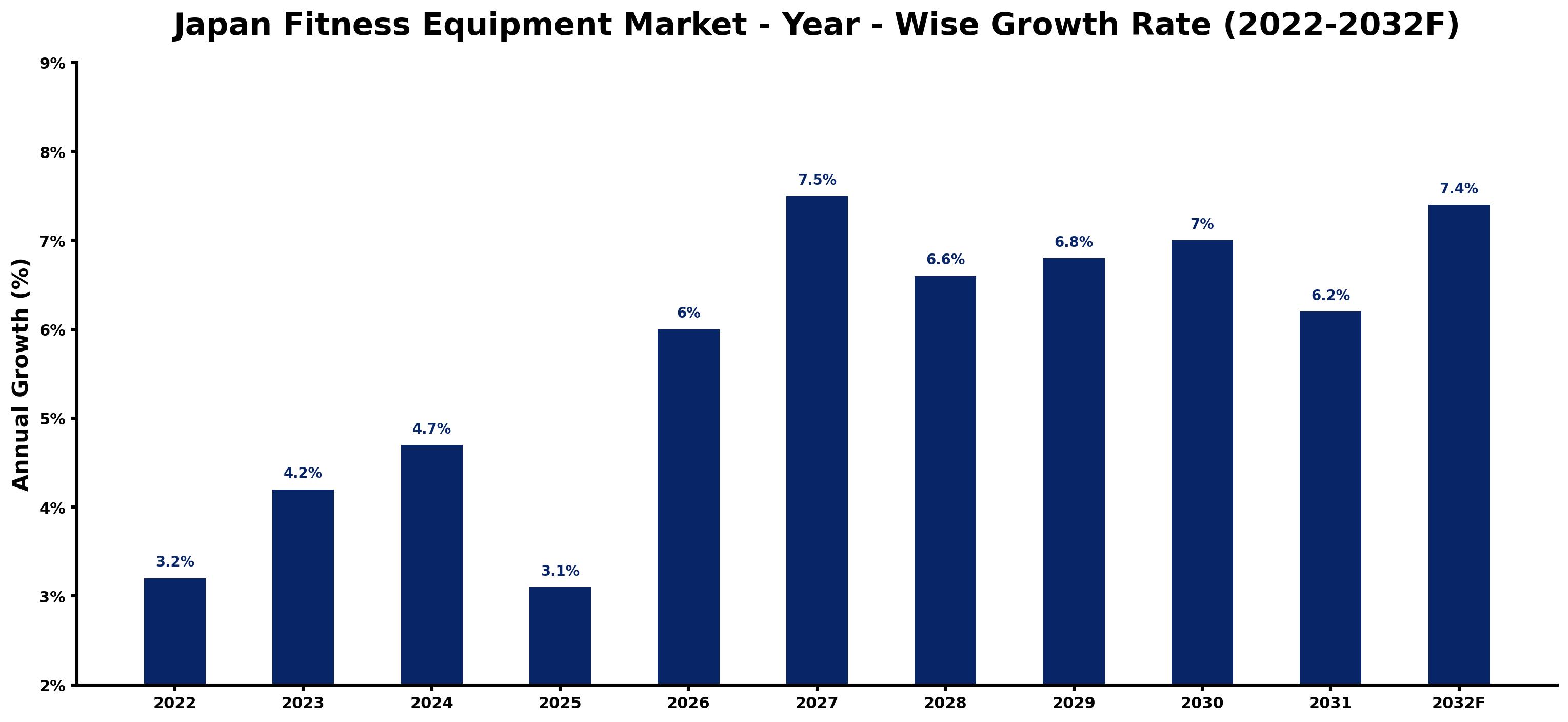
Year by year, the estimates below pair each growth rate with the development that shaped it.
| Year | Estimated Annual Growth (%) | Market Rationale |
| 2022 | 3.2 | The market saw steady growth as interest in fitness continued to rise among the population. |
| 2023 | 4.2 | Demand increased due to heightened awareness of health and fitness trends. |
| 2024 | 4.7 | Growth accelerated as more gyms opened, attracting a larger membership base. |
| 2025 | 3.1 | Growth slowed slightly as market saturation began to impact new gym openings. |
| 2026 | 6.0 | The market is expected to expand rapidly as investment in fitness infrastructure increases. |
| 2027 | 7.5 | Peak growth will be driven by a surge in the popularity of strength training and fitness classes. |
| 2028 | 6.6 | Growth is projected to moderate as the market stabilises after reaching peak levels. |
| 2029 | 6.8 | Demand will rise as commercial fitness centers expand their offerings and services. |
| 2030 | 7.0 | The market will continue to grow as urban populations seek convenient fitness solutions. |
| 2031 | 6.2 | Growth will decelerate slightly as competition among fitness providers intensifies. |
| 2032 | 7.4 | Demand will increase as more health initiatives encourage physical activity among citizens. |
Note: Market size estimations and growth projections presented in this report are based on 6Wresearch's proprietary forecasting methodology, utilizing the latest available industry data, government publications, and primary research inputs.
Japan Fitness Equipment Market Synopsis
Fitness equipment includes machines and tools designed for exercise, constructed from materials such as steel and rubber. Gyms and health clubs are the primary users, catering to a growing population interested in fitness. The Japan Fitness Equipment Market is growing due to increasing health consciousness, urbanisation, and greater investment in fitness facilities. With a population exceeding 125 million, Japan's demand for fitness equipment stems from both personal and commercial sectors, particularly in urban areas like Tokyo, which is home to over 1,500 gyms and health clubs.
Market Dynamics Impact Analysis (2026–2032)
| Factor | Type | Impact | Primary Segment Affected |
| Increasing health consciousness among the population | Driver | High | Gyms & Health Clubs |
| Growth of commercial fitness centers offering diverse services | Driver | High | Commercial fitness Centers |
| Rising demand for home fitness solutions | Opportunity | Medium | Residential facilities |
| Expansion of fitness initiatives promoting physical activity | Opportunity | Medium | Gyms & Health Clubs |
| Market saturation in urban areas limiting new gym openings | Restraint | High | Gyms & Health Clubs |
| High costs associated with maintaining equipment standards | Restraint | Medium | Strength Equipment and Others |
| Competition among fitness providers leading to price wars | Challenge | High | Commercial fitness Centers |
| Rising operational costs due to wage increases | Challenge | Medium | Gyms & Health Clubs |
Evaluation of Drivers in Japan Fitness Equipment Market (2026–2032)
The following drivers explain most of the expected growth.
| Drivers | Primary Segment Affected | Why It Matters (Evidence) |
| Growing health awareness driving gym memberships | Gyms & Health Clubs | In 2023, Tokyo's gyms saw a 10% increase in memberships as health awareness rose. |
| Urbanisation leading to higher fitness facility demand | Gyms & Health Clubs | Japan's urban population growth fuels demand for fitness equipment in metropolitan areas. |
| Increase in home workout trends | Residential facilities | Sales of residential fitness equipment surged by 10% in 2023, reflecting changing consumer habits. |
| Expansion of commercial fitness centers | Commercial fitness Centers | Chubu region reported a 15% rise in commercial fitness centers since 2020, boosting equipment demand. |
| Government health initiatives promoting fitness | Gyms & Health Clubs | The 2023 health initiative aims to increase physical activity among citizens, driving gym attendance. |
Buyers are adding capacity as health awareness rises, resulting in increased gym memberships. In 2023, Tokyo's gyms experienced a 10% membership increase, driving demand for fitness equipment. Residential fitness equipment sales surged by 10% in 2023, reflecting a shift towards home workouts. Urban population growth fuels demand for fitness solutions in metropolitan areas, prompting higher equipment purchases.
Evaluation of Restraints in Japan Fitness Equipment Market
Below are the constraints most often cited by buyers and suppliers, with the segment each affects.
| Market Restraint | Primary Segment Affected | Why It Matters (Evidence) |
| Market saturation limiting new gym openings | Gyms & Health Clubs | In urban areas, the number of gyms has reached a saturation point, restricting growth opportunities. |
| High maintenance costs for fitness equipment | Strength Equipment and Others | Producers face rising costs to meet ISO 20957 safety standards, impacting pricing strategies. |
| Intense competition among fitness providers | Commercial fitness Centers | Price wars are common as providers compete for a limited customer base, affecting profitability. |
| Operational costs rising due to wage increases | Gyms & Health Clubs | Japan's national minimum wage rose to JPY 1,055 per hour in October 2024, increasing operational expenses. |
| Limited consumer spending on fitness equipment | Residential facilities | Economic uncertainties have led to cautious consumer spending, affecting equipment sales. |
Japan Fitness Equipment Market Challenges
Producers face rising costs as Japan's national minimum wage reaches JPY 1,055 per hour, which forces them to increase prices and reduces profit margins for gyms. Buyers experience supply chain delays due to challenges in sourcing quality materials like steel and rubber, impacting the availability of fitness equipment in urban areas. Stricter compliance with ISO 20957 and JIS standards complicates manufacturing processes, resulting in longer lead times that limit product options for retailers. Skills shortages in the workforce hinder producers' ability to innovate, ultimately restricting choices for consumers seeking diverse fitness solutions.
Trends in the Japan Fitness Equipment Market
Four trends stand out in the Japan Fitness Equipment Market.
- Shift in Consumer Preferences towards Home Workouts: Residential facilities are seeing a rise in demand for home fitness equipment as consumers prioritise convenience. In 2023, sales of residential fitness equipment increased by 10%, reflecting this trend.
- Expansion of Commercial Fitness Centers: The Chubu region has experienced a 15% growth in commercial fitness centers since 2020, indicating a shift towards diverse fitness offerings. This expansion drives demand for a wider range of fitness equipment.
- Increased Focus on Health Initiatives: Government health initiatives launched in 2023 aim to boost physical activity among citizens, resulting in higher gym attendance. This trend is expected to further increase demand for fitness equipment.
- Emergence of Strength Training Popularity: Strength training is becoming increasingly popular among fitness enthusiasts, leading to a surge in demand for strength equipment. The strength equipment segment is projected to grow at a CAGR of 9.2% from 2026 to 2032.
Investment Opportunities in the Japan Fitness Equipment Market
The openings below show where demand in the Japan Fitness Equipment Market is visible and how suppliers can enter.
- Rising Demand for Home Fitness Solutions: With residential fitness equipment sales increasing by 10% in 2023, there is an opportunity to supply home workout equipment. Targeting urban consumers who prefer convenience can yield high returns.
- Expansion of Fitness Initiatives: The government's 2023 health initiative to promote physical activity opens avenues for investment in fitness programmes. Collaborating with local gyms can enhance outreach and participation.
- Growth in Commercial Fitness Centers: The Chubu region's 15% rise in commercial fitness centres presents an opportunity to supply diverse fitness equipment. Establishing partnerships with these centres can facilitate market entry.
- Increasing Urban Fitness Culture: As urban populations grow, the demand for fitness solutions will rise. Focusing on metropolitan areas like Tokyo can provide substantial market opportunities.
Government Initiatives in the Japan Fitness Equipment Market
The Industrial Safety and Health Act of 1972 mandates employers to ensure safety standards for fitness equipment, impacting producers who must comply with rigorous testing and certification. The Act on the Rational Use of Energy, established in 1979, requires large fitness facilities to improve energy efficiency, influencing operational practices.
In 2023, the government allocated funds for community fitness programmes to promote health, administered by the Ministry of Health, Labour and Welfare. This funding supports local initiatives aimed at increasing physical activity among citizens.
Future Insight of the Japan Fitness Equipment Market
Urban consumers will increasingly seek fitness equipment as health awareness grows. By 2032, technology will drive the development of interactive fitness tools, improving user experience and engagement. The government's health initiative will support community fitness programmes, encouraging broader participation in physical activities. An anticipated rise in the number of fitness clubs will enhance access to quality fitness solutions, creating a more competitive environment for suppliers.
Market Segmentation Analysis
Japan Fitness Equipment Market report covers a detailed analysis of the following market segments:
By Types – Cardiovascular Equipment Leads, Strength Equipment and Others Expected to Grow Fastest
According to Ravi Bhandari, Research Head at 6Wresearch, Cardiovascular Equipment held 63% of the Japan Fitness Equipment Market by types in 2025. Cardiovascular equipment holds the largest share due to its widespread use in promoting aerobic exercise and heart health, appealing to a broad demographic. For instance, many gyms in urban areas prioritise these machines to attract fitness enthusiasts. Over 2026–2032, Strength Equipment and Others are expected to post the fastest growth, at a CAGR of 9.2%. Strength equipment and others are experiencing rapid growth as more individuals focus on muscle building and overall fitness, particularly following the government's health initiative launched in 2023. This trend is evidenced by a 15% rise in commercial fitness centers in the Chubu region since 2020. Suppliers should focus on expanding their strength equipment offerings to meet rising consumer demand.
By End User – Gyms & Health Clubs Lead, Commercial fitness Centers Expected to Grow Fastest
In 2025, Gyms & Health Clubs led the end user split with a 44% share. Gyms and health clubs dominate the market as the primary users of fitness equipment, catering to a large membership base seeking diverse workout options. The high number of facilities in regions like Kanto further solidifies their leading position. Commercial fitness Centers are projected to grow fastest, at a CAGR of 8.8% during 2026–2032. Commercial fitness centers are growing quickly, driven by the increasing variety of fitness services and equipment they provide, which aligns with the rising interest in fitness among the population. The 15% growth in such centers in the Chubu region highlights this trend. Buyers should consider partnerships with commercial fitness centers to access a wider range of fitness solutions.
By Regions – Kanto Leads, Chubu Expected to Grow Fastest
Kanto took 34% of regions revenue in 2025, more than any other category. Kanto commands the largest share because it is a major metropolitan area with a high demand for fitness equipment among its urban population. The concentration of over 1,500 gyms and health clubs in this region exemplifies the robust fitness culture and consumer engagement. Chubu is set to record the highest CAGR in this split, 9.0% over 2026–2032. Chubu is witnessing the fastest growth due to a 15% increase in commercial fitness centers since 2020, which is attracting more fitness enthusiasts. This surge indicates a rising consumer preference for accessible fitness options, likely solidifying Chubu's market position. This suggests that suppliers should strategically target the Chubu region to capitalise on the expanding fitness market.
Key Attractiveness of the Report
- 10 Years of Market Numbers
- Historical Data Starting from 2022 to 2025
- Base Year 2025
- Forecast Data until 2032
- Key Performance Indicators Impacting the Market
- Major Upcoming Developments and Projects
Key Highlights of the Report:
• Japan Fitness Equipment Market Overview• Japan Fitness Equipment Market Outlook
• Market Size & Forecast of Global Fitness Equipment Revenues until 2032
• Japan Fitness Equipment Market Size & Japan Fitness Equipment Market Forecast of Revenues Market until 2032
• Market Size & Forecast of Japan Cardiovascular Training Equipment Market Revenues until 2032
• Market Size & Forecast of Japan Strength Training Equipment Market Revenues until 2032
• Market Size & Forecast of Japan Fitness Equipment Market Revenues, By Gyms & Health Clubs until 2032
• Market Size & Forecast of Japan Fitness Equipment Market Revenues, By Commercial Segment until 2032
• Market Size & Forecast of Japan Fitness Equipment Market Revenues, By Residential Segment until 2032
• Market Size & Forecast of Japan Fitness Equipment Market Volume, By Aged Care Facilities until 2032
• Market Size & Forecast of Japan Fitness Equipment Market Volume, By Corporate Wellness Centers until 2032
• Market Size & Forecast of Japan Fitness Equipment Market Volume, By Aerobic Centers until 2032
• Historical data and Forecast of Japan Fitness Equipment Market, By Regions
• Japan Fitness Equipment Market Drivers and Restraints
• Japan Fitness Equipment Market Trends and Industry Life Cycle
• Japan Fitness Equipment Market Value Chain Analysis, Porter's Five Forces Analysis and Opportunity Assessment
• Japan Fitness Equipment Market Share, by Players
• Japan Fitness Equipment Market Overview on Competitive landscape
• Company Profiles
• Key Strategic Pointers
Market Covered
Coverage by segment is as follows.
By Types
- Cardiovascular Equipment
- Strength Equipment and Others
By End User
- Gyms & Health Clubs
- Commercial fitness Centers
- Residential facilities
By Regions
- Kanto
- Chubu
- Kansai
- Shikoku
- Chugoku
- Hokkaido
- Tohoku
- Kyushu































