UAE Electric Vehicle Market Size & Growth Rate
According to 6Wresearch internal database and industry insights, the UAE Electric Vehicle Market was valued at USD 5 billion in 2025 and is projected to reach USD 31.37 billion by 2032, growing at a CAGR of approximately 30% during 2026–2032.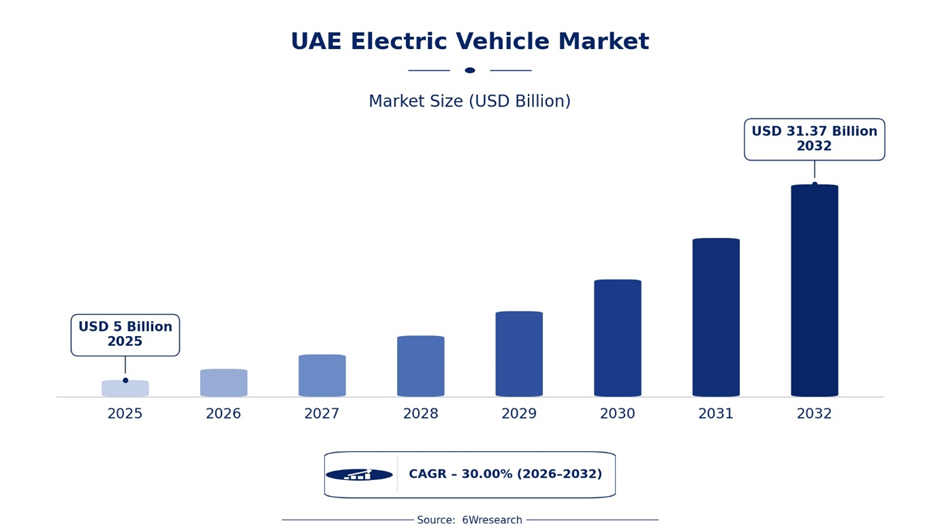
UAE Electric Vehicle Market Highlights
|
Report Metric |
Details |
|
Report Name |
UAE Electric Vehicle Market |
|
Market Size 2025 |
USD 5 billion |
|
Market Size 2032 |
USD 31.37 billion |
|
Absolute Growth 2025–2032 |
USD 26.37 billion |
|
CAGR 2026–2032 |
30% |
|
Peak Annual Growth |
32.2% in 2028 |
|
Forecast Period |
2026–2032 |
|
Historical Data |
2022–2025 |
|
Base Year |
2025 |
|
Leading Vehicle Types, 2025 |
Passenger Vehicle (78% share) |
|
Leading Regions, 2025 |
Northern (58% share) |
|
Fastest-Growing Vehicle Types |
Truck (37.0% CAGR) |
|
Fastest-Growing Regions |
Central (33.0% CAGR) |
|
Growing Sector |
Public transport and commercial fleet electrification |
|
Key End Users |
Private consumers, taxi and ride-hailing operators, public transport authorities, logistics and delivery fleets, rental companies, corporate and government fleets |
UAE Electric Vehicle Market Year-wise Growth Rate and Key Drivers (2022–2032)
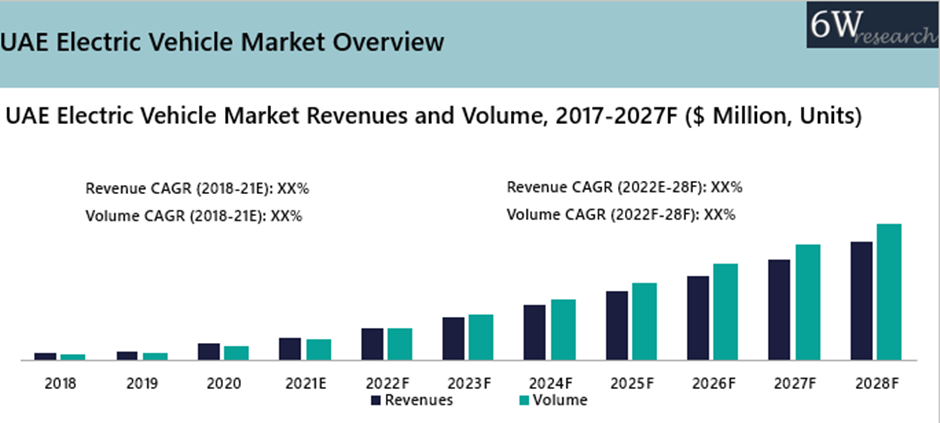
This graph illustrates the annual growth rates of the market from 2022 to 2032, highlighting a steady upward trajectory and projected market expansion over the forecast period.
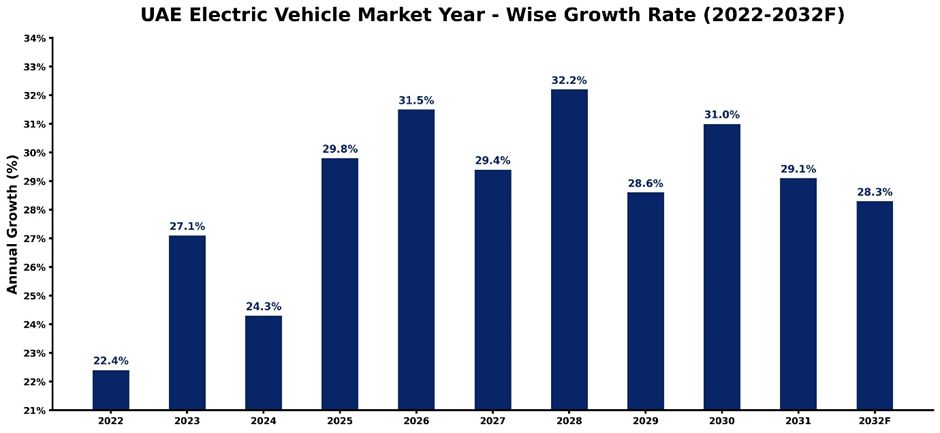
The following table presents the estimated annual growth rate for each year together with the principal factor influencing market performance. The values are intended to highlight year-specific drivers rather than to provide a direct comparison between individual years.
| Year | Estimated Annual Growth (%) | Market Rationale |
| 2022 | 22.4% | Post-pandemic recovery and the Expo 2020 Dubai showcase lifted early EV awareness, though volumes stayed on a small base. |
| 2023 | 27.1% | COP28 preparations and wider Green Charger coverage in Dubai raised buyer confidence and public charging access. |
| 2024 | 24.3% | Growth eased as early-adopter demand matured and global price cuts, led by Tesla, reduced average vehicle values. |
| 2025 | 29.8% | Wider Chinese brand availability and EVs reaching about 9% of new vehicle sales accelerated adoption. |
| 2026 | 31.5% | Continued Dubai bus deliveries through 2026 and the EV World exhibition in November are expected to widen institutional demand. |
| 2027 | 29.4% | Growth is expected to ease as the first public procurement cycles conclude and fleet buyers pause for evaluation. |
| 2028 | 32.2% | Dubai taxi and limousine conversion towards its 2040 target and lower battery costs are expected to accelerate volumes. |
| 2029 | 28.6% | Growth is expected to ease as early private-buyer demand matures and used-EV supply starts competing with new sales. |
| 2030 | 31% | Dubai’s 2030 target of over 15% EV fleet share and bus electrification milestones are expected to lift registrations. |
| 2031 | 29.1% | Growth is expected to moderate as charging retrofits in older residential stock and grid upgrade timelines slow incremental adoption. |
| 2032 | 28.3% | Rates are expected to settle as the larger base limits percentage gains despite continued absolute expansion. |
Note: Market size estimations and growth projections presented in this report are based on 6Wresearch’s proprietary forecasting methodology, utilizing the latest available industry data, government publications, and primary research inputs.
UAE Electric Vehicle Market Synopsis
The UAE Electric Vehicle Market is predicted to increase at a fierce pace through 2032. The industry includes battery electric and plug-in hybrid passenger cars, two-wheelers, buses and trucks sold for road use across the emirates. Industry expansion is shaped by the UAE Net Zero 2050 commitment, charging expansion across all seven emirates, wider Chinese brand availability and public fleet conversion led by Dubai’s Roads and Transport Authority. Competition is intensifying as global manufacturers, local distributors and utility-backed charging operators build integrated ownership offers, making the country the Middle East’s leading electric vehicle sales hub and a reference point for regional policy design.
Market Dynamics Impact Analysis (2026–2032)
|
Factor |
Type |
Impact |
Primary Segment Affected |
|
Rapid expansion of public charging networks |
Driver |
High |
Passenger Vehicle |
|
Electrification of public transport and taxi fleets |
Driver |
High |
Bus |
|
Electrification of last-mile delivery and logistics fleets |
Opportunity |
High |
Truck |
|
Battery swapping and electric motorcycles for delivery riders |
Opportunity |
Medium |
Two-Wheeler |
|
Higher upfront prices compared with combustion models |
Restraint |
High |
Passenger Vehicle |
|
Import dependence and long delivery lead times |
Restraint |
Medium |
Bus |
|
Uneven charging access across emirates and operators |
Challenge |
High |
Passenger Vehicle |
|
Shortage of high-voltage service technicians |
Challenge |
Medium |
Truck |
Evaluation of Drivers in the UAE Electric Vehicle Market (2026–2032)
Below mentioned are some major drivers and their influence on the market dynamics:
|
Drivers |
Primary Segment Affected |
Why It Matters (Evidence) |
|
Expansion of public charging networks |
Passenger Vehicle |
Wider public and fast charging reduces range anxiety and makes ownership practical for residents who cannot install home chargers, which converts interest into purchases. The country now has about 2,800 charging points, including roughly 1,250 DC units. |
|
Electrification of public bus fleets |
Bus |
Authority-led procurement gives manufacturers predictable, volume-based orders and gives charging suppliers long-term depot contracts. Dubai’s RTA received 250 buses in January 2026 under a 735-bus contract, including 40 electric units. |
|
Long-term national electrification targets |
Passenger Vehicle |
Published targets signal sustained demand to importers, lenders and charging investors, which supports stock commitments and infrastructure funding. The national goal is for electric and hybrid vehicles to reach 50% of vehicles on the road by 2050. |
|
Entry of competitively priced Chinese brands |
Passenger Vehicle |
Lower-priced models widen the buyer pool beyond premium customers and raise competition on features and warranties. Tesla’s share of Middle East EV sales has fallen from about half in 2020 to around 15% as new brands entered. |
|
Electrification of taxi and limousine fleets |
Northern |
High-mileage fleet vehicles benefit most from lower running costs, and each conversion adds daily public exposure to electric vehicles. Electric vehicles now make up 19% of Dubai’s taxi and limousine fleet, ahead of the 2026 target. |
UAE Electric Vehicle Market Growth is underpinned by the purchasing power of a resident population of around 11 million, which sustains frequent vehicle replacement and early uptake of new technology. Falling battery pack costs are narrowing the price gap with combustion models. The UAE accounts for almost half of the Middle East’s electric vehicle sales, which supports manufacturers to prioritise it for allocation, early launches and regional distribution hubs. Premium dealership groups are expanding service workshops and certified pre-owned programmes, strengthening ownership confidence. A large tourism and car-rental base exposes visitors to electric vehicles, building familiarity that later converts into purchases.
Evaluation of Restraints in the UAE Electric Vehicle Market
Below mentioned are some major restraints and their influence on the market dynamics:
|
Market Restraint |
Primary Segment Affected |
Why It Matters (Evidence) |
|
High upfront purchase prices |
Passenger Vehicle |
Higher sticker prices than comparable combustion models extend payback periods and deter mass-market buyers, even where running costs are lower. Battery electric vehicles accounted for only 6–8% of new vehicle sales in 2025. |
|
Limited home charging access in multi-tenant buildings |
Northern |
Many residents rent apartments where landlords or building managers control electrical upgrades, which delays home charger installation. Dubai’s entire public network stood at 2,223 points in early 2026, so public charging cannot yet substitute for home charging at scale. |
|
Import dependence and delivery lead times |
Bus |
The market relies on overseas manufacturers, so delivery schedules depend on export allocations and shipping. Dubai’s 735-bus contract is being delivered in tranches through 2026 rather than in a single shipment. |
|
Relatively low fuel costs |
Truck |
Low pump prices narrow the running-cost advantage of electric propulsion, particularly for operators weighing payback on high-mileage vehicles. Fuel prices have been set under a monthly deregulated mechanism since August 2015. |
|
Summer heat and range concerns |
Passenger Vehicle |
Extreme temperatures raise air-conditioning load and stress battery thermal systems, reducing real-world range and increasing buyer caution. Summer daytime temperatures frequently exceed 45°C in much of the country. |
UAE Electric Vehicle Market Challenges
The UAE Electric Vehicle Industry faces several structural challenges. Charging access remains uneven as tariffs and operating rules differ across emirates and providers, and an estimated 45,000 public points would be needed to meet national targets. In addition, many buyers choose hybrids as a lower-risk step, with hybrids above 72% of Dubai’s taxi and limousine fleet, diverting spending away from fully electric models. Heavy-duty operators need depot grid reinforcement before electric buses can approach the 10% share targeted for public transport, which delays charging-ready deliveries. Additionally, skilled high-voltage technicians are scarce outside dealer networks, lengthening downtime and raising servicing costs for independent fleet operators.
Trends in the UAE Electric Vehicle Market
Key market trends influencing UAE Electric Vehicle Market are presented below:
- Transition from Utility-Only to Multi-Operator Charging Networks: Dubai’s public network reached 2,223 charging points by early 2026, comprising DEWA stations and units run by licensed private providers. The model is attracting fuel retailers, developers and technology firms into charging. It favours equipment suppliers and software platforms that can support roaming, billing and uptime across operators.
- High-Power Charging Prioritised over Slow AC Points: Public charging is shifting from slow AC points towards direct-current and high-power units, with roughly 350 high-power chargers now operating nationwide. Faster charging suits long-distance travel between emirates and shorter dwell times at retail and fuel sites. Suppliers of high-capacity chargers, power electronics and grid-connection services stand to gain from this change in specification.
- Autonomous Electric Taxis Emerging as a Commercial Mobility Use Case: Abu Dhabi and Dubai are moving robotaxi services from pilots towards commercial operations, using electric vehicles fitted with autonomous driving systems. Early deployments by international technology firms in partnership with local authorities are building operating experience. The trend creates demand for purpose-built fleets, depot charging and sensor and software suppliers.
Investment Opportunities in the UAE Electric Vehicle Market
Strategic investment opportunities in the UAE Electric Vehicle Market include the following:
- Depot Charging and Electric Bus Support Services: Public transport authorities are scaling electric bus fleets, which creates immediate demand for depot infrastructure. Opportunities lie in depot chargers, energy management systems, battery health diagnostics and maintenance contracts. Suppliers can enter by partnering with bus manufacturers already delivering to the authorities, or by bidding for charging and maintenance packages in public tenders.
- Electric Light Commercial and Last-Mile Delivery Fleets: E-commerce, food delivery and logistics operators are under pressure to cut fuel and servicing costs, and corporate emission goals favour electric vans, light trucks and delivery motorcycles. Investors can offer fleet leasing, battery-as-a-service and charging-as-a-service. Entry is through partnerships with logistics operators and locations in free zones such as JAFZA or KEZAD.
- Battery Servicing, Refurbishment and Recycling: The first generation of electric vehicles sold in the UAE is ageing, so demand for diagnostics and refurbishment is emerging. Investors can set up battery health testing, repair and second-life storage facilities. Entry is through OEM-authorised service partnerships and licensed waste-handling approvals from environmental authorities.
Leading Players in UAE Electric Vehicle Market
A comprehensive listing of prominent companies in the UAE Electric Vehicle Market is provided below:
1. Tesla
|
Company Name |
Tesla |
|---|---|
|
Established Year |
2003 |
|
Headquarters |
Austin, United States |
|
Official Website |
Tesla designs and sells battery electric vehicles and energy products and is a prominent premium brand in the UAE, supported by showrooms, service centres and a dedicated charging network.
2. BYD Company
|
Company Name |
BYD Company |
|---|---|
|
Established Year |
1995 |
|
Headquarters |
Shenzhen, China |
|
Official Website |
BYD manufactures battery electric and plug-in hybrid vehicles, buses and batteries, and serves UAE customers through an authorised dealer network across the emirates.
3. Al-Futtaim Group
|
Company Name |
Al-Futtaim Group |
|---|---|
|
Established Year |
1930 |
|
Headquarters |
Dubai, UAE |
|
Official Website |
Al-Futtaim Group is a diversified business group whose automotive arm distributes and services several global brands, including electric and hybrid models, across the UAE.
Government Initiatives in the UAE Electric Vehicle Market
The UAE Net Zero by 2050 Strategic Initiative, announced in 2021, anchors the policy framework, supported by the UAE Energy Strategy 2050 and its 50% clean energy target. The National Electric Vehicles Policy aims for electric and hybrid vehicles to account for 50% of vehicles on UAE roads by 2050, while Dubai targets more than 15% electric vehicle share in its fleet by 2030.
Implementation is led by DEWA’s EV Green Charger initiative, which had registered more than 11,000 owners by mid-2023, and by Dubai’s Roads and Transport Authority under its Zero-Emission Public Transport Strategy 2050, which targets all buses on electric and hydrogen power by 2050 and all taxis by 2040. In Abu Dhabi, the E2GO venture between TAQA and ADNOC Distribution builds and operates charging infrastructure.
Future Insights of the UAE Electric Vehicle Market
The UAE Electric Vehicle Market is predicted to increase at a fierce pace through 2032. Dubai’s Clean Energy Strategy targets 75% clean energy by 2050 and the UAE Green Agenda runs to 2030, which will lower the carbon intensity of every kilometre driven on electricity. In addition, smart charging and vehicle-to-grid platforms will let utilities schedule charging when solar output is highest, making large-scale electrification easier to absorb. Advances in high-energy-density battery chemistries will extend driving range and shorten charging times, widening the appeal of electric ownership. Moreover, expanding in-country servicing, assembly and component supply capacity will shorten delivery cycles and deepen ownership support.
Market Segmentation Analysis
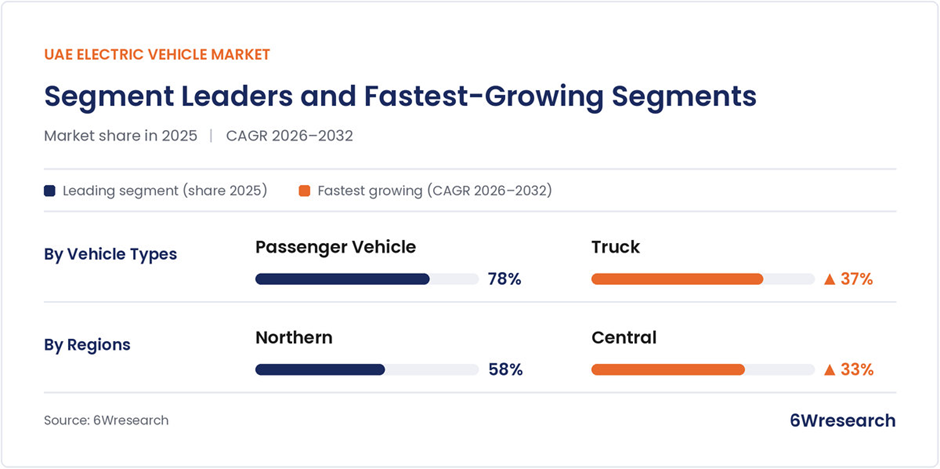
The report offers a comprehensive study of the market across its key segments. The chart below highlights the leading segment by market share in 2025 and the fastest-growing segment by CAGR over 2026–2032, followed by a detailed analysis of each segment.
By Vehicle Types – Passenger Vehicle Leads, Truck Expected to Grow Fastest
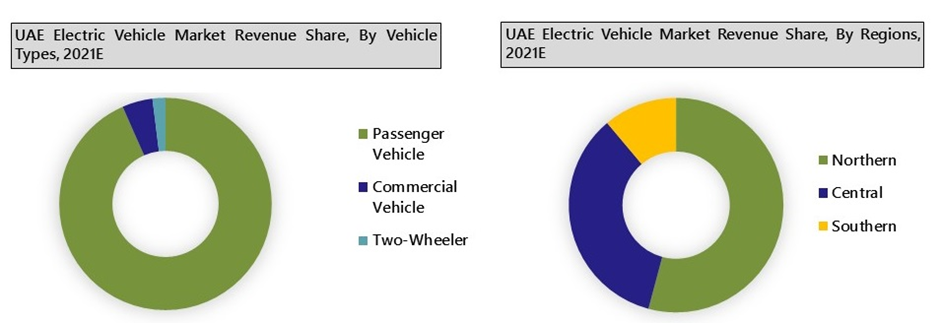
According to Ravi Bhandari, Research Head at 6Wresearch, Passenger Vehicle leads the market with a 78% UAE Electric Vehicle Market Share in 2025, supported by high household incomes, the widening model line-ups of premium and Chinese brands, and the adoption of electric cars by Dubai’s taxi and limousine operators. In parallel, Truck is expected to grow fastest at a CAGR of 37.0% during 2026–2032, as logistics and free-zone operators electrify last-mile and port-linked haulage to cut operating costs and meet corporate emission goals.
By Regions – Northern Leads, Central Expected to Grow Fastest
The Northern region held the largest industry share at 58% in 2025, as Dubai and the neighbouring emirates host the densest public charging network, the largest dealership clusters and the highest concentration of taxi and ride-hailing fleets. At the same time, Growth is led by the Central region, which is projected to record the fastest CAGR of 33% over 2026–2032 as Abu Dhabi expands charging infrastructure through E2GO and procures more public and commercial fleet vehicles.
Key Attractiveness of the Report
- 10 Years of Market Numbers
- Historical Data Starting from 2022 to 2025
- Base Year 2025
- Forecast Data until 2032
- Key Performance Indicators Impacting the Market
- Major Upcoming Developments and Projects
Key Highlights of the Report:
- UAE Electric Vehicle Market Outlook
- Market Size of UAE Electric Vehicle Market, 2025
- Forecast of UAE Electric Vehicle Market, 2032
- Historical Data and Forecast of Electric Vehicle Revenues & Volume for the Period 2022-2032
- UAE Electric Vehicle Market Trend Evolution
- UAE Electric Vehicle Market Drivers and Challenges
- Electric Vehicle Price Trends
- Electric Vehicle Porter’s Five Forces
- Electric Vehicle Industry Life Cycle
- Historical Data and Forecast of UAE Electric Vehicle Market Revenues & Volume By Vehicle Types for the Period 2022-2032
- Historical Data and Forecast of UAE Electric Vehicle Market Revenues & Volume By Passenger Vehicle for the Period 2022-2032
- Historical Data and Forecast of UAE Electric Vehicle Market Revenues & Volume By Two-Wheeler for the Period 2022-2032
- Historical Data and Forecast of UAE Electric Vehicle Market Revenues & Volume By Bus for the Period 2022-2032
- Historical Data and Forecast of UAE Electric Vehicle Market Revenues & Volume By Truck for the Period 2022-2032
- Historical Data and Forecast of UAE Electric Vehicle Market Revenues & Volume By Regions for the Period 2022-2032
- Historical Data and Forecast of UAE Electric Vehicle Market Revenues & Volume By Northern for the Period 2022-2032
- Historical Data and Forecast of UAE Electric Vehicle Market Revenues & Volume By Central for the Period 2022-2032
- Historical Data and Forecast of UAE Electric Vehicle Market Revenues & Volume By Southern for the Period 2022-2032
- Electric Vehicle Import Export Trade Statistics
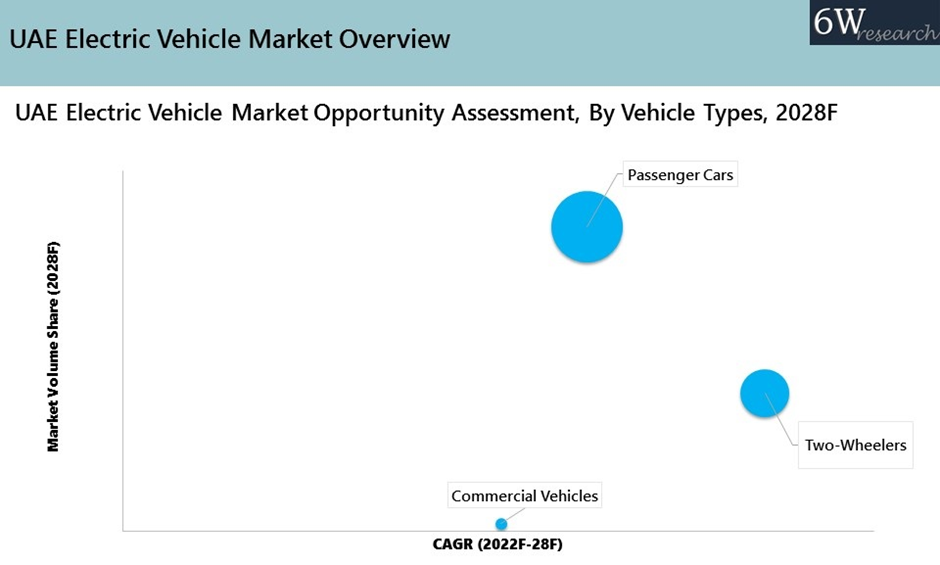
- Market Opportunity Assessment By Vehicle Types
- Market Opportunity Assessment By Regions
- Electric Vehicle Top Companies Market Share
- Electric Vehicle Competitive Benchmarking By Technical and Operational Parameters
- Electric Vehicle Company Profiles
- Electric Vehicle Key Strategic Recommendations
Market Covered
The report offers an extensive study of the following market segments.
By Vehicle Types
- Passenger Vehicle
- Two-Wheeler
- Bus
- Truck
By Regions
- Northern
- Central
- Southern