Algeria Automotive Wheel Rims Market Size, Share & Growth Rate
The Algeria Automotive Wheel Rims Market was estimated at USD 466 Million in 2025 and is projected to reach USD 648 Million by 2032, growing at a CAGR of 4.8% from 2026 to 2032. This promising trajectory is largely driven by increasing vehicle sales and a heightened consumer interest in vehicle customization. The market's growth is bolstered by the rising popularity of lightweight alloy rims, which are favored for their aesthetic appeal and enhanced performance.
Algeria Automotive Wheel Rims Market Year-wise Growth Rate and Key Drivers
This graph highlights how the Algeria Automotive Wheel Rims Market has steadily grown over the years, supported by major growth factors.
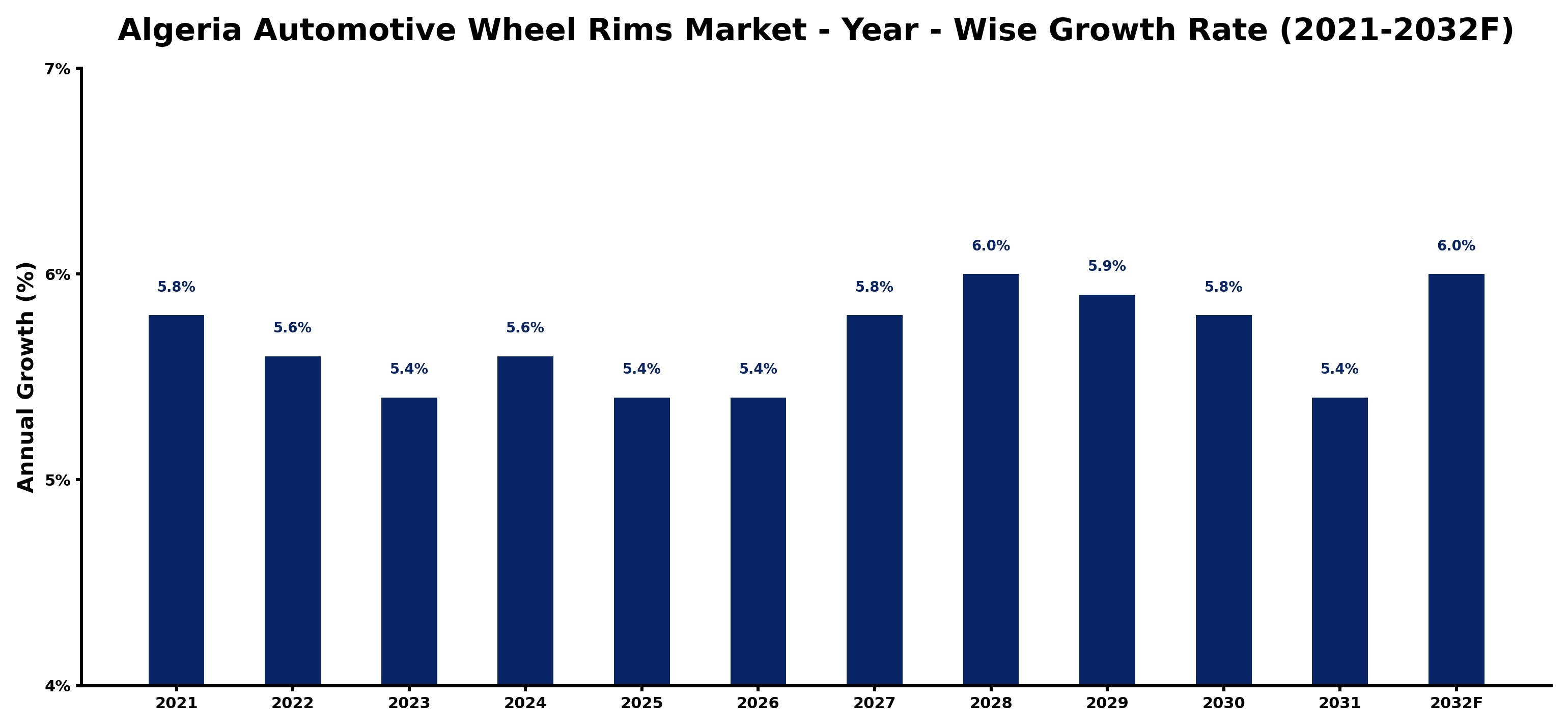
The table below presents the year‑wise growth rates along with the key drivers influencing the market
| Year | Growth Rate | Major Drivers |
| 2021 | 5.8% | Rising vehicle production demands rims |
| 2022 | 5.6% | Increased consumer vehicle purchases |
| 2023 | 5.4% | Enhanced automotive design trends emerged |
| 2024 | 5.6% | Growing demand for lightweight materials |
| 2025 | 5.4% | Expansion of local manufacturing facilities |
| 2026 | 5.4% | Technological advancements in rim production |
| 2027 | 5.8% | Increased aftermarket customization options |
| 2028 | 6.0% | Sustainability trends influenced materials choice |
| 2029 | 5.9% | Growth in electric vehicle market |
| 2030 | 5.8% | Rising demand for high-performance rims |
| 2031 | 5.4% | Industrial activity supported growth |
| 2032 | 6.0% | Increased collaboration with automotive brands |
Note - Market size estimations and growth projections presented in this report are based on 6Wresearch's advanced forecasting approach, validated with industry datasets as of June 2026.
Algeria Automotive Wheel Rims Market Synopsis
In recent years, the Algeria Automotive Wheel Rims Market has gained momentum as vehicle ownership becomes more widespread. As consumers place greater emphasis on personalization and premium quality, manufacturers are expanding their offerings to include innovative designs and materials. Looking forward, this market is set for sustained growth as advancements in technology and shifting consumer preferences shape future demand.
While the current landscape shows a robust interest in wheel rim customization, the market is evolving towards greater sustainability and enhanced functionality. The increasing adoption of electric vehicles further complicates this landscape, as specialized rims become necessary to meet the specific demands of these innovative vehicles. As competition intensifies, innovation will be key in capturing and retaining consumer interest.
Algeria Automotive Wheel Rims Market Key Takeaways
- Growing vehicle sales and demand for customization are driving market expansion.
- Lightweight materials like aluminum alloy and carbon fiber are increasingly favored.
- Innovation in design and materials is essential for remaining competitive.
- Government incentives are encouraging local manufacturing and investment.
- Specialized products are emerging to meet the needs of electric vehicle users.
Evaluation of Restraints in Algeria Automotive Wheel Rims Market
Several real restraints are limiting the potential of the Algeria Automotive Wheel Rims Market. Fluctuating raw material prices pose a significant challenge, potentially leading to increased production costs that could squeeze profit margins for manufacturers. In addition, competition from imported wheel rims—often produced at lower costs—threatens local players. Quality assurance and compliance with international standards also serve as barriers for producers, while economic fluctuations can lead to unpredictable consumer demand, creating uncertainty in sales forecasts.
Algeria Automotive Wheel Rims Market Trends
The market is witnessing a significant shift toward lightweight and durable materials, with aluminum alloys and carbon fiber gaining prominence. This trend is motivated by the dual goals of improved fuel efficiency and enhanced performance. Moreover, manufacturers are increasingly prioritizing innovative designs, unique finishes, and larger rim sizes to attract consumers looking for stylish and custom solutions. There is also a notable rise in demand for specialized wheel rims designed for electric vehicles, focused on aerodynamics and weight reduction.
Algeria Automotive Wheel Rims Market Opportunities
The growth trajectory of the Algeria Automotive Wheel Rims Market reveals promising investment opportunities, particularly in high-quality manufacturing. Establishing facilities that produce durable and stylish wheel rims aligns perfectly with the growing aftermarket and customization trends. Collaboration with local automotive manufacturers offers lucrative possibilities to supply rims for new vehicles, enhancing both market share and brand reputation. As consumer preferences continue to evolve, investments in innovative materials will also be vital for capturing emerging demand.
Government Initiatives in the Algeria Automotive Wheel Rims Market
The Algerian government has implemented various supportive measures aimed at bolstering the automotive industry, including the Automotive Industry Development Plan, which promotes local production and attracts foreign investment. Incentives such as tax breaks, subsidies, and import duty reductions are offered to manufacturers, fostering a competitive environment for local suppliers. Additionally, the National Investment Development Agency provides support to companies looking to invest in the sector, ultimately benefiting the wheel rims market through increased demand for domestically produced components.
Future Insights of the Algeria Automotive Wheel Rims Market
Looking ahead to 2026-2032, the Algeria Automotive Wheel Rims Market is set to expand further, driven by continuous improvements in consumer income levels and ongoing vehicle sales growth. The market is likely to embrace technological advancements, focusing on the development of lightweight alloy wheel rims that enhance fuel efficiency and overall aesthetics. Additionally, consumer trends will shift towards more sustainable and customizable options, necessitating that manufacturers adapt and innovate to meet evolving demands. As such, a proactive approach to market changes will be critical for success.
Algeria Automotive Wheel Rims Market Latest Developments (May 2025 - June 2026)
Recent developments in the Algeria Automotive Wheel Rims Market indicate a strong focus on innovation, particularly in the areas of material technology and design enhancements. Manufacturers are experimenting with new materials and finishes to cater to consumer demand for stylish and high-performance wheel rims. Furthermore, there has been a notable increase in partnerships aimed at integrating advanced production technologies, resulting in more efficient manufacturing processes. The market continues to adapt to the growing trends associated with electric vehicles, positioning itself to meet the future needs of this expanding segment.
Algeria Automotive Wheel Rims Market - Key Attractiveness of the Report
- 10 Years of Market Numbers
- Historical Data Starting from 2022 to 2025
- Base Year: 2025
- Forecast Data until 2032
- Key Performance Indicators Impacting the Market
- Major Upcoming Developments and Projects
Key Highlights of the Report:
- Algeria Automotive Wheel Rims Market Outlook
- Market Size of Algeria Automotive Wheel Rims Market, 2025
- Forecast of Algeria Automotive Wheel Rims Market, 2032
- Historical Data and Forecast of Algeria Automotive Wheel Rims Revenues & Volume for the Period 2022-2032F
- Algeria Automotive Wheel Rims Market Trend Evolution
- Algeria Automotive Wheel Rims Market Drivers and Challenges
- Algeria Automotive Wheel Rims Price Trends
- Algeria Automotive Wheel Rims Porter's Five Forces
- Algeria Automotive Wheel Rims Industry Life Cycle
- Historical Data and Forecast of Algeria Automotive Wheel Rims Market Revenues & Volume By Material Type for the Period 2022-2032F
- Historical Data and Forecast of Algeria Automotive Wheel Rims Market Revenues & Volume By Alloy for the Period 2022-2032F
- Historical Data and Forecast of Algeria Automotive Wheel Rims Market Revenues & Volume By Steel for the Period 2022-2032F
- Historical Data and Forecast of Algeria Automotive Wheel Rims Market Revenues & Volume By Carbon Fiber for the Period 2022-2032F
- Historical Data and Forecast of Algeria Automotive Wheel Rims Market Revenues & Volume By Sales Channel for the Period 2022-2032F
- Historical Data and Forecast of Algeria Automotive Wheel Rims Market Revenues & Volume By OEM for the Period 2022-2032F
- Historical Data and Forecast of Algeria Automotive Wheel Rims Market Revenues & Volume By Aftermarket for the Period 2022-2032F
- Historical Data and Forecast of Algeria Automotive Wheel Rims Market Revenues & Volume By Vehicle Type for the Period 2022-2032F
- Historical Data and Forecast of Algeria Automotive Wheel Rims Market Revenues & Volume By Passenger Cars for the Period 2022-2032F
- Historical Data and Forecast of Algeria Automotive Wheel Rims Market Revenues & Volume By Commercial Vehicles for the Period 2022-2032F
- Algeria Automotive Wheel Rims Import Export Trade Statistics
- Market Opportunity Assessment By Material Type
- Market Opportunity Assessment By Sales Channel
- Market Opportunity Assessment By Vehicle Type
- Algeria Automotive Wheel Rims Top Companies Market Share
- Algeria Automotive Wheel Rims Competitive Benchmarking By Technical and Operational Parameters
- Algeria Automotive Wheel Rims Company Profiles
- Algeria Automotive Wheel Rims Key Strategic Recommendations






































