Algeria Concrete Chain Saw Market Size Growth Rate
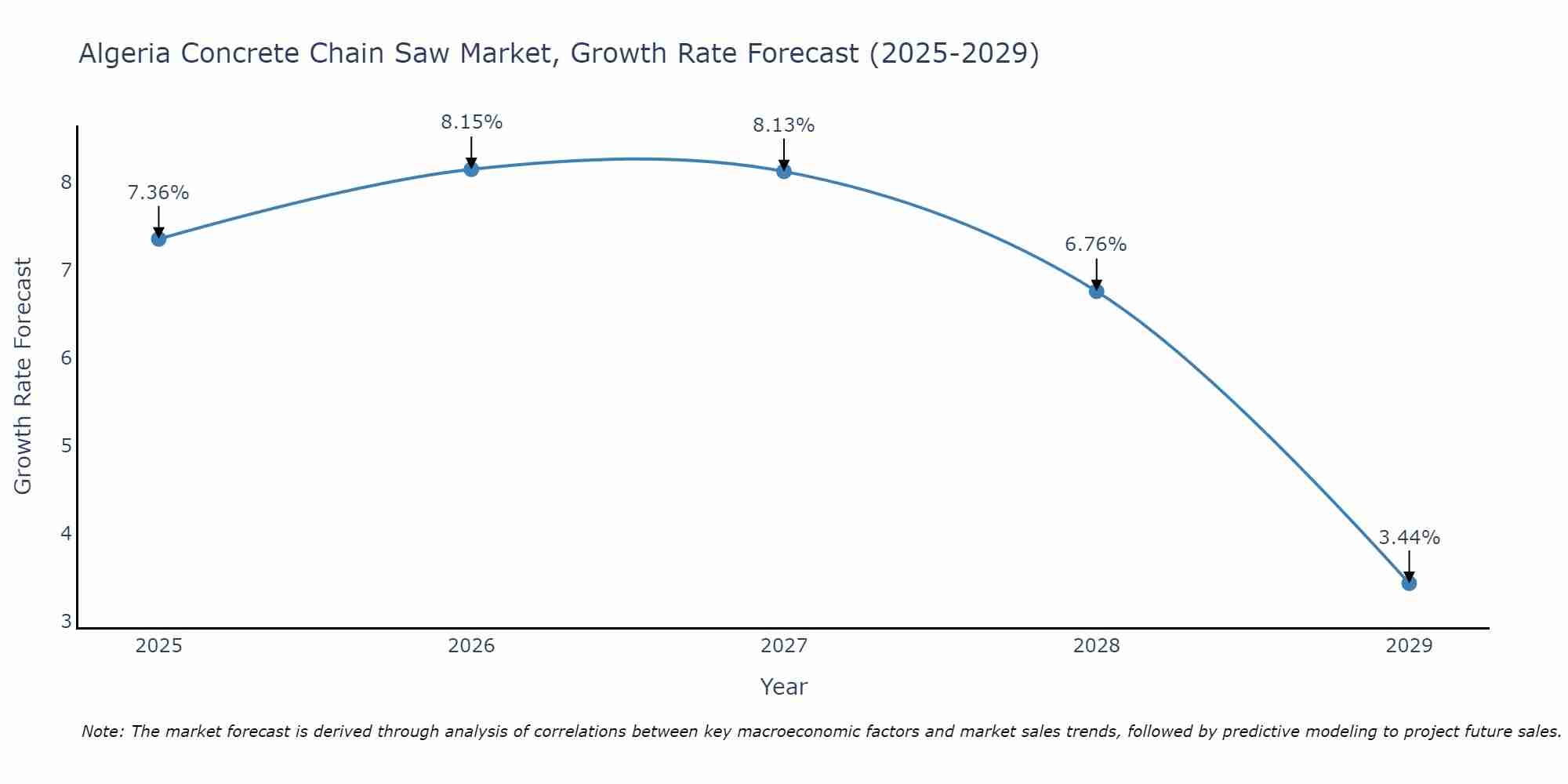
The Algeria Concrete Chain Saw Market is projected to witness mixed growth rate patterns during 2025 to 2029. Starting at 7.36% in 2025, the market peaks at 8.15% in 2026, and settles at 3.44% by 2029.
Algeria Concrete Chain Saw Market Overview
The Algeria Concrete Chain Saw market is witnessing steady growth due to increased construction activities in the country. The demand for concrete chain saws is driven by the need for efficient cutting of concrete, masonry, and stone materials in construction and demolition projects. Key factors influencing market growth include rising urbanization, infrastructure development, and government investment in construction projects. Major players in the market are focusing on product innovation, such as lightweight and ergonomic designs, to cater to the evolving needs of contractors and construction professionals. The market is expected to continue its growth trajectory in the coming years, driven by ongoing construction projects and the adoption of advanced cutting technologies.
Algeria Concrete Chain Saw Market Trends
In the Algeria Concrete Chain Saw Market, a notable trend is the increasing demand for electric chain saws due to their environmental friendliness and lower operating costs compared to traditional gas-powered models. The market is also witnessing a growing preference for lightweight and ergonomic designs that improve user comfort and productivity, particularly in the construction and demolition sectors. Additionally, there is a rising interest in advanced features such as automatic chain lubrication systems and enhanced safety mechanisms to ensure efficient and safe operation. Overall, the Algeria Concrete Chain Saw Market is experiencing a shift towards more sustainable and user-friendly products with improved performance and safety features to meet the evolving needs of professionals in the construction industry.
Algeria Concrete Chain Saw Market Challenges
In the Algeria Concrete Chain Saw Market, several challenges are faced, including limited awareness and adoption of modern cutting technologies, lack of skilled operators trained in the use of concrete chain saws, high initial costs associated with purchasing and maintaining these specialized tools, and limited availability of spare parts and servicing facilities in remote areas. Additionally, the market may also face issues related to inconsistent supply chain management, regulatory barriers, and competition from alternative cutting methods. Overcoming these challenges will require targeted marketing efforts to educate potential customers, investment in training programs for operators, partnerships with local service providers to enhance after-sales support, and continuous innovation to improve the efficiency and cost-effectiveness of concrete chain saws in the Algerian market.
Algeria Concrete Chain Saw Market Investment Opportunities
In the Algeria Concrete Chain Saw Market, there are promising investment opportunities for companies involved in the manufacturing and distribution of advanced concrete cutting equipment. With the construction industry in Algeria experiencing steady growth, there is a rising demand for efficient tools like concrete chain saws for cutting through concrete structures. Investing in innovative technologies that enhance the performance, durability, and safety features of concrete chain saws can position a company well in this market. Additionally, offering training and after-sales support services can further attract customers and build brand loyalty. Collaborating with local construction companies and contractors to understand their specific needs and preferences can also help tailor products to the Algerian market, ensuring a competitive edge.
Algeria Concrete Chain Saw Market Government Policy
Government policies related to the Algeria Concrete Chain Saw Market are primarily focused on safety, environmental regulations, and standardization. The government has implemented strict guidelines to ensure that the manufacturing, sale, and use of concrete chain saws comply with safety standards to protect workers and consumers. Environmental regulations are also enforced to minimize emissions and ensure proper disposal of waste materials associated with the production and use of concrete chain saws. Additionally, the government promotes standardization in the industry to improve product quality and competitiveness. Companies operating in the Algeria Concrete Chain Saw Market must adhere to these policies to ensure compliance and avoid penalties while contributing to a sustainable and regulated market environment.
Algeria Concrete Chain Saw Market Future Outlook
The Algeria Concrete Chain Saw Market is expected to witness steady growth in the coming years due to the increasing infrastructure development projects in the country. The demand for concrete chain saws is likely to rise as construction activities continue to expand, driven by government investments in transportation, housing, and commercial buildings. Additionally, the growing trend towards renovation and remodeling projects is expected to further boost the market for concrete chain saws. Manufacturers in the industry are likely to focus on product innovations, such as improved cutting efficiency, ergonomic designs, and enhanced safety features, to cater to the evolving needs of construction professionals. Overall, the Algeria Concrete Chain Saw Market is anticipated to experience sustained growth opportunities as the construction sector continues to thrive.
Key Highlights of the Report:
- Algeria Concrete Chain Saw Market Outlook
- Market Size of Algeria Concrete Chain Saw Market, 2024
- Forecast of Algeria Concrete Chain Saw Market, 2031
- Historical Data and Forecast of Algeria Concrete Chain Saw Revenues & Volume for the Period 2021 - 2031
- Algeria Concrete Chain Saw Market Trend Evolution
- Algeria Concrete Chain Saw Market Drivers and Challenges
- Algeria Concrete Chain Saw Price Trends
- Algeria Concrete Chain Saw Porter's Five Forces
- Algeria Concrete Chain Saw Industry Life Cycle
- Historical Data and Forecast of Algeria Concrete Chain Saw Market Revenues & Volume By Type for the Period 2021 - 2031
- Historical Data and Forecast of Algeria Concrete Chain Saw Market Revenues & Volume By Gas Chain Saw for the Period 2021 - 2031
- Historical Data and Forecast of Algeria Concrete Chain Saw Market Revenues & Volume By Hydraulic Chain Saw for the Period 2021 - 2031
- Historical Data and Forecast of Algeria Concrete Chain Saw Market Revenues & Volume By Pneumatic Chain Saw for the Period 2021 - 2031
- Algeria Concrete Chain Saw Import Export Trade Statistics
- Market Opportunity Assessment By Type
- Algeria Concrete Chain Saw Top Companies Market Share
- Algeria Concrete Chain Saw Competitive Benchmarking By Technical and Operational Parameters
- Algeria Concrete Chain Saw Company Profiles
- Algeria Concrete Chain Saw Key Strategic Recommendations






































