Algeria High Strength Steel Market Size, Share & Growth Rate
The Algeria High Strength Steel Market was estimated at USD 377 Million in 2025 and is projected to reach USD 504 Million by 2032, growing at a CAGR of 4.2% from 2026 to 2032. This promising trajectory is largely fueled by the increasing demand for lightweight, high-performance materials across critical sectors such as construction, automotive, and infrastructure development. As Algeria continues to invest in its urban landscape and transportation frameworks, the uptake of high-strength steel is poised to play a pivotal role in enhancing structural integrity and operational efficiency.
Algeria High Strength Steel Market Year-wise Growth Rate and Key Drivers
This graph highlights how the Algeria High Strength Steel Market has steadily grown over the years, supported by major growth factors.
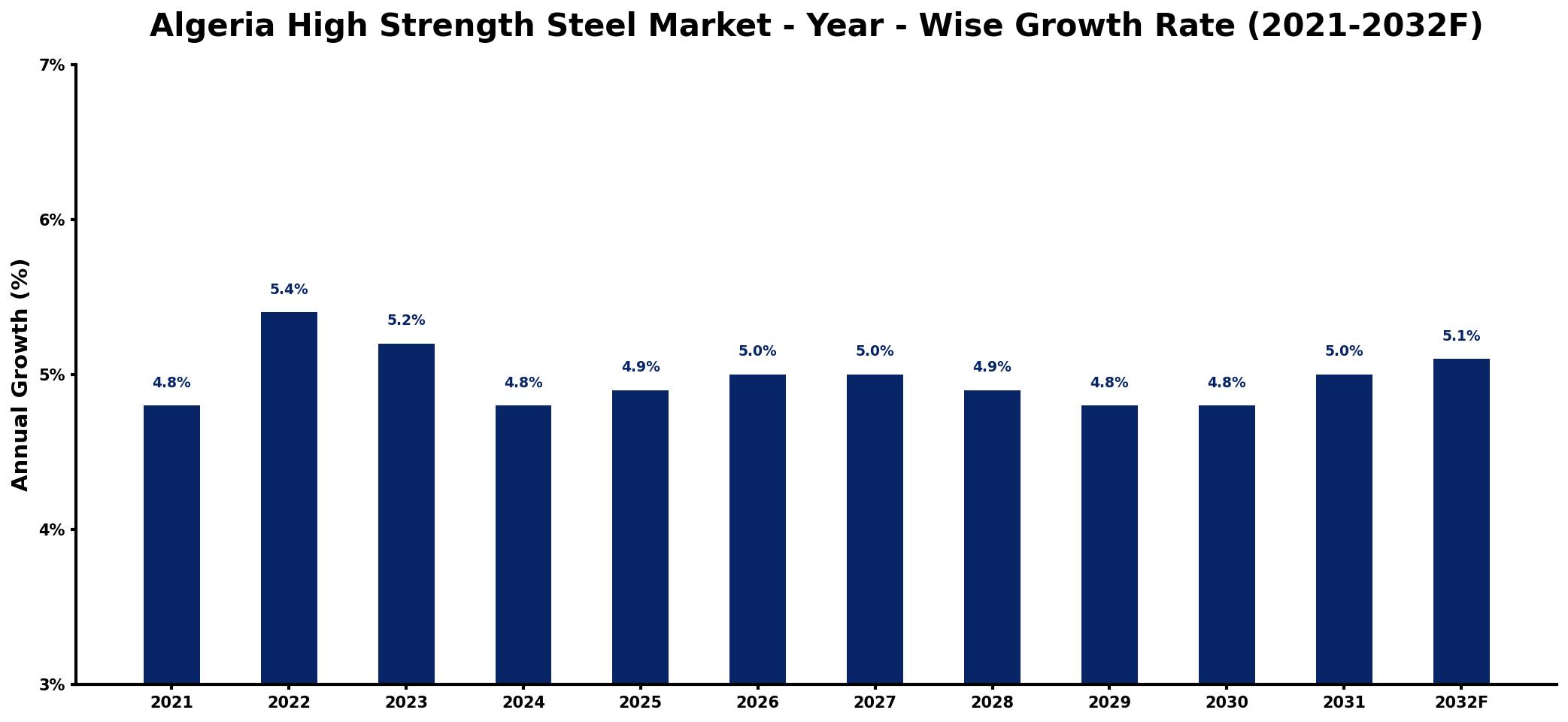
The table below presents the year‑wise growth rates along with the key drivers influencing the market
| Year | Growth Rate | Major Drivers |
| 2021 | 4.8% | Infrastructure projects driving demand growth |
| 2022 | 5.4% | Increased construction activities nationwide |
| 2023 | 5.2% | Rising automotive sector investments |
| 2024 | 4.8% | Expanding energy sector initiatives |
| 2025 | 4.9% | Growing demand from manufacturing industries |
| 2026 | 5.0% | Boost in public transportation projects |
| 2027 | 5.0% | Emergence of renewable energy investments |
| 2028 | 4.9% | Enhancements in construction technologies |
| 2029 | 4.8% | Increased focus on urban development |
| 2030 | 4.8% | growing emerging market penetration |
| 2031 | 5.0% | Surge in defense sector requirements |
| 2032 | 5.1% | Rising investments in industrial automation |
Note: Market size estimations and growth projections presented in this report are based on 6Wresearch's proprietary forecasting methodology, utilizing the latest available industry data, government publications, and primary research inputs.
Algeria High Strength Steel Market Synopsis
Recently, the Algeria high-strength steel market has gained momentum, driven by innovations in steel manufacturing and the growing recognition of the benefits these materials offer. However, as market dynamics evolve, stakeholders must navigate challenges related to fabrication and welding techniques to maximize the potential of high-strength steel applications.
Looking ahead, the market is expected to maintain its upward trajectory, as both public and private sectors increasingly adopt high-strength steels. This shift is reinforced by regulatory advancements and ongoing projects that demand the unique properties of high-strength materials, aligning with global trends towards efficiency and safety.
Algeria High Strength Steel Market Key Takeaways
- The market is projected to grow from USD 377 Million in 2025 to USD 504 Million by 2032.
- Key growth drivers include advancements in manufacturing technologies and rising safety standards in automotive applications.
- Collaboration with fabricators and targeted training programs are essential for widespread adoption.
- Government policies favoring high-strength steel utilization bolster market development.
- Adoption in infrastructure projects is anticipated to significantly impact future demand.
Evaluation of Restraints in Algeria High Strength Steel Market
Despite its growth potential, the Algeria high-strength steel market faces notable restraints that could hinder its advancement. The complexity involved in fabricating high-strength steel products presents challenges that require skilled labor and precise welding techniques. Moreover, the need for specialized training programs for welders, along with the supply of appropriate welding consumables, is paramount to achieving market acceptance and ensuring the reliability of end products. Without addressing these intricacies, the market may struggle to realize its full potential.
Algeria High Strength Steel Market Trends
Several trends are shaping the Algeria high-strength steel market, notably the increasing emphasis on sustainability and energy efficiency. Industries are recognizing the advantages of lighter materials that can enhance fuel efficiency and reduce overall operational costs. Furthermore, the integration of advanced manufacturing technologies, such as automation and data analytics, is fostering innovation in steel production methods, making it easier to meet the rising demands of various sectors.
Algeria High Strength Steel Market Opportunities
As the Algeria high-strength steel market evolves, significant growth opportunities are emerging. The ongoing expansion of urban infrastructure, coupled with the governments commitment to modernizing transportation systems, creates a fertile ground for high-strength steel applications. Additionally, the automotive sector's focus on enhancing safety standards presents an avenue for integrating advanced steel solutions, which can enhance vehicle performance while complying with regulatory frameworks.
Government Initiatives in the Algeria High Strength Steel Market
The Algerian government recognizes the strategic importance of high-strength steel in bolstering national construction and automotive sectors. In response, policies are being formulated to support technological advancements within steel production. This includes incentives aimed at attracting investments in high-quality steel manufacturing and establishing stringent regulations that ensure product standards meet international benchmarks. Collaboration with industry stakeholders to promote high-strength steel utilization across various applications is also a priority.
Future Insights of the Algeria High Strength Steel Market
Between 2026 and 2032, the Algeria high-strength steel market is expected to witness sustained growth, driven by a favorable economic climate and increased infrastructural investments. As companies adapt to technological advancements and evolving consumer preferences, the demand for high-strength steel is likely to intensify. This growth trajectory will be further supported by the continued alignment of government policies with industry needs, ultimately positioning Algeria as a key player in the high-strength steel landscape.
Algeria High Strength Steel Market Latest Developments (2025 - 2026)
In the past year, the Algeria high-strength steel market has seen a shift towards more sustainable production practices and an uptick in research initiatives focused on developing advanced steel alloys. Collaborations among manufacturers and research institutions have led to breakthroughs in steel properties, enhancing applications in automotive safety and structural integrity. Additionally, the government has rolled out programs aimed at elevating local production capabilities, thus fostering a more robust domestic high-strength steel sector.
Algeria High Strength Steel Market - Key Attractiveness of the Report
- 10 Years of Market Numbers
- Historical Data Starting from 2022 to 2025
- Base Year: 2025
- Forecast Data until 2032
- Key Performance Indicators Impacting the Market
- Major Upcoming Developments and Projects
Key Highlights of the Report:
- Algeria High Strength Steel Market Outlook
- Market Size of Algeria High Strength Steel Market, 2025
- Forecast of Algeria High Strength Steel Market, 2032
- Historical Data and Forecast of Algeria High Strength Steel Revenues & Volume for the Period 2022-2032F
- Algeria High Strength Steel Market Trend Evolution
- Algeria High Strength Steel Market Drivers and Challenges
- Algeria High Strength Steel Price Trends
- Algeria High Strength Steel Porter's Five Forces
- Algeria High Strength Steel Industry Life Cycle
- Historical Data and Forecast of Algeria High Strength Steel Market Revenues & Volume By Product Type for the Period 2022-2032F
- Historical Data and Forecast of Algeria High Strength Steel Market Revenues & Volume By Dual Phase Steel for the Period 2022-2032F
- Historical Data and Forecast of Algeria High Strength Steel Market Revenues & Volume By Bake Hardenable Steel for the Period 2022-2032F
- Historical Data and Forecast of Algeria High Strength Steel Market Revenues & Volume By Carbon Manganese Steel for the Period 2022-2032F
- Historical Data and Forecast of Algeria High Strength Steel Market Revenues & Volume By Other Product Types for the Period 2022-2032F
- Historical Data and Forecast of Algeria High Strength Steel Market Revenues & Volume By Application for the Period 2022-2032F
- Historical Data and Forecast of Algeria High Strength Steel Market Revenues & Volume By Automotive for the Period 2022-2032F
- Historical Data and Forecast of Algeria High Strength Steel Market Revenues & Volume By Construction for the Period 2022-2032F
- Historical Data and Forecast of Algeria High Strength Steel Market Revenues & Volume By Yellow Goods and Mining Equipment for the Period 2022-2032F
- Historical Data and Forecast of Algeria High Strength Steel Market Revenues & Volume By Aviation and Marine for the Period 2022-2032F
- Historical Data and Forecast of Algeria High Strength Steel Market Revenues & Volume By Other Applications for the Period 2022-2032F
- Algeria High Strength Steel Import Export Trade Statistics
- Market Opportunity Assessment By Product Type
- Market Opportunity Assessment By Application
- Algeria High Strength Steel Top Companies Market Share
- Algeria High Strength Steel Competitive Benchmarking By Technical and Operational Parameters
- Algeria High Strength Steel Company Profiles
- Algeria High Strength Steel Key Strategic Recommendations






































