Kenya High Strength Steel Market Size, Share & Growth Rate
The Kenya High Strength Steel Market was estimated at USD 1168 Million in 2025 and is projected to reach USD 1670 Million by 2032, growing at a CAGR of 5.2% from 2026 to 2032. This growth trajectory is bolstered by the expansion of the construction and infrastructure sectors, which increasingly demand materials that not only meet rigorous standards but also enhance overall structural integrity. Additionally, the automotive industrys push for high-performance vehicles is driving further adoption of high strength steel, underscoring its crucial role in both enhancing fuel efficiency and ensuring safety.
Kenya High Strength Steel Market Year-wise Growth Rate and Key Drivers
This graph highlights how the Kenya High Strength Steel Market has steadily grown over the years, supported by major growth factors.
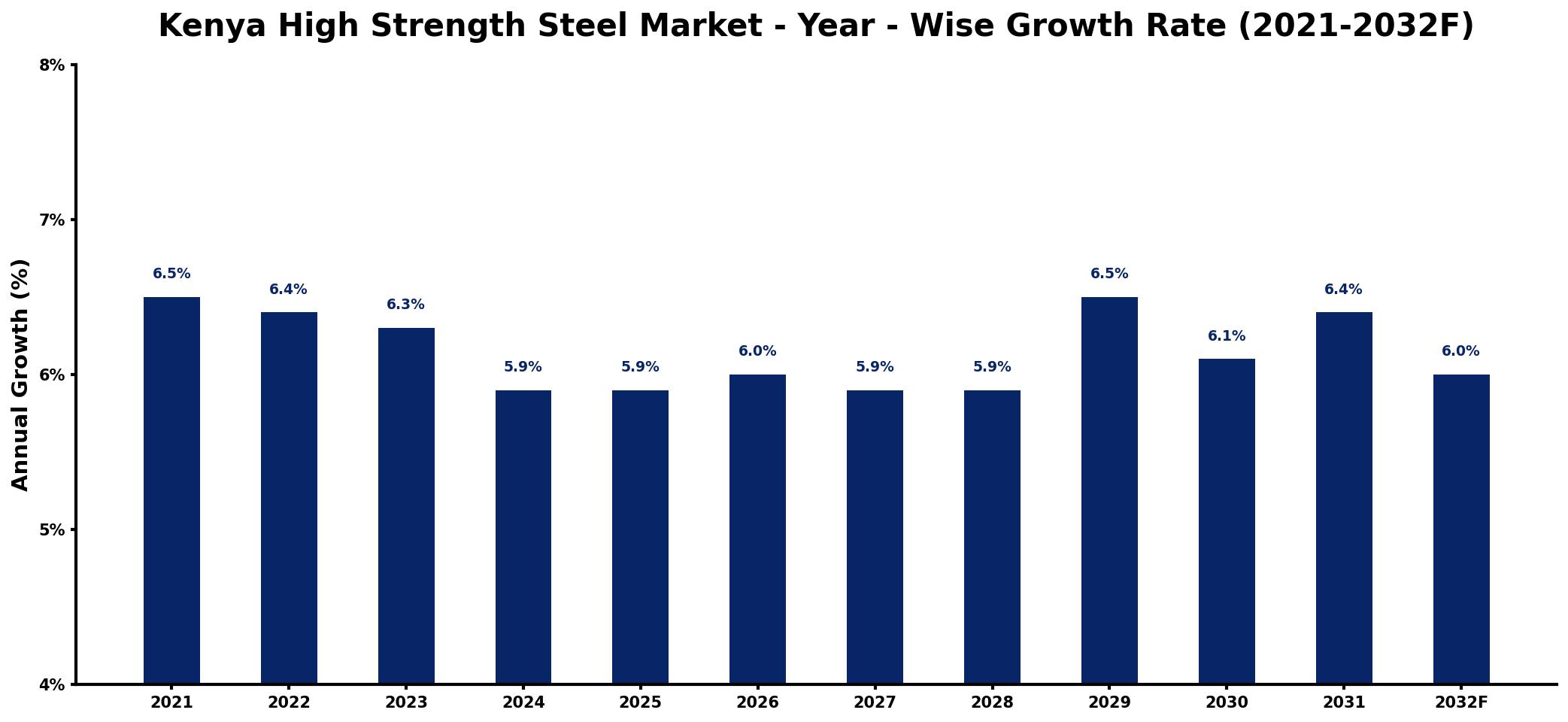
The table below presents the year‑wise growth rates along with the key drivers influencing the market
| Year | Growth Rate | Major Drivers |
| 2021 | 6.5% | Infrastructure projects driving demand |
| 2022 | 6.4% | Increased construction activity nationwide |
| 2023 | 6.3% | Rising urbanization stimulates investments |
| 2024 | 5.9% | Government initiatives boost production |
| 2025 | 5.9% | Renewable energy projects require materials |
| 2026 | 6.0% | Automotive sector expanding rapidly |
| 2027 | 5.9% | Real estate development gaining momentum |
| 2028 | 5.9% | Technological advancements enhance applications |
| 2029 | 6.5% | Export opportunities creating market growth |
| 2030 | 6.1% | Manufacturing sector experiencing resurgence |
| 2031 | 6.4% | Public-private partnerships fostering investments |
| 2032 | 6.0% | Economic recovery supports industry expansion |
Note: Market size estimations and growth projections presented in this report are based on 6Wresearch's proprietary forecasting methodology, utilizing the latest available industry data, government publications, and primary research inputs.
Kenya High Strength Steel Market Synopsis
Recent momentum in the Kenya High Strength Steel Market has been fueled by significant investments in infrastructure development, which are pivotal for economic growth. This trend is expected to continue as both public and private sectors prioritize modernizing existing frameworks and constructing new projects.
Looking ahead, the market is poised for substantial evolution. As the demand for lightweight materials rises, particularly in construction and automotive applications, high strength steel will likely become the material of choice for meeting both performance and regulatory standards, aligning with global best practices.
Kenya High Strength Steel Market Key Takeaways
- Infrastructure growth is a primary driver of demand for high strength steel.
- Local manufacturing policies are likely to encourage market expansion.
- Automotive sector growth directly influences high strength steel consumption.
- Balancing cost and quality remains a significant challenge for industry players.
- Government initiatives are expected to further stimulate demand for steel solutions.
Evaluation of Restraints in Kenya High Strength Steel Market
Despite the positive growth outlook, the Kenya High Strength Steel Market faces several restraints. The challenge of balancing cost-effectiveness with high quality remains paramount, as many industries struggle with the higher expenses associated with high strength steel compared to conventional materials. Furthermore, competition from cheaper alternatives, particularly imports, poses a significant threat to local manufacturers. Regulatory frameworks governing imports may create additional hurdles, impacting the markets accessibility and growth potential.
Kenya High Strength Steel Market Trends
The Kenya High Strength Steel Market is increasingly influenced by trends focusing on sustainability and efficiency. The construction industry is gravitating towards more environmentally friendly materials, driving innovations in high strength steel that meet such criteria. Additionally, advancements in manufacturing technologies are enhancing the performance characteristics of high strength steel, paving the way for broader applications in both construction and automotive sectors.
Kenya High Strength Steel Market Opportunities
There are genuine growth opportunities within the Kenya High Strength Steel Market, particularly in sectors that emphasize infrastructure development. Public-private partnerships aimed at large-scale construction projects can catalyze demand for high strength steel. Additionally, as the automotive industry evolves toward electric and hybrid vehicles, the need for lightweight materials will likely escalate, creating new avenues for high strength steel applications.
Government Initiatives in the Kenya High Strength Steel Market
The Kenyan government is actively promoting initiatives aimed at bolstering infrastructure and enhancing manufacturing capabilities within the country. Policies focused on local production and stringent construction standards are encouraging the use of high strength steel in various projects. Public spending on transportation and energy infrastructure, alongside initiatives aimed at fostering innovation in building materials, is expected to underpin the growth of the high strength steel sector.
Future Insights of the Kenya High Strength Steel Market
From 2026 to 2032, the Kenya High Strength Steel Market is projected to undergo significant transformation driven by rising construction demands and technological advancements. The intersection of governmental policy support and private sector investment is likely to create a robust environment for growth. With heightened awareness around safety and efficiency, high strength steel will continue to play a pivotal role in shaping future construction and automotive projects.
Kenya High Strength Steel Market Latest Developments (2025 - 2026)
The recent landscape in the Kenya High Strength Steel Market indicates a shift towards more sustainable production practices, with companies exploring eco-friendly manufacturing methods. The governments continued push for infrastructure investment has led to numerous new projects being announced, with many stakeholders looking for innovative materials that meet evolving regulatory standards. Additionally, collaborations between government bodies and private firms have increased, facilitating knowledge sharing and resource optimization in high strength steel applications.
Kenya High Strength Steel Market - Key Attractiveness of the Report
- 10 Years of Market Numbers
- Historical Data Starting from 2022 to 2025
- Base Year: 2025
- Forecast Data until 2032
- Key Performance Indicators Impacting the Market
- Major Upcoming Developments and Projects
Key Highlights of the Report:
- Kenya High Strength Steel Market Outlook
- Market Size of Kenya High Strength Steel Market, 2025
- Forecast of Kenya High Strength Steel Market, 2032
- Historical Data and Forecast of Kenya High Strength Steel Revenues & Volume for the Period 2022-2032F
- Kenya High Strength Steel Market Trend Evolution
- Kenya High Strength Steel Market Drivers and Challenges
- Kenya High Strength Steel Price Trends
- Kenya High Strength Steel Porter's Five Forces
- Kenya High Strength Steel Industry Life Cycle
- Historical Data and Forecast of Kenya High Strength Steel Market Revenues & Volume By Product Type for the Period 2022-2032F
- Historical Data and Forecast of Kenya High Strength Steel Market Revenues & Volume By Dual Phase Steel for the Period 2022-2032F
- Historical Data and Forecast of Kenya High Strength Steel Market Revenues & Volume By Bake Hardenable Steel for the Period 2022-2032F
- Historical Data and Forecast of Kenya High Strength Steel Market Revenues & Volume By Carbon Manganese Steel for the Period 2022-2032F
- Historical Data and Forecast of Kenya High Strength Steel Market Revenues & Volume By Other Product Types for the Period 2022-2032F
- Historical Data and Forecast of Kenya High Strength Steel Market Revenues & Volume By Application for the Period 2022-2032F
- Historical Data and Forecast of Kenya High Strength Steel Market Revenues & Volume By Automotive for the Period 2022-2032F
- Historical Data and Forecast of Kenya High Strength Steel Market Revenues & Volume By Construction for the Period 2022-2032F
- Historical Data and Forecast of Kenya High Strength Steel Market Revenues & Volume By Yellow Goods and Mining Equipment for the Period 2022-2032F
- Historical Data and Forecast of Kenya High Strength Steel Market Revenues & Volume By Aviation and Marine for the Period 2022-2032F
- Historical Data and Forecast of Kenya High Strength Steel Market Revenues & Volume By Other Applications for the Period 2022-2032F
- Kenya High Strength Steel Import Export Trade Statistics
- Market Opportunity Assessment By Product Type
- Market Opportunity Assessment By Application
- Kenya High Strength Steel Top Companies Market Share
- Kenya High Strength Steel Competitive Benchmarking By Technical and Operational Parameters
- Kenya High Strength Steel Company Profiles
- Kenya High Strength Steel Key Strategic Recommendations






































