Nigeria High Strength Steel Market Size, Share & Growth Rate
The Nigeria High Strength Steel Market was estimated at USD 1142 Million in 2025 and is projected to reach USD 1660 Million by 2032, growing at a CAGR of 5.5% from 2026 to 2032. This upward trajectory is largely driven by a significant demand surge within the construction and automotive sectors, which increasingly favor materials that offer superior strength-to-weight ratios. Furthermore, the governments strategic infrastructure initiatives are set to propel the market even further, as investments in modernizing facilities and local production capabilities begin to materialize.
Nigeria High Strength Steel Market Year-wise Growth Rate and Key Drivers
This graph highlights how the Nigeria High Strength Steel Market has steadily grown over the years, supported by major growth factors.
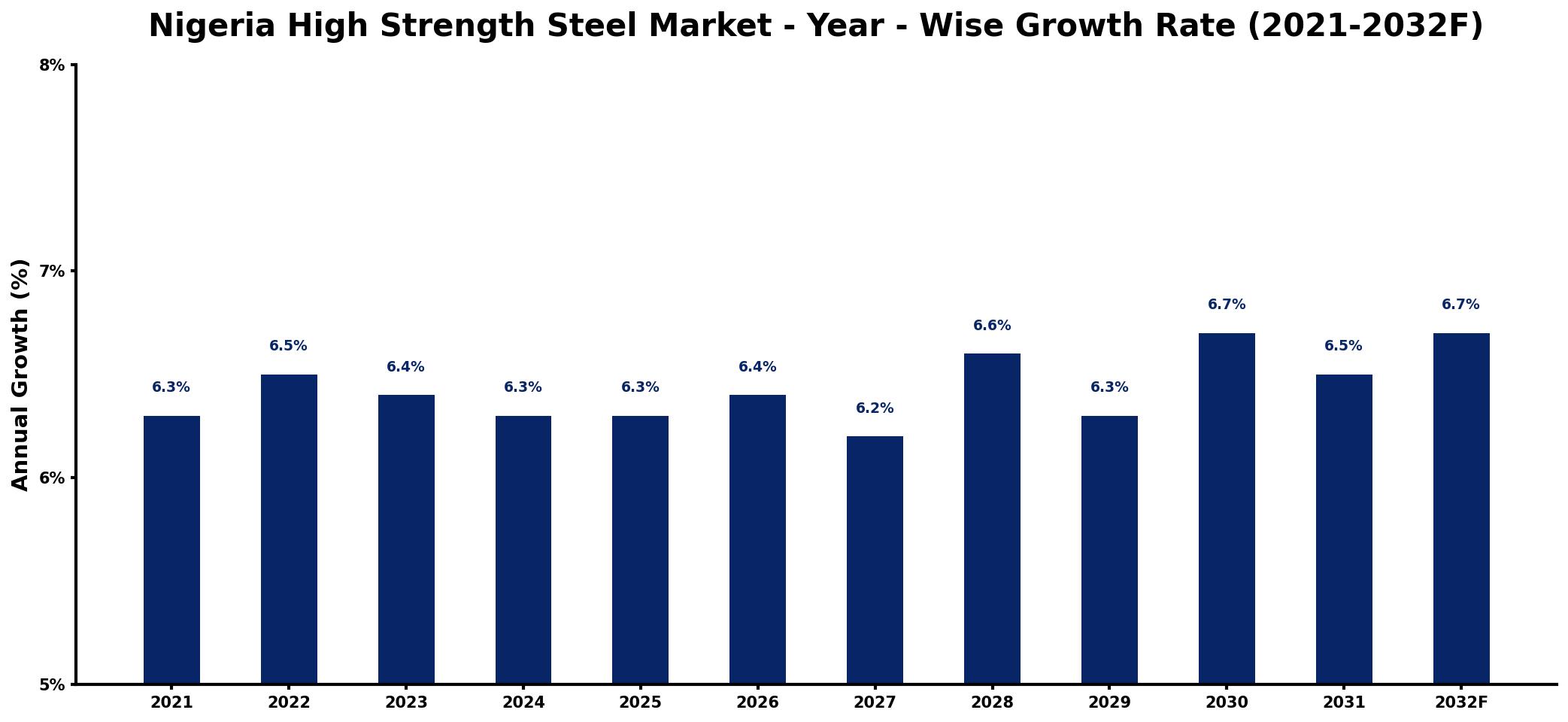
The table below presents the year‑wise growth rates along with the key drivers influencing the market
| Year | Growth Rate | Major Drivers |
| 2021 | 6.3% | Rising construction sector investments |
| 2022 | 6.5% | Increased automotive manufacturing activities |
| 2023 | 6.4% | Growing infrastructure development projects |
| 2024 | 6.3% | Surge in energy sector requirements |
| 2025 | 6.3% | Expansion of mining operations globally |
| 2026 | 6.4% | Boost in transportation infrastructure projects |
| 2027 | 6.2% | Growing demand from manufacturing industries |
| 2028 | 6.6% | Increased renewable energy installations |
| 2029 | 6.3% | Rising urbanization and housing needs |
| 2030 | 6.7% | Expansion in industrial applications growth |
| 2031 | 6.5% | rising infrastructure development spending |
| 2032 | 6.7% | improved processing technologies adoption |
Note: Market size estimations and growth projections presented in this report are based on 6Wresearch's proprietary forecasting methodology, utilizing the latest available industry data, government publications, and primary research inputs.
Nigeria High Strength Steel Market Synopsis
In recent years, the high strength steel market in Nigeria has shown promising growth, primarily fueled by ongoing construction and automotive projects. However, this momentum is counterbalanced by persistent challenges such as high import costs and insufficient domestic production capabilities that threaten to stifle future development. As local production ramps up, a shift in market dynamics is expected, enhancing competition and potentially lowering prices.
The landscape is shifting toward a more favorable environment for high strength steel, with investments in technology and local production facilities gaining traction. This positive outlook aligns with the government's commitment to bolster local manufacturing through policy reforms, positioning the Nigeria High Strength Steel Market for sustainable growth in the years to come.
Nigeria High Strength Steel Market Key Takeaways
- The market is set to experience substantial growth, reaching USD 1660 Million by 2032.
- Demand is primarily driven by construction and automotive industries seeking lightweight, durable materials.
- Government initiatives aim to reduce import reliance and enhance local production capabilities.
- Price volatility of raw materials remains a crucial challenge affecting market stability.
- Investment opportunities in R&D and technology can catalyze growth and innovation in local manufacturing.
Evaluation of Restraints in Nigeria High Strength Steel Market
The growth of the Nigeria High Strength Steel Market is significantly restrained by several key factors. The dominant issue remains the insufficient local production infrastructure, which results in an over-reliance on imports. This dependence not only exposes the market to international price fluctuations but also causes supply chain vulnerabilities that hinder accessibility. Furthermore, the high costs associated with imported high strength steel restrict local industries' ability to leverage these advanced materials. Coupled with a notable gap in technical expertise and research capabilities, these barriers limit the potential for innovation and development in the sector.
Nigeria High Strength Steel Market Trends
Emerging trends within the Nigeria High Strength Steel Market reveal a growing preference for sustainable and innovative materials. The push for eco-friendly construction techniques is prompting manufacturers to adopt high strength steel solutions that reduce carbon footprints. Additionally, advancements in production technologies are leading to more efficient and cost-effective methods of manufacturing, further driving market interest. These trends align closely with global movements toward sustainability in construction and manufacturing.
Nigeria High Strength Steel Market Opportunities
Significant growth opportunities are emerging in the Nigeria High Strength Steel Market, particularly in the realms of infrastructure development and local manufacturing. Investment in local production facilities can not only alleviate import dependency but also create jobs and stimulate economic growth. Moreover, collaboration with international partners to enhance R&D capabilities presents a viable avenue for innovation. The commitment to government-sponsored incentives for local production could also attract new players to the market, fostering a more competitive landscape.
Government Initiatives in the Nigeria High Strength Steel Market
The Nigerian government has recognized the essential role of high strength steel in boosting the construction and automotive industries. As such, it has introduced several policies aimed at increasing local production and reducing import costs. Measures include the reduction of import duties on essential raw materials for steel manufacturing, as well as financial incentives for companies investing in high strength steel production. Additionally, there is a growing emphasis on supporting research and development initiatives to enhance production technologies in line with global standards.
Future Insights of the Nigeria High Strength Steel Market
Looking ahead to the period from 2026 to 2032, the Nigeria High Strength Steel Market is poised for a transformative phase. With a projected growth rate of 5.5% CAGR, we expect to see a gradual enhancement in local production capacity alongside an increase in demand driven by infrastructure projects. As the government continues to foster an environment conducive to investment and innovation, local manufacturers are likely to capitalize on these opportunities, thereby reducing reliance on imports and stabilizing the market.
Nigeria High Strength Steel Market Latest Developments (2025 - 2026)
In the past year, the high strength steel industry in Nigeria has witnessed a shift toward more localized manufacturing. Companies are now exploring partnerships to develop production capabilities domestically. Furthermore, a wave of new projects aimed at infrastructure development has been announced, signaling strong government support for the sector. This momentum reflects a concerted effort to elevate the domestic market, ensuring the availability of high strength steel to meet growing demands.
Nigeria High Strength Steel Market - Key Attractiveness of the Report
- 10 Years of Market Numbers
- Historical Data Starting from 2022 to 2025
- Base Year: 2025
- Forecast Data until 2032
- Key Performance Indicators Impacting the Market
- Major Upcoming Developments and Projects
Key Highlights of the Report:
- Nigeria High Strength Steel Market Outlook
- Market Size of Nigeria High Strength Steel Market, 2025
- Forecast of Nigeria High Strength Steel Market, 2032
- Historical Data and Forecast of Nigeria High Strength Steel Revenues & Volume for the Period 2022-2032F
- Nigeria High Strength Steel Market Trend Evolution
- Nigeria High Strength Steel Market Drivers and Challenges
- Nigeria High Strength Steel Price Trends
- Nigeria High Strength Steel Porter's Five Forces
- Nigeria High Strength Steel Industry Life Cycle
- Historical Data and Forecast of Nigeria High Strength Steel Market Revenues & Volume By Product Type for the Period 2022-2032F
- Historical Data and Forecast of Nigeria High Strength Steel Market Revenues & Volume By Dual Phase Steel for the Period 2022-2032F
- Historical Data and Forecast of Nigeria High Strength Steel Market Revenues & Volume By Bake Hardenable Steel for the Period 2022-2032F
- Historical Data and Forecast of Nigeria High Strength Steel Market Revenues & Volume By Carbon Manganese Steel for the Period 2022-2032F
- Historical Data and Forecast of Nigeria High Strength Steel Market Revenues & Volume By Other Product Types for the Period 2022-2032F
- Historical Data and Forecast of Nigeria High Strength Steel Market Revenues & Volume By Application for the Period 2022-2032F
- Historical Data and Forecast of Nigeria High Strength Steel Market Revenues & Volume By Automotive for the Period 2022-2032F
- Historical Data and Forecast of Nigeria High Strength Steel Market Revenues & Volume By Construction for the Period 2022-2032F
- Historical Data and Forecast of Nigeria High Strength Steel Market Revenues & Volume By Yellow Goods and Mining Equipment for the Period 2022-2032F
- Historical Data and Forecast of Nigeria High Strength Steel Market Revenues & Volume By Aviation and Marine for the Period 2022-2032F
- Historical Data and Forecast of Nigeria High Strength Steel Market Revenues & Volume By Other Applications for the Period 2022-2032F
- Nigeria High Strength Steel Import Export Trade Statistics
- Market Opportunity Assessment By Product Type
- Market Opportunity Assessment By Application
- Nigeria High Strength Steel Top Companies Market Share
- Nigeria High Strength Steel Competitive Benchmarking By Technical and Operational Parameters
- Nigeria High Strength Steel Company Profiles
- Nigeria High Strength Steel Key Strategic Recommendations






































