Algeria Tire Machinery Market Size, Share & Growth Rate
The Algeria Tire Machinery Market was estimated at USD 379 Million in 2025 and is projected to reach USD 515 Million by 2032, growing at a CAGR of 4.5% from 2026 to 2032. This growth is significantly fueled by the expanding automotive sector, which is elevating the demand for both new and replacement tires. The local tire manufacturing landscape is also evolving, as firms invest in advanced machinery and technology to enhance production efficiency.
Algeria Tire Machinery Market Year-wise Growth Rate and Key Drivers
This graph highlights how the Algeria Tire Machinery Market has steadily grown over the years, supported by major growth factors.
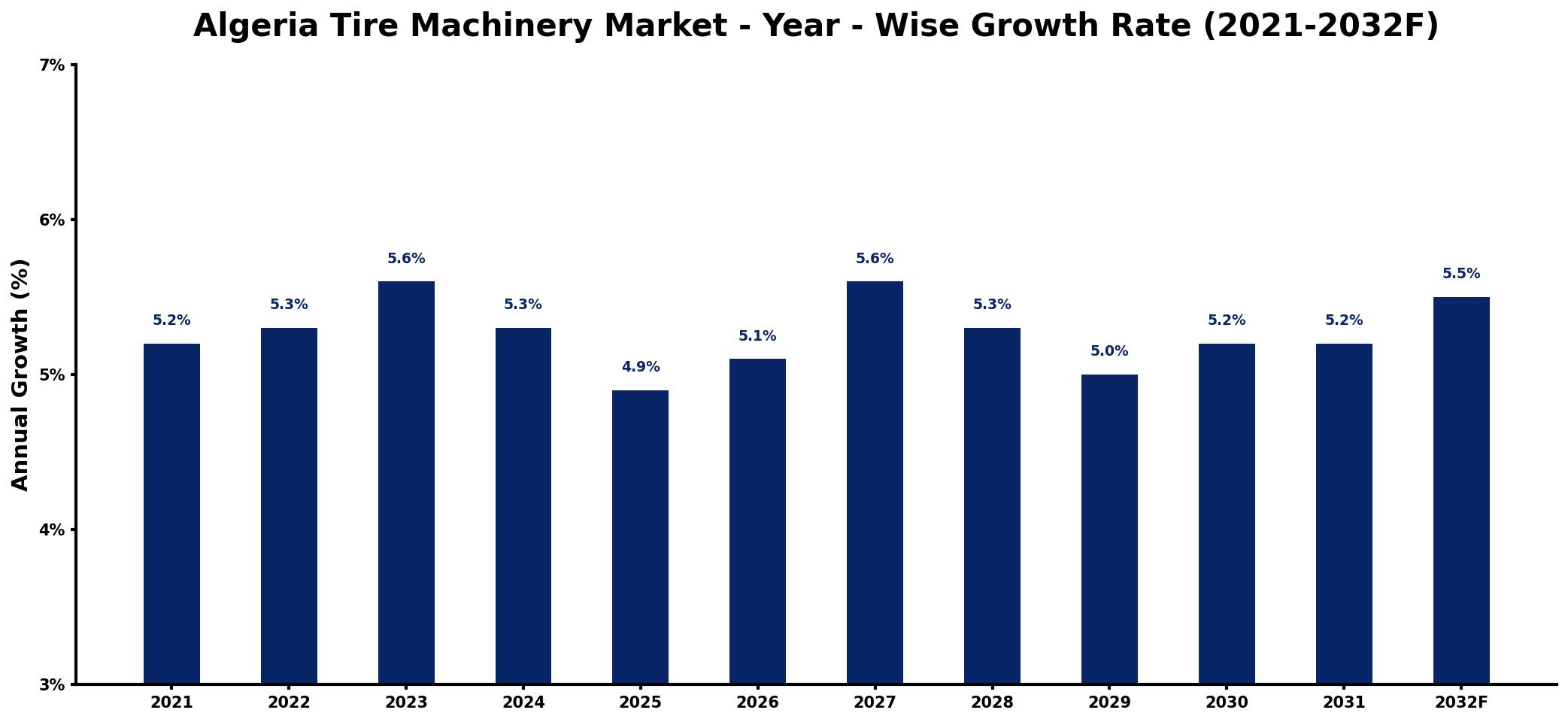
The table below presents the year‑wise growth rates along with the key drivers influencing the market
| Year | Growth Rate | Major Drivers |
| 2021 | 5.2% | Rising automotive sector investments |
| 2022 | 5.3% | Expansion of transportation infrastructure |
| 2023 | 5.6% | Growing demand for logistics services |
| 2024 | 5.3% | Increased manufacturing capabilities development |
| 2025 | 4.9% | Surge in domestic production initiatives |
| 2026 | 5.1% | Boost in export opportunities emerging |
| 2027 | 5.6% | Strengthening regional trade agreements |
| 2028 | 5.3% | Adoption of advanced production technologies |
| 2029 | 5.0% | Revitalization of small business growth |
| 2030 | 5.2% | Focus on sustainable production practices |
| 2031 | 5.2% | Emergence of new market entrants |
| 2032 | 5.5% | Collaboration with international partners |
Note: Market size estimations and growth projections presented in this report are based on 6Wresearch's proprietary forecasting methodology, utilizing the latest available industry data, government publications, and primary research inputs.
Algeria Tire Machinery Market Synopsis
A robust force shaping the Algeria Tire Machinery Market is the accelerating growth of the automotive industry. This expansion is accompanied by a rising awareness among consumers regarding tire performance and safety, driving up the demand for quality manufacturing equipment.
Additionally, the market is seeing a shift towards modernized manufacturing processes. Companies are investing in innovative tire machinery solutions, which not only improve efficiency but also align with global trends focusing on sustainability and eco-friendliness.
Algeria Tire Machinery Market Key Takeaways
- The Algeria Tire Machinery Market is poised for steady growth driven by the automotive industry's expansion.
- Technological advancements are pivotal for improving tire manufacturing processes.
- Government initiatives promote local manufacturing and infrastructure development.
- Rising consumer awareness regarding tire safety is shaping demand dynamics.
- Investment opportunities exist in both traditional and eco-friendly tire manufacturing technologies.
Evaluation of Restraints in Algeria Tire Machinery Market
Despite the positive outlook, the Algeria Tire Machinery Market faces notable constraints. A significant barrier is the limited access to advanced technologies, which can impede production efficiency. The lack of skilled labor further complicates efforts to modernize operations, hindering companies from fully capitalizing on technological investments. Infrastructure issues, such as unreliable energy sources and insufficient transport networks, also pose challenges that could undermine market competitiveness and growth potential.
Algeria Tire Machinery Market Trends
The market is currently experiencing a marked shift towards advanced tire manufacturing technologies. Companies are adopting automation to streamline processes, particularly in areas such as tire building and curing. Sustainability is emerging as a critical focus, leading to increased adoption of eco-friendly technologies designed to minimize energy consumption and waste production. These trends reflect a broader transition toward modernization in the tire manufacturing sector.
Algeria Tire Machinery Market Opportunities
Investment opportunities in the Algeria Tire Machinery Market are robust, primarily driven by the growth of the automotive industry. There is a clear demand for modern tire machinery, including tire building machines and curing presses, to support domestic manufacturing. Additionally, as global consumers trend towards sustainability, investors have the chance to develop innovative, environmentally friendly tire production technologies. Collaborating with local manufacturers can facilitate entry into the market and optimize growth prospects.
Government Initiatives in the Algeria Tire Machinery Market
The Algerian government is actively promoting industrial development to strengthen the local manufacturing sector, particularly in tire machinery. Policies that impose import tariffs aim to protect domestic producers, while funding programs for small and medium-sized enterprises (SMEs) encourage innovation and competitiveness. These initiatives are designed to not only enhance local manufacturing capabilities but also create job opportunities within the sector, contributing to overall economic growth.
Future Insights of the Algeria Tire Machinery Market
Looking ahead, the Algeria Tire Machinery Market is well-positioned for growth through 2026-2032. The anticipated increase in vehicle sales and demand for replacement tires will be key drivers. Furthermore, government efforts to improve road infrastructure will likely enhance tire demand. Global shifts toward electric vehicles and sustainable manufacturing practices will continue to influence the market dynamics, providing additional opportunities for technological innovation.
Algeria Tire Machinery Market Latest Developments (2025 - 2026)
Recent developments in the Algeria Tire Machinery Market reflect a growing trend towards the adoption of automated solutions and greener manufacturing processes. Industry players are increasingly focusing on partnerships aimed at technological advancement. Notably, initiatives to improve local manufacturing capacity are gaining traction, aligning with government strategies to boost economic performance. Overall, a modernization push is evident, positioning the market for sustainable growth.
Algeria Tire Machinery Market - Key Attractiveness of the Report
- 10 Years of Market Numbers
- Historical Data Starting from 2022 to 2025
- Base Year: 2025
- Forecast Data until 2032
- Key Performance Indicators Impacting the Market
- Major Upcoming Developments and Projects
Key Highlights of the Report:
- Algeria Tire Machinery Market Outlook
- Market Size of Algeria Tire Machinery Market, 2025
- Forecast of Algeria Tire Machinery Market, 2032
- Historical Data and Forecast of Algeria Tire Machinery Revenues & Volume for the Period 2022-2032F
- Algeria Tire Machinery Market Trend Evolution
- Algeria Tire Machinery Market Drivers and Challenges
- Algeria Tire Machinery Price Trends
- Algeria Tire Machinery Porter's Five Forces
- Algeria Tire Machinery Industry Life Cycle
- Historical Data and Forecast of Algeria Tire Machinery Market Revenues & Volume By Type for the Period 2022-2032F
- Historical Data and Forecast of Algeria Tire Machinery Market Revenues & Volume By Mixing Machine/ Rubber Mixers for the Period 2022-2032F
- Historical Data and Forecast of Algeria Tire Machinery Market Revenues & Volume By Calendaring Machine for the Period 2022-2032F
- Historical Data and Forecast of Algeria Tire Machinery Market Revenues & Volume By Extrusion Machines for the Period 2022-2032F
- Historical Data and Forecast of Algeria Tire Machinery Market Revenues & Volume By Multi Extrusion Lines for the Period 2022-2032F
- Historical Data and Forecast of Algeria Tire Machinery Market Revenues & Volume By Inner Liner Lines for the Period 2022-2032F
- Historical Data and Forecast of Algeria Tire Machinery Market Revenues & Volume By Extruders for the Period 2022-2032F
- Historical Data and Forecast of Algeria Tire Machinery Market Revenues & Volume By Cooling Units for the Period 2022-2032F
- Historical Data and Forecast of Algeria Mixing Machine/ Rubber Mixers Tire Machinery Market Revenues & Volume By Cutting Machines for the Period 2022-2032F
- Historical Data and Forecast of Algeria Tire Machinery Market Revenues & Volume By Tire Type for the Period 2022-2032F
- Historical Data and Forecast of Algeria Tire Machinery Market Revenues & Volume By Radial Tire for the Period 2022-2032F
- Historical Data and Forecast of Algeria Tire Machinery Market Revenues & Volume By Bias Tire for the Period 2022-2032F
- Historical Data and Forecast of Algeria Tire Machinery Market Revenues & Volume By Application for the Period 2022-2032F
- Historical Data and Forecast of Algeria Tire Machinery Market Revenues & Volume By Two-wheeler tires for the Period 2022-2032F
- Historical Data and Forecast of Algeria Tire Machinery Market Revenues & Volume By Passenger Vehicle Tires for the Period 2022-2032F
- Historical Data and Forecast of Algeria Tire Machinery Market Revenues & Volume By Hatchback for the Period 2022-2032F
- Historical Data and Forecast of Algeria Tire Machinery Market Revenues & Volume By Sedan for the Period 2022-2032F
- Historical Data and Forecast of Algeria Tire Machinery Market Revenues & Volume By Utility Vehicles for the Period 2022-2032F
- Historical Data and Forecast of Algeria Tire Machinery Market Revenues & Volume By Light Commercial Vehicle Tires for the Period 2022-2032F
- Historical Data and Forecast of Algeria Tire Machinery Market Revenues & Volume By Medium & Heavy Commercial Vehicle Tires for the Period 2022-2032F
- Historical Data and Forecast of Algeria Tire Machinery Market Revenues & Volume By Off-road Vehicle Tires for the Period 2022-2032F
- Algeria Tire Machinery Import Export Trade Statistics
- Market Opportunity Assessment By Type
- Market Opportunity Assessment By Tire Type
- Market Opportunity Assessment By Application
- Algeria Tire Machinery Top Companies Market Share
- Algeria Tire Machinery Competitive Benchmarking By Technical and Operational Parameters
- Algeria Tire Machinery Company Profiles
- Algeria Tire Machinery Key Strategic Recommendations






































