Argentina Cryptocurrency Market Size, Share & Growth Rate
The Argentina Cryptocurrency Market was estimated at USD 169 Million in 2025 and is projected to reach USD 230 Million by 2032, growing at a CAGR of 4.5% from 2026 to 2032. This promising trajectory can be attributed to Argentina's ongoing economic challenges, including rampant inflation and strict capital controls, which are prompting individuals to seek alternative investments. As citizens increasingly adopt cryptocurrencies for wealth preservation and transactions, local trading platforms are witnessing a surge in activity, further fueling market expansion.
Argentina Cryptocurrency Market Year-wise Growth Rate and Key Drivers
This graph highlights how the Argentina Cryptocurrency Market has steadily grown over the years, supported by major growth factors.
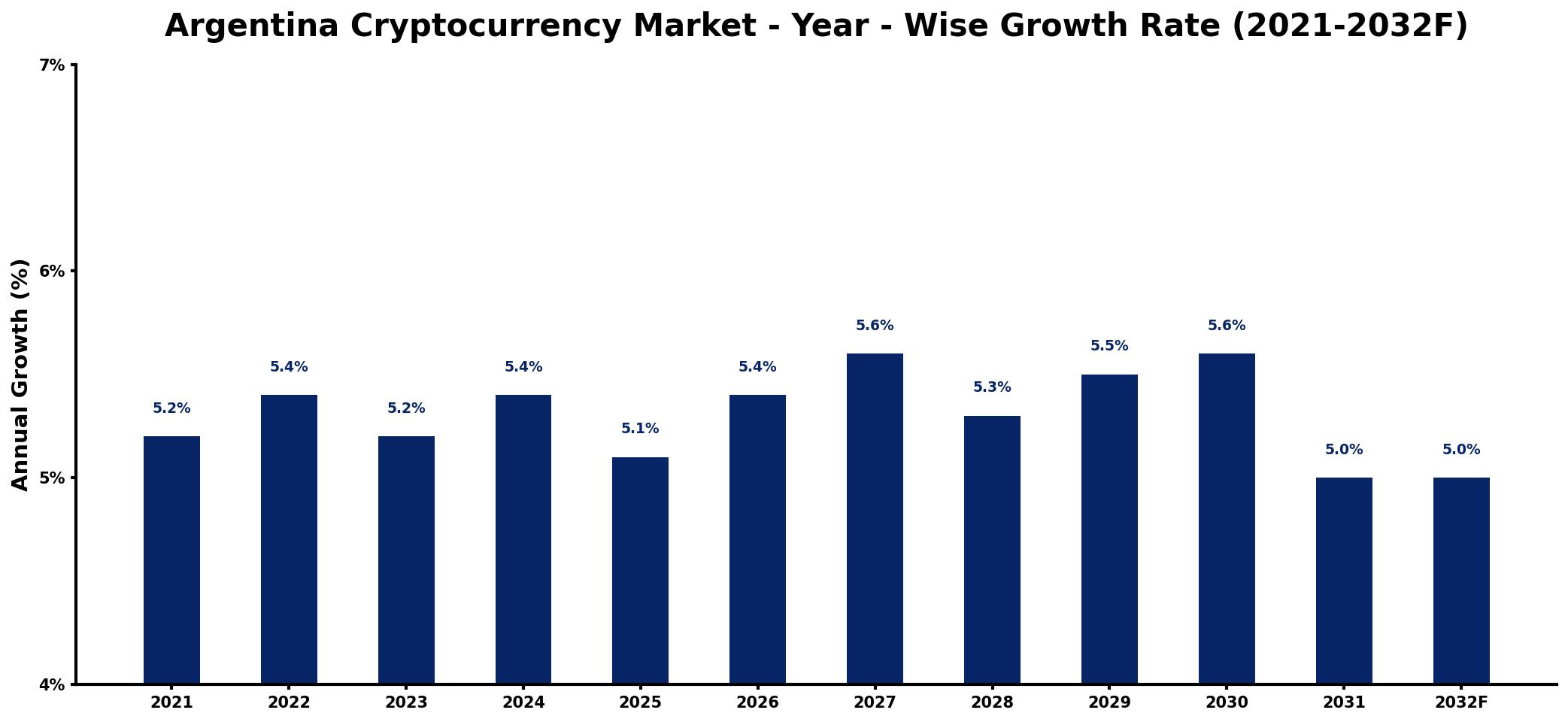
The table below presents the year‑wise growth rates along with the key drivers influencing the market
| Year | Growth Rate | Major Drivers |
| 2021 | 5.2% | Emerging digital asset adoption |
| 2022 | 5.4% | Institutional investment increases significantly |
| 2023 | 5.2% | Regulatory clarity fosters growth |
| 2024 | 5.4% | Retail interest drives market expansion |
| 2025 | 5.1% | Technological advancements enhance security |
| 2026 | 5.4% | Increased transaction volume observed |
| 2027 | 5.6% | Diverse use cases gain traction |
| 2028 | 5.3% | Global partnerships enhance accessibility |
| 2029 | 5.5% | Educational initiatives boost awareness |
| 2030 | 5.6% | Innovative financial products introduced |
| 2031 | 5.0% | Sustainable practices attract investors |
| 2032 | 5.0% | User-friendly platforms encourage participation |
Note: Market size estimations and growth projections presented in this report are based on 6Wresearch's proprietary forecasting methodology, utilizing the latest available industry data, government publications, and primary research inputs.
Argentina Cryptocurrency Market Synopsis
The Argentina cryptocurrency market is characterized by a rapid increase in adoption and usage as citizens navigate economic turmoil. With inflation rates soaring and traditional banking options limited, cryptocurrencies offer a practical alternative for those seeking financial stability.
Local exchanges and trading platforms are emerging in response to this growing demand, offering a wide array of digital assets. Yet, the market grapples with regulatory uncertainty and security concerns, which pose significant challenges to investors and businesses alike.
Argentina Cryptocurrency Market Key Takeaways
- The market's growth is driven by economic instability, with a rising number of Argentinians turning to cryptocurrencies for financial protection.
- Local exchanges are increasingly facilitating a robust trading environment, catering to both individual and business needs.
- Decentralized finance (DeFi) platforms are gaining traction, providing new opportunities for financial access and passive income generation.
- Regulatory clarity is essential for sustainable growth, as current uncertainties may deter potential market entrants.
- Investment in blockchain solutions addressing local challenges presents significant opportunities for growth and innovation.
Evaluation of Restraints in Argentina Cryptocurrency Market
The Argentina cryptocurrency market faces considerable restraints primarily stemming from regulatory ambiguity. The absence of clear guidelines creates a landscape filled with uncertainty, which can deter both investors and businesses from fully engaging in cryptocurrency activities. Furthermore, the market's inherent volatility poses significant risks for participants, complicating investment decisions. These factors, combined with ongoing economic challenges, underscore the need for a more stable and regulated environment to bolster growth and trust within the cryptocurrency ecosystem.
Argentina Cryptocurrency Market Trends
A significant trend in the Argentina cryptocurrency market is the shift towards digital assets as a hedge against economic instability. Citizens increasingly view cryptocurrencies, particularly Bitcoin and Ethereum, as viable stores of value. Concurrently, a growing number of businesses are beginning to accept cryptocurrencies as payment, enhancing their integration into everyday transactions. Additionally, the rise of DeFi platforms is revolutionizing financial services, granting individuals access to tools that facilitate financial autonomy without relying on traditional banking systems.
Argentina Cryptocurrency Market Opportunities
Investment opportunities within the Argentina cryptocurrency market are plentiful for discerning investors. Established cryptocurrencies, such as Bitcoin and Ethereum, remain strong candidates for investment. Additionally, the exploration of altcoins with innovative technologies presents potential for substantial returns. Another promising avenue lies in projects that leverage blockchain technology to address pressing local challenges, such as enhancing supply chain transparency or increasing financial inclusion. Given the volatility of traditional currencies, stablecoins also offer a strategic hedge against devaluation, providing further avenues for investor interest.
Government Initiatives in the Argentina Cryptocurrency Market
The Argentine government has adopted a relatively open stance towards cryptocurrencies, recognizing their potential benefits. Initiatives aimed at promoting the use of digital currencies have been implemented; however, authorities have also introduced measures to combat money laundering and terrorism financing. This includes requiring registration with the Financial Information Unit for individuals and businesses engaging in cryptocurrency transactions. Although the regulatory framework remains fluid, the government continues to monitor the market, striving to balance innovation with security concerns.
Future Insights of the Argentina Cryptocurrency Market
Looking ahead to the period between 2026 and 2032, the Argentina cryptocurrency market is poised for continued growth. The rising awareness and acceptance of cryptocurrencies among both consumers and businesses will drive further innovation and participation. As the government refines its regulatory approach, greater clarity is expected, which could enhance market confidence and encourage investment. The integration of cryptocurrencies into everyday financial transactions and the broader financial ecosystem will position Argentina as a significant player in the Latin American cryptocurrency landscape.
Argentina Cryptocurrency Market Latest Developments (2025 - 2026)
In recent months, the Argentina cryptocurrency market has seen a notable uptick in activity, with local exchanges reporting increased trading volumes amid a growing consumer base. Various initiatives aimed at educating the public about the benefits and risks of digital assets have gained traction, fostering a more informed user community. Additionally, the emergence of several blockchain projects addressing local economic challenges is paving the way for increased investment and interest in innovative financial solutions.
Argentina Cryptocurrency Market - Key Attractiveness of the Report
- 10 Years of Market Numbers
- Historical Data Starting from 2022 to 2025
- Base Year: 2025
- Forecast Data until 2032
- Key Performance Indicators Impacting the Market
- Major Upcoming Developments and Projects
Key Highlights of the Report:
- Argentina Cryptocurrency Market Outlook
- Market Size of Argentina Cryptocurrency Market, 2025
- Forecast of Argentina Cryptocurrency Market, 2032
- Historical Data and Forecast of Argentina Cryptocurrency Revenues & Volume for the Period 2022-2032F
- Argentina Cryptocurrency Market Trend Evolution
- Argentina Cryptocurrency Market Drivers and Challenges
- Argentina Cryptocurrency Price Trends
- Argentina Cryptocurrency Porter's Five Forces
- Argentina Cryptocurrency Industry Life Cycle
- Historical Data and Forecast of Argentina Cryptocurrency Market Revenues & Volume By Offering for the Period 2022-2032F
- Historical Data and Forecast of Argentina Cryptocurrency Market Revenues & Volume By Hardware for the Period 2022-2032F
- Historical Data and Forecast of Argentina Cryptocurrency Market Revenues & Volume By ASIC for the Period 2022-2032F
- Historical Data and Forecast of Argentina Cryptocurrency Market Revenues & Volume By Full Custom ASIC for the Period 2022-2032F
- Historical Data and Forecast of Argentina Cryptocurrency Market Revenues & Volume By Semi-custom ASIC for the Period 2022-2032F
- Historical Data and Forecast of Argentina Cryptocurrency Market Revenues & Volume By Programmable ASIC for the Period 2022-2032F
- Historical Data and Forecast of Argentina Cryptocurrency Market Revenues & Volume By GPU for the Period 2022-2032F
- Historical Data and Forecast of Argentina Cryptocurrency Market Revenues & Volume By FPGA for the Period 2022-2032F
- Historical Data and Forecast of Argentina Hardware Cryptocurrency Market Revenues & Volume By Others for the Period 2022-2032F
- Historical Data and Forecast of Argentina Cryptocurrency Market Revenues & Volume By Process for the Period 2022-2032F
- Historical Data and Forecast of Argentina Cryptocurrency Market Revenues & Volume By Mining for the Period 2022-2032F
- Historical Data and Forecast of Argentina Cryptocurrency Market Revenues & Volume By Transaction for the Period 2022-2032F
- Historical Data and Forecast of Argentina Cryptocurrency Market Revenues & Volume By End User for the Period 2022-2032F
- Historical Data and Forecast of Argentina Cryptocurrency Market Revenues & Volume By Trading for the Period 2022-2032F
- Historical Data and Forecast of Argentina Cryptocurrency Market Revenues & Volume By Retail and E-commerce for the Period 2022-2032F
- Historical Data and Forecast of Argentina Cryptocurrency Market Revenues & Volume By Banking for the Period 2022-2032F
- Historical Data and Forecast of Argentina Cryptocurrency Market Revenues & Volume By Others for the Period 2022-2032F
- Historical Data and Forecast of Argentina Cryptocurrency Market Revenues & Volume By Type for the Period 2022-2032F
- Historical Data and Forecast of Argentina Cryptocurrency Market Revenues & Volume By Bitcoin (BTC) for the Period 2022-2032F
- Historical Data and Forecast of Argentina Cryptocurrency Market Revenues & Volume By Ethereum (ETH) for the Period 2022-2032F
- Historical Data and Forecast of Argentina Cryptocurrency Market Revenues & Volume By Tether (USDT) for the Period 2022-2032F
- Historical Data and Forecast of Argentina Cryptocurrency Market Revenues & Volume By Binance Coin (BNB) for the Period 2022-2032F
- Historical Data and Forecast of Argentina Cryptocurrency Market Revenues & Volume By Cardano (ADA) for the Period 2022-2032F
- Historical Data and Forecast of Argentina Cryptocurrency Market Revenues & Volume By Ripple (XRP) for the Period 2022-2032F
- Historical Data and Forecast of Argentina Cryptocurrency Market Revenues & Volume By Others for the Period 2022-2032F
- Argentina Cryptocurrency Import Export Trade Statistics
- Market Opportunity Assessment By Offering
- Market Opportunity Assessment By Process
- Market Opportunity Assessment By End User
- Market Opportunity Assessment By Type
- Argentina Cryptocurrency Top Companies Market Share
- Argentina Cryptocurrency Competitive Benchmarking By Technical and Operational Parameters
- Argentina Cryptocurrency Company Profiles
- Argentina Cryptocurrency Key Strategic Recommendations






































