Argentina Food & Grocery Retail Market Size, Share & Growth Rate
The Argentina Food & Grocery Retail Market was estimated at USD 472 Million in 2025 and is projected to reach USD 822 Million by 2032, growing at a CAGR of 8.2% from 2026 to 2032. This growth trajectory is primarily driven by increasing urbanization, changing consumer preferences towards convenience and organic products, and the expansion of e-commerce platforms. The evolving landscape presents numerous opportunities for retailers to cater to health-conscious consumers while embracing technological advancements.
Argentina Food & Grocery Retail Market Year-wise Growth Rate and Key Drivers
This graph highlights how the Argentina Food & Grocery Retail Market has steadily grown over the years, supported by major growth factors.
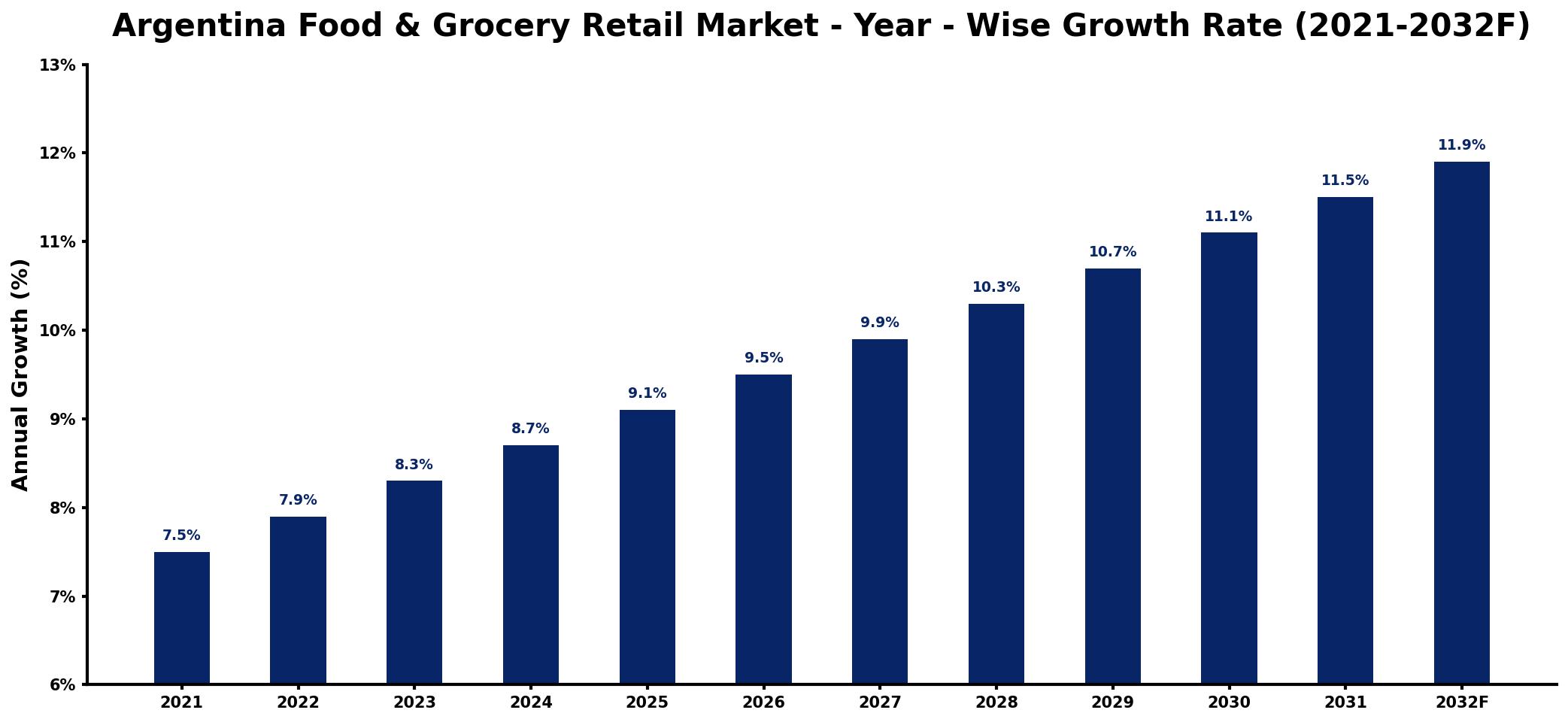
The table below presents the year‑wise growth rates along with the key drivers influencing the market
| Year | Growth Rate | Major Drivers |
| 2021 | 7.5% | Rising consumer purchasing power |
| 2022 | 7.9% | Increased urban population density |
| 2023 | 8.3% | Expansion of delivery services |
| 2024 | 8.7% | Growth in online shopping platforms |
| 2025 | 9.1% | Investment in logistics infrastructure |
| 2026 | 9.5% | Surge in health-conscious consumers |
| 2027 | 9.9% | Diversification of product offerings |
| 2028 | 10.3% | Emergence of local brands |
| 2029 | 10.7% | Innovations in supply chain management |
| 2030 | 11.1% | Growing preference for convenience |
| 2031 | 11.5% | Strengthening of loyalty programs |
| 2032 | 11.9% | Enhanced marketing strategies adoption |
Note: Market size estimations and growth projections presented in this report are based on 6Wresearch's proprietary forecasting methodology, utilizing the latest available industry data, government publications, and primary research inputs.
Argentina Food & Grocery Retail Market Synopsis
The Argentine food and grocery retail market is undergoing a significant transformation, reflecting a blend of local traditions and modern retailing strategies. Supermarkets and hypermarkets are leading the charge, offering a wide array of products, from staples to specialty items, and catering to the diverse needs of consumers.
Amidst economic challenges, such as inflation and fluctuating purchasing power, there is a notable shift towards health-focused and sustainable food choices. Consumers are increasingly seeking locally sourced products and organic options, which is reshaping the competitive landscape and driving innovation in the market.
- The market demonstrates strong growth potential, bolstered by a CAGR of 8.2% from 2026 to 2032.
- Health consciousness and demand for organic products are significantly influencing consumer purchasing behavior.
- E-commerce is rapidly expanding, providing consumers with accessible and convenient shopping options.
- Government initiatives aim to stabilize food prices and support local producers amidst economic fluctuations.
- Investment opportunities abound in specialty stores, health food retailers, and e-commerce platforms.
Despite the promising outlook, the Argentina Food & Grocery Retail Market faces substantial challenges. Economic instability remains a prominent concern, with inflation affecting consumer spending power and altering buying habits. Retailers are pressured to adapt quickly to these fluctuations in demand, making it imperative to balance competitive pricing with quality. Additionally, the ongoing repercussions of the COVID-19 pandemic have disrupted supply chains, necessitating agile strategies to navigate this unpredictable landscape. As businesses strive to regain momentum, they must remain vigilant in addressing these constraints to thrive.
Several trends are shaping the Argentine food and grocery retail landscape. The rising popularity of organic and health-oriented food products is catalyzing the growth of specialty stores and dedicated sections within supermarkets. Similarly, e-commerce continues to gain traction, particularly in urban centers where convenience and quick delivery are paramount. Furthermore, consumers are increasingly drawn to sustainable practices, favoring brands that prioritize ethical sourcing and support local agriculture. These trends signify a broader shift towards health-conscious and environmentally responsible consumption.
The Argentina Food & Grocery Retail Market offers numerous investment avenues for stakeholders. With a growing urban population, the demand for diverse and convenient food options is surging. Expanding supermarkets, hypermarkets, and specialty grocery stores can capitalize on this trend by creating one-stop shopping experiences. Additionally, the shift toward healthier eating habits opens doors for investments in health food outlets and organic product lines. As e-commerce continues to thrive, ventures focused on online grocery shopping and delivery services present lucrative opportunities. Furthermore, the nation's rich agricultural resources create potential for food import/export businesses.
The Argentine government has introduced several initiatives aimed at stabilizing the food and grocery retail market. The Price Control Program is a critical measure designed to maintain affordability for essential food items, addressing inflation concerns and promoting consumer access. Additionally, incentives and subsidies are provided to encourage domestic production, bolstering the local food industry. Regulations have also been established to ensure fair competition, especially protecting small retailers from monopolistic practices by larger supermarket chains. These policies strive to enhance food security and promote a sustainable retail environment.
Looking ahead to 2026-2032, the Argentina Food & Grocery Retail Market is poised for robust growth. As urbanization accelerates and disposable incomes rise, consumers will increasingly prioritize convenience and quality. The demand for organic and premium products is anticipated to escalate, fostering innovation in product offerings. E-commerce is expected to play a pivotal role in the market's evolution, necessitating retailers to enhance their omnichannel capabilities. Despite ongoing economic challenges, the market's adaptability signals resilience and ongoing opportunities for growth.
In recent months, the Argentina Food & Grocery Retail Market has witnessed several noteworthy developments. Retailers are increasingly investing in technology to optimize operations and enhance the customer shopping experience. E-commerce platforms are expanding their service offerings, with many introducing new delivery options to cater to changing consumer preferences. Furthermore, there is a noticeable increase in collaborations aimed at promoting local produce and sustainable practices, reflecting a growing commitment to ethical sourcing across the sector.
- 10 Years of Market Numbers
- Historical Data Starting from 2022 to 2025
- Base Year: 2025
- Forecast Data until 2032
- Key Performance Indicators Impacting the Market
- Major Upcoming Developments and Projects
Key Highlights of the Report:
- Argentina Food & Grocery Retail Market Outlook
- Market Size of Argentina Food & Grocery Retail Market, 2025
- Forecast of Argentina Food & Grocery Retail Market, 2032
- Historical Data and Forecast of Argentina Food & Grocery Retail Revenues & Volume for the Period 2022-2032F
- Argentina Food & Grocery Retail Market Trend Evolution
- Argentina Food & Grocery Retail Market Drivers and Challenges
- Argentina Food & Grocery Retail Price Trends
- Argentina Food & Grocery Retail Porter's Five Forces
- Argentina Food & Grocery Retail Industry Life Cycle
- Historical Data and Forecast of Argentina Food & Grocery Retail Market Revenues & Volume By Product for the Period 2022-2032F
- Historical Data and Forecast of Argentina Food & Grocery Retail Market Revenues & Volume By Fresh Food for the Period 2022-2032F
- Historical Data and Forecast of Argentina Food & Grocery Retail Market Revenues & Volume By Frozen Food for the Period 2022-2032F
- Historical Data and Forecast of Argentina Food & Grocery Retail Market Revenues & Volume By Food Cupboard for the Period 2022-2032F
- Historical Data and Forecast of Argentina Food & Grocery Retail Market Revenues & Volume By Beverages for the Period 2022-2032F
- Historical Data and Forecast of Argentina Food & Grocery Retail Market Revenues & Volume By Cleaning & Household for the Period 2022-2032F
- Historical Data and Forecast of Argentina Food & Grocery Retail Market Revenues & Volume By Others for the Period 2022-2032F
- Historical Data and Forecast of Argentina Food & Grocery Retail Market Revenues & Volume By Distribution Channel for the Period 2022-2032F
- Historical Data and Forecast of Argentina Food & Grocery Retail Market Revenues & Volume By Supermarkets & Hypermarkets for the Period 2022-2032F
- Historical Data and Forecast of Argentina Food & Grocery Retail Market Revenues & Volume By Convenience Stores for the Period 2022-2032F
- Historical Data and Forecast of Argentina Food & Grocery Retail Market Revenues & Volume By Departmental Stores & Clubs for the Period 2022-2032F
- Historical Data and Forecast of Argentina Food & Grocery Retail Market Revenues & Volume By Online for the Period 2022-2032F
- Argentina Food & Grocery Retail Import Export Trade Statistics
- Market Opportunity Assessment By Product
- Market Opportunity Assessment By Distribution Channel
- Argentina Food & Grocery Retail Top Companies Market Share
- Argentina Food & Grocery Retail Competitive Benchmarking By Technical and Operational Parameters
- Argentina Food & Grocery Retail Company Profiles
- Argentina Food & Grocery Retail Key Strategic Recommendations






































