Argentina Industrial Machinery Market Size, Share & Growth Rate
The Argentina Industrial Machinery Market was estimated at USD 128 Million in 2025 and is projected to reach USD 139 Million by 2032, growing at a CAGR of 1.2% from 2026 to 2032. This modest growth trajectory is primarily fueled by Argentina's increasing industrialization and a significant push towards automation in diverse sectors such as manufacturing and agriculture. As industries adopt advanced technologies and seek to enhance productivity, the demand for innovative machinery is expected to surge, aligning with the global trends of efficiency and smart manufacturing.
Argentina Industrial Machinery Market Year-wise Growth Rate and Key Drivers
This graph highlights how the Argentina Industrial Machinery Market has steadily grown over the years, supported by major growth factors.
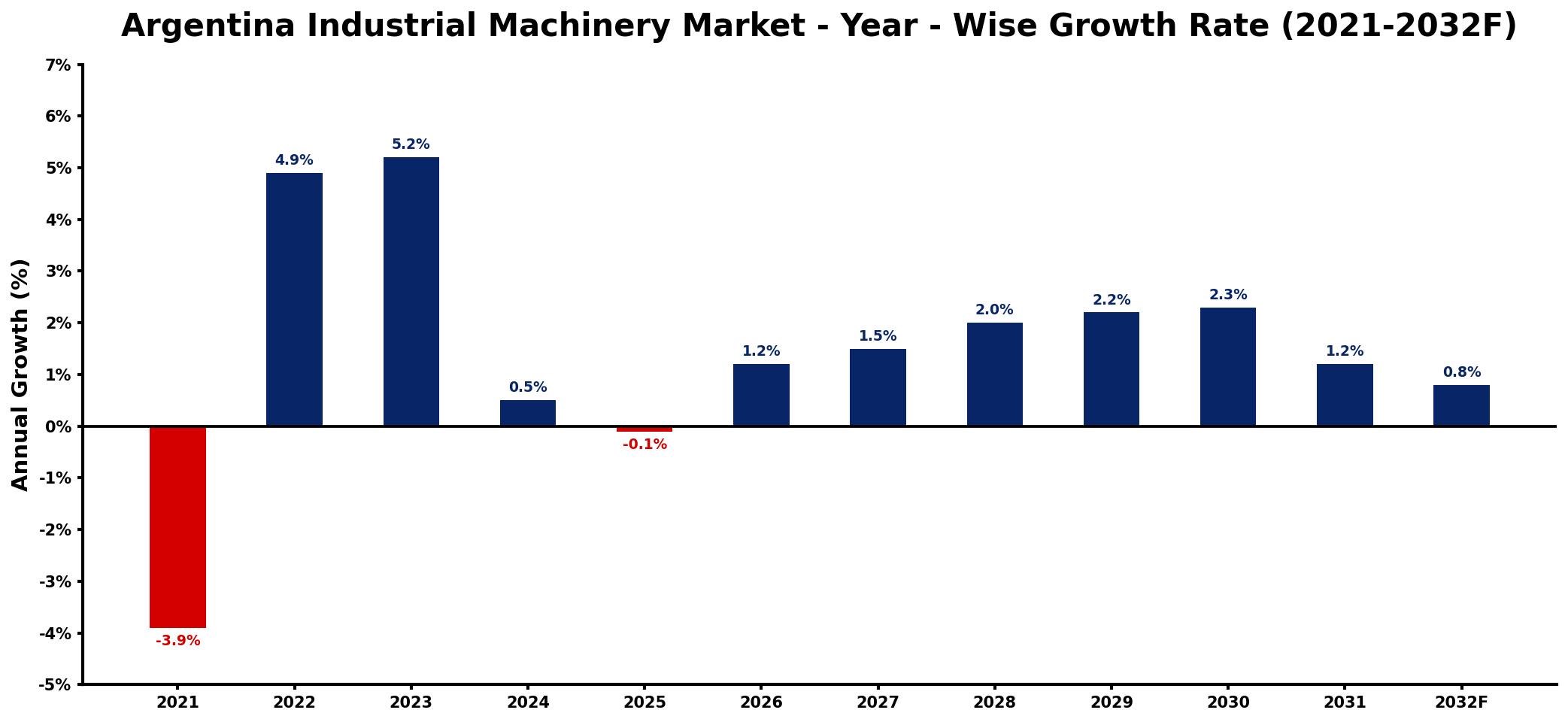
The table below presents the year‑wise growth rates along with the key drivers influencing the market
| Year | Growth Rate | Major Drivers |
| 2021 | -3.9% | Lower investment in construction projects |
| 2022 | 4.9% | Rising demand for automation solutions |
| 2023 | 5.2% | Increased infrastructure development initiatives |
| 2024 | 0.5% | Expansion of renewable energy sector |
| 2025 | -0.1% | Decreased foreign direct investment flows |
| 2026 | 1.2% | Growth in agricultural equipment needs |
| 2027 | 1.5% | Surge in manufacturing sector output |
| 2028 | 2.0% | Enhanced logistics and transportation investments |
| 2029 | 2.2% | Growing focus on sustainability practices |
| 2030 | 2.3% | Advancements in technology adoption rates |
| 2031 | 1.2% | Strengthening of local supply chains |
| 2032 | 0.8% | increased overall sector activity |
Note: Market size estimations and growth projections presented in this report are based on 6Wresearch's proprietary forecasting methodology, utilizing the latest available industry data, government publications, and primary research inputs.
Argentina Industrial Machinery Market Synopsis
The Argentina Industrial Machinery Market has demonstrated a robust response to recent technological advancements, with manufacturers increasingly integrating IoT-enabled systems and automation solutions. This momentum has positioned the market favorably, yet the landscape is evolving toward greater demand for interconnected machinery and predictive maintenance systems.
As companies shift focus towards operational excellence and efficiency gains, they are investing in equipment that not only meets current production needs but is also future-ready. With government initiatives further reinforcing this trajectory, the market is poised for a transformative journey over the next several years.
Argentina Industrial Machinery Market Key Takeaways
- The market is on a steady growth path, driven by the integration of advanced manufacturing technologies.
- Technological disruptions and automation are reshaping traditional industrial practices.
- Government initiatives are promoting domestic manufacturing and innovation, creating a conducive environment for growth.
- Industries are increasingly adopting smart technologies to enhance efficiency and reduce operational costs.
- Compliance with stringent regulations is shaping the development and design of industrial machinery.
Evaluation of Restraints in Argentina Industrial Machinery Market
While the Argentina Industrial Machinery Market is poised for growth, it faces significant restraints primarily linked to economic volatility and regulatory compliance. Economic fluctuations, including currency devaluation, can lead to hesitance in investments critical for infrastructure and machinery upgrades. Moreover, companies must navigate complex safety and quality standards, which can complicate product development timelines. These challenges compel manufacturers to continuously innovate while managing costs, necessitating strategic investments in R&D to maintain competitive advantage.
Argentina Industrial Machinery Market Trends
Current trends in the Argentina Industrial Machinery Market indicate a pronounced shift towards Industry 4.0 principles. The adoption of IoT technologies is revolutionizing equipment functionality, enabling real-time monitoring and analytics. Furthermore, the rise of AI-driven solutions is enhancing predictive maintenance capabilities, significantly reducing downtime. There is also a growing emphasis on sustainable practices, with many manufacturers pursuing energy-efficient machinery designs that align with global sustainability goals. As these trends mature, they will continue to shape the future landscape of industrial operations in Argentina.
Argentina Industrial Machinery Market Opportunities
Investment opportunities within the Argentina Industrial Machinery Market are expanding, particularly in the realm of automation technologies and smart systems. The demand for advanced CNC machines, robotics, and material handling solutions is set to rise as industries strive for efficiency and competitive edge. Additionally, the government's encouragement of domestic manufacturing presents a ripe environment for both local and foreign investments, particularly in developing innovative machinery tailored to the unique needs of Argentine industries. Strategic partnerships and collaborations can further enhance market entry and expansion prospects.
Government Initiatives in the Argentina Industrial Machinery Market
The Argentine government is actively promoting initiatives to bolster the industrial machinery sector, emphasizing the importance of domestic manufacturing, export growth, and technological innovation. Various programs aimed at fostering R&D in manufacturing technologies have been introduced, aiming to support local manufacturers in adopting advanced machinery. Additionally, public spending on infrastructure development is expected to facilitate further growth in this market, providing a solid foundation for industries reliant on sophisticated machinery.
Future Insights of the Argentina Industrial Machinery Market
Looking ahead to 2026-2032, the Argentina Industrial Machinery Market is anticipated to experience steady progress driven by increased adoption of automation and smart technologies. As industries continue to embrace digital transformation, machinery that offers connectivity and adaptability will be at the forefront of demand. The governments ongoing support for industrial development will further catalyze innovation and investment, setting the stage for a resilient and competitive market landscape.
Argentina Industrial Machinery Market Latest Developments (2025 - 2026)
Recent developments in the Argentina Industrial Machinery Market reflect a shift toward incorporating more digital solutions into traditional machinery operations. Companies are increasingly focusing on retrofitting existing equipment with IoT capabilities to optimize performance and maintenance. Additionally, there is a noticeable trend of partnerships between technology firms and machinery manufacturers aimed at enhancing product offerings with cutting-edge AI and machine learning technologies.
Argentina Industrial Machinery Market - Key Attractiveness of the Report
- 10 Years of Market Numbers
- Historical Data Starting from 2022 to 2025
- Base Year: 2025
- Forecast Data until 2032
- Key Performance Indicators Impacting the Market
- Major Upcoming Developments and Projects
Key Highlights of the Report:
- Argentina Industrial Machinery Market Outlook
- Market Size of Argentina Industrial Machinery Market, 2025
- Forecast of Argentina Industrial Machinery Market, 2032
- Historical Data and Forecast of Argentina Industrial Machinery Revenues & Volume for the Period 2022-2032F
- Argentina Industrial Machinery Market Trend Evolution
- Argentina Industrial Machinery Market Drivers and Challenges
- Argentina Industrial Machinery Price Trends
- Argentina Industrial Machinery Porter's Five Forces
- Argentina Industrial Machinery Industry Life Cycle
- Historical Data and Forecast of Argentina Industrial Machinery Market Revenues & Volume By Application for the Period 2022-2032F
- Historical Data and Forecast of Argentina Industrial Machinery Market Revenues & Volume By Agriculture for the Period 2022-2032F
- Historical Data and Forecast of Argentina Industrial Machinery Market Revenues & Volume By Construction for the Period 2022-2032F
- Historical Data and Forecast of Argentina Industrial Machinery Market Revenues & Volume By Packaging for the Period 2022-2032F
- Historical Data and Forecast of Argentina Industrial Machinery Market Revenues & Volume By Food Processing for the Period 2022-2032F
- Historical Data and Forecast of Argentina Industrial Machinery Market Revenues & Volume By Mining for the Period 2022-2032F
- Historical Data and Forecast of Argentina Industrial Machinery Market Revenues & Volume By Semiconductor Manufacturing for the Period 2022-2032F
- Argentina Industrial Machinery Import Export Trade Statistics
- Market Opportunity Assessment By Application
- Argentina Industrial Machinery Top Companies Market Share
- Argentina Industrial Machinery Competitive Benchmarking By Technical and Operational Parameters
- Argentina Industrial Machinery Company Profiles
- Argentina Industrial Machinery Key Strategic Recommendations






































