Australia Cathode ray tube display Market Size, Share & Growth Rate
The Australia Cathode ray tube display Market was estimated at USD 198 Million in 2025 and is projected to reach USD 234 Million by 2032, growing at a CAGR of 2.4% from 2026 to 2032. This growth is primarily driven by the persistent demand for CRTs in niche applications such as medical imaging and certain industrial monitoring sectors, where these displays continue to provide unique advantages. Additionally, the gradual transition toward digital signage solutions is fostering continued interest in CRT technology, albeit within limited contexts.
Australia Cathode ray tube display Market Year-wise Growth Rate and Key Drivers
This graph highlights how the Australia Cathode ray tube display Market has steadily grown over the years, supported by major growth factors.
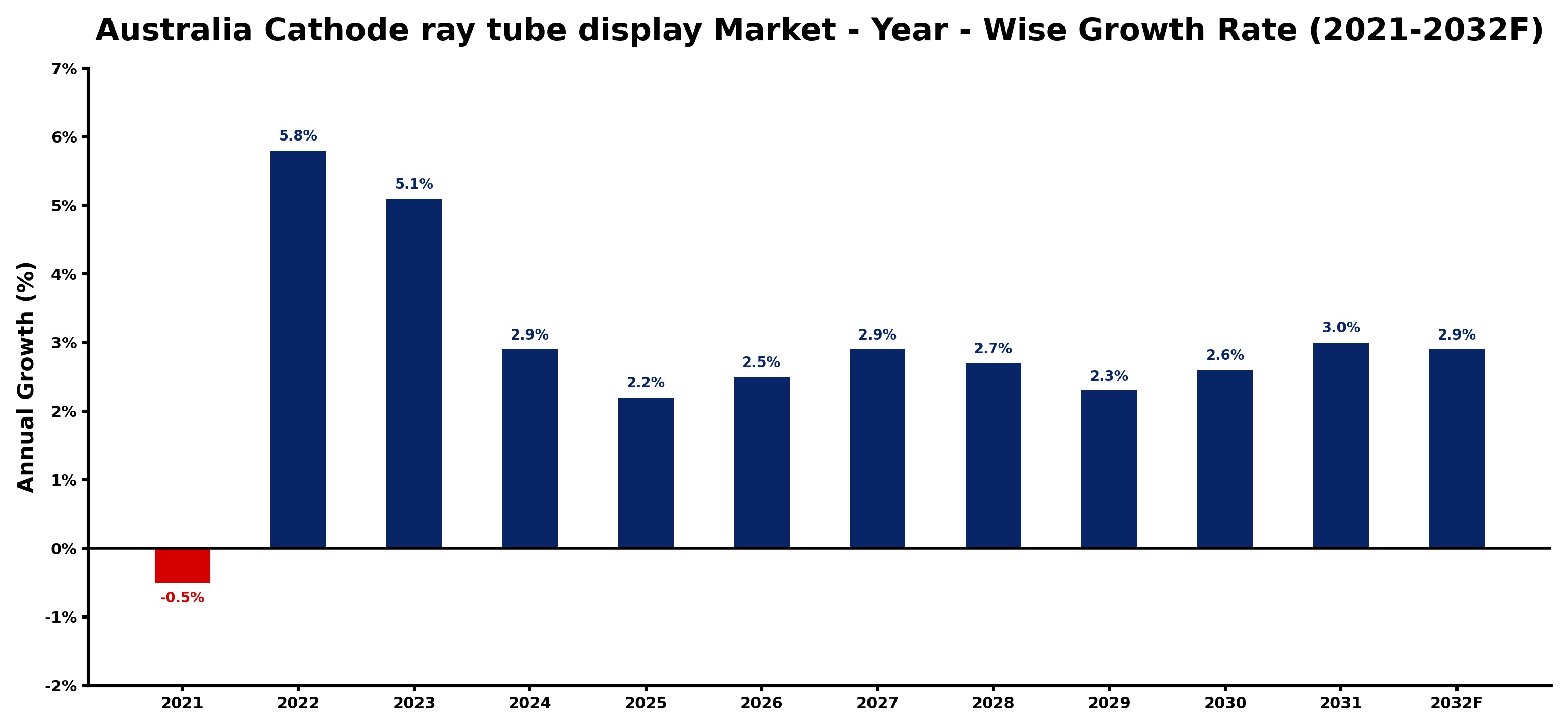
The table below presents the year‑wise growth rates along with the key drivers influencing the market
| Year | Growth Rate | Major Drivers |
| 2021 | -0.5% | Weak mining sector demand limited cathode ray tube purchases |
| 2022 | 5.8% | Mining sector advancements boost cathode ray tube production efficiency |
| 2023 | 5.1% | Accelerated mining sector investments boosted cathode ray tube production |
| 2024 | 2.9% | Mining sector expansion drives cathode ray tube display orders |
| 2025 | 2.2% | Mining sector investments drive cathode ray tube production capacity expansion |
| 2026 | 2.5% | Mining sector technology upgrades boost cathode ray tube demand |
| 2027 | 2.9% | Mining sector investments boosted cathode ray tube manufacturing capacity |
| 2028 | 2.7% | Mining sector maintenance drives demand for cathode ray tube displays |
| 2029 | 2.3% | Mining sector automation drives demand for advanced display technologies |
| 2030 | 2.6% | Mining sector technology integration boosts cathode ray tube demand |
| 2031 | 3.0% | Manufacturing investments boosted capacity utilization in cathode ray tube production |
| 2032 | 2.9% | Export driven mining technology upgrades boost cathode ray tube demand |
Note - Market size estimations and growth projections presented in this report are based on 6Wresearch’s advanced forecasting approach, validated with industry datasets as of June 2026.
Australia Cathode ray tube display Market Synopsis
The strongest force currently shaping the Australia Cathode ray tube display Market is the lingering need for CRT technology in specialized applications. Despite the overall decline in consumer demand for CRT televisions and monitors, sectors like healthcare rely on these displays for specific imaging tasks, ensuring a steady, albeit niche, market.
Furthermore, environmental regulations are influencing how CRTs are managed at the end of their life cycle. Government initiatives aimed at electronic waste recycling and incentives for proper disposal are becoming increasingly relevant, pushing for responsible management of CRT technology in Australia.
Australia Cathode ray tube display Market Key Takeaways
- The market is characterized by a niche demand driven by specialized applications like medical imaging and industrial monitoring.
- Government policies are promoting sustainable disposal and recycling of CRTs, influencing market dynamics.
- Technological advancements in alternative display technologies continue to overshadow the general CRT market growth.
- Digital signage solutions are emerging as a potential area for CRT application and market interest.
- Environmental concerns are leading to increased focus on responsible waste management practices for CRT technology.
Evaluation of Restraints in Australia Cathode ray tube display Market
The Australia Cathode ray tube display Market faces several restraints that limit its potential growth. Primarily, the rapid obsolescence of CRT technology continues to challenge its market position, as modern flat-panel displays such as LCDs, LEDs, and OLEDs dominate the landscape with their enhanced energy efficiency, superior image quality, and reduced space requirements. Environmental regulations regarding CRT disposal further complicate market viability, pushing stakeholders to navigate increasingly stringent compliance measures. Consequently, the market remains constrained by both technological advancement and regulatory pressures, inhibiting broader adoption of CRT solutions.
Australia Cathode ray tube display Market Trends
Current trends in the Australia Cathode ray tube display Market indicate a shift towards the utilization of CRTs in specific sectors that value the unique attributes these displays offer. For instance, in medical imaging, the precise color representation and response time of CRTs can be advantageous for diagnostic applications. Furthermore, there is a growing interest in repurposing existing CRT technology for digital signage, especially in environments where traditional flat-panel displays may not suffice.
On the technological front, advancements in waste management and recycling processes are also emerging as critical trends, reflecting a broader commitment to sustainability within the industry. This could potentially increase the longevity and usability of CRTs in specialty applications where they can still be relevant.
Australia Cathode ray tube display Market Opportunities
The most genuine growth opportunities within the Australia Cathode ray tube display Market lie in specialized sectors that continue to depend on CRT technology for its distinctive advantages. The medical imaging sector stands out as a primary opportunity, with ongoing demand for high-fidelity displays in diagnostic equipment. Additionally, sectors such as industrial monitoring and retro display setups for digital signage could benefit from CRTs, especially in applications requiring specific characteristics that modern technologies may not replicate. Collaborations aimed at innovation in sustainable disposal and recycling practices could also create new pathways for market participants, fostering a more circular economy for CRTs.
Government Initiatives in the Australia Cathode ray tube display Market
The Australian government is actively implementing policies aimed at addressing the environmental challenges posed by electronic waste, including CRTs. Initiatives focused on promoting recycling programs and incentives for proper disposal highlight a commitment to sustainable practices. Furthermore, government support for innovation in display technologies, as well as educational programs to increase digital literacy, can help facilitate the transition from CRTs to more modern solutions while ensuring that existing CRT technology is managed responsibly.
Future Insights of the Australia Cathode ray tube display Market
Looking ahead to the period from 2026 to 2032, the Australia Cathode ray tube display Market is expected to continue on its niche trajectory, driven primarily by specialized applications in medical imaging and industrial monitoring. While the overall market may face competition from more advanced display technologies, the unique advantages of CRTs in certain contexts will ensure ongoing demand. Additionally, greater emphasis on environmental sustainability will prompt industry stakeholders to focus on responsible CRT disposal and recycling, potentially extending the lifecycle of CRT technology in specific sectors.
Australia Cathode ray tube display Market Latest Developments (May 2025 - June 2026)
Recent developments in the Australia Cathode ray tube display Market indicate a consolidation of efforts to address the environmental impact of CRTs. Stakeholders are increasingly engaging in discussions surrounding the best practices for waste management and recycling. Concurrently, there is growing interest in adapting CRT technology for use in digital signage applications, as businesses seek innovative ways to utilize existing infrastructure while maintaining operational efficiency.
Australia Cathode ray tube display Market - Key Attractiveness of the Report
- 10 Years of Market Numbers
- Historical Data Starting from 2022 to 2025
- Base Year: 2025
- Forecast Data until 2032
- Key Performance Indicators Impacting the Market
- Major Upcoming Developments and Projects
Key Highlights of the Report:
- Australia Cathode ray tube display Market Outlook
- Market Size of Australia Cathode ray tube display Market, 2025
- Forecast of Australia Cathode ray tube display Market, 2032
- Historical Data and Forecast of Australia Cathode ray tube display Revenues & Volume for the Period 2022-2032F
- Australia Cathode ray tube display Market Trend Evolution
- Australia Cathode ray tube display Market Drivers and Challenges
- Australia Cathode ray tube display Price Trends
- Australia Cathode ray tube display Porter's Five Forces
- Australia Cathode ray tube display Industry Life Cycle
- Historical Data and Forecast of Australia Cathode ray tube display Market Revenues & Volume By Type for the Period 2022-2032F
- Historical Data and Forecast of Australia Cathode ray tube display Market Revenues & Volume By Random Scan Display for the Period 2022-2032F
- Historical Data and Forecast of Australia Cathode ray tube display Market Revenues & Volume By Raster Scan Display for the Period 2022-2032F
- Historical Data and Forecast of Australia Cathode ray tube display Market Revenues & Volume By Screen Type for the Period 2022-2032F
- Historical Data and Forecast of Australia Cathode ray tube display Market Revenues & Volume By Curved Screen for the Period 2022-2032F
- Historical Data and Forecast of Australia Cathode ray tube display Market Revenues & Volume By Flat Screen for the Period 2022-2032F
- Historical Data and Forecast of Australia Cathode ray tube display Market Revenues & Volume By Application for the Period 2022-2032F
- Historical Data and Forecast of Australia Cathode ray tube display Market Revenues & Volume By Television Screen for the Period 2022-2032F
- Historical Data and Forecast of Australia Cathode ray tube display Market Revenues & Volume By Desktop Computer Monitor for the Period 2022-2032F
- Historical Data and Forecast of Australia Cathode ray tube display Market Revenues & Volume By Wireless Phone for the Period 2022-2032F
- Historical Data and Forecast of Australia Cathode ray tube display Market Revenues & Volume By Portable IT Devices for the Period 2022-2032F
- Historical Data and Forecast of Australia Cathode ray tube display Market Revenues & Volume By Others for the Period 2022-2032F
- Historical Data and Forecast of Australia Cathode ray tube display Market Revenues & Volume By Industry Vertical for the Period 2022-2032F
- Historical Data and Forecast of Australia Cathode ray tube display Market Revenues & Volume By Consumer Electronics for the Period 2022-2032F
- Historical Data and Forecast of Australia Cathode ray tube display Market Revenues & Volume By Automotive for the Period 2022-2032F
- Historical Data and Forecast of Australia Cathode ray tube display Market Revenues & Volume By Industrial for the Period 2022-2032F
- Historical Data and Forecast of Australia Cathode ray tube display Market Revenues & Volume By Healthcare for the Period 2022-2032F
- Historical Data and Forecast of Australia Cathode ray tube display Market Revenues & Volume By Others for the Period 2022-2032F
- Australia Cathode ray tube display Import Export Trade Statistics
- Market Opportunity Assessment By Type
- Market Opportunity Assessment By Screen Type
- Market Opportunity Assessment By Application
- Market Opportunity Assessment By Industry Vertical
- Australia Cathode ray tube display Top Companies Market Share
- Australia Cathode ray tube display Competitive Benchmarking By Technical and Operational Parameters
- Australia Cathode ray tube display Company Profiles
- Australia Cathode ray tube display Key Strategic Recommendations






































