Australia Electrical Testing Equipment Market Size, Share & Growth Rate
The Australia Electrical Testing Equipment Market was estimated at USD 195 Million in 2025 and is projected to reach USD 227 Million by 2032, growing at a CAGR of 2.2% from 2026 to 2032. This growth trajectory is driven primarily by the increasing emphasis on quality assurance and safety compliance across diverse sectors, including telecommunications, manufacturing, and utilities. As industries expand and incorporate advanced technology, the demand for reliable electrical testing equipment that ensures optimal performance is expected to rise significantly.
Australia Electrical Testing Equipment Market Year-wise Growth Rate and Key Drivers
This graph highlights how the Australia Electrical Testing Equipment Market has steadily grown over the years, supported by major growth factors.
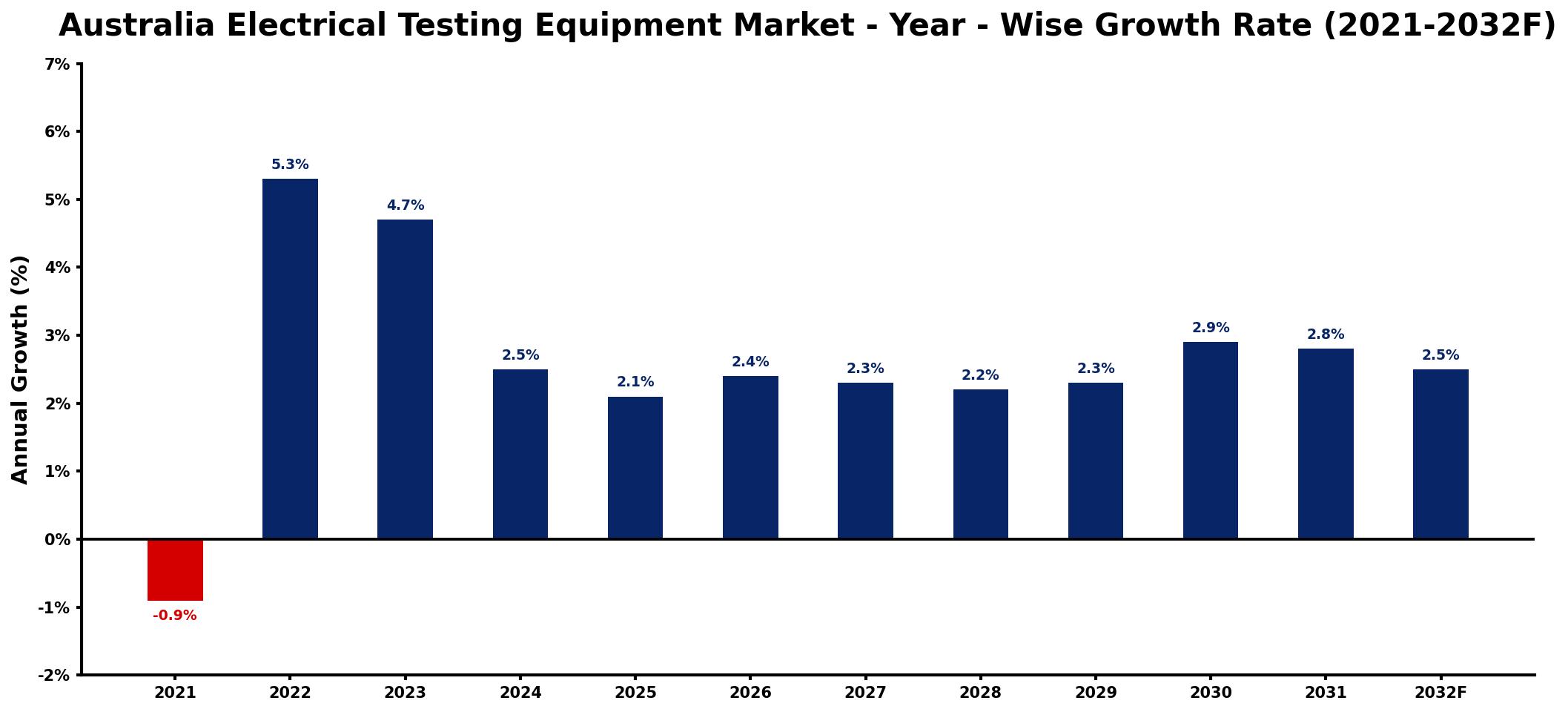
The table below presents the year‑wise growth rates along with the key drivers influencing the market
| Year | Growth Rate | Major Drivers |
| 2021 | -0.9% | Supply chain disruptions impact demand |
| 2022 | 5.3% | Renewable energy sector expansion drives |
| 2023 | 4.7% | Increased safety regulations stimulate investments |
| 2024 | 2.5% | Technological advancements enhance market opportunities |
| 2025 | 2.1% | Growing construction activities fuel demand |
| 2026 | 2.4% | increased production capacity utilization |
| 2027 | 2.3% | Infrastructure upgrades boost market potential |
| 2028 | 2.2% | Emerging markets drive innovation demand |
| 2029 | 2.3% | Government incentives promote sector growth |
| 2030 | 2.9% | Industrial automation trends increase investments |
| 2031 | 2.8% | Sustainability initiatives enhance market prospects |
| 2032 | 2.5% | Rising consumer awareness supports demand |
Note: Market size estimations and growth projections presented in this report are based on 6Wresearch's proprietary forecasting methodology, utilizing the latest available industry data, government publications, and primary research inputs.
Australia Electrical Testing Equipment Market Synopsis
In recent years, the Australia Electrical Testing Equipment Market has experienced steady growth, propelled by advancements in technology and a growing awareness of safety standards. However, as we look ahead, the market is poised for further evolution with the integration of smart technologies, promising to enhance testing accuracy and efficiency.
The landscape is changing as industries adapt to emerging trends like the Internet of Things (IoT) and 5G, which necessitate more sophisticated testing solutions. This evolution presents both challenges and opportunities, pushing manufacturers to innovate continuously in response to the dynamic needs of the market.
Australia Electrical Testing Equipment Market Key Takeaways
- Robust growth in demand driven by quality assurance and safety compliance across sectors.
- Technological advancements are reshaping testing equipment capabilities and accuracy.
- Market expansion is influenced by regulatory standards enforced by bodies like the National Measurement Institute.
- Emerging technologies, including IoT and 5G, are creating new testing requirements.
- Multi-functional testing equipment is becoming essential for a diverse range of industries.
Evaluation of Restraints in Australia Electrical Testing Equipment Market
Despite the overall positive outlook, the Australia Electrical Testing Equipment Market faces significant restraints. Manufacturers are challenged with developing testing equipment that not only meets stringent accuracy and safety standards but also accommodates the rapid pace of technological advancements. The need for multi-functional solutions that can seamlessly integrate with existing systems adds complexity to product development. Furthermore, adapting to the diverse testing needs across industries such as aerospace, automotive, and telecommunications complicates the design and production processes.
Australia Electrical Testing Equipment Market Trends
Current trends indicate a shift towards compact, portable, and user-friendly testing devices, reflecting the needs of modern technicians and engineers. Additionally, the integration of IoT capabilities within testing equipment is becoming increasingly prevalent, allowing for real-time monitoring and data analysis. This trend not only enhances performance testing but also facilitates predictive maintenance, ultimately improving operational efficiency.
Australia Electrical Testing Equipment Market Opportunities
The potential for growth within the Australia Electrical Testing Equipment Market is promising. As industries increasingly rely on technology-driven solutions, opportunities arise for manufacturers to develop cutting-edge equipment that meets evolving standards. Moreover, as more organizations transition to sustainable energy sources, there will be heightened demand for testing equipment tailored to renewable energy applications, creating a niche market ripe for investment.
Government Initiatives in the Australia Electrical Testing Equipment Market
The Australian government is actively involved in promoting compliance and safety within the electrical testing equipment market through regulatory frameworks that enforce industry standards. Initiatives led by the National Measurement Institute (NMI) focus on ensuring that testing equipment meets rigorous calibration and certification requirements. Public spending aimed at enhancing infrastructure and safety standards further supports the market, while various programs are designed to encourage innovation in testing technologies.
Future Insights of the Australia Electrical Testing Equipment Market
Looking ahead to the period from 2026 to 2032, the Australia Electrical Testing Equipment Market is expected to witness significant transformations driven by technological innovation. The continuous integration of smart technology will likely enhance testing accuracy and efficiency. Furthermore, as industries face the imperative of sustainability, the market will adapt to cater to the increasing demand for eco-friendly testing solutions, positioning itself for sustainable growth.
Australia Electrical Testing Equipment Market Latest Developments (2025 - 2026)
The electrical testing equipment sector is currently experiencing a wave of innovations aimed at improving efficiency and user experience. Manufacturers are focusing on the development of multi-functional devices that incorporate the latest technological advancements, such as remote monitoring capabilities and enhanced data analytics. The industry is also responding to government regulations by upgrading compliance standards to ensure safety and reliability across various applications.
Australia Electrical Testing Equipment Market - Key Attractiveness of the Report
- 10 Years of Market Numbers
- Historical Data Starting from 2022 to 2025
- Base Year: 2025
- Forecast Data until 2032
- Key Performance Indicators Impacting the Market
- Major Upcoming Developments and Projects
Key Highlights of the Report:
- Australia Electrical Testing Equipment Market Outlook
- Market Size of Australia Electrical Testing Equipment Market, 2025
- Forecast of Australia Electrical Testing Equipment Market, 2032
- Historical Data and Forecast of Australia Electrical Testing Equipment Revenues & Volume for the Period 2022-2032F
- Australia Electrical Testing Equipment Market Trend Evolution
- Australia Electrical Testing Equipment Market Drivers and Challenges
- Australia Electrical Testing Equipment Price Trends
- Australia Electrical Testing Equipment Porter's Five Forces
- Australia Electrical Testing Equipment Industry Life Cycle
- Historical Data and Forecast of Australia Electrical Testing Equipment Market Revenues & Volume By Service Type for the Period 2022-2032F
- Historical Data and Forecast of Australia Electrical Testing Equipment Market Revenues & Volume By Electrical Testing Equipment Calibration Services for the Period 2022-2032F
- Historical Data and Forecast of Australia Electrical Testing Equipment Market Revenues & Volume By Electrical Testing Equipment Repair Services or After Sales Services for the Period 2022-2032F
- Historical Data and Forecast of Australia Electrical Testing Equipment Market Revenues & Volume By Product Type for the Period 2022-2032F
- Historical Data and Forecast of Australia Electrical Testing Equipment Market Revenues & Volume By General Purpose Electrical Testing Equipment for the Period 2022-2032F
- Historical Data and Forecast of Australia Electrical Testing Equipment Market Revenues & Volume By Mechanical Electrical Test Equipment for the Period 2022-2032F
- Historical Data and Forecast of Australia Electrical Testing Equipment Market Revenues & Volume By End User for the Period 2022-2032F
- Historical Data and Forecast of Australia Electrical Testing Equipment Market Revenues & Volume By Aerospace and Defense for the Period 2022-2032F
- Historical Data and Forecast of Australia Electrical Testing Equipment Market Revenues & Volume By Telecommunications for the Period 2022-2032F
- Historical Data and Forecast of Australia Electrical Testing Equipment Market Revenues & Volume By Semiconductor and Electronics for the Period 2022-2032F
- Australia Electrical Testing Equipment Import Export Trade Statistics
- Market Opportunity Assessment By Service Type
- Market Opportunity Assessment By Product Type
- Market Opportunity Assessment By End User
- Australia Electrical Testing Equipment Top Companies Market Share
- Australia Electrical Testing Equipment Competitive Benchmarking By Technical and Operational Parameters
- Australia Electrical Testing Equipment Company Profiles
- Australia Electrical Testing Equipment Key Strategic Recommendations






































