Australia Energy Saving & Fluorescent Market Summary
The australia energy saving & fluorescent market was estimated at USD 140 Million in 2025 and is projected to reach USD 165 Million by 2032, growing at a CAGR of 2.8% from 2026 to 2032.
Australia Energy Saving & Fluorescent Market Year-wise Growth Rate and Key Drivers
This graph highlights how the Australia Energy Saving & Fluorescent Market has steadily grown over the past five years, supported by major growth factors.
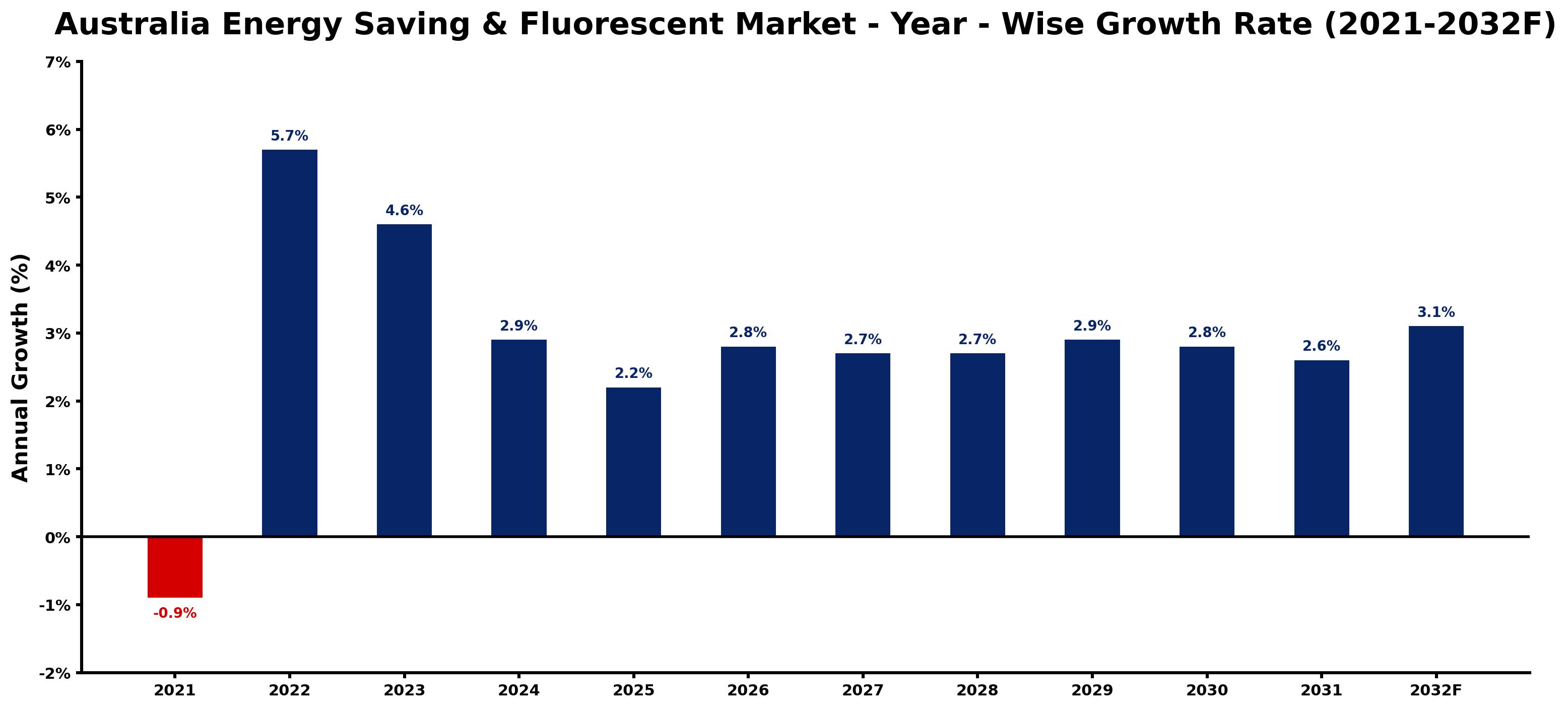
The table below presents the year wise growth rates along with the key drivers influencing the market
| Year | Growth Rate | Major Drivers |
| 2021 | -0.9% | Heightened awareness of environmental issues led to increased consumer preference for alternative energy solutions over fluorescent options. |
| 2022 | 5.7% | Corporate social responsibility initiatives increasingly prioritize energy-efficient lighting options. |
| 2023 | 4.6% | Heightened consumer awareness of energy conservation shapes purchasing decisions in households. |
| 2024 | 2.9% | Local manufacturers enhance product offerings with innovative energy-saving technologies. |
| 2025 | 2.2% | Energy-efficient lighting gains traction in urban residential developments, boosting market demand. |
| 2026 | 2.8% | Renewable energy integration encourages the shift toward fluorescent lighting alternatives. |
| 2027 | 2.7% | Smart home innovations include energy-saving lighting systems, attracting tech-savvy consumers. |
| 2028 | 2.7% | Architectural trends favor designs that incorporate natural light and energy-efficient solutions. |
| 2029 | 2.9% | Investment in retrofitting older buildings enhances the appeal of fluorescent lighting systems. |
| 2030 | 2.8% | Emerging environmental certifications motivate businesses to adopt energy-efficient lighting practices. |
| 2031 | 2.6% | Increased competition in the market leads to price reductions and broader consumer access. |
| 2032 | 3.1% | Long-term sustainability goals drive continuous innovation in energy-saving lighting technologies. |
Note - Market size estimations and growth projections presented in this report are based on 6Wresearch's advanced forecasting approach, validated with industry datasets as of June 2026.
Australia Energy Saving & Fluorescent Market Synopsis
The Australia Energy Saving Fluorescent Market is projected to reach 2.8% and witness significant growth during the forecast period (2026-2032). The landscape of this market is shaped by a combination of consumer demand for energy-efficient solutions, increasing awareness of sustainability, and ongoing regulatory frameworks aimed at enhancing energy efficiency. Energy-saving fluorescent lamps, including compact fluorescent lamps (CFLs) and traditional fluorescent tubes, present viable alternatives to older incandescent lighting technologies by offering longer lifespans and substantial energy savings.
Australia Energy Saving & Fluorescent Market Growth Drivers
The growth of the Australia Energy Saving & Fluorescent Market is primarily fueled by several key factors:
- The rise in government initiatives promoting energy-efficient lighting solutions creates a favorable environment for the adoption of energy-saving fluorescent products.
- Consumer awareness regarding the economic benefits of energy conservation is increasing, leading to heightened interest in energy-saving fluorescent lamps.
- Advancements in fluorescent lamp technology have resulted in improved energy efficiencies and extended lifespans, making these products more attractive to a broader customer base.
- The phasing out of less efficient incandescent and traditional fluorescent lamps spurs demand for energy-saving alternatives that meet regulatory standards.
- The increasing focus on sustainability across various sectors encourages businesses and consumers alike to opt for energy-saving fluorescent lighting, aligning with broader environmental goals.
Australia Energy Saving & Fluorescent Market Challenges and Restraints
Despite the positive growth trajectory, the Australia Energy Saving & Fluorescent Market faces several challenges that could hinder progress:
- Competition from alternative lighting technologies, particularly LED solutions, presents a significant challenge, as these technologies continue to gain market share due to their superior energy efficiency and longevity.
- Concerns surrounding mercury content in fluorescent lamps and the complexities associated with their disposal may deter environmentally conscious consumers.
- The need for ongoing research and development within the fluorescent lighting sector is crucial to maintain competitiveness against rapidly evolving lighting technologies.
- Market players must address the public's knowledge gaps regarding the advantages and proper usage of energy-saving fluorescent lamps to enhance market uptake.
- Economic fluctuations and shifts in public policy could impact investment and innovation in the sector, affecting long-term growth prospects.
Australia Energy Saving & Fluorescent Market Government Investment and Initiatives
Government policy is a pivotal driver in shaping the Australia Energy Saving & Fluorescent Market. Initiatives aimed at phasing out traditional lighting technologies have catalyzed the market's gradual transition toward energy-efficient alternatives. Key aspects of government involvement include:
- Implementation of regulatory measures to phase out incandescent bulbs and older fluorescent lamps, compelling consumers to shift towards energy-saving alternatives.
- Support for public awareness campaigns that educate consumers on the benefits of energy-saving fluorescent technologies, promoting informed purchasing decisions.
- Investment in research and innovation to improve the efficiency and performance of fluorescent lighting options, ensuring they remain competitive in a rapidly evolving market.
- Development of energy efficiency labeling programs that guide consumers in identifying and choosing energy-efficient products.
- Establishment of incentives for businesses and institutions to adopt energy-saving fluorescent solutions, thereby accelerating market adoption and reinforcing environmental commitments.
Australia Energy Saving & Fluorescent Market Latest Developments (May 2025 - June 2026)
Recent developments in the Australia Energy Saving & Fluorescent Market indicate a continued shift towards modern lighting technologies. Over the period from May 2025 to June 2026, various trends and activities have emerged:
- Further tightening of regulations regarding energy efficiency has prompted a surge in consumer and business interest in energy-saving fluorescent solutions.
- Ongoing government campaigns aimed at educating the public about the advantages of fluorescent lighting have gained traction, leading to increased sales and awareness.
- Technological advancements in fluorescent lamp designs have been noted, focusing on enhancing energy efficiency and extending the lifespan of the products.
- A notable increase in collaborations between research institutions and manufacturers has emerged, aimed at innovating the fluorescent lighting space and tackling existing challenges.
- Market players have begun exploring new distribution channels and online platforms to reach a broader audience, responding to changing consumer purchasing behaviors.
Australia Energy Saving & Fluorescent Market - Key Attractiveness of the Report
- 10 Years of Market Numbers
- Historical Data Starting from 2022 to 2025
- Base Year: 2025
- Forecast Data until 2032
- Key Performance Indicators Impacting the Market
- Major Upcoming Developments and Projects
Key Highlights of the Report:
- Australia Energy Saving & Fluorescent Market Outlook
- Market Size of Australia Energy Saving & Fluorescent Market, 2025
- Forecast of Australia Energy Saving & Fluorescent Market, 2032
- Historical Data and Forecast of Australia Energy Saving & Fluorescent Revenues & Volume for the Period 2022-2032F
- Australia Energy Saving & Fluorescent Market Trend Evolution
- Australia Energy Saving & Fluorescent Market Drivers and Challenges
- Australia Energy Saving & Fluorescent Price Trends
- Australia Energy Saving & Fluorescent Porter's Five Forces
- Australia Energy Saving & Fluorescent Industry Life Cycle
- Historical Data and Forecast of Australia Energy Saving & Fluorescent Market Revenues & Volume By Sources for the Period 2022-2032F
- Historical Data and Forecast of Australia Energy Saving & Fluorescent Market Revenues & Volume By High-Intensity Discharge Lamps (HID) for the Period 2022-2032F
- Historical Data and Forecast of Australia Energy Saving & Fluorescent Market Revenues & Volume By Linear Fluorescent Lamps (LFL) for the Period 2022-2032F
- Historical Data and Forecast of Australia Energy Saving & Fluorescent Market Revenues & Volume By Light Emitting Diodes (LED) for the Period 2022-2032F
- Historical Data and Forecast of Australia Energy Saving & Fluorescent Market Revenues & Volume By Applications for the Period 2022-2032F
- Historical Data and Forecast of Australia Energy Saving & Fluorescent Market Revenues & Volume By Commercial for the Period 2022-2032F
- Historical Data and Forecast of Australia Energy Saving & Fluorescent Market Revenues & Volume By Residential for the Period 2022-2032F
- Historical Data and Forecast of Australia Energy Saving & Fluorescent Market Revenues & Volume By Government for the Period 2022-2032F
- Australia Energy Saving & Fluorescent Import Export Trade Statistics
- Market Opportunity Assessment By Sources
- Market Opportunity Assessment By Applications
- Australia Energy Saving & Fluorescent Top Companies Market Share
- Australia Energy Saving & Fluorescent Competitive Benchmarking By Technical and Operational Parameters
- Australia Energy Saving & Fluorescent Company Profiles
- Australia Energy Saving & Fluorescent Key Strategic Recommendations






































