Australia Intruder Detection Systems Market (2026-2032) | Analysis, Forecast, Revenue, Size, Value, Trends, Share, Growth, Industry, Outlook & Companies
Market Forecast By Components (Hardware, Software), By Deployment (Infrastructure based, Cloud Based), By End-users (BFSI, IT& Communication, Aerospace & Defense, Software Industry, Manufacturing) And Competitive Landscape
| Product Code: ETC027115 | Publication Date: Oct 2020 | Updated Date: Jun 2026 | Product Type: Report | |
| Publisher: 6Wresearch | Author: Ravi Bhandari | No. of Pages: 70 | No. of Figures: 35 | No. of Tables: 5 |
Australia Intruder Detection Systems Market Summary
The australia intruder detection systems market was estimated at USD 184 Million in 2025 and is projected to reach USD 217 Million by 2032, growing at a CAGR of 2.6% from 2026 to 2032.
Australia Intruder Detection Systems Market Growth Rate Analysis (2021-2032)
The intruder detection systems market in Australia has exhibited notable fluctuations over the past few years. After a decline of 0.5% in 2021, driven by the pandemic's impact on consumer spending and reduced investments, the sector rebounded with a remarkable growth of 5.9% in 2022. This resurgence can be attributed to heightened consumer awareness of security, driven by rising crime rates and increasing demand for advanced technology solutions. In 2023, the market saw a 4.5% growth, fueled by technological advancements and digitalization trends. Despite a projected slowdown to 2.2% in 2025, ongoing investments in infrastructure and energy-efficient systems are expected to sustain a stable increase, culminating in a 2.5% growth by 2032.
Australia Intruder Detection Systems Market Year-wise Growth Rate and Key Drivers
This graph highlights how the Australia Intruder Detection Systems Market has steadily grown over the past five years, supported by major growth factors.
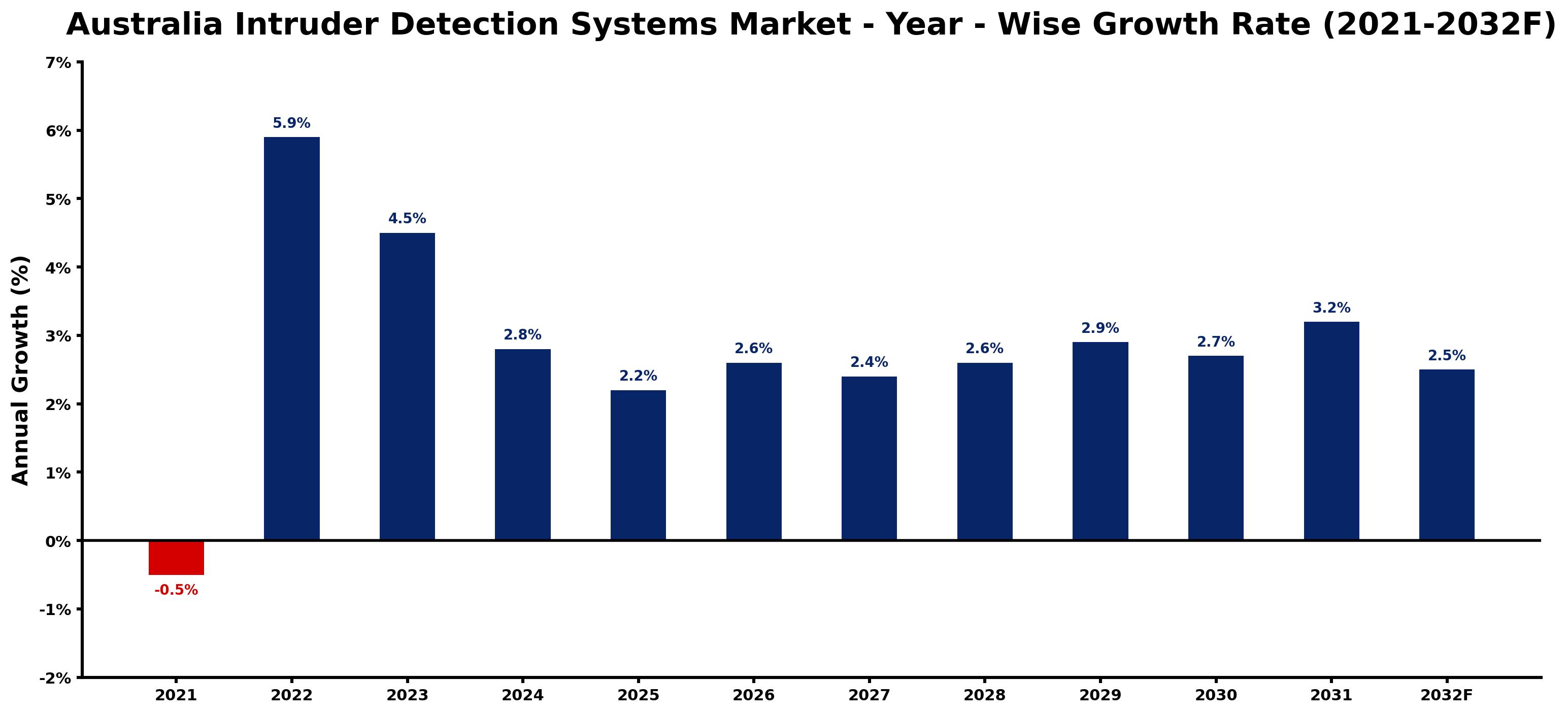
The table below presents the year wise growth rates along with the key drivers influencing the market
| Year | Growth Rate | Major Drivers |
| 2021 | -0.5% | Increased competition from costeffective security solutions diminished demand for traditional intruder detection systems. |
| 2022 | 5.9% | Technological innovations make smart security systems more accessible and affordable. |
| 2023 | 4.5% | Insurance premium reductions for homes with advanced security systems attract interest. |
| 2024 | 2.8% | Increased focus on remote monitoring enhances appeal of intrusion detection technology. |
| 2025 | 2.2% | Corporate crime incidents generate heightened awareness of security in businesses. |
| 2026 | 2.6% | Collaborations between tech firms and security providers fuel innovative product offerings. |
| 2027 | 2.4% | Elevated residential construction projects stimulate market demand for integrated security systems. |
| 2028 | 2.6% | Consumer preference shifts towards DIY security solutions, expanding market reach significantly. |
| 2029 | 2.9% | Cybersecurity threats prompt integration of physical and digital security measures. |
| 2030 | 2.7% | Urbanization trends lead to higher investments in comprehensive security for urban dwellings. |
| 2031 | 3.2% | Increased public awareness surrounding personal safety influences security market engagement. |
| 2032 | 2.5% | Market maturity fosters competitive pricing strategies, benefiting consumers and driving growth. |
Note - Market size estimations and growth projections presented in this report are based on 6Wresearch's advanced forecasting approach, validated with industry datasets as of June 2026.
Australia Intruder Detection Systems Market Synopsis
The Australia Intruder Detection Systems Market is projected to reach 2.6% and witness significant growth during the forecast period (2026-2032). This market encompasses a range of technologies such as alarms, sensors, and surveillance cameras designed to provide security solutions for residential, commercial, and institutional premises. The emphasis on preventative security measures underscores the critical importance of these systems in safeguarding property and enhancing overall safety for occupants.
Australia Intruder Detection Systems Market Growth Drivers
The growth of the Australia Intruder Detection Systems Market is largely driven by several key factors:
- The increasing prevalence of property crimes, including burglary and vandalism, has heightened demand for robust security solutions. Homeowners and business operators are increasingly recognizing the necessity of implementing intruder detection systems to deter criminal activity.
- Advancements in sensor technologies, particularly in motion detection and image capturing, have enhanced the efficacy of intruder detection systems. These improvements facilitate real-time alerts and contribute significantly to a rapid response to security breaches.
- Integration of wireless communication technology has simplified the installation and management of intruder detection systems. This evolution allows for seamless connectivity with mobile devices, enabling users to monitor their property remotely.
- Rising consumer awareness regarding personal safety is fostering the adoption of comprehensive security solutions. Individuals are more willing to invest in advanced systems that offer not only detection capabilities but also integrated features such as video surveillance.
- Furthermore, the growing trend of smart home technologies, which emphasize automation and connectivity, is favoring the expansion of intruder detection systems that can interact with other home security measures.
Australia Intruder Detection Systems Market Challenges and Restraints
Despite the favorable growth prospects, the Australia Intruder Detection Systems Market faces notable challenges:
- A key challenge is ensuring the reliability and accuracy of intruder detection systems to minimize false alarms. An increase in false alarms can lead to complacency among security personnel and undermine the trust of property owners in the systems.
- Compatibility issues with legacy security systems pose significant technical hurdles. Retrofitting existing buildings with modern intrusion detection technologies requires substantial resources and expertise.
- Privacy concerns regarding video surveillance and data collection can create regulatory challenges. Companies must navigate complex legal frameworks to ensure compliance with privacy regulations while maintaining effective security measures.
- The fluctuating costs of advanced security technology can hinder market growth, particularly for small businesses and homeowners who may be priced out of the high-end offerings.
- Moreover, the industry needs to focus on educating consumers about the importance of comprehensive security solutions to combat misinformation and skepticism regarding the effectiveness of intruder detection systems.
Australia Intruder Detection Systems Market Trends and Opportunities
The Australia Intruder Detection Systems Market is witnessing several trends that present opportunities for growth:
- Increased integration of artificial intelligence and machine learning technologies is enabling smarter intruder detection systems. These technologies enhance the capability to distinguish between genuine threats and false alarms, improving overall system reliability.
- There is a marked shift towards holistic security solutions that incorporate intrusion detection, access control, and comprehensive surveillance, catering to buyers seeking a unified security approach.
- The demand for DIY security systems is on the rise. Consumers are opting for self-installed solutions that provide flexibility and cost savings, driving innovation in easy-to-use products.
- As urban areas grow and the density of populations increases, there will likely be a surge in demand for scalable intruder detection systems that can be adapted to various property sizes and types.
- Opportunities exist in the development of mobile applications that complement intruder detection systems, providing users with real-time notifications and surveillance feeds directly to their smartphones.
Australia Intruder Detection Systems Market Government Investment and Initiatives
The Australian government plays a critical role in promoting the intruder detection systems market through various initiatives:
- Government funding programs aimed at enhancing public safety often include support for advanced security infrastructure, which benefits the intruder detection systems market.
- Regulatory frameworks are being developed to standardize alarm systems, ensuring they meet required safety and efficiency benchmarks for both residential and commercial properties.
- Public-private partnerships are being encouraged to spur innovation in security technology, facilitating the adoption of next-generation intruder detection systems across different sectors.
- Establishing guidelines for the ethical use of surveillance technology is part of governmental efforts to balance security needs with public privacy concerns.
- The government is also investing in community education programs to raise awareness about the importance of security measures and the benefits of intruder detection systems.
Australia Intruder Detection Systems Market Latest Developments (May 2025 - June 2026)
Between May 2025 and June 2026, the Australia Intruder Detection Systems Market has seen notable developments:
- Innovative security solutions integrating AI have gained traction, providing users with enhanced predictive analytics and threat assessment capabilities.
- Wireless and cloud-based surveillance options have become more prevalent, enabling users to manage their security systems remotely with ease.
- Collaborations among technology providers and integrators have increased, focusing on creating synergistic solutions that meet diverse security needs.
- Industry stakeholders have prioritized efforts to streamline the installation process of intruder detection systems, making them more accessible to smaller enterprises and homeowners.
- The public discourse on privacy has led to more transparent practices and the development of systems that emphasize ethical surveillance and data handling protocols.
Australia Intruder Detection Systems Market - Key Attractiveness of the Report
- 10 Years of Market Numbers
- Historical Data Starting from 2022 to 2025
- Base Year: 2025
- Forecast Data until 2032
- Key Performance Indicators Impacting the Market
- Major Upcoming Developments and Projects
Key Highlights of the Report:
- Australia Intruder Detection Systems Market Outlook
- Market Size of Australia Intruder Detection Systems Market, 2025
- Forecast of Australia Intruder Detection Systems Market, 2032
- Historical Data and Forecast of Australia Intruder Detection Systems Revenues & Volume for the Period 2022-2032F
- Australia Intruder Detection Systems Market Trend Evolution
- Australia Intruder Detection Systems Market Drivers and Challenges
- Australia Intruder Detection Systems Price Trends
- Australia Intruder Detection Systems Porter's Five Forces
- Australia Intruder Detection Systems Industry Life Cycle
- Historical Data and Forecast of Australia Intruder Detection Systems Market Revenues & Volume By Components? for the Period 2022-2032F
- Historical Data and Forecast of Australia Intruder Detection Systems Market Revenues & Volume By Hardware for the Period 2022-2032F
- Historical Data and Forecast of Australia Intruder Detection Systems Market Revenues & Volume By Software for the Period 2022-2032F
- Historical Data and Forecast of Australia Intruder Detection Systems Market Revenues & Volume By Deployment for the Period 2022-2032F
- Historical Data and Forecast of Australia Intruder Detection Systems Market Revenues & Volume By Infrastructure based for the Period 2022-2032F
- Historical Data and Forecast of Australia Intruder Detection Systems Market Revenues & Volume By Cloud Based for the Period 2022-2032F
- Historical Data and Forecast of Australia Intruder Detection Systems Market Revenues & Volume By End-users for the Period 2022-2032F
- Historical Data and Forecast of Australia Intruder Detection Systems Market Revenues & Volume By BFSI for the Period 2022-2032F
- Historical Data and Forecast of Australia Intruder Detection Systems Market Revenues & Volume By IT& Communication for the Period 2022-2032F
- Historical Data and Forecast of Australia Intruder Detection Systems Market Revenues & Volume By Aerospace & Defense for the Period 2022-2032F
- Historical Data and Forecast of Australia Intruder Detection Systems Market Revenues & Volume By Software Industry for the Period 2022-2032F
- Historical Data and Forecast of Australia Intruder Detection Systems Market Revenues & Volume By Manufacturing for the Period 2022-2032F
- Australia Intruder Detection Systems Import Export Trade Statistics
- Market Opportunity Assessment By Components?
- Market Opportunity Assessment By Deployment
- Market Opportunity Assessment By End-users
- Australia Intruder Detection Systems Top Companies Market Share
- Australia Intruder Detection Systems Competitive Benchmarking By Technical and Operational Parameters
- Australia Intruder Detection Systems Company Profiles
- Australia Intruder Detection Systems Key Strategic Recommendations
Frequently Asked Questions About the Market Study (FAQs):
The growth is driven by rising concerns about property crime, advancements in technology, and increased consumer awareness regarding personal safety.
Major challenges include ensuring the reliability of systems, addressing compatibility issues, and navigating privacy regulations.
The government supports the market through funding for security infrastructure, establishing regulatory frameworks, and fostering public education on security technologies.
Opportunities include the integration of AI technologies, development of mobile applications, and the demand for DIY security systems that cater to consumer preferences.
6Wresearch actively monitors the Australia Intruder Detection Systems Market and publishes its comprehensive annual report, highlighting emerging trends, growth drivers, revenue analysis, and forecast outlook. Our insights help businesses to make data-backed strategic decisions with ongoing market dynamics. Our analysts track relevent industries related to the Australia Intruder Detection Systems Market, allowing our clients with actionable intelligence and reliable forecasts tailored to emerging regional needs.
Yes, we provide customisation as per your requirements. To learn more, feel free to contact us on sales@6wresearch.com
1 Executive Summary |
2 Introduction |
2.1 Key Highlights of the Report |
2.2 Report Description |
2.3 Market Scope & Segmentation |
2.4 Research Methodology |
2.5 Assumptions |
3 Australia Intruder Detection Systems Market Overview |
3.1 Australia Country Macro Economic Indicators |
3.2 Australia Intruder Detection Systems Market Revenues & Volume, 2022 & 2032F |
3.3 Australia Intruder Detection Systems Market - Industry Life Cycle |
3.4 Australia Intruder Detection Systems Market - Porter's Five Forces |
3.5 Australia Intruder Detection Systems Market Revenues & Volume Share, By Components , 2022 & 2032F |
3.6 Australia Intruder Detection Systems Market Revenues & Volume Share, By Deployment, 2022 & 2032F |
3.7 Australia Intruder Detection Systems Market Revenues & Volume Share, By End-users, 2022 & 2032F |
4 Australia Intruder Detection Systems Market Dynamics |
4.1 Impact Analysis |
4.2 Market Drivers |
4.2.1 Increasing concerns about security and safety in residential and commercial spaces |
4.2.2 Technological advancements leading to more sophisticated and effective intruder detection systems |
4.2.3 Rising instances of burglary and theft incidents in Australia |
4.3 Market Restraints |
4.3.1 High initial investment costs associated with installing intruder detection systems |
4.3.2 Lack of awareness and understanding about the benefits of intruder detection systems among consumers |
4.3.3 Potential privacy concerns related to the use of surveillance technologies |
5 Australia Intruder Detection Systems Market Trends |
6 Australia Intruder Detection Systems Market, By Types |
6.1 Australia Intruder Detection Systems Market, By Components |
6.1.1 Overview and Analysis |
6.1.2 Australia Intruder Detection Systems Market Revenues & Volume, By Components , 2022-2032F |
6.1.3 Australia Intruder Detection Systems Market Revenues & Volume, By Hardware, 2022-2032F |
6.1.4 Australia Intruder Detection Systems Market Revenues & Volume, By Software, 2022-2032F |
6.2 Australia Intruder Detection Systems Market, By Deployment |
6.2.1 Overview and Analysis |
6.2.2 Australia Intruder Detection Systems Market Revenues & Volume, By Infrastructure based, 2022-2032F |
6.2.3 Australia Intruder Detection Systems Market Revenues & Volume, By Cloud Based, 2022-2032F |
6.3 Australia Intruder Detection Systems Market, By End-users |
6.3.1 Overview and Analysis |
6.3.2 Australia Intruder Detection Systems Market Revenues & Volume, By BFSI, 2022-2032F |
6.3.3 Australia Intruder Detection Systems Market Revenues & Volume, By IT& Communication, 2022-2032F |
6.3.4 Australia Intruder Detection Systems Market Revenues & Volume, By Aerospace & Defense, 2022-2032F |
6.3.5 Australia Intruder Detection Systems Market Revenues & Volume, By Software Industry, 2022-2032F |
6.3.6 Australia Intruder Detection Systems Market Revenues & Volume, By Manufacturing, 2022-2032F |
7 Australia Intruder Detection Systems Market Import-Export Trade Statistics |
7.1 Australia Intruder Detection Systems Market Export to Major Countries |
7.2 Australia Intruder Detection Systems Market Imports from Major Countries |
8 Australia Intruder Detection Systems Market Key Performance Indicators |
8.1 Number of new installations and upgrades of intruder detection systems in Australia |
8.2 Rate of adoption of smart intruder detection systems in residential and commercial sectors |
8.3 Customer satisfaction levels and feedback on the effectiveness of installed intruder detection systems |
8.4 Average response time of security agencies or authorities to intruder alerts |
8.5 Number of false alarms reported and measures taken to reduce them |
9 Australia Intruder Detection Systems Market - Opportunity Assessment |
9.1 Australia Intruder Detection Systems Market Opportunity Assessment, By Components , 2022 & 2032F |
9.2 Australia Intruder Detection Systems Market Opportunity Assessment, By Deployment, 2022 & 2032F |
9.3 Australia Intruder Detection Systems Market Opportunity Assessment, By End-users, 2022 & 2032F |
10 Australia Intruder Detection Systems Market - Competitive Landscape |
10.1 Australia Intruder Detection Systems Market Revenue Share, By Companies, 2025 |
10.2 Australia Intruder Detection Systems Market Competitive Benchmarking, By Operating and Technical Parameters |
11 Company Profiles |
12 Recommendations |
13 Disclaimer |
Global Go To Market Strategy - 2030
Export potential enables firms to identify high-growth global markets with greater confidence by combining advanced trade intelligence with a structured quantitative methodology. The framework analyzes emerging demand trends and country-level import patterns while integrating macroeconomic and trade datasets such as GDP and population forecasts, bilateral import–export flows, tariff structures, elasticity differentials between developed and developing economies, geographic distance, and import demand projections. Using weighted trade values from 2020–2024 as the base period to project country-to-country export potential for 2030, these inputs are operationalized through calculated drivers such as gravity model parameters, tariff impact factors, and projected GDP per-capita growth. Through an analysis of hidden potentials, demand hotspots, and market conditions that are most favorable to success, this method enables firms to focus on target countries, maximize returns, and global expansion with data, backed by accuracy.
By factoring in the projected importer demand gap that is currently unmet and could be potential opportunity, it identifies the potential for the Exporter (Country) among 190 countries, against the general trade analysis, which identifies the biggest importer or exporter.
To discover high-growth global markets and optimize your business strategy:
Click Here
Pricing
- Single User License$ 1,995
- Department License$ 2,400
- Site License$ 3,120
- Global License$ 3,795

Leadership Perspectives from Industry Events
Search
Thought Leadership and Analyst Meet





Our Clients








6WResearch In News
- India Air Conditioner Market Set for Strong Rebound in 2026 After Weather-Led Correction and GST-Driven Recovery: 6Wresearch
- ADAS in India: How Automatic Emergency Braking, Blind Spot Detection & Driver Monitoring are Transforming Road Safety
- Doha a strategic location for EV manufacturing hub: IPA Qatar
- Demand for luxury TVs surging in the GCC, says Samsung
- Empowering Growth: The Thriving Journey of Bangladesh’s Cable Industry
- Demand for luxury TVs surging in the GCC, says Samsung
Latest Reports
- Poland Fire Protection Systems Market (2026-2032)
- Cape Verde Portable Hand-Thrown Extinguisher Market (2026-2032)
- Canada Portable Hand-Thrown Extinguisher Market (2026-2032)
- Cameroon Portable Hand-Thrown Extinguisher Market (2026-2032)
- Burundi Portable Hand-Thrown Extinguisher Market (2026-2032)
- Burkina Faso Portable Hand-Thrown Extinguisher Market (2026-2032)
- Bulgaria Portable Hand-Thrown Extinguisher Market (2026-2032)
- Brunei Portable Hand-Thrown Extinguisher Market (2026-2032)
- Botswana Portable Hand-Thrown Extinguisher Market (2026-2032)
- Bosnia and Herzegovina Portable Hand-Thrown Extinguisher Market (2026-2032)
Industry Events and Analyst Meet

HIMTEX 2026

India Refining Summit 2026

India EV Show 2026

EV tech India Expo 2026

Auto Tech Asia 2026
Whitepaper
- Middle East & Africa Commercial Security Market Click here to view more.
- Middle East & Africa Fire Safety Systems & Equipment Market Click here to view more.
- GCC Drone Market Click here to view more.
- Middle East Lighting Fixture Market Click here to view more.
- GCC Physical & Perimeter Security Market Click here to view more.


