Topics Covered in Australia Mining Machinery and Equipment Market Report
Australia Mining Machinery and Equipment Market Report thoroughly covers the market By Product Type, By Pulverizing Equipment, By Function & By End Users. Australia Mining Machinery and Equipment Market Outlook report provides an unbiased and detailed analysis of the ongoing Australia Mining Machinery and Equipment Market trends, opportunities/high growth areas, and market drivers. This would help stakeholders devise and align their market strategies according to the current and future market dynamics.
Australia Mining Machinery and Equipment Market Synopsis
The Australia Mining Machinery and Equipment Market has seen significant growth, driven by the robust mining sector, a cornerstone of the Australian economy. In 2023, mining accounted for 75% of Australia's total exports, generating about $280 billion in export revenues. Western Australia remains the heart of mining activity, containing 98% of the country's iron ore and 60% of its gold reserves, with other states contributing through coal, copper, and uranium. Investments in mining technology and infrastructure, both public and private, continue to support market growth. The Australian government promotes exploration and has invested $1.5 billion in the Resources Technology and Critical Minerals Processing Roadmap to foster sustainable mining technologies. In 2023, mining contributed 13.6% to the GDP, with investments reaching $11.5 billion in the first quarter of 2024, a 6% increase from the previous year, totaling $53 billion by the end of FY2024 boosted the significant demand of mining equipment in past years.
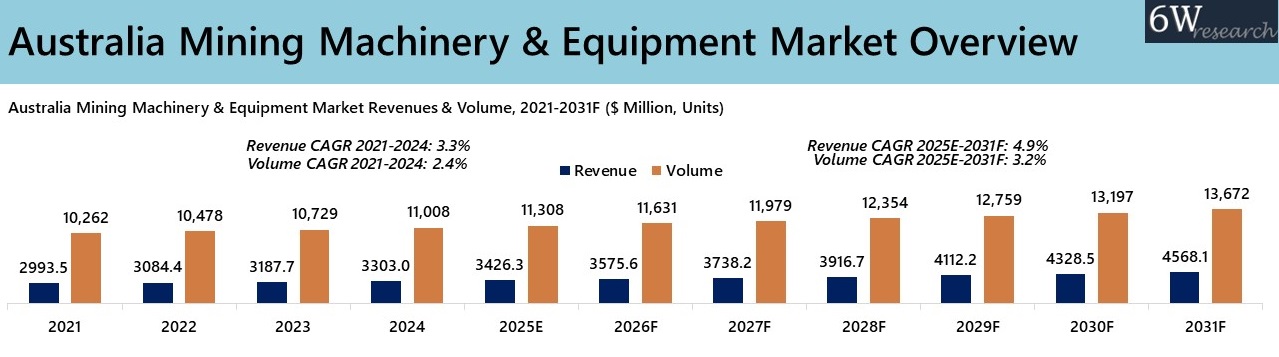
According to 6Wresearch, Australia Mining Machinery and Equipment Market is expected to witness robust growth with a CAGR 4.9 % during 2025-2031F. The Australia Mining Machinery and Equipment Market is set for substantial growth, fueled by technological advancements and increasing resource extraction, especially with significant projects like the Biloela Copper and Gold Project in Queensland. This project alone is expected to greatly increase the demand for mining equipment from its commencement in 2025. Australia's dominance in the lithium market, where it controls 47% of global production, is anticipated to generate over $6.89 billion from lithium exports by 2029. Efforts are underway to enhance the production of lithium hydroxide, crucial for the electric vehicle battery sector. Additionally, the Australian government's Critical Mineral Strategy for 2023-2030 aims to attract around US$100 billion annually in global mining investments, contributing to the country's goal of net zero emissions by 2050. These strategic initiatives underline Australia's commitment to strengthening its lead in the global mining and critical minerals market.
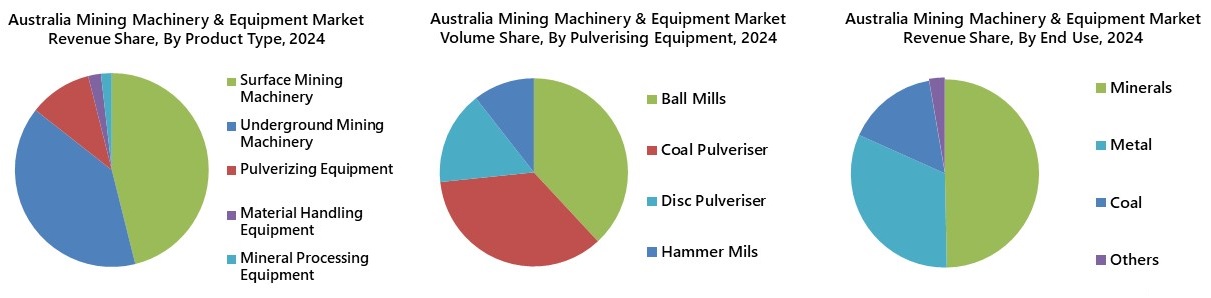
Market Segmentation By Product Type
Surface mining machinery is expected to grow because of increasing demand for bulk commodities, cost-effectiveness over underground mining, and rapid technological advancements in automation and electrification.
Market Segmentation By Pulverizing Equipment
Hammer Mills are projected to see the most significant growth fueled by the rising need for fine particle reduction in mineral and coal processing. Innovations in high-speed, energy-efficient technology, along with enhanced durability, are making these mills increasingly appealing for mining operations. Additionally, the growth in lithium and critical minerals processing is further boosting the use of Hammer Mills throughout Australia.
Market Segmentation By Function
Excavation is expected to see significant growth by 2031, fueled by the rising demand for large-scale mining projects, greater adoption of advanced excavation machinery, and the expansion of both surface and underground mining operations. Additionally, the increasing need for high-efficiency drilling, blasting, and earth-moving equipment is further driving the demand for excavation machinery in Australia.
Market Segmentation By End Users
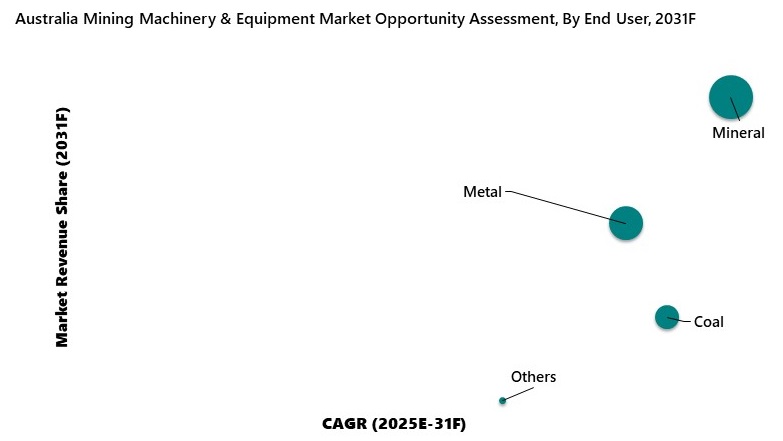
Mineral growth is expected to surge by 2031, driven by the increasing demand for critical minerals, heightened investment in mineral exploration and processing, and the growth of sustainable mining practices. The rising need for lithium, rare earth elements, and other strategic minerals is further boosting the demand for mineral extraction and processing machinery in Australia.
Key Attractiveness of the Report
- 10 Years Market Numbers.
- Historical Data Starting from 2021 to 2024.
- Base Year: 2024
- Forecast Data until 2031
- Key Performance Indicators Impacting the Market.
- Major Upcoming Developments and Projects.
Key Highlights of the Report:
- Australia Mining Machinery and Equipment Market Overview
- Australia Mining Machinery and Equipment Market Outlook
- Australia Mining Machinery and Equipment Market Forecast
- Industry Life Cycle
- Porter’s Five Forces Analysis
- Historical Data and Forecast of Australia Mining Machinery and Equipment Market Revenues for the Period 2021-2031F
- Historical Data and Forecast of Australia Mining Machinery and Equipment Market Revenues, By Product Types, for the Period 2021-2031F
- Historical Data and Forecast of Australia Mining Machinery and Equipment Market Revenues, By Pulverizing Equipment, for the Period 2021-2031F
- Historical Data and Forecast of Australia Mining Machinery and Equipment Market Revenues, By Function, for the Period 2021-2031F
- Historical Data and Forecast of Australia Mining Machinery and Equipment Market Revenues, By End User, for the Period 2021-2031F
- Market Drivers and Restraints
- Market Trends
- Market Opportunity Assessment
- Competitive Benchmarking
- Company Profiles
- Key Strategic Recommendations
Market Scope and Segmentation
Thereportprovides a detailed analysis of the following market segments:
By Product Type
- Underground Mining Machinery
- Surface Mining Machinery
- Mineral Processing Equipment
- Material Handling Equipment
- Pulverizing Equipment
- Other (Screening Equipment, Drills and Breakers etc.)
By Pulverizing Equipment
- Hammer Mils
- Ball Mills
- Disc Pulveriser
- Coal Pulveriser
By Function
- Transportation
- Processing
- Excavation
By End User
- Coal
- Mineral
- Metal
- Others (Salts, Phosphates, Elements)






































