Australia Nickel Nitrate Market Size, Share & Growth Rate
The Australia Nickel Nitrate Market was estimated at USD 214 Million in 2025 and is projected to reach USD 250 Million by 2032, growing at a CAGR of 2.2% from 2026 to 2032. This growth trajectory is primarily fueled by the increasing utilization of nickel nitrate in electroplating processes and catalyst manufacturing, as well as the burgeoning demand for nickel-based batteries tied to green energy initiatives. The synergy of Australia's robust nickel mining industry and its strategic investments in sustainable technology lays a strong foundation for long-term market stability.
Australia Nickel Nitrate Market Year-wise Growth Rate and Key Drivers
This graph highlights how the Australia Nickel Nitrate Market has steadily grown over the years, supported by major growth factors.
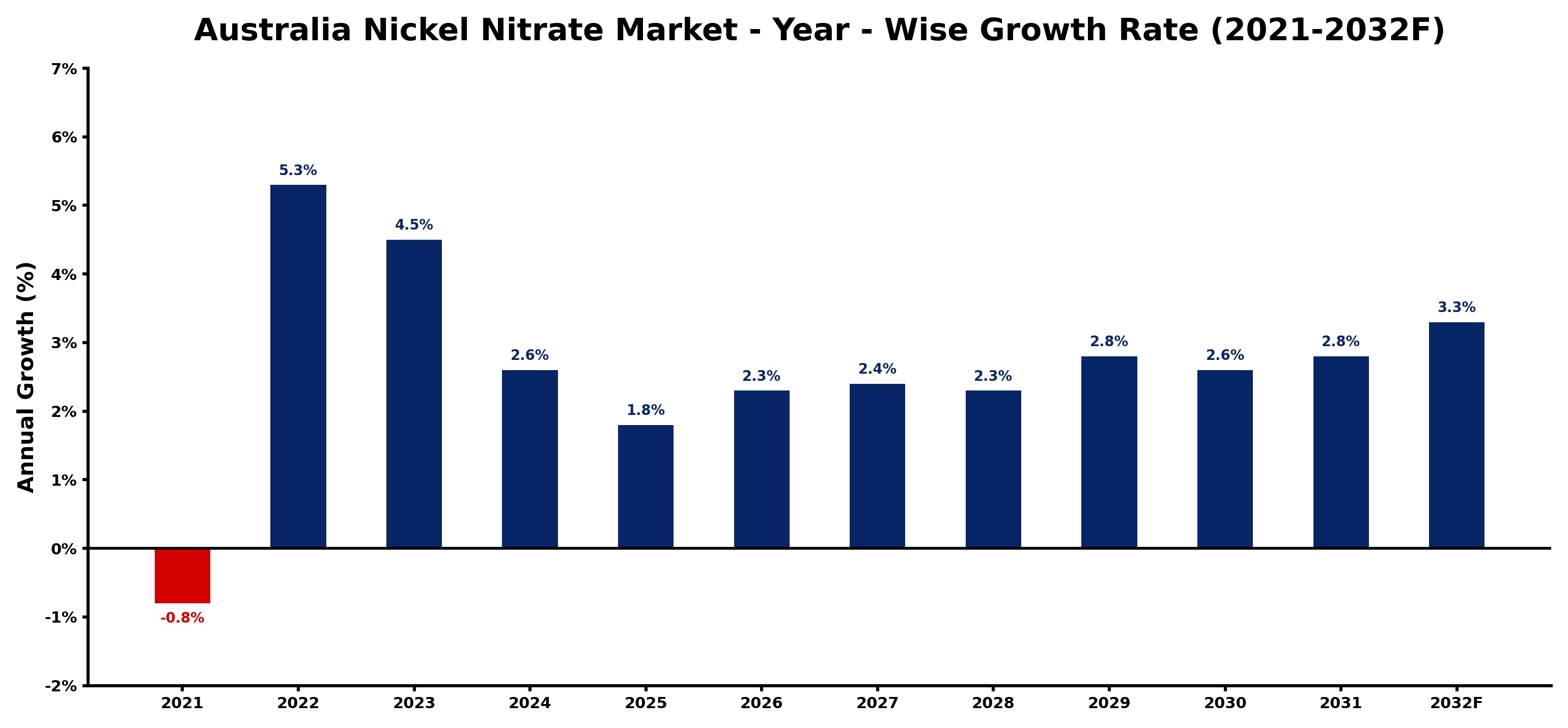
The table below presents the year‑wise growth rates along with the key drivers influencing the market
| Year | Growth Rate | Major Drivers |
| 2021 | -0.8% | Supply chain disruptions affected availability |
| 2022 | 5.3% | Electric vehicle demand spurred growth |
| 2023 | 4.5% | Renewable energy projects increased usage |
| 2024 | 2.6% | Agricultural applications expanded significantly |
| 2025 | 1.8% | Battery production requirements rose sharply |
| 2026 | 2.3% | Industrial applications drove higher consumption |
| 2027 | 2.4% | Technological advancements enhanced efficiency |
| 2028 | 2.3% | Sustainability initiatives promoted adoption |
| 2029 | 2.8% | Global market expansion created opportunities |
| 2030 | 2.6% | Research and development investments increased |
| 2031 | 2.8% | Strategic partnerships enhanced market presence |
| 2032 | 3.3% | Regulatory support fostered industry growth |
Note - Market size estimations and growth projections presented in this report are based on 6Wresearch's advanced forecasting approach, validated with industry datasets as of June 2026.
Australia Nickel Nitrate Market Synopsis
In Australia, the nickel nitrate market is witnessing a notable shift driven by advancements in industrial applications, particularly in electroplating and chemical manufacturing. The local mining sector not only provides a steady supply of nickel but also underpins the production of high-quality nickel nitrate, ensuring that domestic industries remain competitive.
As environmental regulations tighten, industries are increasingly exploring innovative applications for nickel nitrate, enhancing its appeal in corrosion-resistant coatings and energy-efficient battery technologies. This evolution in demand reflects broader global trends, emphasizing the critical role that nickel nitrate will play in the transition toward sustainable energy solutions.
Australia Nickel Nitrate Market Key Takeaways
- The Australia Nickel Nitrate Market is bolstered by significant investments in green energy solutions.
- Strong demand from the electroplating and catalyst sectors drives market stability.
- Australia's abundant nickel resources ensure a reliable supply chain for nickel nitrate production.
- Innovative formulations for corrosion-resistant coatings present new opportunities for growth.
- Regulatory frameworks are adapting, influencing market dynamics and operational strategies.
Evaluation of Restraints in Australia Nickel Nitrate Market
Despite the promising growth, the Australia Nickel Nitrate Market is confronted with several challenges. High raw material costs significantly impact profit margins, compelling manufacturers to seek efficiencies in production. Additionally, reliance on imports for certain raw materials creates vulnerabilities in the supply chain. Environmental concerns regarding the disposal of nickel compounds are prompting stricter regulations, thus necessitating compliance that can elevate operational costs. Moreover, the volatility in global nickel prices adds an element of unpredictability, compelling stakeholders to navigate a complex pricing landscape.
Australia Nickel Nitrate Market Trends
Emerging trends indicate a robust shift towards sustainable practices within the nickel nitrate market. The growing adoption of nickel-based batteries, particularly for electric vehicles and renewable energy storage, is reshaping demand dynamics. Moreover, advancements in electroplating technologies are leading to enhanced efficiency and reduced environmental impact. Innovations in formulations for industrial applications further signify a trend toward maximizing performance while adhering to stringent safety and environmental standards.
Australia Nickel Nitrate Market Opportunities
The landscape of the Australia Nickel Nitrate Market is ripe with investment opportunities. High-purity nickel nitrate manufacturing stands as a lucrative venture, especially for applications in advanced catalysts and battery production. Expanding supply chains into the automotive and chemical industries presents avenues for growth, particularly as electric vehicle adoption continues to rise. Furthermore, developing innovative corrosion-resistant coatings can cater to the industrial sector's demand for enhanced durability, presenting significant potential for market participants.
Government Initiatives in the Australia Nickel Nitrate Market
The Australian government actively promotes initiatives to support sustainable industrial practices, which directly influence the nickel nitrate market. Regulatory frameworks are increasingly focused on enhancing safety standards in handling and disposal, reflecting a commitment to environmental stewardship. Additionally, public investments are being directed toward research and development in clean technologies that utilize nickel compounds. Policies aimed at bolstering the mining sector also ensure that domestic production remains competitive, securing a stable supply of nickel for local industries.
Future Insights of the Australia Nickel Nitrate Market
Looking ahead to the 2026-2032 period, the Australia Nickel Nitrate Market is poised for steady growth, driven by ongoing advancements in technology and increasing regulatory support for sustainable practices. The transition to greener energy solutions will continue to propel the demand for nickel-based products, particularly in battery and alloy manufacturing. As industries seek more efficient and environmentally responsible methods, the market is likely to see innovations that enhance the functionality of nickel nitrate in various applications, solidifying its role as a crucial player in the materials sector.
Australia Nickel Nitrate Market Latest Developments (May 2025 - June 2026)
Recent developments in the Australia Nickel Nitrate Market indicate a robust focus on innovation and sustainability. Companies are prioritizing research initiatives to enhance the purity and performance of nickel nitrate in electroplating and catalysis. Additionally, partnerships between mining firms and technology developers are emerging, aiming to streamline production processes while adhering to environmental regulations. As the demand for nickel-based batteries surges, the market is witnessing strategic investments to bolster capabilities and expand production capacities, positioning stakeholders favorably for future growth.
Australia Nickel Nitrate Market - Key Attractiveness of the Report
- 10 Years of Market Numbers
- Historical Data Starting from 2022 to 2025
- Base Year: 2025
- Forecast Data until 2032
- Key Performance Indicators Impacting the Market
- Major Upcoming Developments and Projects
Key Highlights of the Report:
- Australia Nickel Nitrate Market Outlook
- Market Size of Australia Nickel Nitrate Market, 2025
- Forecast of Australia Nickel Nitrate Market, 2032
- Historical Data and Forecast of Australia Nickel Nitrate Revenues & Volume for the Period 2022-2032F
- Australia Nickel Nitrate Market Trend Evolution
- Australia Nickel Nitrate Market Drivers and Challenges
- Australia Nickel Nitrate Price Trends
- Australia Nickel Nitrate Porter's Five Forces
- Australia Nickel Nitrate Industry Life Cycle
- Historical Data and Forecast of Australia Nickel Nitrate Market Revenues & Volume By Application for the Period 2022-2032F
- Historical Data and Forecast of Australia Nickel Nitrate Market Revenues & Volume By Nickel Plating for the Period 2022-2032F
- Historical Data and Forecast of Australia Nickel Nitrate Market Revenues & Volume By Nickel Catalysts for the Period 2022-2032F
- Historical Data and Forecast of Australia Nickel Nitrate Market Revenues & Volume By Ceramic Color for the Period 2022-2032F
- Historical Data and Forecast of Australia Nickel Nitrate Market Revenues & Volume By Other for the Period 2022-2032F
- Historical Data and Forecast of Australia Nickel Nitrate Market Revenues & Volume By Type for the Period 2022-2032F
- Historical Data and Forecast of Australia Nickel Nitrate Market Revenues & Volume By Technical Grade for the Period 2022-2032F
- Historical Data and Forecast of Australia Nickel Nitrate Market Revenues & Volume By Battery Grade for the Period 2022-2032F
- Australia Nickel Nitrate Import Export Trade Statistics
- Market Opportunity Assessment By Application
- Market Opportunity Assessment By Type
- Australia Nickel Nitrate Top Companies Market Share
- Australia Nickel Nitrate Competitive Benchmarking By Technical and Operational Parameters
- Australia Nickel Nitrate Company Profiles
- Australia Nickel Nitrate Key Strategic Recommendations






































