Australia Packaged Water Market: Import Trend Analysis
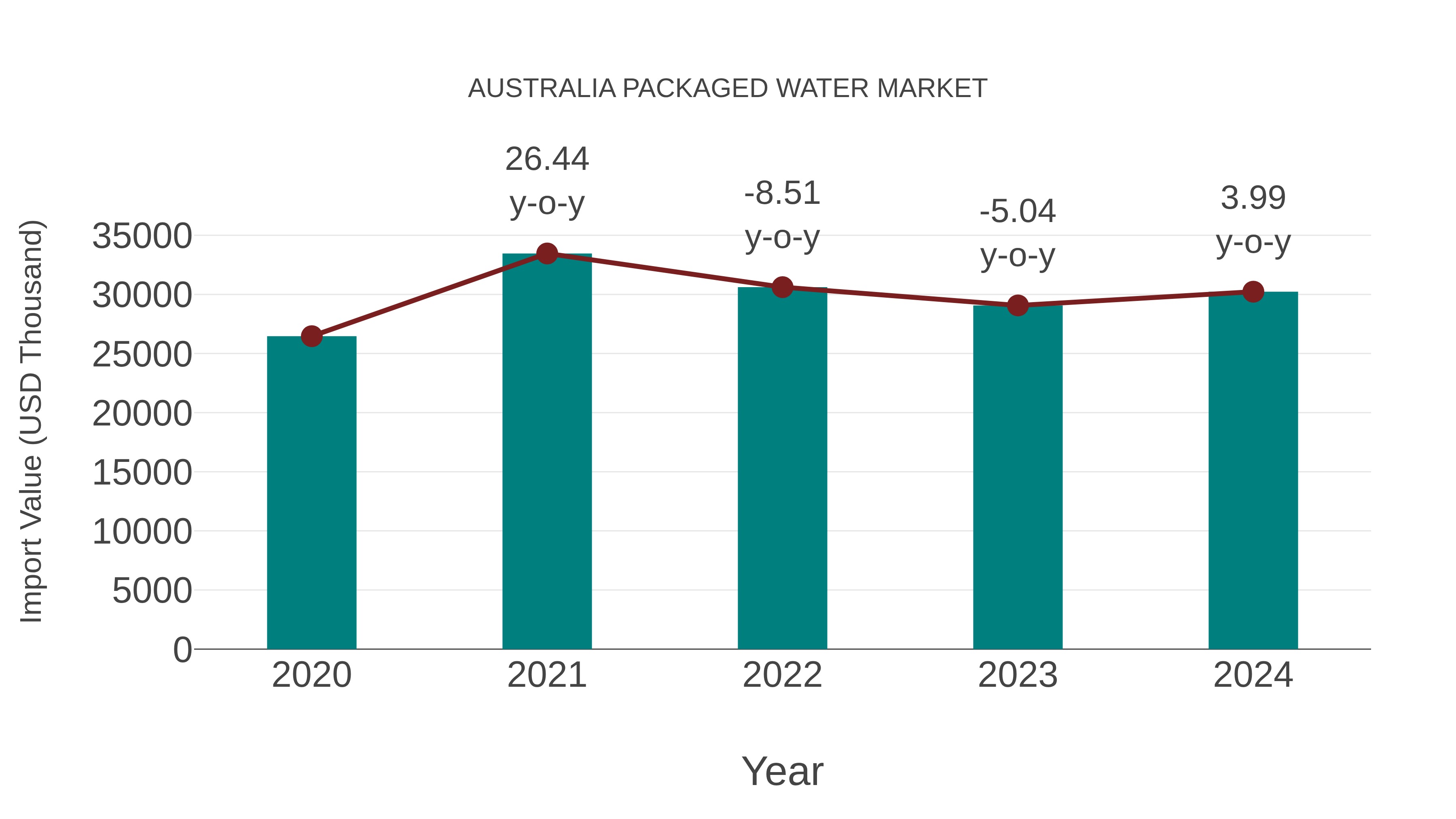
In the Australia packaged water market, the import trend showed a growth rate of 3.99% from 2023 to 2024, with a compound annual growth rate (CAGR) of 3.38% from 2020 to 2024. This import momentum could be attributed to evolving consumer preferences towards healthier beverage options, driving increased demand for imported packaged water in the Australian market.
Australia Packaged water Market Overview
The Australia packaged water market is experiencing steady growth driven by increasing consumer awareness about the importance of hydration and health-conscious lifestyles. The market is characterized by a wide range of products including still, sparkling, flavored, and functional waters. Key players in the market are focusing on innovation in packaging, sustainability, and product differentiation to cater to evolving consumer preferences. Convenience, portability, and the perception of packaged water as a safe and reliable source of hydration are driving factors for market growth. Additionally, the rising trend of on-the-go consumption and the shift towards healthier beverage choices are contributing to the market`s positive outlook. With a competitive landscape and a growing emphasis on sustainability practices, the Australia packaged water market is expected to witness continued expansion in the coming years.
Australia Packaged water Market Trends and Opportunities
The Australia packaged water market is experiencing significant growth, driven by the increasing consumer preference for healthier beverage options and the convenience of on-the-go hydration. Key trends include the rising popularity of functional and flavored waters, sustainable packaging solutions, and the shift towards premium and luxury bottled water brands. Opportunities in the market lie in the development of innovative packaging designs, such as eco-friendly materials and smart packaging technologies, as well as expanding distribution channels to reach a wider consumer base. With the growing awareness of the importance of hydration for overall health and wellness, the Australia packaged water market is poised for continued expansion and diversification in the coming years.
Australia Packaged water Market Challenges
In the Australia Packaged water market, key challenges include increasing competition from other beverage categories like flavored water and sports drinks, as well as concerns over environmental sustainability due to the use of plastic bottles. Consumer preferences are shifting towards healthier and more sustainable options, leading to a demand for eco-friendly packaging and reduced plastic usage. Additionally, fluctuations in raw material prices, stringent regulations on water sourcing and quality, and logistical issues related to distribution and storage also pose challenges for packaged water companies in Australia. To stay competitive, companies in the market need to innovate with new product offerings, focus on sustainability practices, and adapt to changing consumer preferences to overcome these challenges.
Australia Packaged water Market Drivers
The Australia Packaged water market is primarily driven by the increasing health consciousness among consumers, leading to a growing preference for convenient and portable hydration options. The trend towards healthier lifestyles, coupled with rising awareness about the importance of staying hydrated, has propelled the demand for packaged water in the country. Additionally, concerns over water quality and safety, especially in regions facing water scarcity or contamination issues, have further boosted the market for packaged water as a reliable and safe alternative. The convenience factor of on-the-go packaging formats and the availability of a variety of flavored and functional waters also contribute to the market growth. Overall, the shift towards healthier beverage choices and the need for safe drinking water are key drivers fueling the growth of the Australia Packaged water market.
Australia Packaged water Market Government Policy
In Australia, the packaged water market is governed by various government policies aimed at ensuring the safety, quality, and sustainability of bottled water products. The Australian Food Standards Code sets out requirements for labeling, composition, and packaging of packaged water to protect consumer health and prevent misrepresentation. Additionally, the Australian Competition and Consumer Commission (ACCC) oversees fair trading practices in the industry to prevent misleading claims and promote market competition. Furthermore, environmental regulations promote sustainable practices in packaging and waste management to minimize the environmental impact of packaged water products. Overall, government policies in Australia aim to maintain high standards in the packaged water market, safeguard consumer interests, and promote environmental sustainability.
Australia Packaged water Market Future Outlook
The Australia Packaged water market is expected to continue growing steadily in the coming years, driven by factors such as increasing health consciousness among consumers, a shift towards healthier beverage options, and the convenience of on-the-go packaging. The market is likely to see innovation in product offerings, including flavored and functional waters, as well as sustainable packaging solutions to align with the growing environmental concerns. With a focus on hydration and wellness trends, the demand for packaged water is anticipated to remain strong, particularly among urban populations and health-conscious individuals. Market players are also expected to invest in marketing strategies and distribution channels to reach a wider consumer base and capitalize on the growing demand for packaged water in Australia.
Key Highlights of the Report:
- Australia Packaged water Market Outlook
- Market Size of Australia Packaged water Market, 2025
- Forecast of Australia Packaged water Market, 2032
- Historical Data and Forecast of Australia Packaged water Revenues & Volume for the Period 2022 - 2032F
- Australia Packaged water Market Trend Evolution
- Australia Packaged water Market Drivers and Challenges
- Australia Packaged water Price Trends
- Australia Packaged water Porter's Five Forces
- Australia Packaged water Industry Life Cycle
- Historical Data and Forecast of Australia Packaged water Market Revenues & Volume By Product for the Period 2022 - 2032F
- Historical Data and Forecast of Australia Packaged water Market Revenues & Volume By Still for the Period 2022 - 2032F
- Historical Data and Forecast of Australia Packaged water Market Revenues & Volume By Carbonated for the Period 2022 - 2032F
- Historical Data and Forecast of Australia Packaged water Market Revenues & Volume By Flavored for the Period 2022 - 2032F
- Historical Data and Forecast of Australia Packaged water Market Revenues & Volume By Functional for the Period 2022 - 2032F
- Australia Packaged water Import Export Trade Statistics
- Market Opportunity Assessment By Product
- Australia Packaged water Top Companies Market Share
- Australia Packaged water Competitive Benchmarking By Technical and Operational Parameters
- Australia Packaged water Company Profiles
- Australia Packaged water Key Strategic Recommendations






































