Australia Permanent Magnets Market Size, Share & Growth Rate
The Australia Permanent Magnets Market was estimated at USD 119 Million in 2025 and is projected to reach USD 140 Million by 2032, growing at a CAGR of 2.3% from 2026 to 2032. This upward trajectory is primarily fueled by the robust demand for high-performance magnets in electric vehicles and renewable energy systems, particularly wind energy. Additionally, the expansion of the electronics sector is further solidifying the market's growth, as permanent magnets become increasingly integral to various applications.
Australia Permanent Magnets Market Year-wise Growth Rate and Key Drivers
This graph highlights how the Australia Permanent Magnets Market has steadily grown over the years, supported by major growth factors.
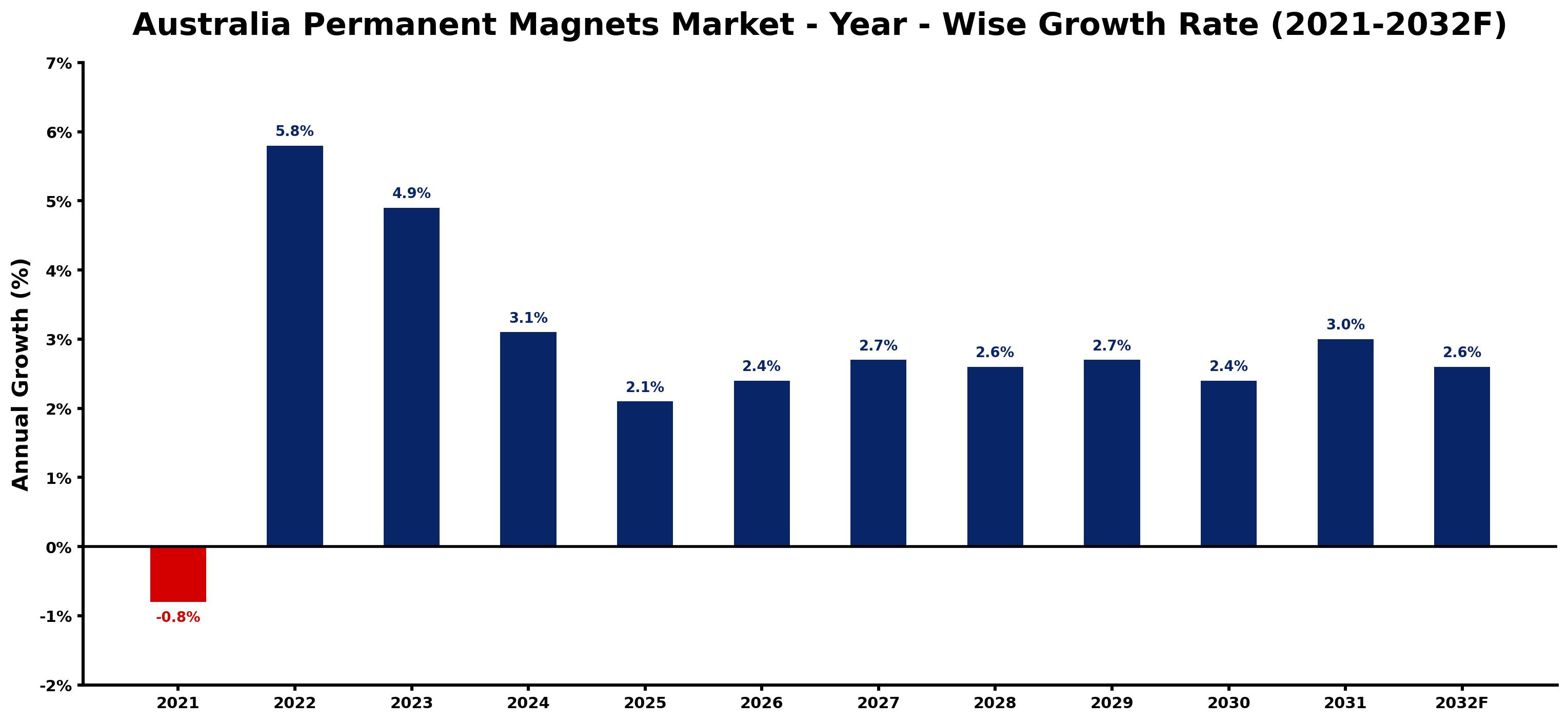
The table below presents the year‑wise growth rates along with the key drivers influencing the market
| Year | Growth Rate | Major Drivers |
| 2021 | -0.8% | Expansion of transportation and logistics networks |
| 2022 | 5.8% | Increasing smart city development projects |
| 2023 | 4.9% | Increasing adoption of advanced technologies |
| 2024 | 3.1% | Increasing industrial infrastructure investments |
| 2025 | 2.1% | Increasing industrial automation investments |
| 2026 | 2.4% | Government infrastructure modernization initiatives |
| 2027 | 2.7% | Increasing adoption of advanced technologies |
| 2028 | 2.6% | Increasing industrial infrastructure investments |
| 2029 | 2.7% | Increasing adoption of advanced technologies |
| 2030 | 2.4% | Expansion of commercial construction activities |
| 2031 | 3.0% | Expansion of manufacturing activities |
| 2032 | 2.6% | Increasing industrial automation investments |
Note - Market size estimations and growth projections presented in this report are based on 6Wresearch's advanced forecasting approach, validated with industry datasets as of June 2026.
Australia Permanent Magnets Market Synopsis
The landscape of the Australia Permanent Magnets Market is transforming, driven by a surge in applications across multiple industries. Notably, the accelerating shift towards electric vehicles and renewable energy sources is creating substantial demand for both rare-earth and ferrite magnets, which are essential for improving efficiency and performance.
The convergence of environmental consciousness and technological advancement is not only reshaping consumer preferences but also influencing manufacturing processes. As Australia prioritizes clean energy initiatives, the market is poised for growth, ensuring that local businesses can capitalize on emerging opportunities within the sector.
Australia Permanent Magnets Market Key Takeaways
- The market is witnessing growth driven by electric vehicle adoption and renewable energy initiatives.
- Substantial reserves of rare-earth materials such as neodymium and dysprosium position Australia favorably in global supply chains.
- Government policies aimed at enhancing local production of critical minerals are set to bolster market development.
- The industrial machinery sector is a significant contributor to the overall demand for permanent magnets.
- Opportunities in recycling rare-earth magnets are becoming increasingly relevant in the context of sustainability.
Evaluation of Restraints in Australia Permanent Magnets Market
Despite promising growth prospects, the Australia Permanent Magnets Market faces certain limitations. Fluctuations in global supply chains can lead to price volatility, particularly affecting the sourcing of rare-earth materials. This dependency not only complicates market stability but also amplifies environmental concerns regarding mining practices. Moreover, the trend towards organic farming may reduce the demand for synthetic fertilizers, which are intrinsically linked to certain magnet production processes.
Australia Permanent Magnets Market Trends
A notable trend is the increasing integration of artificial intelligence and automation in manufacturing processes, enhancing the efficiency and precision of permanent magnet production. Additionally, as industries seek to minimize environmental impacts, there is a significant push towards developing sustainable methods for magnet recycling. This shift not only aligns with global sustainability goals but also offers economic benefits by reducing reliance on newly mined materials.
Australia Permanent Magnets Market Opportunities
Investment opportunities abound in the Australia Permanent Magnets Market, particularly in the realms of rare-earth magnet production and recycling. With a growing emphasis on electric vehicles and renewable energy technologies, businesses can tap into markets that require advanced magnetic solutions. Moreover, by developing local manufacturing capabilities, Australia can enhance supply security and reduce its dependency on imports, paving the way for a more resilient and self-sufficient market.
Government Initiatives in the Australia Permanent Magnets Market
The Australian government plays a pivotal role in supporting the permanent magnets market through its critical minerals strategy. This initiative aims to promote domestic production of rare earth elements, thereby reducing reliance on international sources. Furthermore, government funding is directed towards local mining projects, fostering innovation and sustainable practices in the sector. Environmental and labor regulations ensure that mining activities align with responsible practices, further enhancing the market's credibility.
Future Insights of the Australia Permanent Magnets Market
Looking ahead to 2026-2032, the Australia Permanent Magnets Market is set to experience significant evolution. The increasing demand for sustainable and high-performance products will likely drive innovation in magnet technology. Additionally, as global economies increasingly prioritize renewable energy, Australia's wealth of rare-earth resources positions it as a key player in international markets. The combined effects of government initiatives and growing domestic industries are expected to further solidify the country's standing in the global supply chain for permanent magnets.
Australia Permanent Magnets Market Latest Developments (May 2025 - June 2026)
Recent developments in the Australia Permanent Magnets Market indicate a strong commitment to advancing local production capabilities. Industry collaborations are becoming more common, aimed at enhancing the efficiency of magnet manufacturing processes. There is also a noticeable increase in research and development activities focused on recycling technologies, as companies seek to minimize waste and optimize resource usage. These trends reflect a broader commitment to sustainability and innovation within the sector.
Australia Permanent Magnets Market - Key Attractiveness of the Report
- 10 Years of Market Numbers
- Historical Data Starting from 2022 to 2025
- Base Year: 2025
- Forecast Data until 2032
- Key Performance Indicators Impacting the Market
- Major Upcoming Developments and Projects
Key Highlights of the Report:
- Australia Permanent Magnets Market Outlook
- Market Size of Australia Permanent Magnets Market, 2025
- Forecast of Australia Permanent Magnets Market, 2032
- Historical Data and Forecast of Australia Permanent Magnets Revenues & Volume for the Period 2022-2032F
- Australia Permanent Magnets Market Trend Evolution
- Australia Permanent Magnets Market Drivers and Challenges
- Australia Permanent Magnets Price Trends
- Australia Permanent Magnets Porter's Five Forces
- Australia Permanent Magnets Industry Life Cycle
- Historical Data and Forecast of Australia Permanent Magnets Market Revenues & Volume By Material for the Period 2022-2032F
- Historical Data and Forecast of Australia Permanent Magnets Market Revenues & Volume By Ferrite for the Period 2022-2032F
- Historical Data and Forecast of Australia Permanent Magnets Market Revenues & Volume By Neodymium Iron Boron (NdFeB) for the Period 2022-2032F
- Historical Data and Forecast of Australia Permanent Magnets Market Revenues & Volume By Aluminium Nickel Cobalt (Alnico) for the Period 2022-2032F
- Historical Data and Forecast of Australia Permanent Magnets Market Revenues & Volume By Samarium Cobalt (SmCo) for the Period 2022-2032F
- Historical Data and Forecast of Australia Permanent Magnets Market Revenues & Volume By Applications for the Period 2022-2032F
- Historical Data and Forecast of Australia Permanent Magnets Market Revenues & Volume By Automotive for the Period 2022-2032F
- Historical Data and Forecast of Australia Permanent Magnets Market Revenues & Volume By Consumer Goods & Electronics for the Period 2022-2032F
- Historical Data and Forecast of Australia Permanent Magnets Market Revenues & Volume By Industrial for the Period 2022-2032F
- Historical Data and Forecast of Australia Permanent Magnets Market Revenues & Volume By Aerospace & Defense for the Period 2022-2032F
- Historical Data and Forecast of Australia Permanent Magnets Market Revenues & Volume By Energy for the Period 2022-2032F
- Historical Data and Forecast of Australia Permanent Magnets Market Revenues & Volume By Medical for the Period 2022-2032F
- Historical Data and Forecast of Australia Permanent Magnets Market Revenues & Volume By Others for the Period 2022-2032F
- Australia Permanent Magnets Import Export Trade Statistics
- Market Opportunity Assessment By Material
- Market Opportunity Assessment By Applications
- Australia Permanent Magnets Top Companies Market Share
- Australia Permanent Magnets Competitive Benchmarking By Technical and Operational Parameters
- Australia Permanent Magnets Company Profiles
- Australia Permanent Magnets Key Strategic Recommendations






































