Australia Process Automation And Instrumentation Market Size, Share & Growth Rate
The Australia Process Automation And Instrumentation Market was estimated at USD 262 Million in 2025 and is projected to reach USD 331 Million by 2032, growing at a CAGR of 3.4% from 2026 to 2032. This growth trajectory is primarily driven by the increasing need for operational efficiency and the integration of advanced technologies such as AI and IoT in industrial applications. As companies in sectors like manufacturing and mining strive to enhance productivity and reduce costs, the demand for automation solutions continues to gain momentum.
Australia Process Automation And Instrumentation Market Year-wise Growth Rate and Key Drivers
This graph highlights how the Australia Process Automation And Instrumentation Market has steadily grown over the years, supported by major growth factors.
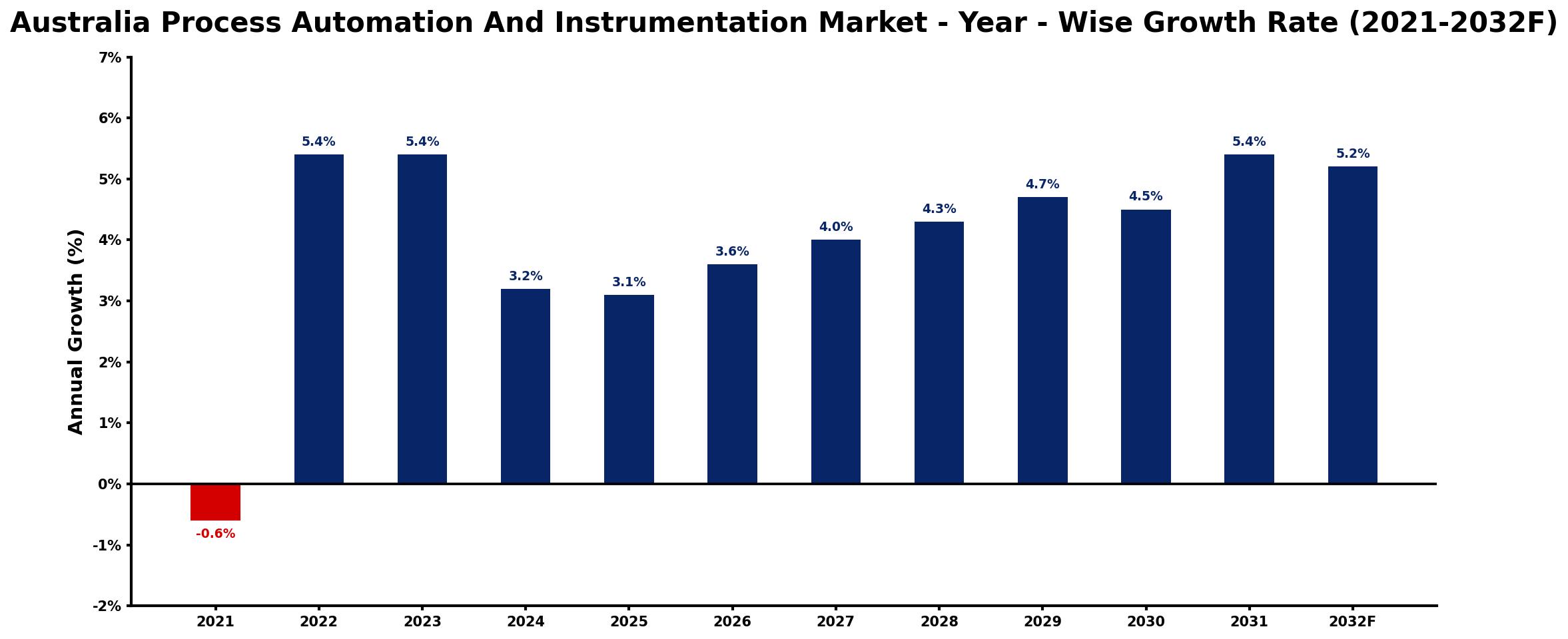
The table below presents the year‑wise growth rates along with the key drivers influencing the market
| Year | Growth Rate | Major Drivers |
| 2021 | -0.6% | decreased industrial investment activities |
| 2022 | 5.4% | rising demand for efficiency solutions |
| 2023 | 5.4% | increased focus on sustainability initiatives |
| 2024 | 3.2% | growing adoption of smart technology |
| 2025 | 3.1% | expansion of renewable energy projects |
| 2026 | 3.6% | enhanced regulatory compliance requirements |
| 2027 | 4.0% | surge in remote monitoring systems |
| 2028 | 4.3% | higher investments in digital transformation |
| 2029 | 4.7% | increased integration of IoT applications |
| 2030 | 4.5% | growing need for real-time data |
| 2031 | 5.4% | expanding healthcare application demand |
| 2032 | 5.2% | rising interest in predictive maintenance |
Note: Market size estimations and growth projections presented in this report are based on 6Wresearch's proprietary forecasting methodology, utilizing the latest available industry data, government publications, and primary research inputs.
Australia Process Automation And Instrumentation Market Synopsis
Australia's process automation and instrumentation market has witnessed significant momentum recently, with many sectors embracing automation as a pathway to improved efficiency. However, the future holds even greater promise, as emerging technologies and government initiatives pave the way for widespread adoption across various industries.
The continued integration of IoT-enabled systems and AI-driven solutions is transforming how industries approach automation. As organizations focus on meeting regulatory standards and enhancing operational performance, the market is set for robust growth, benefiting from innovations that streamline processes and promote sustainability.
Australia Process Automation And Instrumentation Market Key Takeaways
- The market is poised for steady growth, propelled by advancements in AI and IoT technologies.
- Manufacturing, mining, and energy sectors are the primary adopters of automation solutions.
- Government initiatives are reinforcing digital transformation and Industry 4.0 adoption.
- There is a rising demand for skilled professionals to implement and manage automation solutions.
- Investment opportunities abound in customized automation services tailored to industry needs.
Evaluation of Restraints in Australia Process Automation And Instrumentation Market
Despite the promising growth outlook, the Australia Process Automation And Instrumentation Market faces several significant restraints. High initial investment costs for advanced automation systems often deter small and medium-sized enterprises (SMEs) from making the necessary upgrades. Furthermore, a general resistance to adopting automated solutions can impede wider acceptance, particularly in traditional sectors. Cybersecurity threats pose an ongoing challenge, necessitating continual investments in system upgrades to safeguard digital processes. Additionally, there is a pressing need for a workforce skilled in automation technologies, which can hinder rapid market expansion.
Australia Process Automation And Instrumentation Market Trends
Several trends are currently shaping the Australia Process Automation And Instrumentation Market. The adoption of real-time monitoring technologies is enhancing operational transparency, while cloud-based control systems are enabling more flexible and scalable automation solutions. Additionally, Industry 4.0 principles are driving the integration of AI and IoT, leading to smarter manufacturing processes. There is also a marked shift towards sustainability, as organizations seek automation solutions that contribute to environmental goals.
Australia Process Automation And Instrumentation Market Opportunities
The market presents numerous growth and investment opportunities, particularly in the realm of AI-driven automation solutions. As the demand for smart manufacturing and efficient resource management increases, investors can find lucrative prospects in developing tailored automation services for key industries such as mining, oil & gas, and manufacturing. Furthermore, companies focusing on the integration of IoT-enabled systems are well-positioned to capture market share as organizations shift towards digital and connected operations.
Government Initiatives in the Australia Process Automation And Instrumentation Market
The Australian government plays a pivotal role in shaping the process automation and instrumentation landscape. Regulations under industrial automation and safety policies promote efficiency and reliability, ensuring compliance with Australian Standards (AS) across various sectors. These standards emphasize cybersecurity, process safety, and operational reliability, fostering a secure environment for automation solutions. Additionally, government incentives are designed to stimulate the adoption of Industry 4.0 technologies, further encouraging digital transformation in the economy.
Future Insights of the Australia Process Automation And Instrumentation Market
Looking ahead to 2026-2032, the Australia Process Automation And Instrumentation Market is set to experience significant evolution. As technology continues to advance, automation solutions will become increasingly sophisticated, driving further integration of AI and IoT in various industrial processes. The emphasis on operational efficiency and sustainability will persist, with businesses looking for innovative ways to optimize their operations. The ongoing push from the government towards digital transformation is likely to accelerate this trend, positioning the market for robust growth.
Australia Process Automation And Instrumentation Market Latest Developments (2025 - 2026)
Recent developments in the process automation and instrumentation sector indicate a strong commitment to enhancing technological capabilities. Companies are increasingly focusing on collaborations to integrate cutting-edge AI technologies into existing automation frameworks. Moreover, discussions around regulatory compliance and cybersecurity measures have gained prominence, as industries work towards securing their automation investments. The government's support for industry initiatives promoting smart manufacturing is expected to further catalyze growth and innovation in the market.
Australia Process Automation And Instrumentation Market - Key Attractiveness of the Report
- 10 Years of Market Numbers
- Historical Data Starting from 2022 to 2025
- Base Year: 2025
- Forecast Data until 2032
- Key Performance Indicators Impacting the Market
- Major Upcoming Developments and Projects
Key Highlights of the Report:
- Australia Process Automation And Instrumentation Market Outlook
- Market Size of Australia Process Automation And Instrumentation Market, 2025
- Forecast of Australia Process Automation And Instrumentation Market, 2032
- Historical Data and Forecast of Australia Process Automation And Instrumentation Revenues & Volume for the Period 2022-2032F
- Australia Process Automation And Instrumentation Market Trend Evolution
- Australia Process Automation And Instrumentation Market Drivers and Challenges
- Australia Process Automation And Instrumentation Price Trends
- Australia Process Automation And Instrumentation Porter's Five Forces
- Australia Process Automation And Instrumentation Industry Life Cycle
- Historical Data and Forecast of Australia Process Automation And Instrumentation Market Revenues & Volume By Instrument for the Period 2022-2032F
- Historical Data and Forecast of Australia Process Automation And Instrumentation Market Revenues & Volume By Field Instruments for the Period 2022-2032F
- Historical Data and Forecast of Australia Process Automation And Instrumentation Market Revenues & Volume By Control Valve for the Period 2022-2032F
- Historical Data and Forecast of Australia Process Automation And Instrumentation Market Revenues & Volume By Analytical Instruments for the Period 2022-2032F
- Historical Data and Forecast of Australia Process Automation And Instrumentation Market Revenues & Volume By Solution for the Period 2022-2032F
- Historical Data and Forecast of Australia Process Automation And Instrumentation Market Revenues & Volume By Advanced Process Control (APC) for the Period 2022-2032F
- Historical Data and Forecast of Australia Process Automation And Instrumentation Market Revenues & Volume By Distributed Control System (DCS) for the Period 2022-2032F
- Historical Data and Forecast of Australia Process Automation And Instrumentation Market Revenues & Volume By Human Machine Interaction (HMI) for the Period 2022-2032F
- Historical Data and Forecast of Australia Process Automation And Instrumentation Market Revenues & Volume By Manufacturing Execution System (MES) for the Period 2022-2032F
- Historical Data and Forecast of Australia Process Automation And Instrumentation Market Revenues & Volume By Programmable Logic Controller (PLC) for the Period 2022-2032F
- Historical Data and Forecast of Australia Process Automation And Instrumentation Market Revenues & Volume By Safety Automation for the Period 2022-2032F
- Historical Data and Forecast of Australia Process Automation And Instrumentation Market Revenues & Volume By Supervisory Control and Data Acquisition (SCADA) for the Period 2022-2032F
- Historical Data and Forecast of Australia Process Automation And Instrumentation Market Revenues & Volume By End-user Industry for the Period 2022-2032F
- Historical Data and Forecast of Australia Process Automation And Instrumentation Market Revenues & Volume By Oil and Gas for the Period 2022-2032F
- Historical Data and Forecast of Australia Process Automation And Instrumentation Market Revenues & Volume By Food and Beverage for the Period 2022-2032F
- Historical Data and Forecast of Australia Process Automation And Instrumentation Market Revenues & Volume By Pharmaceutical and Biopharma for the Period 2022-2032F
- Historical Data and Forecast of Australia Process Automation And Instrumentation Market Revenues & Volume By Chemical and Petrochemical for the Period 2022-2032F
- Historical Data and Forecast of Australia Process Automation And Instrumentation Market Revenues & Volume By Other End-user Industries for the Period 2022-2032F
- Australia Process Automation And Instrumentation Import Export Trade Statistics
- Market Opportunity Assessment By Instrument
- Market Opportunity Assessment By Solution
- Market Opportunity Assessment By End-user Industry
- Australia Process Automation And Instrumentation Top Companies Market Share
- Australia Process Automation And Instrumentation Competitive Benchmarking By Technical and Operational Parameters
- Australia Process Automation And Instrumentation Company Profiles
- Australia Process Automation And Instrumentation Key Strategic Recommendations






































