Australia Publishing Market Summary
The australia publishing market was estimated at USD 232 Million in 2025 and is projected to reach USD 274 Million by 2032, growing at a CAGR of 2.3% from 2026 to 2032.
Australia Publishing Market Year-wise Growth Rate and Key Drivers
This graph highlights how the Australia Publishing Market has steadily grown over the past five years, supported by major growth factors.
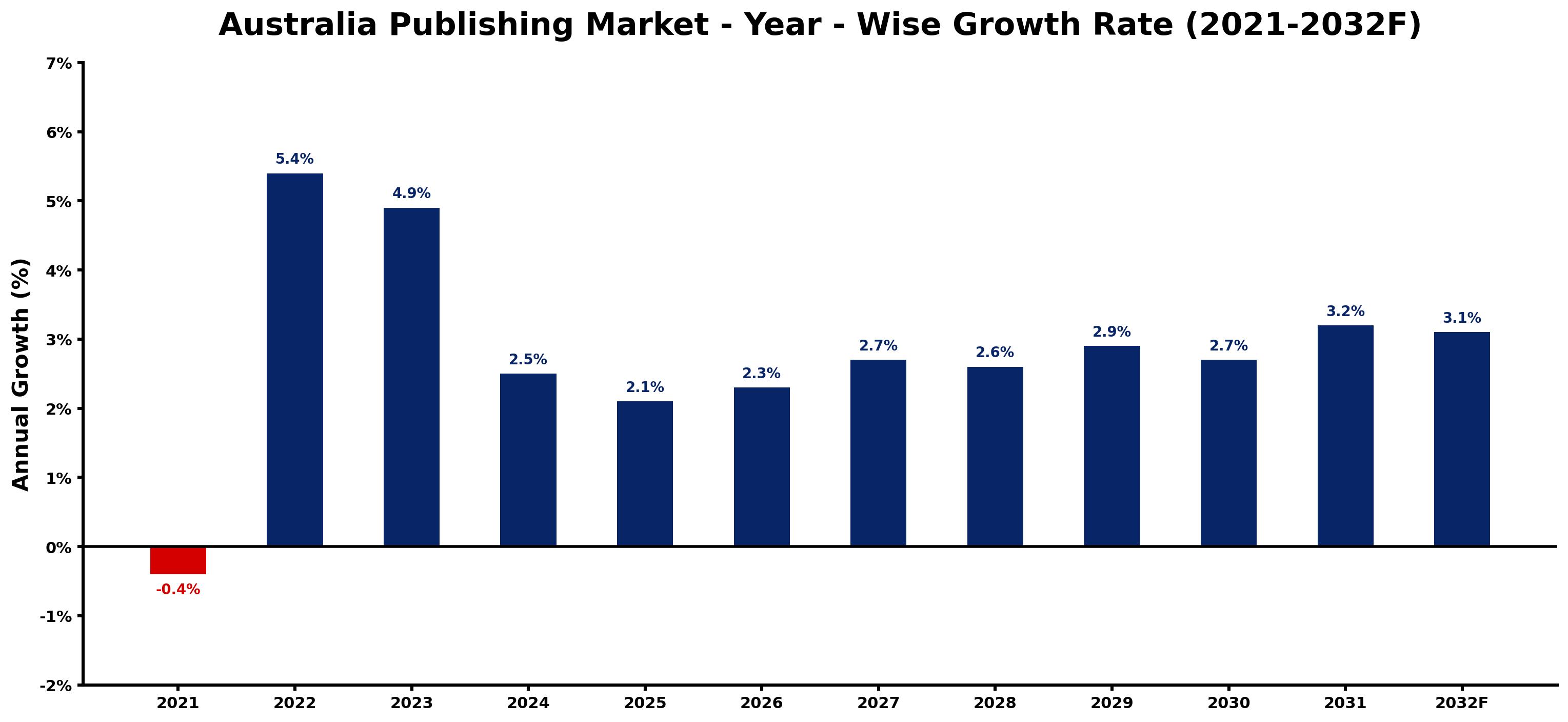
The table below presents the year wise growth rates along with the key drivers influencing the market
| Year | Growth Rate | Major Drivers |
| 2021 | -0.4% | Shifts towards digital media consumption diminished demand for traditional print publications in Australia's publishing sector. |
| 2022 | 5.4% | Consumers increasingly favor e-books, reflecting changing reading habits across demographics. |
| 2023 | 4.9% | Local authors gain recognition, boosting interest in Australian literature and storytelling. |
| 2024 | 2.5% | Sustainability trends drive interest in eco-friendly publishing materials and practices. |
| 2025 | 2.1% | Subscription models flourish, offering readers convenient access to diverse content libraries. |
| 2026 | 2.3% | Technological innovations prompt publishers to enhance user engagement through interactivity. |
| 2027 | 2.7% | Educational publishing sees demand surge with online learning still prevalent post-pandemic. |
| 2028 | 2.6% | Diverse content appeals to multicultural audiences, driving niche markets within publishing. |
| 2029 | 2.9% | Australia's cultural events promote local authors, influencing market dynamics positively. |
| 2030 | 2.7% | Collaboration between traditional and independent publishers fosters wider distribution channels. |
| 2031 | 3.2% | Digital literacy initiatives encourage broader participation in both reading and writing. |
| 2032 | 3.1% | Emergence of new genres challenges traditional publishing norms, creating fresh market opportunities. |
Note - Market size estimations and growth projections presented in this report are based on 6Wresearch's advanced forecasting approach, validated with industry datasets as of June 2026.
Australia Publishing Market Synopsis
The Australia Publishing Market is projected to reach 2.3% and witness significant growth during the forecast period (2026-2032). As the landscape of publishing continues to evolve, the transformation from traditional print media to digital platforms is reshaping revenue models and consumption habits. While printed materials, including books, newspapers, and magazines, still have a dedicated audience, the advent of e-books and various online platforms is significantly influencing the market. The educational and academic publishing segments, driven by a persistent demand for textbooks and research resources, remain robust amidst these changes.
Australia Publishing Market Growth Drivers
The growth of the Australia Publishing Market can be attributed to several key drivers:
- The accelerated digitalization of content consumption is leading to a notable increase in e-books and online subscriptions, reshaping how content is accessed and enjoyed.
- The demand for educational materials, especially in the realm of higher education, is persistent, creating steady revenue streams for publishers specializing in academic content.
- Technological advancements in digital publishing have enabled more publishers to produce and distribute content efficiently, thereby reducing overhead costs and increasing accessibility.
- The increasing popularity of audiobooks as an alternative publishing format is appealing to a broader audience, particularly among busy consumers seeking multitasking opportunities.
- Niche publishing focused on specific interests or demographics is gaining traction, presenting opportunities for growth in underrepresented sectors of the market.
Australia Publishing Market Challenges and Restraints
Despite the promising landscape for growth, the Australia Publishing Market is confronted with several challenges:
- The rise of digital media has led to a marked decline in the demand for printed books and newspapers, causing a shift in revenue streams that traditional publishers must navigate.
- Competition from international publishing houses has intensified, making it increasingly difficult for local publishers to maintain market share and profitability.
- The proliferation of self-publishing platforms allows authors to bypass traditional routes, creating further competition and fragmentation in the market.
- High production and distribution costs present a barrier for smaller publishing firms, challenging their ability to scale and meet profitability goals.
- Rapid changes in consumer preferences, often driven by technological advancements, require publishers to be agile and adaptive to remain relevant in a competitive landscape.
Australia Publishing Market Investment Opportunities
The ongoing transformation of the Australia Publishing Market presents several investment opportunities:
- Investing in digital content platforms is crucial as consumer behavior continues to shift towards online access and consumption of literature.
- The emergence of audiobooks as a popular format represents a lucrative opportunity for publishers looking to diversify their offerings.
- Developing self-publishing services provides an avenue for growth, catering to a growing number of independent authors seeking to produce their work without traditional publishing constraints.
- Niche publications targeting specific audiences can capitalize on underserved markets and drive reader loyalty.
- Sustainable printing practices are becoming a priority for consumers; thus, capitalizing on eco-friendly publishing solutions can enhance brand reputation and attract environmentally-conscious readers.
Australia Publishing Market Government Investment and Initiatives
The government plays a significant role in shaping the landscape of the Australia Publishing Market through various policies and initiatives:
- Strict copyright laws are enforced to protect local authors and publishers, ensuring their work is safeguarded against unauthorized use.
- Government initiatives promoting digital publishing are designed to help traditional publishers transition smoothly into the digital age.
- Public funding for educational resources is aimed at supporting local publishing ventures that provide necessary materials to schools and universities.
- Regulatory frameworks are in place to ensure fair trade practices in both print and digital formats, allowing for a balanced market environment.
- Investment in literacy programs underlines the government's commitment to fostering a reading culture, indirectly benefiting the publishing industry.
Australia Publishing Market Latest Developments (May 2025 - June 2026)
Recent developments in the Australia Publishing Market indicate a continued focus on digital transformation. As publishers adapt to changing consumer preferences, many are enhancing their digital platforms and investing in user-friendly interfaces to attract tech-savvy readers. The growth in audiobooks is notable, with several companies expanding their offerings to include this format, reaching a wider audience.
Additionally, collaborative initiatives between publishers and educational institutions are increasingly common, aiming to deliver tailored content to students. This trend highlights the ongoing demand for personalized educational resources. Moreover, discussions around sustainable practices in publishing are gaining traction, prompting many in the industry to explore eco-friendly materials and processes. Collectively, these directions reflect the publishing industry's commitment to innovation and adaptation in a rapidly changing environment.
Australia Publishing Market - Key Attractiveness of the Report
- 10 Years of Market Numbers
- Historical Data Starting from 2022 to 2025
- Base Year: 2025
- Forecast Data until 2032
- Key Performance Indicators Impacting the Market
- Major Upcoming Developments and Projects
Key Highlights of the Report:
- Australia Publishing Market Outlook
- Market Size of Australia Publishing Market, 2025
- Forecast of Australia Publishing Market, 2032
- Historical Data and Forecast of Australia Publishing Revenues & Volume for the Period 2022-2032F
- Australia Publishing Market Trend Evolution
- Australia Publishing Market Drivers and Challenges
- Australia Publishing Price Trends
- Australia Publishing Porter's Five Forces
- Australia Publishing Industry Life Cycle
- Historical Data and Forecast of Australia Publishing Market Revenues & Volume By Types for the Period 2022-2032F
- Historical Data and Forecast of Australia Publishing Market Revenues & Volume By Newspaper for the Period 2022-2032F
- Historical Data and Forecast of Australia Publishing Market Revenues & Volume By Journals for the Period 2022-2032F
- Historical Data and Forecast of Australia Publishing Market Revenues & Volume By Catalogues for the Period 2022-2032F
- Historical Data and Forecast of Australia Publishing Market Revenues & Volume By Magazine for the Period 2022-2032F
- Historical Data and Forecast of Australia Publishing Market Revenues & Volume By Books for the Period 2022-2032F
- Historical Data and Forecast of Australia Publishing Market Revenues & Volume By E-Books for the Period 2022-2032F
- Historical Data and Forecast of Australia Publishing Market Revenues & Volume By Platform for the Period 2022-2032F
- Historical Data and Forecast of Australia Publishing Market Revenues & Volume By Digital? for the Period 2022-2032F
- Historical Data and Forecast of Australia Publishing Market Revenues & Volume By Paper for the Period 2022-2032F
- Australia Publishing Import Export Trade Statistics
- Market Opportunity Assessment By Types
- Market Opportunity Assessment By Platform
- Australia Publishing Top Companies Market Share
- Australia Publishing Competitive Benchmarking By Technical and Operational Parameters
- Australia Publishing Company Profiles
- Australia Publishing Key Strategic Recommendations






































