Australia Temperature Measuring Instruments Market Summary
The australia temperature measuring instruments market was estimated at USD 144 Million in 2025 and is projected to reach USD 170 Million by 2032, growing at a CAGR of 3.0% from 2026 to 2032.
Australia Temperature Measuring Instruments Market Year-wise Growth Rate and Key Drivers
This graph highlights how the Australia Temperature Measuring Instruments Market has steadily grown over the past five years, supported by major growth factors.
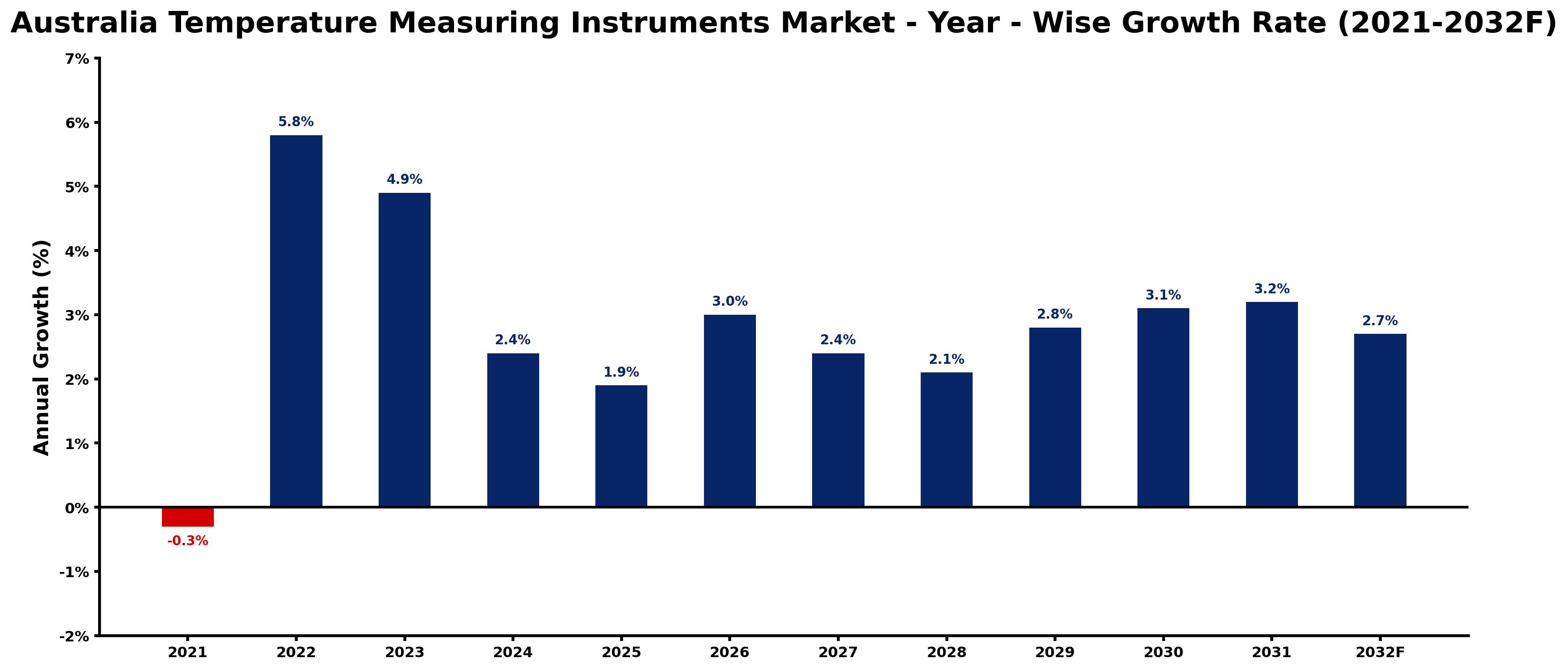
The table below presents the year wise growth rates along with the key drivers influencing the market
| Year | Growth Rate | Major Drivers |
| 2021 | -0.3% | Supply chain disruptions hindered timely product delivery, leading to decreased sales and consumer dissatisfaction in the market. |
| 2022 | 5.8% | Emerging technologies enhance precision in temperature measuring instruments across industries. |
| 2023 | 4.9% | Consumer awareness around health drives demand for accurate home temperature devices. |
| 2024 | 2.4% | Investment in renewable energy sectors necessitates advanced monitoring equipment for efficiency. |
| 2025 | 1.9% | Growing focus on food safety standards increases adoption of reliable measuring tools. |
| 2026 | 3.0% | Technological integration in agriculture promotes smart temperature solutions for crop management. |
| 2027 | 2.4% | Industrial automation trends require seamless temperature monitoring in manufacturing processes. |
| 2028 | 2.1% | Rapid urbanization leads to heightened demand for effective climate control solutions. |
| 2029 | 2.8% | Expanding healthcare infrastructure drives the need for temperature control in lab settings. |
| 2030 | 3.1% | Smart home technology advancements incorporate temperature monitoring into everyday devices. |
| 2031 | 3.2% | Energy efficiency regulations create a market for sophisticated measurement instruments. |
| 2032 | 2.7% | Sustainability initiatives push for innovative temperature solutions in various sectors. |
Note - Market size estimations and growth projections presented in this report are based on 6Wresearch's advanced forecasting approach, validated with industry datasets as of June 2026.
Australia Temperature Measuring Instruments Market Synopsis
The Australia Temperature Measuring Instruments Market is projected to reach 3.0% and witness significant growth during the forecast period (2026-2032). This market encompasses a diverse array of temperature measurement devices, including thermometers, thermocouples, infrared sensors, and thermal imaging cameras, which facilitate essential temperature monitoring, control, and analysis across industrial, commercial, and scientific sectors. Growing advancements in sensor technology, alongside the integration of wireless connectivity and data analytics, are enhancing the versatility, accuracy, and accessibility of these instruments, thereby enabling improved decision-making and process optimization.
Australia Temperature Measuring Instruments Market Growth Drivers
Several key factors are driving the expansion of the Australia Temperature Measuring Instruments Market. First, there is an increasing demand for accurate and reliable temperature measurement solutions across critical sectors, including manufacturing, healthcare, and research laboratories. In these industries, temperature measuring instruments are vital for monitoring and controlling processes, ensuring product quality, and maintaining workplace safety. Second, the heightened focus on regulatory compliance and quality assurance necessitates substantial investments in advanced temperature measurement technologies that provide real-time data and traceability.
- The critical role of temperature measurement is underscored by its application in quality control processes across various industries.
- Healthcare facilities are particularly reliant on accurate temperature monitoring to ensure proper functioning of medical equipment and storage of pharmaceuticals.
- Manufacturers are adopting temperature measuring instruments to optimize production processes and enhance overall operational efficiency.
- The increasing trend towards automation in industries is propelling the demand for smart temperature measuring instruments equipped with wireless connectivity and remote monitoring features.
- The emphasis on protecting environmental conditions also fuels demand for accurate temperature measurement instruments in sectors such as agriculture and environmental monitoring.
Australia Temperature Measuring Instruments Market Challenges and Restraints
Despite its growth potential, the Australia Temperature Measuring Instruments Market faces several challenges. One major issue pertains to the accuracy and calibration of measurement devices, particularly in diverse industrial applications. Ensuring the reliability of temperature measurements is paramount, as inaccuracies can lead to significant operational and safety risks. Moreover, compliance with established calibration standards, data accuracy, and instrumentation compatibility are vital for maintaining measurement integrity.
- Challenges related to calibration standards necessitate regular updates and compliance with stringent regulatory frameworks.
- Data accuracy issues can arise from varying environmental conditions affecting measurement outcomes.
- Instrumentation compatibility can hinder the integration of new technologies with legacy systems, creating operational inefficiencies.
- The high cost associated with advanced temperature measuring instruments may limit adoption rates among smaller enterprises.
- Training and expertise required for effective usage and maintenance of sophisticated instruments can be an impediment to market growth.
Australia Temperature Measuring Instruments Market Government Investment and Initiatives
The regulatory landscape in Australia significantly influences the temperature measuring instruments market. The government actively supports the development and adoption of advanced measurement technologies by establishing policies aimed at enhancing calibration standards and accuracy requirements. This regulatory framework is designed to ensure measurement integrity across various industries, particularly in healthcare, food safety, and manufacturing. Public spending on infrastructure and technology upgrades further incentivizes the integration of state-of-the-art temperature measuring instruments in various sectors.
- Government initiatives focused on research and development are fostering innovation within the temperature measuring instruments market.
- Investment in public health and safety regulations drives demand for precise temperature control in healthcare and food sectors.
- Incentives for adopting advanced measurement technologies help streamline compliance with regulatory requirements.
- Collaboration between public agencies and private enterprises enhances knowledge sharing and technological advancements in temperature measurement.
- Government support for environmental monitoring initiatives underscores the importance of accurate temperature measurement in addressing climate change challenges.
Australia Temperature Measuring Instruments Market Latest Developments (May 2025 - June 2026)
Recent developments in the Australia Temperature Measuring Instruments Market indicate a strong push towards enhancing product capabilities and user experience. The market has seen an increasing trend in the incorporation of IoT features within temperature measuring instruments, improving connectivity and real-time data access. Innovations in sensor technology have been pivotal, offering enhanced accuracy and reliability in extreme temperature conditions. Additionally, there is a growing focus on developing portable and user-friendly devices to cater to various end-user needs, solidifying market growth.
- Advancements in thermal imaging technology have improved the effectiveness of temperature measurement in industries such as construction and maintenance.
- The incorporation of machine learning and AI algorithms is set to revolutionize data analysis and predictive maintenance in temperature-sensitive applications.
- Market players are increasingly prioritizing safety and compliance features in their product offerings to avoid regulatory breaches.
- Emerging applications in the renewable energy sector necessitate innovative temperature measurement solutions for monitoring and optimizing energy production.
- Partnerships between technology providers and industrial sectors are promoting the dissemination of cutting-edge temperature measurement solutions.
Australia Temperature Measuring Instruments Market - Key Attractiveness of the Report
- 10 Years of Market Numbers
- Historical Data Starting from 2022 to 2025
- Base Year: 2025
- Forecast Data until 2032
- Key Performance Indicators Impacting the Market
- Major Upcoming Developments and Projects
Key Highlights of the Report:
- Australia Temperature Measuring Instruments Market Outlook
- Market Size of Australia Temperature Measuring Instruments Market, 2025
- Forecast of Australia Temperature Measuring Instruments Market, 2032
- Historical Data and Forecast of Australia Temperature Measuring Instruments Revenues & Volume for the Period 2022-2032F
- Australia Temperature Measuring Instruments Market Trend Evolution
- Australia Temperature Measuring Instruments Market Drivers and Challenges
- Australia Temperature Measuring Instruments Price Trends
- Australia Temperature Measuring Instruments Porter's Five Forces
- Australia Temperature Measuring Instruments Industry Life Cycle
- Historical Data and Forecast of Australia Temperature Measuring Instruments Market Revenues & Volume By Applications for the Period 2022-2032F
- Historical Data and Forecast of Australia Temperature Measuring Instruments Market Revenues & Volume By Automotive for the Period 2022-2032F
- Historical Data and Forecast of Australia Temperature Measuring Instruments Market Revenues & Volume By Consumer Electronics for the Period 2022-2032F
- Historical Data and Forecast of Australia Temperature Measuring Instruments Market Revenues & Volume By Environmental for the Period 2022-2032F
- Historical Data and Forecast of Australia Temperature Measuring Instruments Market Revenues & Volume By Healthcare & Medical for the Period 2022-2032F
- Historical Data and Forecast of Australia Temperature Measuring Instruments Market Revenues & Volume By Process Industries for the Period 2022-2032F
- Historical Data and Forecast of Australia Temperature Measuring Instruments Market Revenues & Volume By Others for the Period 2022-2032F
- Historical Data and Forecast of Australia Temperature Measuring Instruments Market Revenues & Volume By Types for the Period 2022-2032F
- Historical Data and Forecast of Australia Temperature Measuring Instruments Market Revenues & Volume By Contact-based for the Period 2022-2032F
- Historical Data and Forecast of Australia Temperature Measuring Instruments Market Revenues & Volume By Non-contact-based for the Period 2022-2032F
- Australia Temperature Measuring Instruments Import Export Trade Statistics
- Market Opportunity Assessment By Applications
- Market Opportunity Assessment By Types
- Australia Temperature Measuring Instruments Top Companies Market Share
- Australia Temperature Measuring Instruments Competitive Benchmarking By Technical and Operational Parameters
- Australia Temperature Measuring Instruments Company Profiles
- Australia Temperature Measuring Instruments Key Strategic Recommendations






































