Austria Chlorine Market: Import Trend Analysis
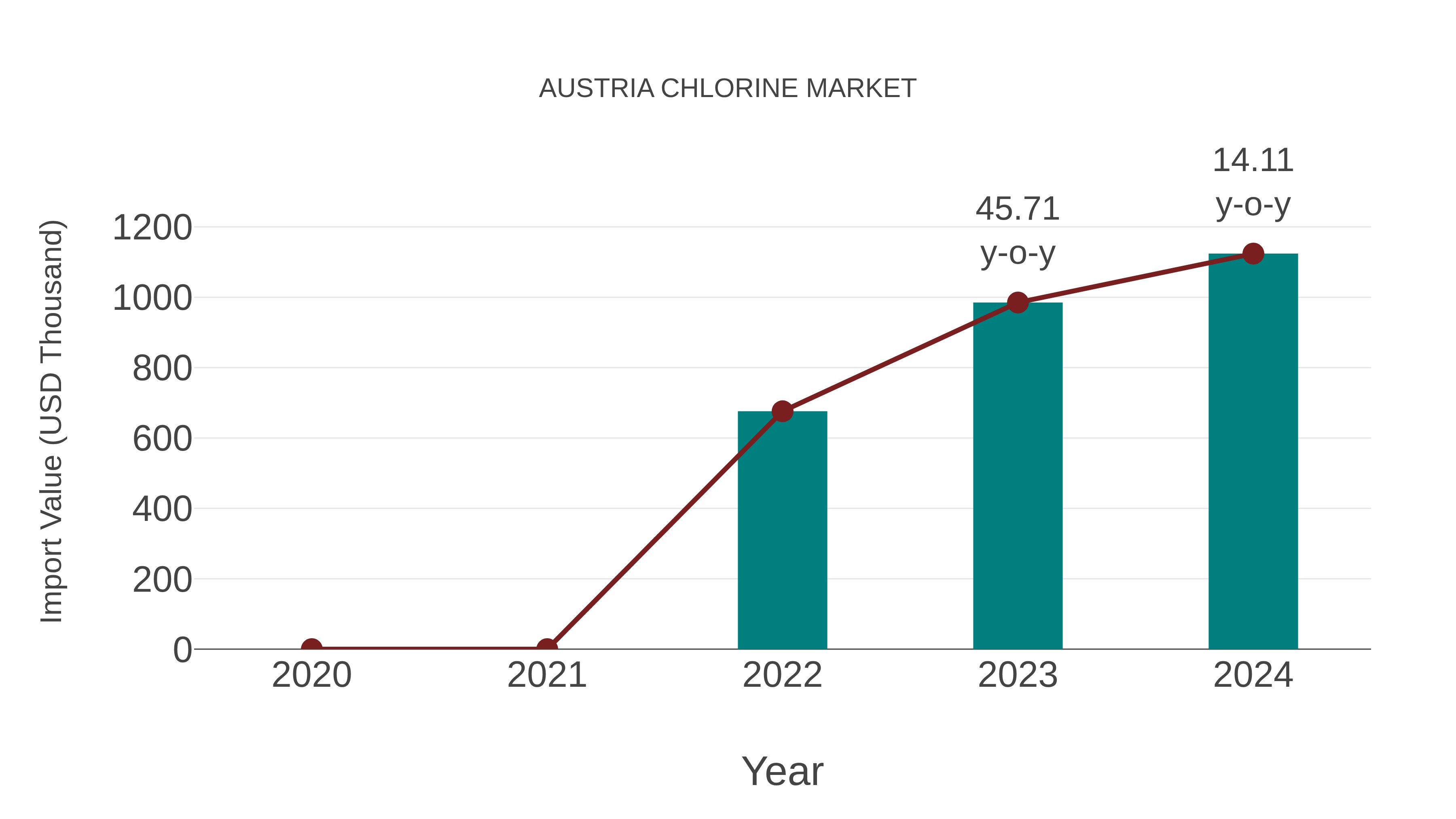
In the Austria chlorine market, the import trend showed significant growth, with a 14.11% increase from 2023 to 2024. The compound annual growth rate (CAGR) for imports from 2020 to 2024 stood at 28.95%. This growth can be attributed to a notable demand shift towards chlorine-based products in various industries, driving import momentum in the market.
Austria Chlorine Market Overview
The chlorine market in Austria supplies elemental chlorine gas and chlorine compounds used in chemical synthesis, water disinfection, and polymer manufacturing. Chlorine products play crucial roles in PVC production, bleach manufacturing, and pharmaceutical synthesis, supporting global industries with essential chemical building blocks. Key applications include chlor-alkali production, pool sanitation, and textile bleaching. Key trends include the adoption of brine electrolysis technology for chlorine production, the development of chlorine-free water treatment alternatives, and the customization of chlorine derivatives for diverse industrial and consumer applications.
Drivers of the market
Austria`s chlorine market is primarily driven by its extensive use in water treatment, disinfection, and chemical manufacturing. The demand from these sectors, coupled with regulatory requirements for safe water and sanitation, supports market growth.
Challenges of the market
The chlorine market in Austria faces challenges related to the fluctuating prices and availability of raw materials, such as salt and electricity, which are influenced by global supply and demand dynamics. Ensuring the consistent quality, performance, and safety of chlorine for various applications, such as water treatment, chemical manufacturing, and disinfection, adds complexity to the market. Additionally, competition from alternative chlorine sources and technologies impacts market demand. Regulatory compliance with safety and environmental standards also poses challenges. Manufacturers must invest in sustainable sourcing practices, quality control systems, and research and development to maintain market competitiveness and meet industrial demands for high-quality chlorine.
Government Policy of the market
Government policies in Austria for the chlorine market emphasize supporting the chemical and water treatment sectors. Financial incentives are provided for companies producing chlorine used in various applications, including disinfection and chemical production. The government promotes research into improving the safety and environmental impact of chlorine production and use, fostering innovation and supporting public health and industrial processes.
Key Highlights of the Report:
- Austria Chlorine Market Outlook
- Market Size of Austria Chlorine Market, 2025
- Forecast of Austria Chlorine Market, 2032
- Historical Data and Forecast of Austria Chlorine Revenues & Volume for the Period 2022-2032F
- Austria Chlorine Market Trend Evolution
- Austria Chlorine Market Drivers and Challenges
- Austria Chlorine Price Trends
- Austria Chlorine Porter`s Five Forces
- Austria Chlorine Industry Life Cycle
- Historical Data and Forecast of Austria Chlorine Market Revenues & Volume By Application for the Period 2022-2032F
- Historical Data and Forecast of Austria Chlorine Market Revenues & Volume By EDC/PVC for the Period 2022-2032F
- Historical Data and Forecast of Austria Chlorine Market Revenues & Volume By Isocyanates and Oxygenates for the Period 2022-2032F
- Historical Data and Forecast of Austria Chlorine Market Revenues & Volume By Chloromethanes for the Period 2022-2032F
- Historical Data and Forecast of Austria Chlorine Market Revenues & Volume By Solvents and Epichlorohydrin for the Period 2022-2032F
- Historical Data and Forecast of Austria Chlorine Market Revenues & Volume By Inorganic Chemicals for the Period 2022-2032F
- Historical Data and Forecast of Austria Chlorine Market Revenues & Volume By Other Applications for the Period 2022-2032F
- Historical Data and Forecast of Austria Chlorine Market Revenues & Volume By End-user for the Period 2022-2032F
- Historical Data and Forecast of Austria Chlorine Market Revenues & Volume By Water Treatment for the Period 2022-2032F
- Historical Data and Forecast of Austria Chlorine Market Revenues & Volume By Pharmaceutical for the Period 2022-2032F
- Historical Data and Forecast of Austria Chlorine Market Revenues & Volume By Chemicals for the Period 2022-2032F
- Historical Data and Forecast of Austria Chlorine Market Revenues & Volume By Paper and Pulp for the Period 2022-2032F
- Historical Data and Forecast of Austria Chlorine Market Revenues & Volume By Plastic for the Period 2022-2032F
- Historical Data and Forecast of Austria Chlorine Market Revenues & Volume By Pesticides for the Period 2022-2032F
- Historical Data and Forecast of Austria Chlorine Market Revenues & Volume By Other for the Period 2022-2032F
- Austria Chlorine Import Export Trade Statistics
- Market Opportunity Assessment By Application
- Market Opportunity Assessment By End-user
- Austria Chlorine Top Companies Market Share
- Austria Chlorine Competitive Benchmarking By Technical and Operational Parameters
- Austria Chlorine Company Profiles
- Austria Chlorine Key Strategic Recommendations






































