Azerbaijan Energy Saving & Fluorescent Market Summary
The azerbaijan energy saving & fluorescent market was estimated at USD 1169 Million in 2025 and is projected to reach USD 1939 Million by 2032, growing at a CAGR of 8.6% from 2026 to 2032.
Azerbaijan Energy Saving & Fluorescent Market Year-wise Growth Rate and Key Drivers
This graph highlights how the Azerbaijan Energy Saving & Fluorescent Market has steadily grown over the past five years, supported by major growth factors.
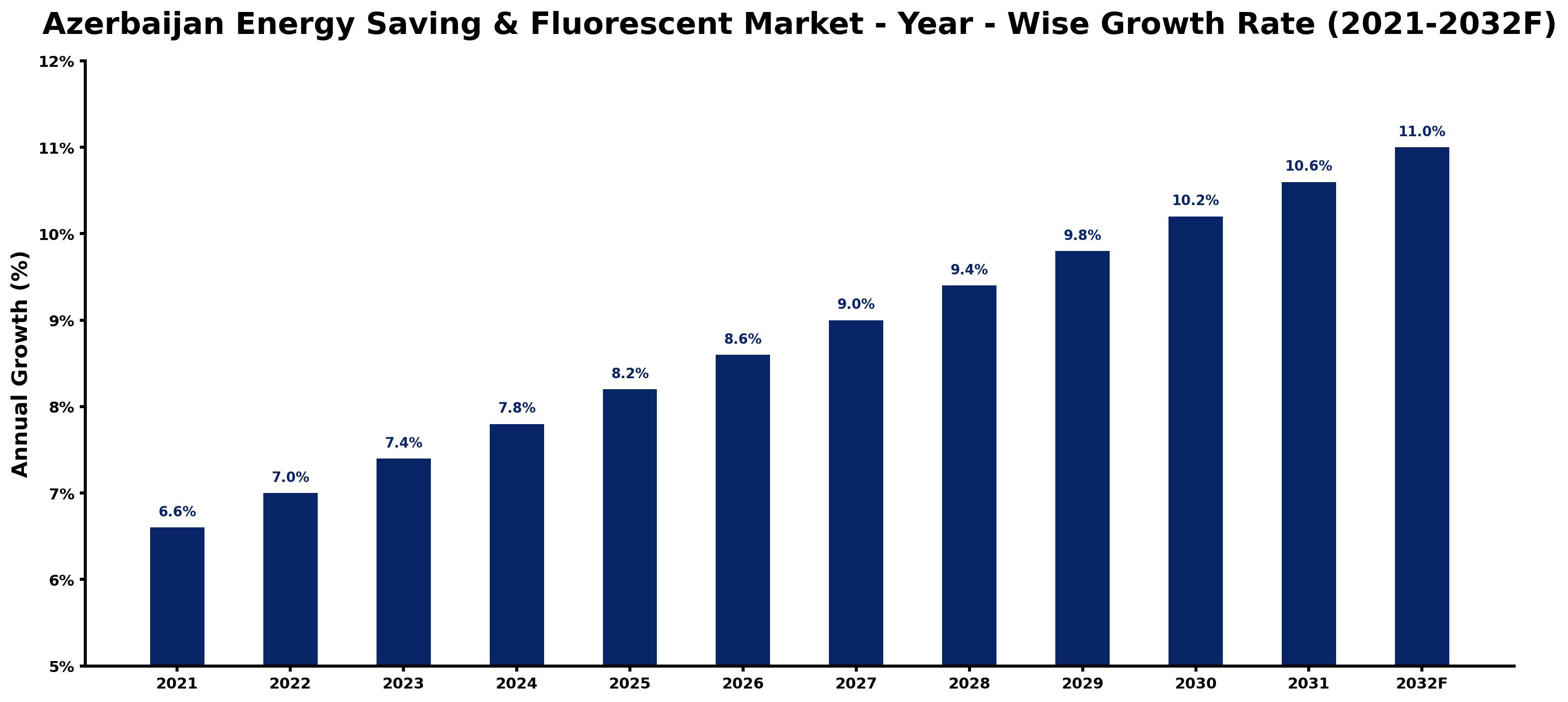
The table below presents the year wise growth rates along with the key drivers influencing the market
| Year | Growth Rate | Major Drivers |
| 2021 | 6.6% | Fluorescent technology gains traction as energy efficiency becomes a priority for businesses. |
| 2022 | 7.0% | Increased consumer awareness about energy conservation influences purchasing decisions significantly. |
| 2023 | 7.4% | Local manufacturers begin enhancing production capabilities to meet rising market demands effectively. |
| 2024 | 7.8% | Energy-efficient practices in construction lead to higher sales of fluorescent lighting solutions. |
| 2025 | 8.2% | Collaborations between manufacturers and local government streamline access to energy-saving technologies. |
| 2026 | 8.6% | Investment in renovation projects boosts the need for upgraded lighting systems nationwide. |
| 2027 | 9.0% | Emerging companies enter the market, introducing innovative energy-saving product lines. |
| 2028 | 9.4% | Warm climates necessitate efficient lighting, further pushing fluorescent technology adoption. |
| 2029 | 9.8% | Urbanization trends create expanded opportunities for energy-efficient residential developments. |
| 2030 | 10.2% | Corporate sustainability commitments compel businesses to transition toward energy-saving solutions. |
| 2031 | 10.6% | Technological advancements in fluorescent lighting enhance performance and reduce operational costs. |
| 2032 | 11.0% | Integration of smart technologies with fluorescent systems drives value for modern consumers. |
Note - Market size estimations and growth projections presented in this report are based on 6Wresearch's advanced forecasting approach, validated with industry datasets as of June 2026.
Key Highlights of the Report:
- Azerbaijan Energy Saving & Fluorescent Market Outlook
- Market Size of Azerbaijan Energy Saving & Fluorescent Market, 2025
- Forecast of Azerbaijan Energy Saving & Fluorescent Market, 2032F
- Historical Data and Forecast of Azerbaijan Energy Saving & Fluorescent Revenues & Volume for the Period 2022-2032F
- Azerbaijan Energy Saving & Fluorescent Market Trend Evolution
- Azerbaijan Energy Saving & Fluorescent Market Drivers and Challenges
- Azerbaijan Energy Saving & Fluorescent Price Trends
- Azerbaijan Energy Saving & Fluorescent Porter's Five Forces
- Azerbaijan Energy Saving & Fluorescent Industry Life Cycle
- Historical Data and Forecast of Azerbaijan Energy Saving & Fluorescent Market Revenues & Volume By Sources for the Period 2022-2032F
- Historical Data and Forecast of Azerbaijan Energy Saving & Fluorescent Market Revenues & Volume By High-Intensity Discharge Lamps (HID) for the Period 2022-2032F
- Historical Data and Forecast of Azerbaijan Energy Saving & Fluorescent Market Revenues & Volume By Linear Fluorescent Lamps (LFL) for the Period 2022-2032F
- Historical Data and Forecast of Azerbaijan Energy Saving & Fluorescent Market Revenues & Volume By Light Emitting Diodes (LED) for the Period 2022-2032F
- Historical Data and Forecast of Azerbaijan Energy Saving & Fluorescent Market Revenues & Volume By Applications for the Period 2022-2032F
- Historical Data and Forecast of Azerbaijan Energy Saving & Fluorescent Market Revenues & Volume By Commercial for the Period 2022-2032F
- Historical Data and Forecast of Azerbaijan Energy Saving & Fluorescent Market Revenues & Volume By Residential for the Period 2022-2032F
- Historical Data and Forecast of Azerbaijan Energy Saving & Fluorescent Market Revenues & Volume By Government for the Period 2022-2032F
- Azerbaijan Energy Saving & Fluorescent Import Export Trade Statistics
- Market Opportunity Assessment By Sources
- Market Opportunity Assessment By Applications
- Azerbaijan Energy Saving & Fluorescent Top Companies Market Share
- Azerbaijan Energy Saving & Fluorescent Competitive Benchmarking By Technical and Operational Parameters
- Azerbaijan Energy Saving & Fluorescent Company Profiles
- Azerbaijan Energy Saving & Fluorescent Key Strategic Recommendations






































