Azerbaijan Peat Market Size, Share & Growth Rate
The Azerbaijan Peat Market was estimated at USD 896 Million in 2025 and is projected to reach USD 1552 Million by 2032, growing at a CAGR of 8.2% from 2026 to 2032. This growth trajectory is propelled by the increasing demand for peat in agriculture, particularly due to its beneficial properties as a soil amendment. Furthermore, the shift towards sustainable farming practices and organic cultivation methods has fostered a favorable environment for the peat market, as more growers recognize the value of peat-based products.
Azerbaijan Peat Market Year-wise Growth Rate and Key Drivers
This graph highlights how the Azerbaijan Peat Market has steadily grown over the years, supported by major growth factors.
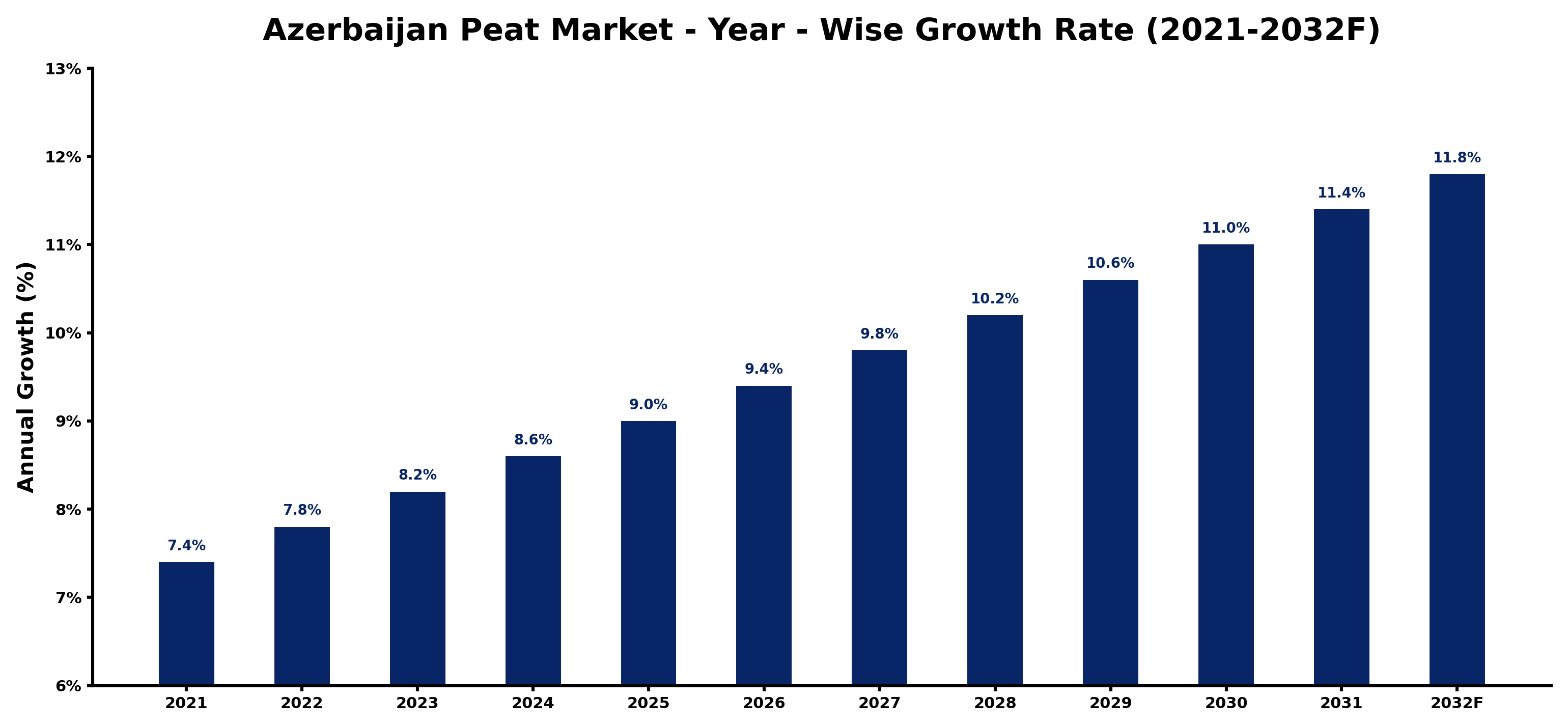
The table below presents the year‑wise growth rates along with the key drivers influencing the market
| Year | Growth Rate | Major Drivers |
| 2021 | 7.4% | Export driven horticultural sector growth boosts peat production demand |
| 2022 | 7.8% | Export driven peat processing investments enhance product quality and capacity |
| 2023 | 8.2% | Peat extraction technology advancements boosted production efficiency significantly |
| 2024 | 8.6% | New processing plants boost local peat production capacity significantly |
| 2025 | 9.0% | Advanced drying technologies enhance peat extraction efficiency and yield |
| 2026 | 9.4% | Manufacturing investments in peat extraction equipment boosted production capacity |
| 2027 | 9.8% | Peat extraction automation enhances yield and reduces labor costs |
| 2028 | 10.2% | Peat processing facility upgrades enhanced raw material extraction efficiency |
| 2029 | 10.6% | Increased fertilizer production drives demand for high quality peat supply |
| 2030 | 11.0% | Manufacturing investments in sustainable energy bolster peat extraction efficiency |
| 2031 | 11.4% | Improved construction projects boosted domestic demand for peat supplies |
| 2032 | 11.8% | Peat processing technology upgrades boost domestic energy production efficiency |
Note - Market size estimations and growth projections presented in this report are based on 6Wresearch's advanced forecasting approach, validated with industry datasets as of June 2026.
Azerbaijan Peat Market Synopsis
Recently, the Azerbaijan peat market has gained momentum, driven by rising interest from the agricultural sector and evolving consumer preferences toward eco-friendly products. However, the landscape is shifting towards sustainable extraction practices and value-added peat products, which could redefine the market's dynamics in the coming years.
As domestic production meets local needs and some companies engage in exports, the market's competitive nature continues to intensify. Nevertheless, addressing environmental concerns through effective policies will be crucial in shaping a sustainable future for the Azerbaijan peat market.
Azerbaijan Peat Market Key Takeaways
- The Azerbaijan peat market is experiencing robust growth driven by agricultural demand.
- There is a notable shift towards sustainable harvesting practices among local producers.
- Investment opportunities abound in innovative peat-based products and technologies.
- Government regulations aim to balance peat extraction with environmental conservation efforts.
- Education and awareness initiatives are essential to boost market penetration and consumer acceptance.
Evaluation of Restraints in Azerbaijan Peat Market
Despite its promising outlook, the Azerbaijan peat market grapples with significant constraints. Limited availability of peat resources, primarily due to stringent environmental regulations, hampers production capabilities. Furthermore, competition from alternative energy sources, such as natural gas and renewables, poses a threat to peat's market share. Infrastructure challenges related to extraction and processing also hinder the sector's growth potential, while a general lack of public awareness about peat's benefits complicates market expansion efforts. Addressing these issues requires a focused strategy combining sustainable management practices with increased public education and robust infrastructure investment.
Azerbaijan Peat Market Trends
Current trends in the Azerbaijan peat market highlight a growing preference for sustainable peat extraction techniques aimed at minimizing environmental impact. Additionally, there is a rise in demand for value-added peat products such as peat-based fertilizers and soil conditioners. These trends reflect the agriculture sector's increasing recognition of peat's role in enhancing soil quality and crop productivity. Alongside this, heightened investments in research and development are paving the way for innovative applications of peat in various industries, signaling a bright future for the market.
Azerbaijan Peat Market Opportunities
The Azerbaijan peat market presents several lucrative investment opportunities fueled by the country's rich peat reserves. Potential growth areas include peat extraction operations and the development of peat-derived products, like sustainable fuels and horticultural substrates. Partnerships with local agricultural entities to promote sustainable management practices are also on the rise. With the increasing global shift towards renewable resources, investments in advanced extraction technologies and eco-friendly products stand to yield significant returns, positioning investors favorably within this emerging market.
Government Initiatives in the Azerbaijan Peat Market
The Azerbaijani government is proactively fostering a regulatory framework that emphasizes sustainable peat extraction practices and environmental protection. Policies have been established to limit extraction in ecologically sensitive areas and to mandate restoration activities post-extraction. Additionally, the government is investing in research initiatives aimed at finding alternative materials to peat, which not only supports conservation efforts but also helps ensure that the peat industry remains viable in a changing environmental landscape. Through these initiatives, the government aims to harmonize economic development with environmental stewardship.
Future Insights of the Azerbaijan Peat Market
Looking ahead to 2026-2032, the Azerbaijan peat market appears well-positioned for steady growth. The anticipated rise in demand for peat as a renewable energy source, coupled with an increasing emphasis on organic farming practices, will likely drive market expansion. Continued government support for sustainable practices and investment in peat extraction technologies will further bolster this growth. Nevertheless, industry stakeholders must remain vigilant of environmental concerns and the ongoing competition from alternative fuels, which could impact the market's evolution.
Azerbaijan Peat Market Latest Developments (May 2025 - June 2026)
Recent developments in the Azerbaijan peat market illustrate a trend towards more sustainable practices and product innovation. Local producers are increasingly adopting advanced techniques for peat extraction that align with environmental standards, ensuring that operations minimize ecological disruption. Additionally, research initiatives focusing on enhancing the quality and utility of peat products are gaining traction, with collaborations emerging between private sectors and educational institutions to drive innovation. This proactive approach indicates a commitment to both market growth and ecological responsibility.
Azerbaijan Peat Market - Key Attractiveness of the Report
- 10 Years of Market Numbers
- Historical Data Starting from 2022 to 2025
- Base Year: 2025
- Forecast Data until 2032
- Key Performance Indicators Impacting the Market
- Major Upcoming Developments and Projects
Key Highlights of the Report:
- Azerbaijan Peat Market Outlook
- Market Size of Azerbaijan Peat Market, 2025
- Forecast of Azerbaijan Peat Market, 2032
- Historical Data and Forecast of Azerbaijan Peat Revenues & Volume for the Period 2022-2032F
- Azerbaijan Peat Market Trend Evolution
- Azerbaijan Peat Market Drivers and Challenges
- Azerbaijan Peat Price Trends
- Azerbaijan Peat Porter's Five Forces
- Azerbaijan Peat Industry Life Cycle
- Historical Data and Forecast of Azerbaijan Peat Market Revenues & Volume By Type for the Period 2022-2032F
- Historical Data and Forecast of Azerbaijan Peat Market Revenues & Volume By Coco Peat for the Period 2022-2032F
- Historical Data and Forecast of Azerbaijan Peat Market Revenues & Volume By Sod Peat for the Period 2022-2032F
- Historical Data and Forecast of Azerbaijan Peat Market Revenues & Volume By Other for the Period 2022-2032F
- Historical Data and Forecast of Azerbaijan Peat Market Revenues & Volume By Material Type for the Period 2022-2032F
- Historical Data and Forecast of Azerbaijan Peat Market Revenues & Volume By Fibric for the Period 2022-2032F
- Historical Data and Forecast of Azerbaijan Peat Market Revenues & Volume By Hemic for the Period 2022-2032F
- Historical Data and Forecast of Azerbaijan Peat Market Revenues & Volume By Sapric for the Period 2022-2032F
- Historical Data and Forecast of Azerbaijan Peat Market Revenues & Volume By Others for the Period 2022-2032F
- Historical Data and Forecast of Azerbaijan Peat Market Revenues & Volume By Application for the Period 2022-2032F
- Historical Data and Forecast of Azerbaijan Peat Market Revenues & Volume By Agriculture for the Period 2022-2032F
- Historical Data and Forecast of Azerbaijan Peat Market Revenues & Volume By Fuel & Energy for the Period 2022-2032F
- Historical Data and Forecast of Azerbaijan Peat Market Revenues & Volume By Others for the Period 2022-2032F
- Azerbaijan Peat Import Export Trade Statistics
- Market Opportunity Assessment By Type
- Market Opportunity Assessment By Material Type
- Market Opportunity Assessment By Application
- Azerbaijan Peat Top Companies Market Share
- Azerbaijan Peat Competitive Benchmarking By Technical and Operational Parameters
- Azerbaijan Peat Company Profiles
- Azerbaijan Peat Key Strategic Recommendations






































