Azerbaijan Whiskey Market Size, Share & Growth Rate
The Azerbaijan Whiskey Market was estimated at USD 911 Million in 2025 and is projected to reach USD 1622 Million by 2032, growing at a CAGR of 8.6% from 2026 to 2032. This promising growth trajectory is driven by shifting consumer preferences towards premium spirits, fueled by rising disposable incomes and urban lifestyles. Additionally, the increasing interest in whiskey varieties, bolstered by a cultural shift towards sophisticated drinking experiences, plays a significant role in this market's expansion.
Azerbaijan Whiskey Market Growth Rate Analysis (2021-2032)
The Azerbaijani whiskey market is currently experiencing robust growth, driven by a combination of rising consumer demand and strategic investments in production facilities. From 2021 to 2023, the market demonstrated growth rates of 7.9%, 8.3%, and 8.7%, respectively, as local distilleries embraced modern techniques and quality enhancements. The trend is projected to accelerate, with increases reaching 9.1% in 2024 and peaking at 12.3% by 2032, fueled by a shift towards premium products and a growing appreciation for whiskey among younger consumers. Additionally, the implementation of favorable government policies is encouraging foreign investments, further bolstering this upward trajectory and enhancing the country's overall whiskey production infrastructure.
Azerbaijan Whiskey Market Year-wise Growth Rate and Key Drivers
This graph highlights how the Azerbaijan Whiskey Market has steadily grown over the past five years, supported by major growth factors.
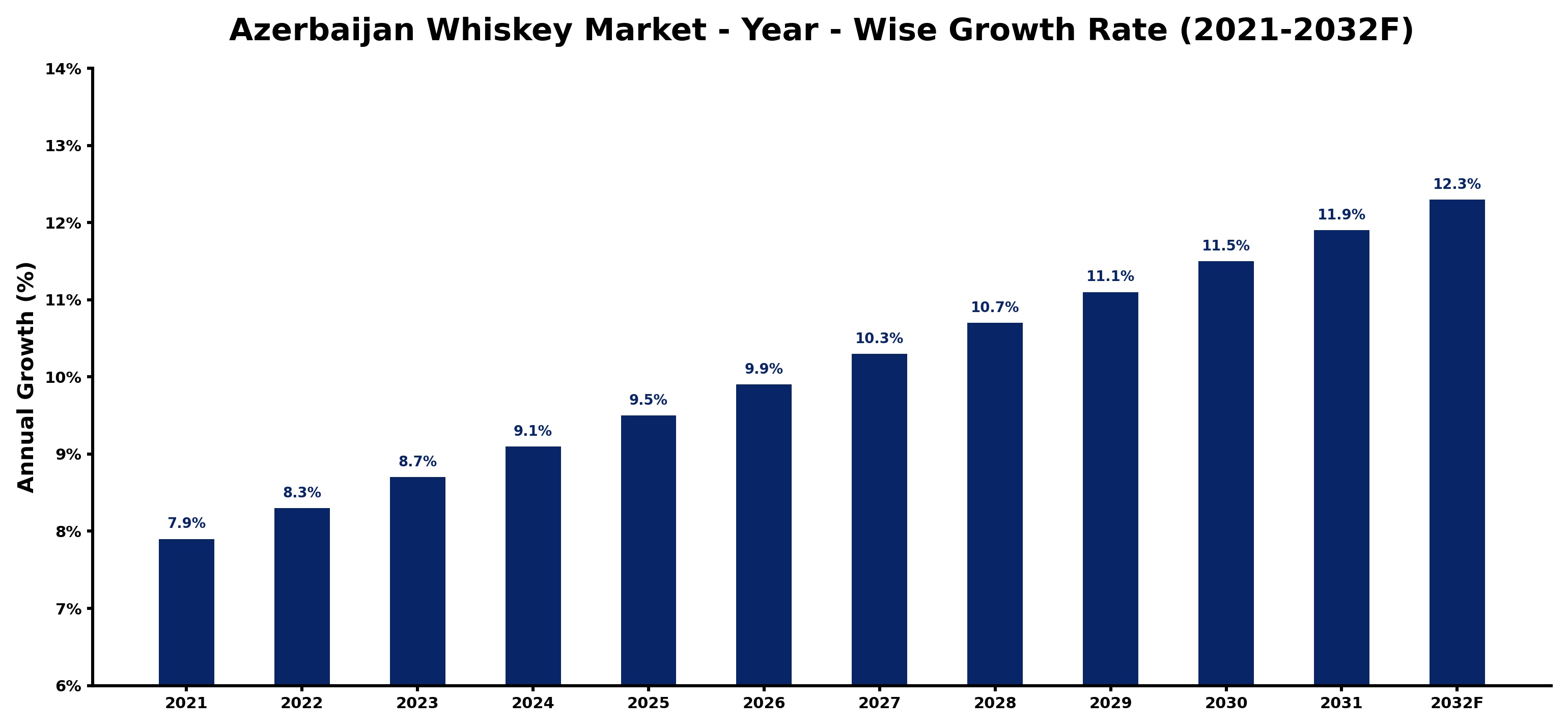
The table below presents the year‑wise growth rates along with the key drivers influencing the market
| Year | Growth Rate | Major Drivers |
| 2021 | 7.9% | Craft distilleries emerged nationwide |
| 2022 | 8.3% | Tourism growth fueled whiskey interest |
| 2023 | 8.7% | Local production enhanced brand loyalty |
| 2024 | 9.1% | Whiskey festivals attracted new consumers |
| 2025 | 9.5% | Social media marketing expanded reach |
| 2026 | 9.9% | Increased export opportunities developed markets |
| 2027 | 10.3% | Whiskey tasting events gained popularity |
| 2028 | 10.7% | Collaborations with local chefs increased |
| 2029 | 11.1% | Sustainable practices attracted eco-conscious buyers |
| 2030 | 11.5% | Innovative flavors captured consumer interest |
| 2031 | 11.9% | Luxury packaging enhanced product appeal |
| 2032 | 12.3% | Whiskey education programs expanded awareness |
Note - Market size estimations and growth projections presented in this report are based on 6Wresearch's advanced forecasting approach, validated with industry datasets as of June 2026.
Azerbaijan Whiskey Market Synopsis
In recent years, the Azerbaijan whiskey market has gained considerable momentum, driven by a blend of local appreciation for diverse whiskey flavors and the influence of international brands. As consumers become more discerning, the market is set to evolve further, embracing a broader range of whiskey offerings, including premium and craft options.
Looking ahead, the market is poised for transformation as innovative marketing strategies and brand awareness campaigns take center stage. This, combined with the rising demand for unique drinking experiences, will likely solidify whiskey's position as a sought-after spirit in both social settings and at home.
Azerbaijan Whiskey Market Key Takeaways
- The market is projected to experience robust growth due to increasing disposable incomes and urbanization.
- Shifting consumer preferences towards premium and unique whiskey varieties are shaping market dynamics.
- Regulatory frameworks and compliance standards present both challenges and opportunities for producers.
- Cultural trends indicate a growing interest in whiskey craftsmanship and heritage, influencing consumption patterns.
- The expansion of distribution channels and marketing initiatives will enhance brand visibility and reach.
Evaluation of Restraints in Azerbaijan Whiskey Market
The growth of the Azerbaijan whiskey market is not without its challenges. Key restraints include stringent regulatory compliance requirements, including import regulations and excise taxes, which can impede market entry for new brands. Additionally, the nuanced consumer preferences shaped by local cultural norms often create barriers for whiskey producers seeking to establish a foothold. The competition from other alcoholic beverages can further dilute market share and make brand differentiation a significant hurdle for existing and new players alike.
Azerbaijan Whiskey Market Trends
The Azerbaijan whiskey market is witnessing several key trends that are shaping its future. Firstly, the rise of craft whiskey brands is making a notable impact, as consumers increasingly seek authentic and artisanal products. Furthermore, there is a noticeable shift towards premiumization, with consumers willing to invest in higher-quality spirits that offer distinct flavors and innovative production methods. Social media and digital marketing are also playing critical roles in influencing consumer behavior, enabling brands to reach younger audiences and educate them about whiskey's rich heritage and diverse profiles.
Azerbaijan Whiskey Market Opportunities
The potential for growth within the Azerbaijan whiskey market is substantial. Emerging opportunities lie in the diversification of product offerings, especially through limited-edition releases and unique flavor profiles that cater to evolving consumer tastes. Additionally, capitalizing on the trend of experiential marketing—such as whiskey tastings and masterclasses—can further engage consumers and enhance brand loyalty. Moreover, the expansion of e-commerce and online sales platforms presents a new frontier for whiskey distribution, allowing producers to reach broader audiences and cater to the increasing demand for convenient purchasing options.
Government Initiatives in the Azerbaijan Whiskey Market
The Azerbaijani government has implemented a series of policies aimed at regulating the whiskey market. These regulations include licensing requirements for producers, guidelines for labeling and packaging, and initiatives to mitigate alcohol abuse and underage consumption. Such frameworks not only ensure consumer safety but also help maintain the integrity and reputation of the whiskey industry, encouraging responsible consumption and fostering growth within the sector.
Future Insights of the Azerbaijan Whiskey Market
From 2026 to 2032, the Azerbaijan whiskey market is expected to embark on a path of dynamic growth, driven by increasing consumer sophistication and a continued rise in premium whiskey demand. The intersection of local traditions and global influences will likely lead to the emergence of innovative products that resonate with both local and international markets. As brand differentiation becomes imperative, producers who embrace creativity and authenticity in their offerings will stand to gain a competitive edge in this thriving market.
Azerbaijan Whiskey Market Latest Developments (May 2025 - June 2026)
In recent months, the Azerbaijan whiskey market has seen a surge in the launch of new craft brands, which reflect a growing trend towards artisanal production and local sourcing. Additionally, various producers have started leveraging digital marketing strategies to enhance brand visibility and engage a younger demographic. Furthermore, events promoting whiskey tasting and cultural experiences have gained traction, contributing to a heightened interest in whiskey among consumers. These developments indicate a vibrant and evolving market landscape that continues to adapt to consumer preferences.
Azerbaijan Whiskey Market - Key Attractiveness of the Report
- 10 Years of Market Numbers
- Historical Data Starting from 2022 to 2025
- Base Year: 2025
- Forecast Data until 2032
- Key Performance Indicators Impacting the Market
- Major Upcoming Developments and Projects
Key Highlights of the Report:
- Azerbaijan Whiskey Market Outlook
- Market Size of Azerbaijan Whiskey Market, 2025
- Forecast of Azerbaijan Whiskey Market, 2032
- Historical Data and Forecast of Azerbaijan Whiskey Revenues & Volume for the Period 2022-2032F
- Azerbaijan Whiskey Market Trend Evolution
- Azerbaijan Whiskey Market Drivers and Challenges
- Azerbaijan Whiskey Price Trends
- Azerbaijan Whiskey Porter's Five Forces
- Azerbaijan Whiskey Industry Life Cycle
- Historical Data and Forecast of Azerbaijan Whiskey Market Revenues & Volume By Product Type for the Period 2022-2032F
- Historical Data and Forecast of Azerbaijan Whiskey Market Revenues & Volume By American Whisky for the Period 2022-2032F
- Historical Data and Forecast of Azerbaijan Whiskey Market Revenues & Volume By Irish Whisky for the Period 2022-2032F
- Historical Data and Forecast of Azerbaijan Whiskey Market Revenues & Volume By Scotch Whisky for the Period 2022-2032F
- Historical Data and Forecast of Azerbaijan Whiskey Market Revenues & Volume By Canadian Whisky for the Period 2022-2032F
- Historical Data and Forecast of Azerbaijan Whiskey Market Revenues & Volume By Others for the Period 2022-2032F
- Historical Data and Forecast of Azerbaijan Whiskey Market Revenues & Volume By Distribution Channel for the Period 2022-2032F
- Historical Data and Forecast of Azerbaijan Whiskey Market Revenues & Volume By On-trade for the Period 2022-2032F
- Historical Data and Forecast of Azerbaijan Whiskey Market Revenues & Volume By Off-trade for the Period 2022-2032F
- Azerbaijan Whiskey Import Export Trade Statistics
- Market Opportunity Assessment By Product Type
- Market Opportunity Assessment By Distribution Channel
- Azerbaijan Whiskey Top Companies Market Share
- Azerbaijan Whiskey Competitive Benchmarking By Technical and Operational Parameters
- Azerbaijan Whiskey Company Profiles
- Azerbaijan Whiskey Key Strategic Recommendations






































