Bahrain AI in Telecommunication Market Size & Growth Rate (2026-2032)
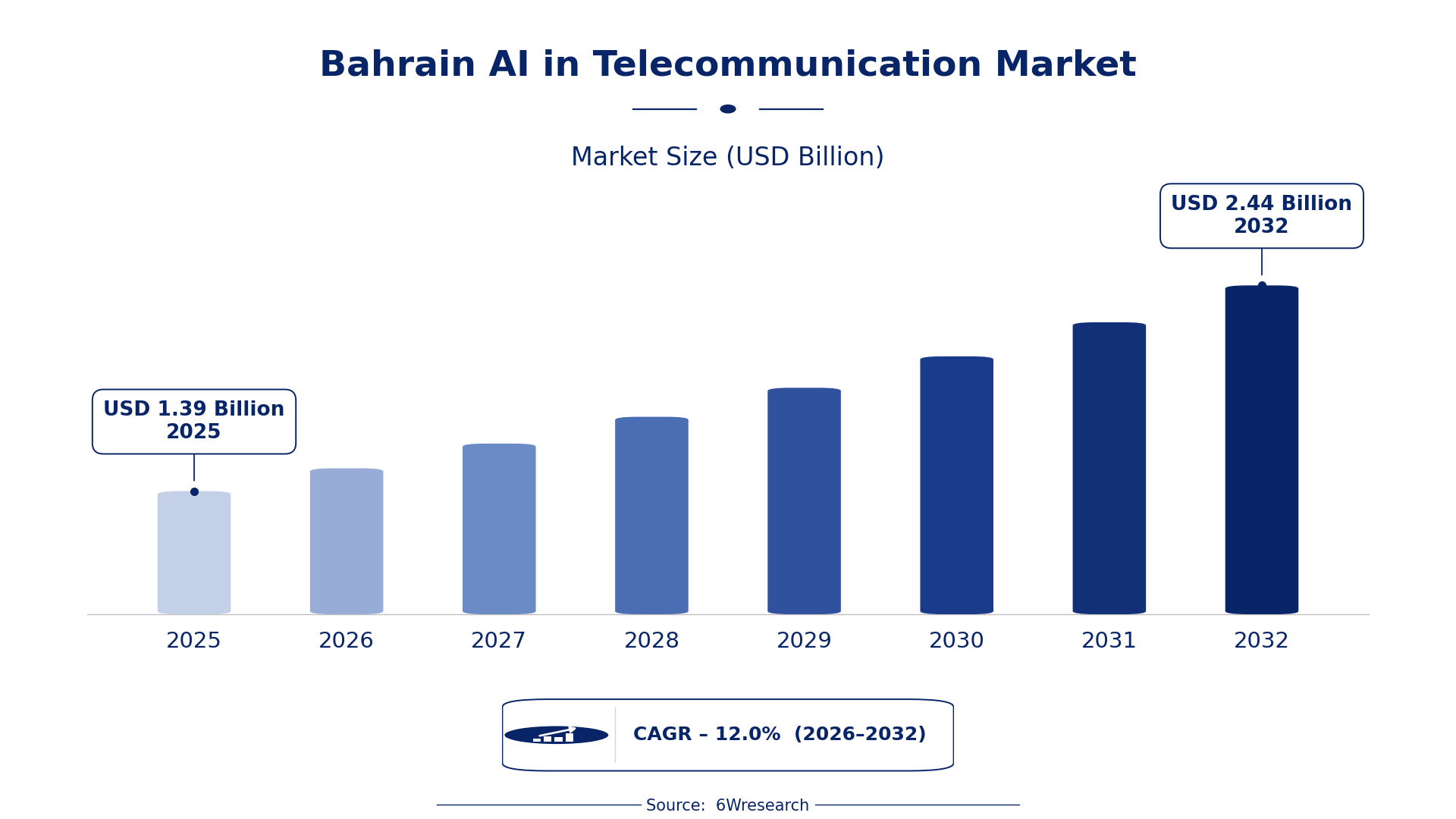
The Bahrain AI in Telecommunication Market was estimated at USD 1394 Million in 2025 and is projected to reach USD 2442 Million by 2032, growing at a CAGR of 12.0% from 2026 to 2032.
Bahrain AI in Telecommunication Market Synopsis
In Bahrain, the integration of AI technologies into the telecommunications sector is rapidly reshaping operational efficiencies. This transformation is driven by the need for telecom operators to optimize network management, enhance customer engagement, and minimize downtime through predictive maintenance.
AI applications, including intelligent chatbots and machine learning algorithms, are currently revolutionizing customer support and operational workflows. As telecom networks grow increasingly intricate, the demand for real-time data analytics and automation continues to rise, further driving adoption among service providers.
Bahrain AI in Telecommunication Market Year-wise Growth Rate and Key Drivers
This graph illustrates the annual growth rates of the Bahrain AI in Telecommunication Market from 2021 to 2032, highlighting a steady upward trajectory and projected expansion over the forecast period.
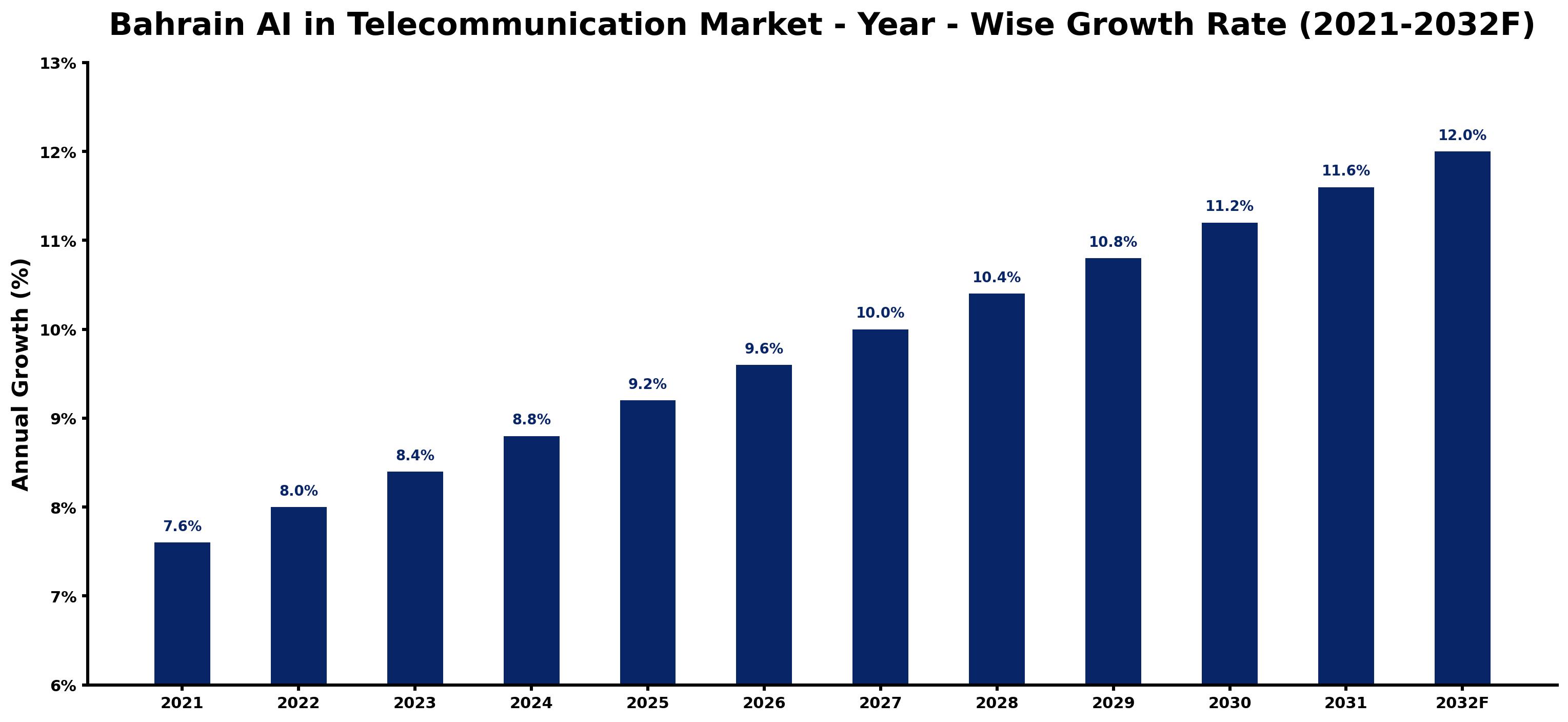
The table below presents the year‑wise growth rates along with the key drivers influencing the market
| Year | Growth Rate | Major Drivers |
| 2021 | 7.6% | Bahrain's 5G rollout enhances AI communication technologies. |
| 2022 | 8.0% | Telecom regulator supports AI adoption through new frameworks. |
| 2023 | 8.4% | Increased mobile penetration accelerates AI service demand. |
| 2024 | 8.8% | Government initiatives promote AI innovation in telecommunications. |
| 2025 | 9.2% | Local startups leverage AI for enhanced customer service. |
| 2026 | 9.6% | Partnerships with tech giants enhance AI capabilities locally. |
| 2027 | 10.0% | Rising investments in AI-driven telecom solutions. |
| 2028 | 10.4% | Demand for smart applications drives AI telecom advancements. |
| 2029 | 10.8% | AI enhances network optimization for Bahrain's telecom sector. |
| 2030 | 11.2% | Regulatory incentives boost AI project funding in telecommunications. |
| 2031 | 11.6% | Increased consumer demand for personalized AI services. |
| 2032 | 12.0% | Growth in IoT spurs advanced AI telecommunications integration. |
Note: Market size estimations and growth projections presented in this report are based on 6Wresearch's proprietary forecasting methodology, utilizing the latest available industry data, government publications, and primary research inputs.
Bahrain AI in Telecommunication Market Key Takeaways
Below are some of the specific key takeaways from the market, including:
- AI is a crucial component for network optimization, enhancing both mobile and broadband services.
- Telecom operators are increasingly utilizing AI for predictive maintenance and traffic management.
- Investment opportunities abound in AI-driven platforms and cloud-based infrastructure.
- The government actively supports AI integration through strategic policies and innovation incentives.
- Market growth is backed by a strong push for digital transformation and smart technology adoption.
Evaluation of Restraints in Bahrain AI in Telecommunication Market
Despite the promising outlook for AI in Bahrain’s telecommunications sector, several challenges persist. The high initial costs associated with deploying AI systems pose a significant barrier for many operators. Justifying the return on investment can be daunting when immediate benefits may not be apparent.
A shortage of qualified professionals capable of implementing and maintaining AI technologies further exacerbates this issue. Additionally, the regulatory landscape remains in flux, creating uncertainty regarding future AI applications. Compounding these factors, the integration of new AI systems with existing legacy technologies continues to complicate the deployment process.
Bahrain AI in Telecommunication Market Trends
The current trends in the Bahrain AI in Telecommunication Market highlight a significant push towards automation and enhanced customer service. Operators are increasingly investing in AI-powered chatbots and virtual assistants, which streamline customer interactions and reduce response times.
Machine learning algorithms are being deployed for fault detection, aiding in faster problem resolution and improved network reliability. As telecom companies prioritize efficiency and customer satisfaction, AI technologies are becoming an integral part of their operational strategies.
Bahrain AI in Telecommunication Market Opportunities
Bahrain's commitment to digital innovation presents numerous avenues for growth in the AI in Telecommunication Market. Operators looking to boost operational efficiency can harness AI for predictive analytics and maintenance scheduling, which optimizes resource allocation.
Furthermore, there is a growing demand for AI-enhanced platforms that improve customer experiences through personalized services. As providers strive to differentiate themselves in a competitive market, AI technologies will play a vital role in shaping their strategies moving forward.
Government Initiatives in the Bahrain AI in Telecommunication Market
Bahrain’s government is committed to fostering an environment conducive to the growth of AI within telecommunications. Policies that promote innovation and ethical AI use are crucial to support the sector's modernization. As regulatory frameworks evolve, they are increasingly focusing on leveraging AI for better customer service and operational excellence.
- A national digital infrastructure upgrade program launched to enhance connectivity and support AI applications.
- Currently underway is an initiative to develop AI talent within the telecom sector through partnerships with educational institutions.
- A regulatory framework introduced in 2025 promoting ethical AI use, emphasizing data protection compliance.
- Investment incentives for telecom companies focusing on AI-powered technologies, intended to spur further development.
- Future plans include a public-private collaboration expected to drive telecom infrastructure accessibility by 2028.
Future Insights of the Bahrain AI in Telecommunication Market
Looking ahead to 2026-2032, Bahrain’s AI in Telecommunication Market is on a trajectory of exponential growth. The increasing complexity of telecom networks necessitates more advanced AI solutions for optimization and maintenance. As telecom providers continue to prioritize operational efficiency and enhanced customer experiences, AI technologies will increasingly become central to their strategies.
By aligning with the national digital transformation agenda, the sector is set to witness innovations that will not only improve service delivery but also ensure compliance with emerging regulatory standards. The interplay between government initiatives and market demands will shape the future of AI in this vital industry.
Bahrain AI in Telecommunication Market Latest Developments
Recent developments in the Bahrain AI in Telecommunication Market reflect an active pursuit of technological advancements. Operators are increasingly implementing AI-driven solutions to enhance both customer service and operational efficiency.
- A leading regional operator rolled out an AI-driven customer service chatbot in early 2025, significantly reducing response times.
- Investment in an AI-powered predictive maintenance system began in mid-2025 and remains underway, aimed at reducing network downtime.
- A major technology vendor is set to launch a cloud-based AI infrastructure service by late 2026 to enhance data processing capabilities.
- Telecom providers have begun a collaborative initiative focused on ethical AI practices, initiated in Q1 2025 and currently ongoing.
- Plans are in place for a nationwide data analytics platform expected to start development in 2027, promoting smarter network management.
Bahrain AI in Telecommunication Market - Key Attractiveness of the Report
- 10 Years of Market Numbers
- Historical Data Starting from 2022 to 2025
- Base Year: 2025
- Forecast Data until 2032
- Key Performance Indicators Impacting the Market
- Major Upcoming Developments and Projects
The government promotes innovation through tax incentives for R&D, supports AI training programs, and implements regulations to ensure ethical AI deployment in telecom operations.
Key Highlights of the Report:
- Bahrain AI in Telecommunication Market Outlook
- Market Size of Bahrain AI in Telecommunication Market, 2025
- Forecast of Bahrain AI in Telecommunication Market, 2032
- Historical Data and Forecast of Bahrain AI in Telecommunication Revenues & Volume for the Period 2022-2032F
- Bahrain AI in Telecommunication Market Trend Evolution
- Bahrain AI in Telecommunication Market Drivers and Challenges
- Bahrain AI in Telecommunication Price Trends
- Bahrain AI in Telecommunication Porter's Five Forces
- Bahrain AI in Telecommunication Industry Life Cycle
- Historical Data and Forecast of Bahrain AI in Telecommunication Market Revenues & Volume By Application for the Period 2022-2032F
- Historical Data and Forecast of Bahrain AI in Telecommunication Market Revenues & Volume By Customer analytics for the Period 2022-2032F
- Historical Data and Forecast of Bahrain AI in Telecommunication Market Revenues & Volume By Network security for the Period 2022-2032F
- Historical Data and Forecast of Bahrain AI in Telecommunication Market Revenues & Volume By Network optimization for the Period 2022-2032F
- Historical Data and Forecast of Bahrain AI in Telecommunication Market Revenues & Volume By Self-diagnostics for the Period 2022-2032F
- Historical Data and Forecast of Bahrain AI in Telecommunication Market Revenues & Volume By Virtual assistance for the Period 2022-2032F
- Historical Data and Forecast of Bahrain AI in Telecommunication Market Revenues & Volume By Others (contact center analytics and marketing campaign analytics) for the Period 2022-2032F
- Historical Data and Forecast of Bahrain AI in Telecommunication Market Revenues & Volume By Component for the Period 2022-2032F
- Historical Data and Forecast of Bahrain AI in Telecommunication Market Revenues & Volume By Solutions for the Period 2022-2032F
- Historical Data and Forecast of Bahrain AI in Telecommunication Market Revenues & Volume By Services for the Period 2022-2032F
- Historical Data and Forecast of Bahrain AI in Telecommunication Market Revenues & Volume By Deployment Mode for the Period 2022-2032F
- Historical Data and Forecast of Bahrain AI in Telecommunication Market Revenues & Volume By Cloud for the Period 2022-2032F
- Historical Data and Forecast of Bahrain AI in Telecommunication Market Revenues & Volume By On-premises for the Period 2022-2032F
- Historical Data and Forecast of Bahrain AI in Telecommunication Market Revenues & Volume By Technology for the Period 2022-2032F
- Historical Data and Forecast of Bahrain AI in Telecommunication Market Revenues & Volume By Machine learning and deep learning for the Period 2022-2032F
- Historical Data and Forecast of Bahrain AI in Telecommunication Market Revenues & Volume By Natural Language Processing (NLP) for the Period 2022-2032F
- Bahrain AI in Telecommunication Import Export Trade Statistics
- Market Opportunity Assessment By Application
- Market Opportunity Assessment By Component
- Market Opportunity Assessment By Deployment Mode
- Market Opportunity Assessment By Technology
- Bahrain AI in Telecommunication Top Companies Market Share
- Bahrain AI in Telecommunication Competitive Benchmarking By Technical and Operational Parameters
- Bahrain AI in Telecommunication Company Profiles
- Bahrain AI in Telecommunication Key Strategic Recommendations






































