Bahrain Critical Infrastructure Protection Market Size & Growth Rate (2026-2032)
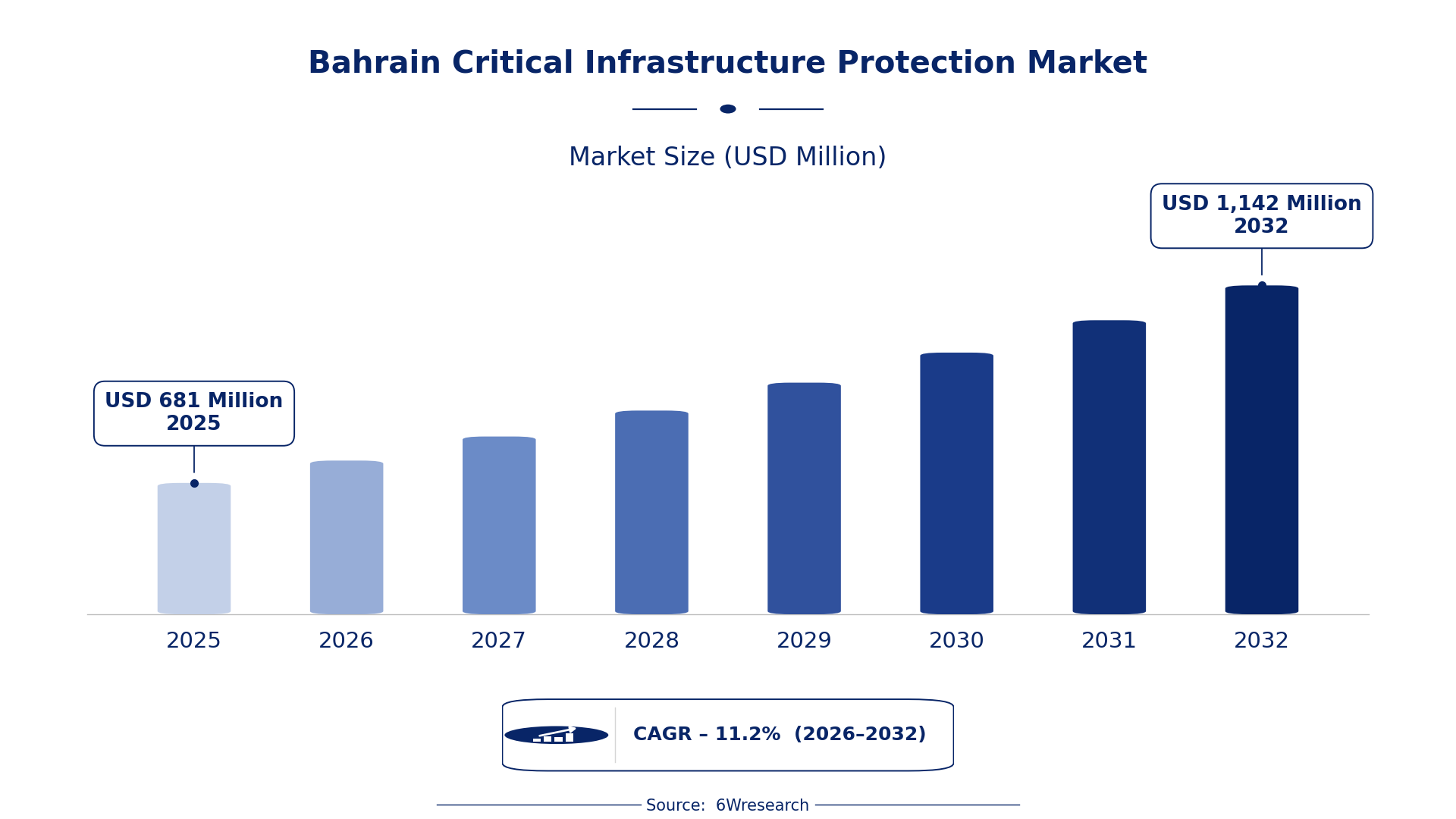
The Bahrain Critical Infrastructure Protection Market was estimated at USD 681 Million in 2025 and is projected to reach USD 1142 Million by 2032, growing at a CAGR of 11.2% from 2026 to 2032.
Bahrain Critical Infrastructure Protection Market Synopsis
Bahrain's commitment to securing critical infrastructure has gained significant momentum in recent years, driven by escalating threats and the interdependence of vital services. However, the market is set to evolve as a robust framework takes shape, integrating advanced technologies with stringent regulatory compliance.
As the nation addresses vulnerabilities across energy, water, and transportation sectors, investments in cybersecurity and incident response solutions are becoming essential. The ongoing modernization of these infrastructures indicates a shift towards more resilient systems that prioritize public safety and economic stability.
Bahrain Critical Infrastructure Protection Market Year-wise Growth Rate and Key Drivers
This graph illustrates the annual growth rates of the Bahrain Critical Infrastructure Protection Market from 2021 to 2032, highlighting a steady upward trajectory and projected expansion over the forecast period.
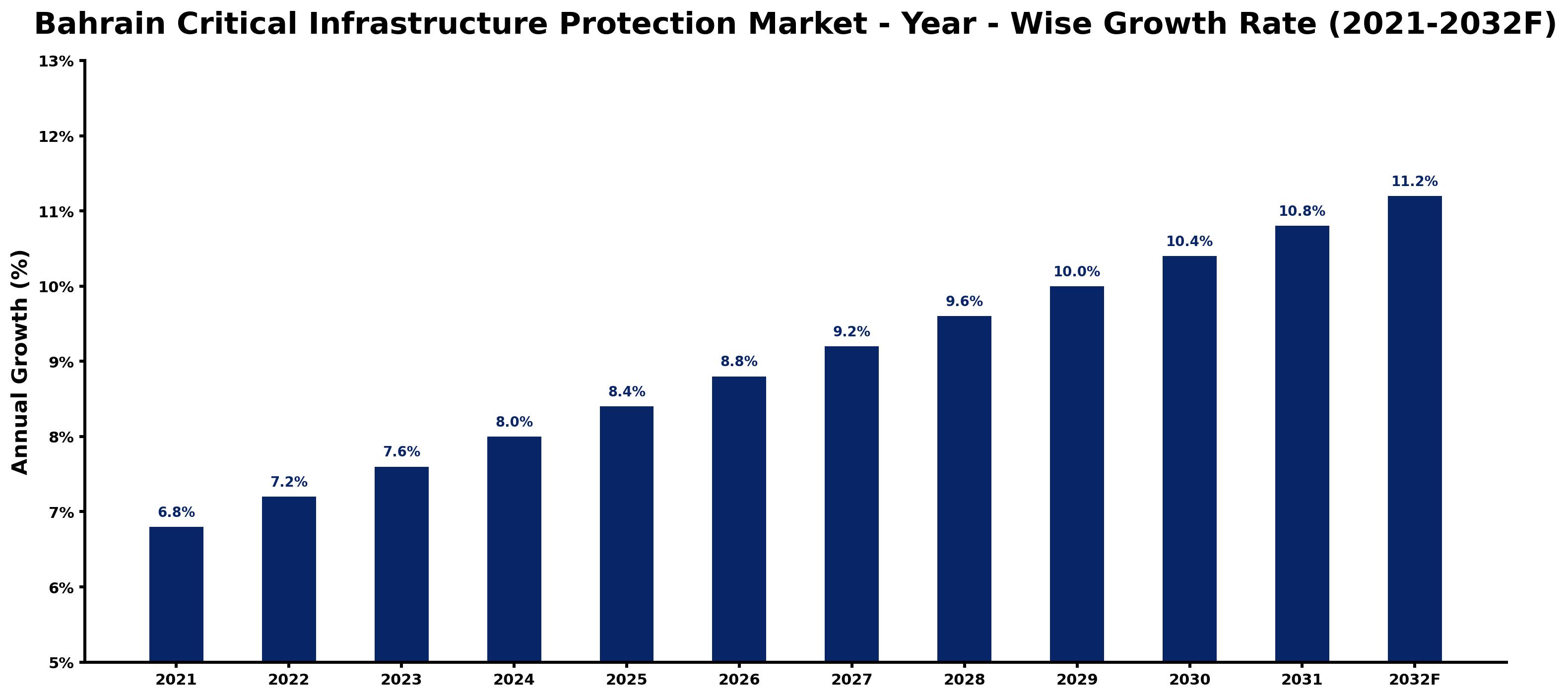
The table below presents the year‑wise growth rates along with the key drivers influencing the market
| Year | Growth Rate | Major Drivers |
| 2021 | 6.8% | Bahrain's National Cybersecurity Strategy implementation progress. |
| 2022 | 7.2% | Increased investments in national critical infrastructure resilience. |
| 2023 | 7.6% | Growing threat landscape prompting enhanced infrastructure security measures. |
| 2024 | 8.0% | Collaboration with Gulf Cooperation Council on security standards. |
| 2025 | 8.4% | Government subsidies for advanced security technology adoption. |
| 2026 | 8.8% | Bahrain Defense Force expanding infrastructure protection initiatives. |
| 2027 | 9.2% | Launch of Smart Cities program increasing security requirements. |
| 2028 | 9.6% | Boost in tourism leading to higher infrastructure security demands. |
| 2029 | 10.0% | Regional escalation of cybersecurity threats influencing policy adjustments. |
| 2030 | 10.4% | Bahrain's hosting of international events driving infrastructure upgrades. |
| 2031 | 10.8% | Strengthened public-private partnerships for critical infrastructure security. |
| 2032 | 11.2% | Increased focus on resilience against climate change impacts. |
Note: Market size estimations and growth projections presented in this report are based on 6Wresearch's proprietary forecasting methodology, utilizing the latest available industry data, government publications, and primary research inputs.
Bahrain Critical Infrastructure Protection Market Key Takeaways
Below are some of the specific key takeaways from the market, including:
- Rapid expansion fueled by increasing cyber threats to vital sectors.
- Investment in advanced monitoring and threat detection systems is on the rise.
- Integration of operational technology and information technology poses security challenges.
- Government policies are pushing for compliance and enhanced security measures.
- Growing opportunities in the IoT sector necessitate tailored cybersecurity solutions.
Evaluation of Restraints in Bahrain Critical Infrastructure Protection Market
One of the primary restraints in the Bahrain Critical Infrastructure Protection Market lies in the complexity introduced by the convergence of operational technology (OT) and information technology (IT). As systems become more interconnected, the potential for cyberattacks increases, necessitating sophisticated protection strategies that many operators struggle to implement. Resource constraints, particularly for smaller infrastructure providers, limit the capacity for robust security investments.
Additionally, compliance with national and international regulations can prove burdensome. Operators are required to meet stringent security protocols while maintaining operational efficiency, a balancing act that can hinder progress. The issue of insider threats remains a critical concern, complicating security efforts further.
Bahrain Critical Infrastructure Protection Market Trends
Current trends in the Bahrain Critical Infrastructure Protection Market highlight a shift towards advanced surveillance technologies, including AI-driven threat detection and response systems. The rising adoption of intrusion detection systems and enhanced video surveillance reflects the urgent need for comprehensive security solutions.
on top of that, as the Internet of Things (IoT) proliferates within industrial environments, there is a growing focus on safeguarding these networks against emerging cyber threats. The emphasis on integrated cybersecurity frameworks indicates a transformation in how critical infrastructure is protected across the region.
Bahrain Critical Infrastructure Protection Market Opportunities
Investment opportunities are abundant in Bahrain's critical infrastructure protection sector, particularly in areas such as SCADA systems and industrial control system security. Companies that can offer innovative solutions tailored to the unique challenges of critical infrastructure will find significant growth prospects.
As national focus intensifies on cybersecurity, the demand for real-time monitoring and incident response capabilities is set to increase. This environment creates a fertile ground for businesses aiming to provide comprehensive security solutions that address the complexities of modern threats.
Government Initiatives in the Bahrain Critical Infrastructure Protection Market
The government of Bahrain is proactive in shaping the Critical Infrastructure Protection Market through stringent security regulations and policies designed to fortify essential services. With national security at stake, the government's commitment to enhancing infrastructure resilience drives compliance and innovation.
- A national cybersecurity strategy was recently launched to bolster protective measures across critical sectors.
- Current initiatives include regular audits conducted by the National Cybersecurity Center (NCSC) to assess and enhance infrastructure resilience.
- A planned framework to promote public-private partnerships in cybersecurity initiatives is expected to roll out by mid-2026.
- Ongoing training programs for personnel in critical sectors aim to address resource constraints and enhance operational security.
- Upcoming investments in real-time threat detection systems are set to enhance operational reliability by 2028.
Future Insights of the Bahrain Critical Infrastructure Protection Market
Looking ahead to 2026-2032, the Bahrain Critical Infrastructure Protection Market is expected to see considerable growth driven by heightened awareness of vulnerabilities. With increasing investment in cybersecurity technologies, there will be a stronger emphasis on integrated systems that can adapt to evolving threats.
As global cyber threats intensify, Bahrain's focus on public safety and economic stability will propel further advancements in protection strategies, making this market an attractive avenue for investors and solution providers alike.
Bahrain Critical Infrastructure Protection Market Latest Developments
In the past year, Bahrain's Critical Infrastructure Protection Market has witnessed significant developments as stakeholders seek to reinforce their defenses against growing threats. The pace of investment in advanced technologies and security frameworks indicates a robust response to evolving challenges.
- A major initiative aimed at upgrading national SCADA systems was launched in Q1 2023, focusing on enhancing cybersecurity measures.
- Current efforts include the rollout of a real-time monitoring system designed to improve incident response capabilities across key sectors, which began in early 2023.
- An upcoming cybersecurity conference scheduled for late 2024 will focus on best practices and collaboration between public and private sectors.
- A collaborative project between government and technology vendors to enhance IoT security across critical infrastructure is underway and expected to conclude by late 2023.
- New partnerships between local utility providers and cybersecurity firms are being formed to develop tailored protective solutions, currently in development.
Bahrain Critical Infrastructure Protection Market - Key Attractiveness of the Report
- 10 Years of Market Numbers
- Historical Data Starting from 2022 to 2025
- Base Year: 2025
- Forecast Data until 2032
- Key Performance Indicators Impacting the Market
- Major Upcoming Developments and Projects
Key Highlights of the Report:
- Bahrain Critical Infrastructure Protection Market Outlook
- Market Size of Bahrain Critical Infrastructure Protection Market, 2025
- Forecast of Bahrain Critical Infrastructure Protection Market, 2032
- Historical Data and Forecast of Bahrain Critical Infrastructure Protection Revenues & Volume for the Period 2022-2032F
- Bahrain Critical Infrastructure Protection Market Trend Evolution
- Bahrain Critical Infrastructure Protection Market Drivers and Challenges
- Bahrain Critical Infrastructure Protection Price Trends
- Bahrain Critical Infrastructure Protection Porter's Five Forces
- Bahrain Critical Infrastructure Protection Industry Life Cycle
- Historical Data and Forecast of Bahrain Critical Infrastructure Protection Market Revenues & Volume By Solution for the Period 2022-2032F
- Historical Data and Forecast of Bahrain Critical Infrastructure Protection Market Revenues & Volume By Physical Safety for the Period 2022-2032F
- Historical Data and Forecast of Bahrain Critical Infrastructure Protection Market Revenues & Volume By Security Video Surveillance Systems for the Period 2022-2032F
- Historical Data and Forecast of Bahrain Critical Infrastructure Protection Market Revenues & Volume By Screening for the Period 2022-2032F
- Historical Data and Forecast of Bahrain Critical Infrastructure Protection Market Revenues & Volume By Scanning for the Period 2022-2032F
- Historical Data and Forecast of Bahrain Critical Infrastructure Protection Market Revenues & Volume By Cybersecurity for the Period 2022-2032F
- Historical Data and Forecast of Bahrain Critical Infrastructure Protection Market Revenues & Volume By Encryption for the Period 2022-2032F
- Historical Data and Forecast of Bahrain Critical Infrastructure Protection Market Revenues & Volume By Threat Intelligence for the Period 2022-2032F
- Historical Data and Forecast of Bahrain Critical Infrastructure Protection Market Revenues & Volume By Component for the Period 2022-2032F
- Historical Data and Forecast of Bahrain Critical Infrastructure Protection Market Revenues & Volume By Solution for the Period 2022-2032F
- Historical Data and Forecast of Bahrain Critical Infrastructure Protection Market Revenues & Volume By Services for the Period 2022-2032F
- Historical Data and Forecast of Bahrain Critical Infrastructure Protection Market Revenues & Volume By Vertical for the Period 2022-2032F
- Historical Data and Forecast of Bahrain Critical Infrastructure Protection Market Revenues & Volume By Financial Institutions for the Period 2022-2032F
- Historical Data and Forecast of Bahrain Critical Infrastructure Protection Market Revenues & Volume By Government for the Period 2022-2032F
- Historical Data and Forecast of Bahrain Critical Infrastructure Protection Market Revenues & Volume By Defense for the Period 2022-2032F
- Historical Data and Forecast of Bahrain Critical Infrastructure Protection Market Revenues & Volume By Transport and Logistics for the Period 2022-2032F
- Historical Data and Forecast of Bahrain Critical Infrastructure Protection Market Revenues & Volume By Energy and Power for the Period 2022-2032F
- Historical Data and Forecast of Bahrain Critical Infrastructure Protection Market Revenues & Volume By Commercial Sector for the Period 2022-2032F
- Historical Data and Forecast of Bahrain Critical Infrastructure Protection Market Revenues & Volume By Telecom for the Period 2022-2032F
- Historical Data and Forecast of Bahrain Critical Infrastructure Protection Market Revenues & Volume By Chemicals and Manufacturing for the Period 2022-2032F
- Bahrain Critical Infrastructure Protection Import Export Trade Statistics
- Market Opportunity Assessment By Solution
- Market Opportunity Assessment By Cybersecurity
- Market Opportunity Assessment By Component
- Market Opportunity Assessment By Vertical
- Bahrain Critical Infrastructure Protection Top Companies Market Share
- Bahrain Critical Infrastructure Protection Competitive Benchmarking By Technical and Operational Parameters
- Bahrain Critical Infrastructure Protection Company Profiles
- Bahrain Critical Infrastructure Protection Key Strategic Recommendations






































