Bahrain IoT Connectivity Market Size & Growth Rate (2026-2032)
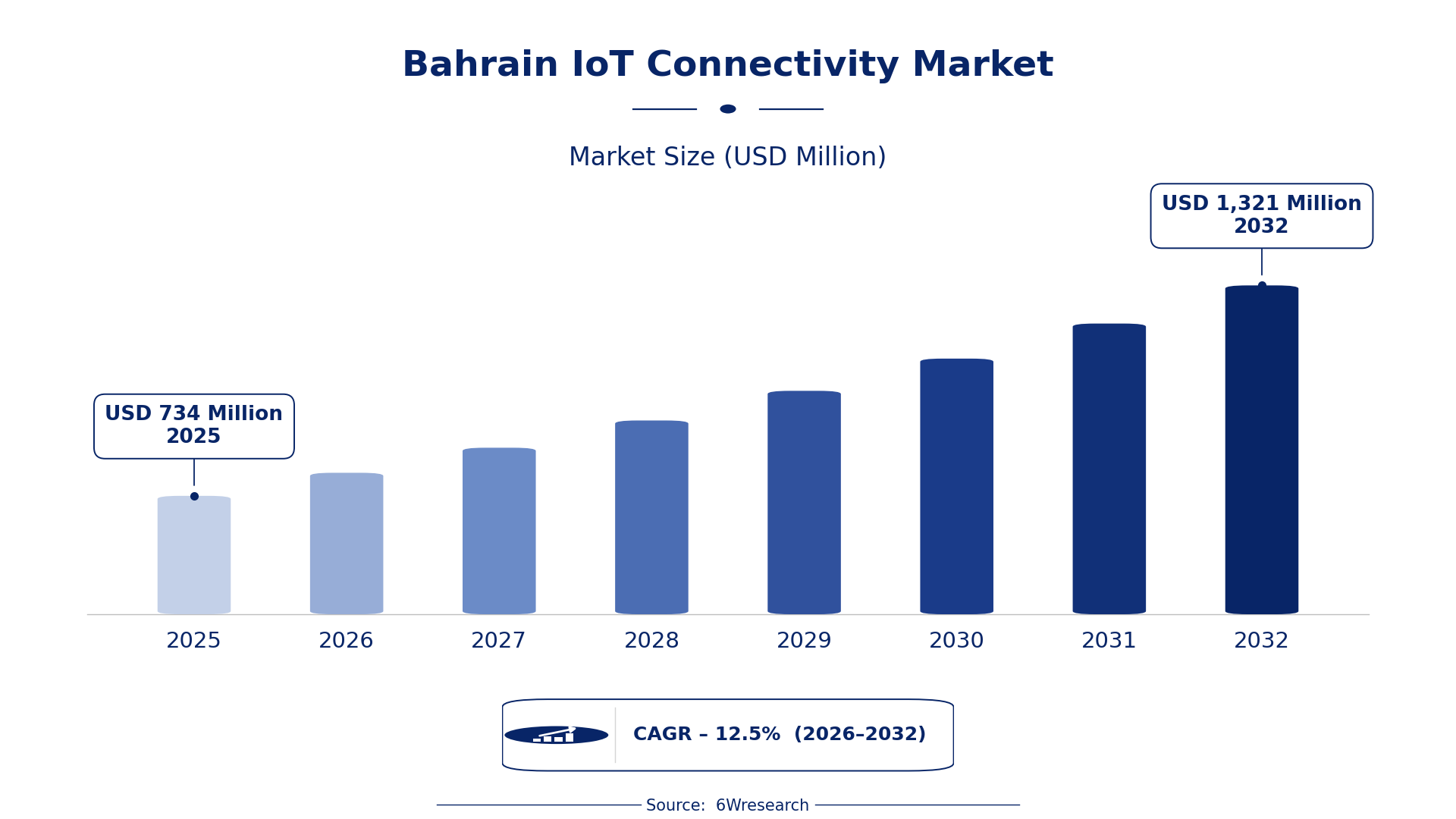
The Bahrain IoT Connectivity Market was estimated at USD 734 Million in 2025 and is projected to reach USD 1321 Million by 2032, growing at a CAGR of 12.5% from 2026 to 2032.
Bahrain IoT Connectivity Market Synopsis
The Bahrain IoT connectivity market is experiencing a surge in demand driven by the rapid adoption of IoT devices across various sectors. Industries such as healthcare, transportation, and manufacturing are increasingly relying on IoT solutions for enhanced operational efficiency and real-time analytics.
Advanced networking technologies like LPWAN, NB-IoT, and LTE-M are becoming vital enablers, providing low-power, cost-effective connectivity. The government's focus on smart city initiatives further fuels this demand, positioning Bahrain as a burgeoning hub for IoT development.
Bahrain IoT Connectivity Market Year-wise Growth Rate and Key Drivers
This graph illustrates the annual growth rates of the Bahrain IoT Connectivity Market from 2021 to 2032, highlighting a steady upward trajectory and projected expansion over the forecast period.
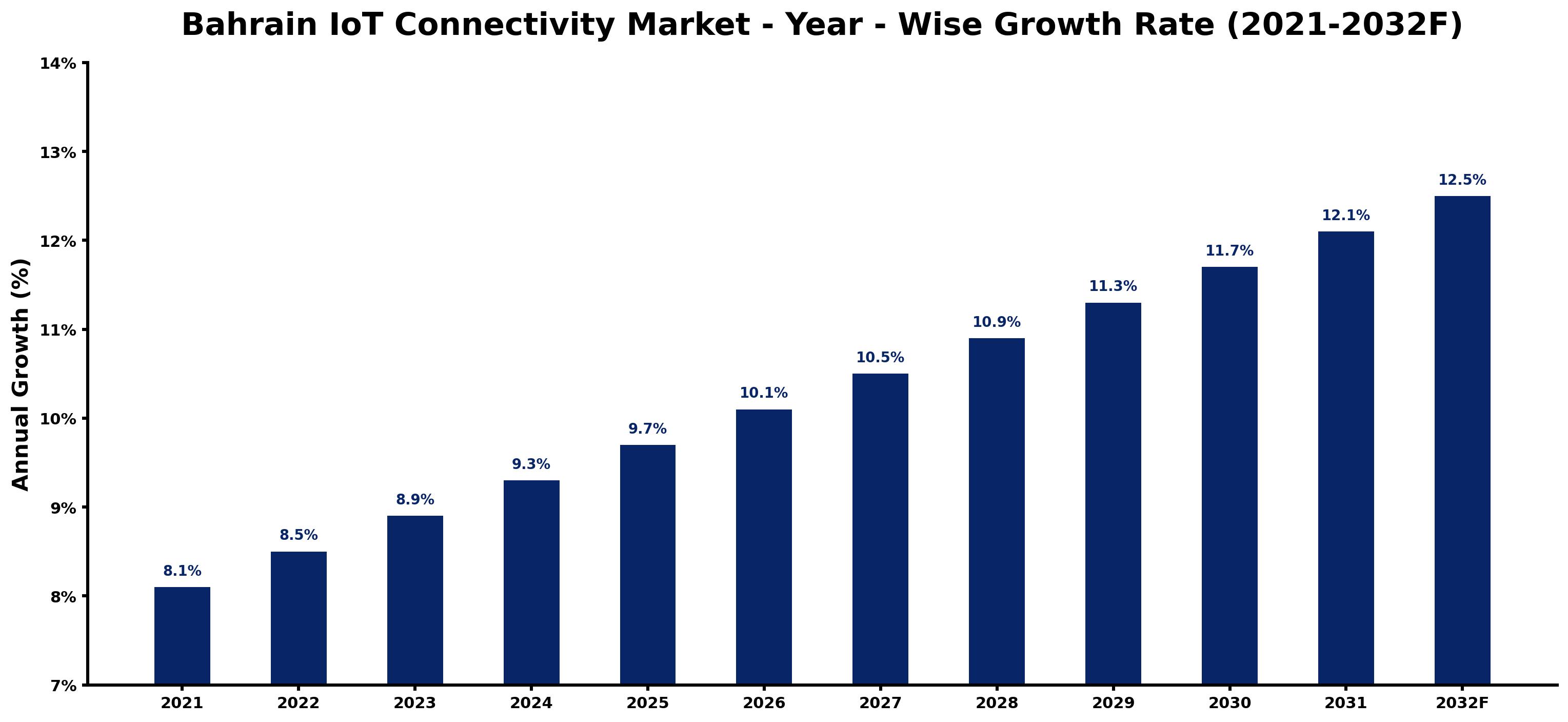
The table below presents the year‑wise growth rates along with the key drivers influencing the market
| Year | Growth Rate | Major Drivers |
| 2021 | 8.1% | Bahrain's National IoT Strategy enhancing connectivity infrastructure. |
| 2022 | 8.5% | New telecommunication regulations stimulating IoT service offerings. |
| 2023 | 8.9% | Increased investments by Batelco in 5G IoT solutions. |
| 2024 | 9.3% | Growing number of IoT startups supported by accelerators. |
| 2025 | 9.7% | Government initiatives promoting smart city pilot projects. |
| 2026 | 10.1% | Bahrain's Vision 2030 emphasizing digital transformation efforts. |
| 2027 | 10.5% | Rising consumer interest in smart wearables adoption. |
| 2028 | 10.9% | Enhancements in data security regulations encouraging IoT growth. |
| 2029 | 11.3% | Strategic partnerships between local firms and global tech leaders. |
| 2030 | 11.7% | Increased deployment of smart meters by utility companies. |
| 2031 | 12.1% | Public demand for sustainable IoT solutions boosting market. |
| 2032 | 12.5% | Bahrain's focus on improving urban mobility through IoT. |
Note: Market size estimations and growth projections presented in this report are based on 6Wresearch's proprietary forecasting methodology, utilizing the latest available industry data, government publications, and primary research inputs.
Bahrain IoT Connectivity Market Key Takeaways
Below are some of the specific key takeaways from the market, including:
- The market is set to grow from USD 734 Million in 2025 to USD 1321 Million by 2032.
- Technological advancements such as 5G will significantly enhance connectivity options.
- Government initiatives are accelerating the adoption of IoT solutions across various sectors.
- Healthcare and transportation are leading sectors driving IoT demand in Bahrain.
- Challenges in data security and network reliability require ongoing attention and innovation.
Evaluation of Restraints in Bahrain IoT Connectivity Market
Despite its growth potential, the Bahrain IoT connectivity market faces notable challenges. One of the primary restraints is the need for reliable and secure connectivity. As IoT devices proliferate, the pressure on networks to manage vast amounts of data efficiently grows. Ensuring high levels of security against cyber threats is critical, as breaches can compromise sensitive information. This dual challenge of maintaining performance while enhancing security measures remains a key concern for stakeholders.
Bahrain IoT Connectivity Market Trends
Several trends are shaping the Bahrain IoT connectivity market. The rollout of 5G networks is at the forefront, providing the speed and low latency required for advanced applications. Additionally, the growing interest in smart city projects has led to increased investment in IoT solutions across urban infrastructure.
on top of that, there is a notable shift towards integrating AI and machine learning with IoT systems, enhancing data analytics capabilities. This trend is becoming essential for industries aiming to derive actionable insights from real-time data streams.
Bahrain IoT Connectivity Market Opportunities
Opportunities for growth in the Bahrain IoT connectivity market are abundant. The increasing push for digital transformation across industries opens new avenues for IoT applications. Areas like smart healthcare, where real-time monitoring and telehealth solutions can significantly improve patient outcomes, are particularly promising.
on top of that, as the government continues to invest in infrastructure, sectors such as logistics and supply chain management can leverage IoT for enhanced tracking and inventory management, thereby optimizing operations and reducing costs.
Government Initiatives in the Bahrain IoT Connectivity Market
The Bahraini government is actively promoting the development of the IoT connectivity market through a range of initiatives aimed at enhancing digital infrastructure and connectivity. By investing in high-speed internet and supporting smart city projects, the government is creating a conducive environment for IoT innovation. Policies designed to reduce barriers for IoT service providers are also critical in this context.
- A national digital infrastructure upgrade programme recently completed, enhancing connectivity across urban areas.
- An ongoing initiative focusing on developing IoT frameworks to support smart city projects is currently underway.
- Plans for a public-private partnership aimed at expanding telecom infrastructure access are expected to be launched by 2026.
- Regulatory measures introduced to facilitate the deployment of 5G technology and other advanced networks.
Future Insights of the Bahrain IoT Connectivity Market
Looking ahead to 2026-2032, the Bahrain IoT connectivity market is expected to witness accelerated growth driven by continuous technological advancements and government support. The integration of AI and machine learning with IoT solutions will reshape how data is utilized, providing deeper insights and more efficient operations across industries.
As the demand for smart solutions grows, Bahrain's position as a technology hub will likely strengthen, attracting both local and international investments. The focus on enhancing security measures will also be paramount, as stakeholders seek to build consumer trust in IoT technologies.
Bahrain IoT Connectivity Market Latest Developments
In the past year, the Bahrain IoT connectivity market has seen significant developments that reflect its growth trajectory. Various initiatives aimed at enhancing connectivity and security have been launched, while partnerships between tech companies and local industries have gained momentum.
- A major technology vendor initiated a project to deploy NB-IoT solutions in key urban centers, expected to be completed by early 2026.
- A partnership between local authorities and telecom providers was formed to enhance smart city infrastructure, currently in the implementation phase.
- An expansion of IoT service offerings by a leading regional operator was announced in Q2 2025, focusing on the healthcare sector.
- Upcoming plans for a national IoT innovation hub are set to be revealed by the end of 2025, aimed at fostering startups in the sector.
Bahrain IoT Connectivity Market - Key Attractiveness of the Report
- 10 Years of Market Numbers
- Historical Data Starting from 2022 to 2025
- Base Year: 2025
- Forecast Data until 2032
- Key Performance Indicators Impacting the Market
- Major Upcoming Developments and Projects
Key Highlights of the Report:
- Bahrain IoT Connectivity Market Outlook
- Market Size of Bahrain IoT Connectivity Market, 2025
- Forecast of Bahrain IoT Connectivity Market, 2032
- Historical Data and Forecast of Bahrain IoT Connectivity Revenues & Volume for the Period 2022-2032F
- Bahrain IoT Connectivity Market Trend Evolution
- Bahrain IoT Connectivity Market Drivers and Challenges
- Bahrain IoT Connectivity Price Trends
- Bahrain IoT Connectivity Porter's Five Forces
- Bahrain IoT Connectivity Industry Life Cycle
- Historical Data and Forecast of Bahrain IoT Connectivity Market Revenues & Volume By Component for the Period 2022-2032F
- Historical Data and Forecast of Bahrain IoT Connectivity Market Revenues & Volume By Platform for the Period 2022-2032F
- Historical Data and Forecast of Bahrain IoT Connectivity Market Revenues & Volume By Services for the Period 2022-2032F
- Historical Data and Forecast of Bahrain IoT Connectivity Market Revenues & Volume By Application Areas for the Period 2022-2032F
- Historical Data and Forecast of Bahrain IoT Connectivity Market Revenues & Volume By Building & Home Automation for the Period 2022-2032F
- Historical Data and Forecast of Bahrain IoT Connectivity Market Revenues & Volume By Smart Energy & Utility for the Period 2022-2032F
- Historical Data and Forecast of Bahrain IoT Connectivity Market Revenues & Volume By Smart Manufacturing for the Period 2022-2032F
- Historical Data and Forecast of Bahrain IoT Connectivity Market Revenues & Volume By Connected Health for the Period 2022-2032F
- Historical Data and Forecast of Bahrain IoT Connectivity Market Revenues & Volume By Smart Retail for the Period 2022-2032F
- Historical Data and Forecast of Bahrain IoT Connectivity Market Revenues & Volume By Smart Transportation for the Period 2022-2032F
- Historical Data and Forecast of Bahrain IoT Connectivity Market Revenues & Volume By Others (Education and Agriculture) for the Period 2022-2032F
- Historical Data and Forecast of Bahrain IoT Connectivity Market Revenues & Volume By Organization Size for the Period 2022-2032F
- Historical Data and Forecast of Bahrain IoT Connectivity Market Revenues & Volume By Large Enterprises for the Period 2022-2032F
- Historical Data and Forecast of Bahrain IoT Connectivity Market Revenues & Volume By SMEs for the Period 2022-2032F
- Bahrain IoT Connectivity Import Export Trade Statistics
- Market Opportunity Assessment By Component
- Market Opportunity Assessment By Application Areas
- Market Opportunity Assessment By Organization Size
- Bahrain IoT Connectivity Top Companies Market Share
- Bahrain IoT Connectivity Competitive Benchmarking By Technical and Operational Parameters
- Bahrain IoT Connectivity Company Profiles
- Bahrain IoT Connectivity Key Strategic Recommendations






































