Bahrain Ladders Market Size, Share & Growth Rate
The Bahrain Ladders Market was estimated at USD 673 Million in 2025 and is projected to reach USD 1141 Million by 2032, growing at a CAGR of 7.8% from 2026 to 2032. This growth trajectory is spurred by a robust demand from both residential and commercial sectors, bolstered by an increasing DIY culture and stringent safety regulations in construction. The popularity of lightweight aluminum and fiberglass ladders, driven by their portability and resistance to corrosion, further enhances market potential.
Bahrain Ladders Market Year-wise Growth Rate and Key Drivers
This graph highlights how the Bahrain Ladders Market has steadily grown over the years, supported by major growth factors.
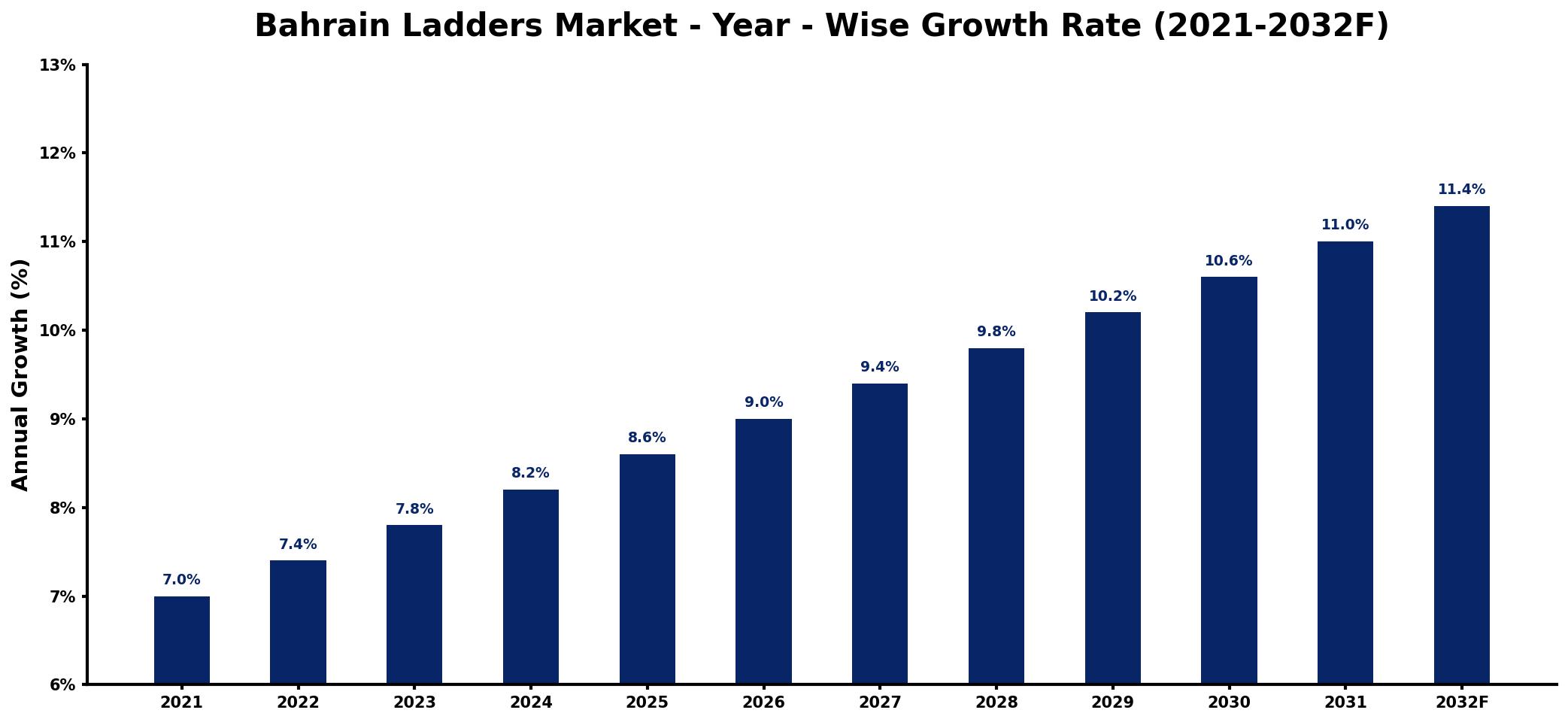
The table below presents the year‑wise growth rates along with the key drivers influencing the market
| Year | Growth Rate | Major Drivers |
| 2021 | 7.0% | Construction sector recovery initiatives |
| 2022 | 7.4% | Increased residential building projects |
| 2023 | 7.8% | Growth in infrastructure investments |
| 2024 | 8.2% | Rising demand for safety equipment |
| 2025 | 8.6% | Expansion of commercial real estate |
| 2026 | 9.0% | Surge in DIY home improvement |
| 2027 | 9.4% | Technological advancements in manufacturing |
| 2028 | 9.8% | Increase in urban population density |
| 2029 | 10.2% | Government incentives for construction |
| 2030 | 10.6% | increased domestic production output |
| 2031 | 11.0% | Rising focus on workplace safety |
| 2032 | 11.4% | growing commercial sector adoption |
Note: Market size estimations and growth projections presented in this report are based on 6Wresearch's proprietary forecasting methodology, utilizing the latest available industry data, government publications, and primary research inputs.
Bahrain Ladders Market Synopsis
The ladders market in Bahrain is characterized by a diverse customer base, including households, construction sites, and various industrial facilities. The unique demand for lightweight, non-conductive materials like aluminum and fiberglass plays a significant role in shaping purchasing preferences within the market.
A competitive landscape predominates as imports maintain a strong foothold, with customers increasingly favoring multifunctional, extendable, and folding ladder designs. This trend reflects the evolving needs of users, particularly in urban settings where space constraints are a key consideration.
Bahrain Ladders Market Key Takeaways
- The market is primarily driven by safety regulations and a rising DIY culture across both residential and commercial segments.
- Lightweight aluminum and fiberglass ladders are becoming increasingly favored for their portability and durability.
- Multifunctional ladder designs are gaining traction due to space limitations in urban environments.
- Local manufacturers face challenges from international competitors offering lower-priced alternatives.
- Investment opportunities exist for innovative ladder designs tailored to specific industry needs.
Evaluation of Restraints in Bahrain Ladders Market
While the Bahrain Ladders Market is poised for growth, it faces notable challenges. Rising material costs, particularly for aluminum and fiberglass, pose significant pressure on local manufacturers. These rising costs impact pricing strategies and profit margins, especially in a market where competition from international suppliers is fierce. Additionally, increasing safety standards demand continuous innovation, requiring investments in both production technologies and new product development, which can further strain resources.
Bahrain Ladders Market Trends
Current trends indicate a shift towards advanced ladder designs, especially those that emphasize multifunctionality and compactness. The demand for foldable and extendable ladders is rising, as urban dwellers seek solutions that maximize utility while conserving space. Furthermore, there is a growing emphasis on ergonomic designs that prioritize user safety and comfort, aligning with heightened regulatory standards.
Bahrain Ladders Market Opportunities
With the expanding commercial and industrial sectors, there are significant opportunities for the development of specialized ladder designs that cater to unique industry requirements. Innovations that align with safety compliance and urban functionality could carve out niche markets, appealing to both consumers and businesses. The integration of smart technologies in ladder designs may also present forward-looking investment opportunities as the market evolves.
Government Initiatives in the Bahrain Ladders Market
The government of Bahrain is actively supporting the ladders market through stringent safety regulations that enhance workplace safety across various sectors. These regulations necessitate the use of certified and ergonomically designed ladders, promoting a safer working environment. Public spending on infrastructure and construction projects also boosts demand in the ladder market, further underscoring the government's commitment to occupational safety and product compliance.
Future Insights of the Bahrain Ladders Market
Looking ahead, the Bahrain Ladders Market is expected to undergo substantial transformation between 2026 and 2032. With a projected market size of USD 1141 Million by 2032, the sector will likely see heightened innovation in ladder designs that address specific market needs. Increased urbanization and ongoing development within the construction industry will drive demand further, making investment in this space both lucrative and vital for stakeholders.
Bahrain Ladders Market Latest Developments (2025 - 2026)
Recent developments in the Bahrain Ladders Market have highlighted a push towards innovation and enhanced safety standards. Companies are increasingly focusing on the development of multi-purpose ladder designs that comply with updated regulations. Additionally, there is a growing trend towards collaborations aimed at integrating advanced materials and technologies into ladder manufacturing, which is expected to reshape product offerings in the near future.
Bahrain Ladders Market - Key Attractiveness of the Report
- 10 Years of Market Numbers
- Historical Data Starting from 2022 to 2025
- Base Year: 2025
- Forecast Data until 2032
- Key Performance Indicators Impacting the Market
- Major Upcoming Developments and Projects
Key Highlights of the Report:
- Bahrain Ladders Market Outlook
- Market Size of Bahrain Ladders Market, 2025
- Forecast of Bahrain Ladders Market, 2032
- Historical Data and Forecast of Bahrain Ladders Revenues & Volume for the Period 2022-2032F
- Bahrain Ladders Market Trend Evolution
- Bahrain Ladders Market Drivers and Challenges
- Bahrain Ladders Price Trends
- Bahrain Ladders Porter's Five Forces
- Bahrain Ladders Industry Life Cycle
- Historical Data and Forecast of Bahrain Ladders Market Revenues & Volume By Application for the Period 2022-2032F
- Historical Data and Forecast of Bahrain Ladders Market Revenues & Volume By Industrial for the Period 2022-2032F
- Historical Data and Forecast of Bahrain Ladders Market Revenues & Volume By Domestic for the Period 2022-2032F
- Historical Data and Forecast of Bahrain Ladders Market Revenues & Volume By Commercial for the Period 2022-2032F
- Bahrain Ladders Import Export Trade Statistics
- Market Opportunity Assessment By Application
- Bahrain Ladders Top Companies Market Share
- Bahrain Ladders Competitive Benchmarking By Technical and Operational Parameters
- Bahrain Ladders Company Profiles
- Bahrain Ladders Key Strategic Recommendations






































