Bahrain Micropropagation Market (2026-2032) | Forecast, Value, Share, Trends, Segmentation, Growth, Size & Revenue, Industry, Outlook, Competitive Landscape, Analysis, Companies
Market Forecast By Type (Petri Plates and Test Tubes, Plastic Containers, Glass Bottles), By End-User (Farmers, Research labs) And Competitive Landscape
| Product Code: ETC6271706 | Publication Date: Sep 2024 | Updated Date: Mar 2026 | Product Type: Market Research Report | |
| Publisher: 6Wresearch | Author: Ravi Bhandari | No. of Pages: 75 | No. of Figures: 35 | No. of Tables: 20 |
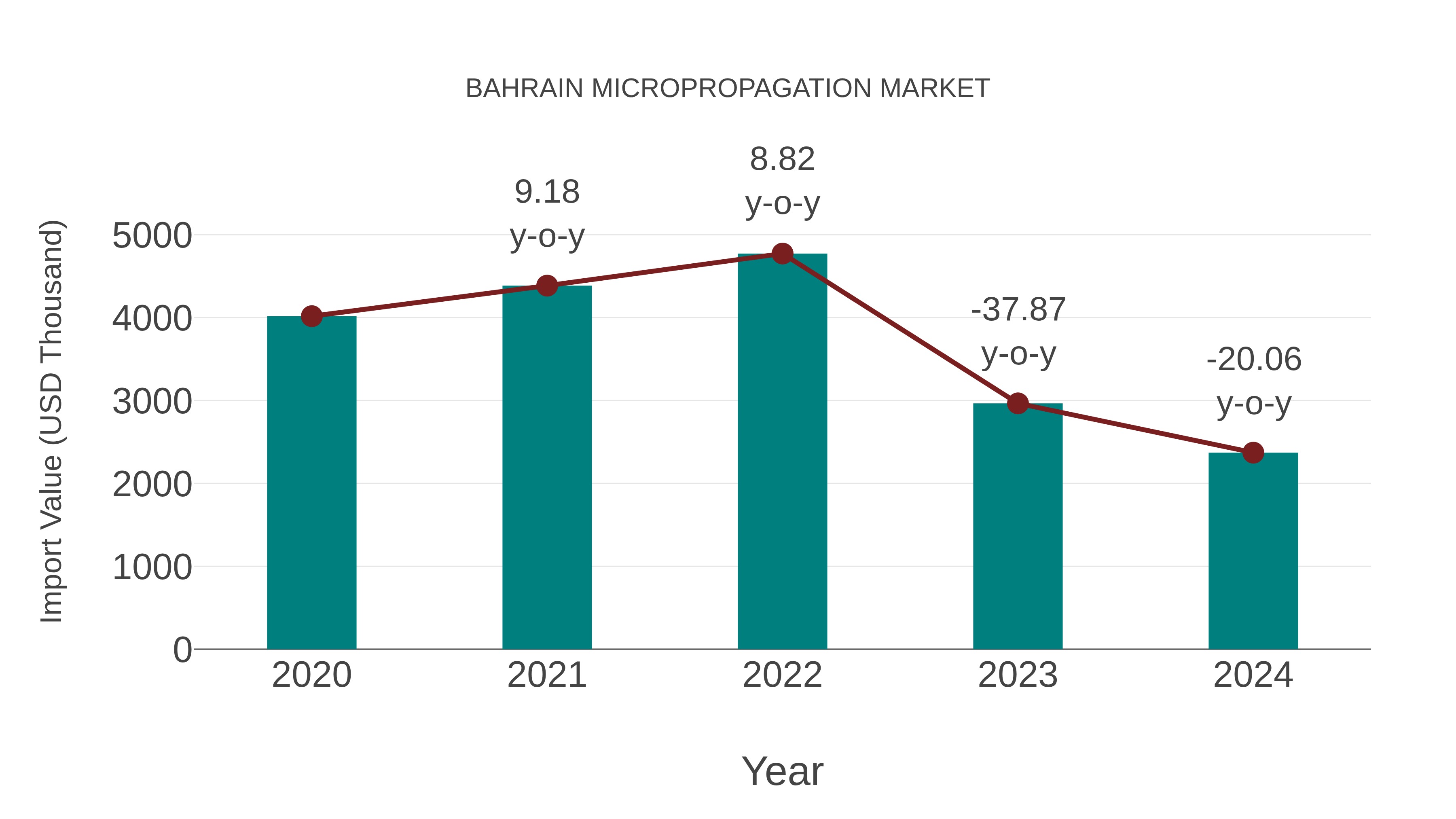
Bahrain Micropropagation Market: Import Trend Analysis
In 2024, Bahrain micropropagation market experienced a notable increase in imports. The trend reflected a growing demand for imported plant tissue culture products in the country, indicating a shift towards reliance on external suppliers for meeting domestic needs.
Bahrain Micropropagation Market Overview
The micropropagation market in Bahrain is growing, driven by the increasing need for high-quality plants and the growth of the agricultural and horticultural industries. Micropropagation, a method of plant tissue culture, allows for the rapid production of large quantities of genetically identical plants, making it a valuable tool for commercial agriculture. This technique is particularly important in the production of ornamental plants, fruit trees, and other high-demand crops. With Bahrain`s efforts to diversify its agricultural sector and ensure a sustainable food supply, micropropagation is gaining traction as a means to increase crop yields and reduce the dependence on traditional methods of plant propagation. The market is also supported by advancements in biotechnology and growing interest in plant-based solutions for health and nutrition.
Trends of the market
The micropropagation market in Bahrain is gaining traction with the country`s increasing interest in modern agriculture and horticulture practices. Micropropagation enables the rapid multiplication of disease-free plants, making it a vital technique for the ornamental, fruit, and forestry sectors. Bahrains limited arable land and climatic constraints are driving innovation in controlled environment agriculture, where micropropagation plays a key role. Investments in tissue culture labs and collaborations with agricultural universities are fostering advancements in this domain. Farmers and agribusinesses are adopting these technologies to boost productivity and sustainability. Demand for high-value, uniform crops such as date palms and ornamentals is particularly influencing market growth. The future of this market is promising with technological integration and government support.
Challenges of the market
The micropropagation market in Bahrain is limited by a lack of commercial-scale tissue culture facilities and trained agricultural technicians. High setup costs and long propagation cycles make it a less attractive option for local growers. Additionally, the small size of the horticulture and floriculture sectors restricts demand. Limited awareness of micropropagations benefits in producing disease-free, uniform plants slows adoption. Regulatory oversight on genetically identical plant production and transport can create bureaucratic delays. These challenges hinder the development of a robust micropropagation industry in the country.
Investment opportunities in the Market
Micropropagation in Bahrain holds significant promise as the country seeks to enhance agricultural productivity and sustainability in arid environments. This technique allows mass propagation of disease-free, high-quality plant material, critical for horticulture, medicinal plants, and landscaping industries. Investors can capitalize on growing government and private sector interest in advanced agricultural biotechnology to improve crop yields and reduce water use. Establishing micropropagation labs equipped with state-of-the-art tissue culture facilities can serve local farmers and exporters. The growing demand for exotic plants and high-value crops increases market potential. Collaborative research with academic institutions can enhance species-specific protocols suited for Bahrains climate. Additionally, micropropagation reduces reliance on imported plant material, supporting national food security initiatives. There are opportunities for developing proprietary plant varieties and offering contract propagation services. With rising regional demand, Bahrain could also serve as a micropropagation hub for the Middle East.
Government Policy of the market
The Bahraini government actively promotes the micropropagation market as part of its agricultural diversification and sustainability initiatives. Micropropagation techniques are encouraged to enhance the production of high-quality, disease-free plants, supporting food security and horticultural development. The Ministry of Agriculture provides guidelines and regulations to ensure biosecurity and quality control in micropropagation practices. Investments in research institutions and public-private partnerships help advance propagation technologies adapted to Bahrains climate and agricultural needs. The government supports training and capacity building to equip farmers and technicians with modern skills. Environmental policies ensure that micropropagation activities minimize chemical use and conserve water resources. Trade policies facilitate the export of high-value plant products generated through micropropagation. Collectively, these efforts strengthen Bahrains agricultural innovation ecosystem.
Key Highlights of the Report:
- Bahrain Micropropagation Market Outlook
- Market Size of Bahrain Micropropagation Market, 2025
- Forecast of Bahrain Micropropagation Market, 2032
- Historical Data and Forecast of Bahrain Micropropagation Revenues & Volume for the Period 2022 - 2032F
- Bahrain Micropropagation Market Trend Evolution
- Bahrain Micropropagation Market Drivers and Challenges
- Bahrain Micropropagation Price Trends
- Bahrain Micropropagation Porter's Five Forces
- Bahrain Micropropagation Industry Life Cycle
- Historical Data and Forecast of Bahrain Micropropagation Market Revenues & Volume By Type for the Period 2022 - 2032F
- Historical Data and Forecast of Bahrain Micropropagation Market Revenues & Volume By Petri Plates and Test Tubes for the Period 2022 - 2032F
- Historical Data and Forecast of Bahrain Micropropagation Market Revenues & Volume By Plastic Containers for the Period 2022 - 2032F
- Historical Data and Forecast of Bahrain Micropropagation Market Revenues & Volume By Glass Bottles for the Period 2022 - 2032F
- Historical Data and Forecast of Bahrain Micropropagation Market Revenues & Volume By End-User for the Period 2022 - 2032F
- Historical Data and Forecast of Bahrain Micropropagation Market Revenues & Volume By Farmers for the Period 2022 - 2032F
- Historical Data and Forecast of Bahrain Micropropagation Market Revenues & Volume By Research labs for the Period 2022 - 2032F
- Bahrain Micropropagation Import Export Trade Statistics
- Market Opportunity Assessment By Type
- Market Opportunity Assessment By End-User
- Bahrain Micropropagation Top Companies Market Share
- Bahrain Micropropagation Competitive Benchmarking By Technical and Operational Parameters
- Bahrain Micropropagation Company Profiles
- Bahrain Micropropagation Key Strategic Recommendations
Bahrain Micropropagation Market (2026-2032): FAQs
6Wresearch actively monitors the Bahrain Micropropagation Market and publishes its comprehensive annual report, highlighting emerging trends, growth drivers, revenue analysis, and forecast outlook. Our insights help businesses to make data-backed strategic decisions with ongoing market dynamics. Our analysts track relevent industries related to the Bahrain Micropropagation Market, allowing our clients with actionable intelligence and reliable forecasts tailored to emerging regional needs.
Yes, we provide customisation as per your requirements. To learn more, feel free to contact us on sales@6wresearch.com
1 Executive Summary |
2 Introduction |
2.1 Key Highlights of the Report |
2.2 Report Description |
2.3 Market Scope & Segmentation |
2.4 Research Methodology |
2.5 Assumptions |
3 Bahrain Micropropagation Market Overview |
3.1 Bahrain Country Macro Economic Indicators |
3.2 Bahrain Micropropagation Market Revenues & Volume, 2022 & 2032F |
3.3 Bahrain Micropropagation Market - Industry Life Cycle |
3.4 Bahrain Micropropagation Market - Porter's Five Forces |
3.5 Bahrain Micropropagation Market Revenues & Volume Share, By Type, 2022 & 2032F |
3.6 Bahrain Micropropagation Market Revenues & Volume Share, By End-User, 2022 & 2032F |
4 Bahrain Micropropagation Market Dynamics |
4.1 Impact Analysis |
4.2 Market Drivers |
4.2.1 Increasing demand for high-quality plant materials in agriculture and horticulture sectors. |
4.2.2 Growing awareness about the benefits of micropropagation technology in enhancing plant yield and quality. |
4.2.3 Government initiatives to promote sustainable agriculture practices. |
4.3 Market Restraints |
4.3.1 Limited awareness about micropropagation techniques among local farmers. |
4.3.2 High initial setup costs and technical expertise required for micropropagation facilities. |
4.3.3 Lack of skilled professionals in the field of micropropagation. |
5 Bahrain Micropropagation Market Trends |
6 Bahrain Micropropagation Market, By Types |
6.1 Bahrain Micropropagation Market, By Type |
6.1.1 Overview and Analysis |
6.1.2 Bahrain Micropropagation Market Revenues & Volume, By Type, 2022 - 2032F |
6.1.3 Bahrain Micropropagation Market Revenues & Volume, By Petri Plates and Test Tubes, 2022 - 2032F |
6.1.4 Bahrain Micropropagation Market Revenues & Volume, By Plastic Containers, 2022 - 2032F |
6.1.5 Bahrain Micropropagation Market Revenues & Volume, By Glass Bottles, 2022 - 2032F |
6.2 Bahrain Micropropagation Market, By End-User |
6.2.1 Overview and Analysis |
6.2.2 Bahrain Micropropagation Market Revenues & Volume, By Farmers, 2022 - 2032F |
6.2.3 Bahrain Micropropagation Market Revenues & Volume, By Research labs, 2022 - 2032F |
7 Bahrain Micropropagation Market Import-Export Trade Statistics |
7.1 Bahrain Micropropagation Market Export to Major Countries |
7.2 Bahrain Micropropagation Market Imports from Major Countries |
8 Bahrain Micropropagation Market Key Performance Indicators |
8.1 Percentage increase in the adoption of micropropagation technology by local farmers. |
8.2 Number of research and development collaborations in the field of micropropagation. |
8.3 Rate of improvement in plant quality and yield due to micropropagation techniques. |
8.4 Percentage increase in the availability of high-quality plant materials in the market. |
8.5 Number of training programs and workshops conducted to educate farmers about micropropagation benefits. |
9 Bahrain Micropropagation Market - Opportunity Assessment |
9.1 Bahrain Micropropagation Market Opportunity Assessment, By Type, 2022 & 2032F |
9.2 Bahrain Micropropagation Market Opportunity Assessment, By End-User, 2022 & 2032F |
10 Bahrain Micropropagation Market - Competitive Landscape |
10.1 Bahrain Micropropagation Market Revenue Share, By Companies, 2025 |
10.2 Bahrain Micropropagation Market Competitive Benchmarking, By Operating and Technical Parameters |
11 Company Profiles |
12 Recommendations |
13 Disclaimer |
Global Go To Market Strategy - 2030
Export potential enables firms to identify high-growth global markets with greater confidence by combining advanced trade intelligence with a structured quantitative methodology. The framework analyzes emerging demand trends and country-level import patterns while integrating macroeconomic and trade datasets such as GDP and population forecasts, bilateral import–export flows, tariff structures, elasticity differentials between developed and developing economies, geographic distance, and import demand projections. Using weighted trade values from 2020–2024 as the base period to project country-to-country export potential for 2030, these inputs are operationalized through calculated drivers such as gravity model parameters, tariff impact factors, and projected GDP per-capita growth. Through an analysis of hidden potentials, demand hotspots, and market conditions that are most favorable to success, this method enables firms to focus on target countries, maximize returns, and global expansion with data, backed by accuracy.
By factoring in the projected importer demand gap that is currently unmet and could be potential opportunity, it identifies the potential for the Exporter (Country) among 190 countries, against the general trade analysis, which identifies the biggest importer or exporter.
To discover high-growth global markets and optimize your business strategy:
Click Here
Pricing
- Single User License$ 1,995
- Department License$ 2,400
- Site License$ 3,120
- Global License$ 3,795

Leadership Perspectives from Industry Events
Search
Thought Leadership and Analyst Meet





Our Clients








6WResearch In News
- Doha a strategic location for EV manufacturing hub: IPA Qatar
- Demand for luxury TVs surging in the GCC, says Samsung
- Empowering Growth: The Thriving Journey of Bangladesh’s Cable Industry
- Demand for luxury TVs surging in the GCC, says Samsung
- Video call with a traditional healer? Once unthinkable, it’s now common in South Africa
- Intelligent Buildings To Smooth GCC’s Path To Net Zero
Latest Reports
- Cape Verde Portable Hand-Thrown Extinguisher Market (2026-2032)
- Canada Portable Hand-Thrown Extinguisher Market (2026-2032)
- Cameroon Portable Hand-Thrown Extinguisher Market (2026-2032)
- Burundi Portable Hand-Thrown Extinguisher Market (2026-2032)
- Burkina Faso Portable Hand-Thrown Extinguisher Market (2026-2032)
- Bulgaria Portable Hand-Thrown Extinguisher Market (2026-2032)
- Brunei Portable Hand-Thrown Extinguisher Market (2026-2032)
- Botswana Portable Hand-Thrown Extinguisher Market (2026-2032)
- Bosnia and Herzegovina Portable Hand-Thrown Extinguisher Market (2026-2032)
- Bolivia Portable Hand-Thrown Extinguisher Market (2026-2032)
Industry Events and Analyst Meet

HIMTEX 2026

India Refining Summit 2026

India EV Show 2026

EV tech India Expo 2026

Auto Tech Asia 2026
Whitepaper
- Middle East & Africa Commercial Security Market Click here to view more.
- Middle East & Africa Fire Safety Systems & Equipment Market Click here to view more.
- GCC Drone Market Click here to view more.
- Middle East Lighting Fixture Market Click here to view more.
- GCC Physical & Perimeter Security Market Click here to view more.


