Crab Market: Bangladesh vs Top 5 Major Economies in 2027 (Asia)
In the Asia region, the Crab market in Bangladesh is projected to expand at a stable growth rate of 0.56% by 2027. The largest economy is China, followed by India, Japan, Australia and South Korea.
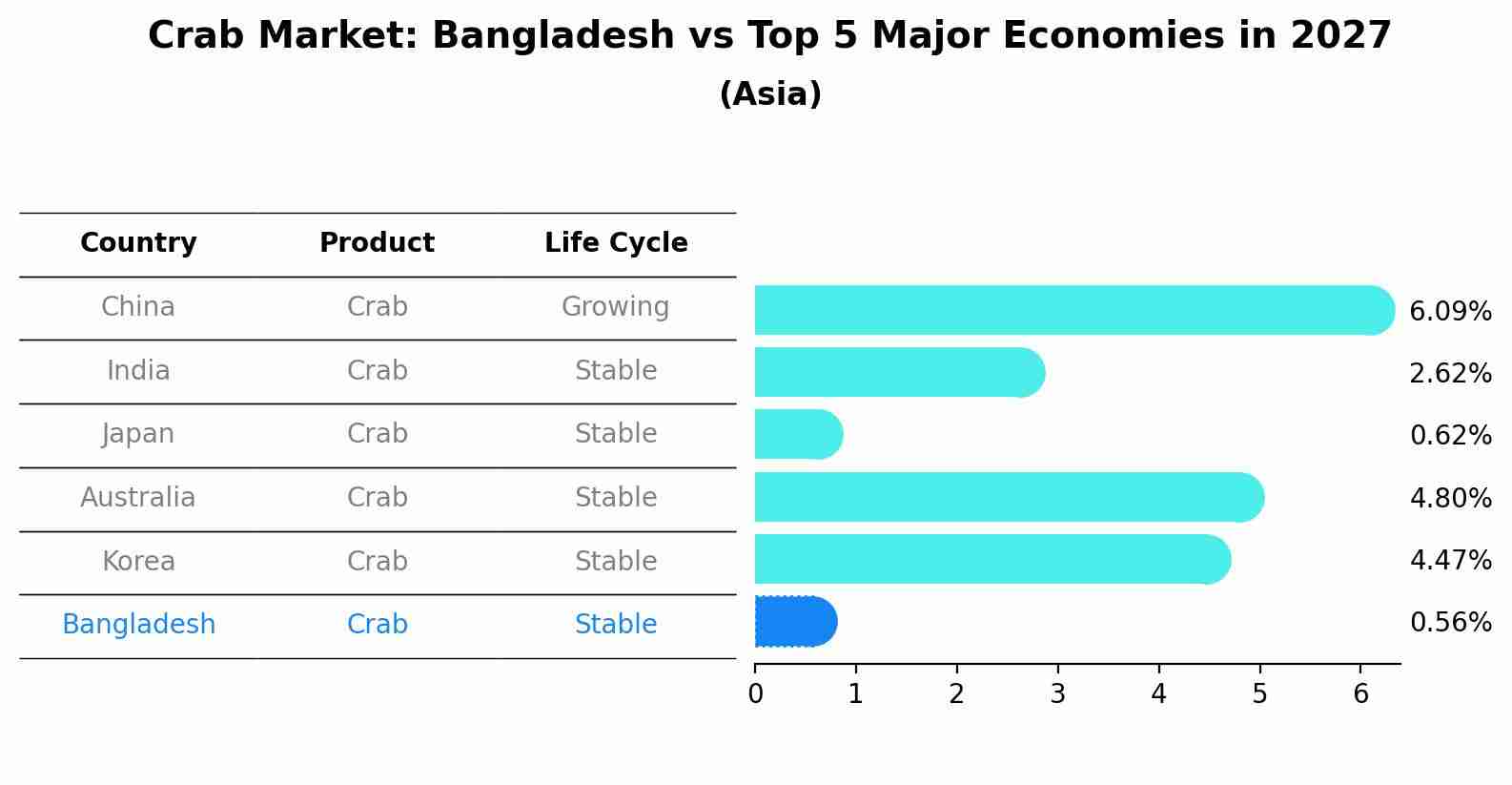
Bangladesh Crab Market Growth Rate
According to 6Wresearch internal database and industry insights, the Bangladesh Crab Market is estimated to grow at a compound annual growth rate (CAGR) of 7.2% during the forecast period (2026–2032).
Topics Covered in the Bangladesh Crab Market Report
The Bangladesh Crab Market report broadly covers the market by type and form. The report provides a comprehensive analysis of ongoing market trends, opportunities/high-growth areas, and market drivers that will be pivotal for various stakeholders to align their strategies based on current and future market dynamics.
Bangladesh Crab Market Highlights
| Report Name |
Bangladesh Crab Market |
| Forecast period | 2026-2032 |
| CAGR | 7.2% |
| Market Size | Export-Oriented Crab Farming & Frozen Processing |
Bangladesh Crab Market Synopsis
Bangladesh Crab Market is anticipated to witness strong expansion during the forecast period due to the country’s rising prominence as a key exporter of mud crabs and other species to international markets. Crabs are collected extensively from coastal areas, estuaries and mangrove ecosystems, especially the Sundarbans which is the ideal natural habitat for crab farming and collection.
Furthermore, the development of coastal aquaculture zones and growing investments in cold storage infrastructure are accelerating the Bangladesh crab market growth. The shift toward processed and frozen seafood products is also contributing significantly to market expansion.
Evaluation of Growth Drivers in Bangladesh Crab Market
Given below are some of the major drivers and their influence on Bangladesh Crab Market dynamics:
| Drivers | Primary Segment Affected | Why It Matters (Evidence) |
| Export Demand Growth | Blue Crab | High demand from China and Southeast Asia boosts export-oriented production. |
| Aquaculture Expansion | Chinese Mitten Crab & Others | Adoption of scientific farming methods improves yield and quality. |
| Government Support Programs | Overall Market | Export incentives and subsidies encourage small-scale farmers. |
| Cold Chain Development | Frozen Segment | Frozen Section Improved logistics increase product shelf life and make exports viable. |
| Rising Seafood Consumption | Gazami Crab | Growing local and global demand for nutrient-packed seafood. |
Bangladesh Crab Market is expected to proliferate, exhibiting a CAGR of 7.2% during the forecast period (2026–2032). There are various aspects which enhance this growth such as the country's focus on strengthening seafood exports and improving aquaculture productivity. Along with this, increasing investments in modern processing facilities are boosting export competitiveness to a major extent. The increasing demand for seafood protein and premium crab varieties is encouraging farmers to adopt improved aquaculture techniques. Moreover, the rising adoption of sustainable aquaculture practices is improving production efficiency and supporting long-term market growth.
Evaluation of Restraints in the Bangladesh Crab Market
Below are some of the major restraints and their influence on market dynamics:
| Restraints | Primary Segment Affected | What This Means (Evidence) |
| Limited Cold Storage Infrastructure | Frozen Segment | Lack of adequate facilities leads to post-harvest losses. |
| Disease Outbreaks in Aquaculture | Blue Crab | Affects production stability and export quality. |
| Export Dependency Risks | Overall Market | Overdependence on a few markets poses risks. |
| Price Volatility | Live Crab Trade | Live Crab Sales Has an impact on farmer’s income. |
| Environmental Challenges | Coastal Farming | Changing climate and salinity levels pose threats |
Bangladesh Crab Market Challenges
Despite promising growth prospects, the Bangladesh Crab Industry faces challenges in maintaining consistent quality standards for export markets. Small farmers may not have access to new farming methods and finance. Furthermore, the lack of a standard grading and packaging system may reduce competitiveness in the international market. Lastly, environmental risks including cyclones and floods are possible hazards to the industry.
Bangladesh Crab Market Trends
The following points highlight the recent trends impacting Bangladesh crab market growth:
- Shift towards Export-Driven Production: Producers are shifting their focus towards crab breeds that can be used for export, especially to China where there exists the highest demand in the world.
- Frozen and Value-Added Crab Product Manufacturing: There has been an increase in the scope of production for frozen crab and cooked crabs for ready consumption.
- Modernization of Aquaculture Practices: Utilizing innovative methods of crab farming such as better breeding techniques, quality water testing, and disease prevention are becoming more popular.
- Increase in Coastal Aquaculture Areas: Coastal areas with aquaculture support from the government are increasing the capacity to produce more crabs.
Investment Opportunities in the Bangladesh Crab Market
The following points provide information regarding investment opportunities within the Bangladesh Crab Market:
- Development of Advanced Aquaculture Farms: Investing in efficient crab farms will help produce more quality crabs.
- Establishment of Cold Storages and Transportation Links: This will help to minimize losses while shipping the produce to foreign destinations.
- Processing and Development of Crabs: Opportunities exist within the sector where crab processing and development of value-added products can be produced for export.
Top 5 Leading Players in Bangladesh Crab Market
Given below is a list of leading companies dominating the Bangladesh crab market share:
1. Bengal Seafood Corporation
| Company Name | Bengal Seafood Corporation |
|---|---|
| Established Year | 2003 |
| Headquarters | Chattogram, Bangladesh |
| Official Website | Click Here |
Bengal Seafood Corporation operates in seafood processing and export, including frozen crab products.
2. Apex Foods Limited
| Company Name | Apex Foods Limited (Seafood Division) |
|---|---|
| Established Year | 1976 |
| Headquarters | Dhaka, Bangladesh |
| Official Website | Click Here |
A major seafood exporter offering a wide range of processed seafood including crabs.
3. Modern Fisheries Bangladesh
| Company Name | Modern Fisheries Bangladesh |
|---|---|
| Established Year | 2010 |
| Headquarters | Cox’s Bazar, Bangladesh |
| Official Website | - |
Focuses on crab farming, collection, and export with emphasis on quality control and sustainability.
4. Ark Seafoods Limited
| Company Name | Ark Seafoods Limited |
|---|---|
| Established Year | 1996 |
| Headquarters | Chattogram, Bangladesh |
| Official Website | Click Here |
Part of a larger industrial group, Ark Seafoods operates a high-capacity processing plant approved by the EU and USFDA.
5. Gemini Sea Food Limited
| Company Name | Gemini Sea Food Limited |
|---|---|
| Established Year | 1982 |
| Headquarters | Khulna, Bangladesh |
| Official Website | Click Here |
Gemini Sea Food is one of the oldest and most respected seafood processors in the country.
Government Initiatives being implemented in the Bangladesh Crab Market
According to Bangladesh Government Data, several initiatives have been implemented to promote sustainable crab farming and exports. Fisheries have developed training programs for farmers in advanced aquaculture and disease prevention.
“Blue Economy Initiative” is an example, which promotes the development of aquaculture along coastal areas such as crab farming. Export subsidies are provided to seafood exporters, while demonstration farms have been set up in places like Satkhira and Khulna to boost production levels.
Training courses such as “National Fisheries Policy” emphasize sustainable fishing and promote investments from the private sector in the development of processing facilities for seafood.
Future Insights of the Bangladesh Crab Market
The Bangladesh Crab Market is anticipated to grow at a fast pace, due to the growing demand for exports, technological innovations, and government policy support. There is a projected increase in the development of processed crab products along with improvements in the supply chain network.
Moreover, sustainable practices and modern farming technologies are going to be essential components in determining the future direction of the industry.
Market Segmentation Analysis
The report offers a comprehensive study of the following market segments and their leading categories:
By Type – Blue Crab Dominate the Market
According to Prerna, Senior Research Analyst, 6Wresearch, Blue Crab dominates Bangladesh crab market share due to its high demand in export markets, especially China. Blue crabs are widely cultivated in coastal regions due to their adaptability and high market value. Their strong demand and premium pricing make them the most preferred species among farmers and exporters.
By Form – Frozen Segment to lead the Market
The Bangladesh crab market is also categorized by form which includes frozen, canned, and others. The frozen segment dominates the market as it ensures longer shelf life and facilitates export to distant markets. Frozen crabs are widely accepted globally due to convenience, quality preservation, and compliance with international trade standards.
Key Attractiveness of the Report
- 10 Years of Market Numbers
- Historical Data Starting from 2022 to 2025
- Base Year: 2025
- Forecast Data until 2032
- Key Performance Indicators Impacting the Market
- Major Upcoming Developments and Projects
Key Highlights of the Report:
- Bangladesh Crab Market Outlook
- Market Size of Bangladesh Crab Market, 2025
- Forecast of Bangladesh Crab Market, 2032
- Historical Data and Forecast of Bangladesh Crab Revenues & Volume for the Period 2022 - 2032
- Bangladesh Crab Market Trend Evolution
- Bangladesh Crab Market Drivers and Challenges
- Bangladesh Crab Price Trends
- Bangladesh Crab Porter's Five Forces
- Bangladesh Crab Industry Life Cycle
- Historical Data and Forecast of Bangladesh Crab Market Revenues & Volume By Type for the Period 2022 - 2032
- Historical Data and Forecast of Bangladesh Crab Market Revenues & Volume By Blue Crab for the Period 2022 - 2032
- Historical Data and Forecast of Bangladesh Crab Market Revenues & Volume By Chinese Mitten Crab for the Period 2022 - 2032
- Historical Data and Forecast of Bangladesh Crab Market Revenues & Volume By Gazami Crab for the Period 2022 - 2032
- Historical Data and Forecast of Bangladesh Crab Market Revenues & Volume By Others for the Period 2022 - 2032
- Historical Data and Forecast of Bangladesh Crab Market Revenues & Volume By Form for the Period 2022 - 2032
- Historical Data and Forecast of Bangladesh Crab Market Revenues & Volume By Frozen for the Period 2022 - 2032
- Historical Data and Forecast of Bangladesh Crab Market Revenues & Volume By Canned for the Period 2022 - 2032
- Historical Data and Forecast of Bangladesh Crab Market Revenues & Volume By Others for the Period 2022 - 2032
- Bangladesh Crab Import Export Trade Statistics
- Market Opportunity Assessment By Type
- Market Opportunity Assessment By Form
- Bangladesh Crab Top Companies Market Share
- Bangladesh Crab Competitive Benchmarking By Technical and Operational Parameters
- Bangladesh Crab Company Profiles
- Bangladesh Crab Key Strategic Recommendations
Market Covered
The report offers a comprehensive study of the subsequent market segments:
By Type
- Blue Crab
- Chinese Mitten Crab
- Gazami Crab
- Others
By Form
- Frozen
- Canned
- Others






































